An organic grocery delivery business sells certified organic produce, dairy, and pantry staples from farms or distributors and delivers them to customers who order through an app or website. Launching one needs food-safety licensing, 30–60 tested SKUs, cold storage, an online ordering platform, and a tight delivery radius.
Online grocery orders made up more than 19% of total US grocery sales in early 2026, up from under 15% in late 2024.
Third-party delivery marketplaces typically charge 15–30% commission per order, which is why more independent grocers are building their own branded ordering channel instead.
US online grocery has grown 20%+ YoY for six straight quarters, now taking about 19% of total grocery spending.
Global organic retail reached €145 billion, with the US the largest market worldwide.
What Is an Organic Grocery Delivery Business?
It is a hyperlocal retail model that sells certified organic food through a website or app and delivers inside a fixed zone. Income comes from product margin, delivery fees, and recurring subscription boxes rather than walk-in traffic, which makes demand far easier to forecast.
Three models dominate right now:
- Inventory-led: you buy, store, deliver. Strongest margins, highest shrink risk.
- Farm-box subscription: fixed weekly boxes from partner growers. Predictable volume, minimal waste — Riverford and Abel & Cole built nine-figure UK businesses on it.
- Marketplace: list local organic sellers, take a commission. No inventory risk, thinner margins.
Demand for online organic grocery shopping is no longer concentrated in coastal metros. Suburban zip codes, college towns, and second-tier cities now generate enough repeat volume to support one chilled location.
The 2026 Market Opportunity
US organic sales reached $76.6 billion in 2025, growing 6.8% double the conventional market. Online grocery has posted 20%-plus growth for six straight quarters and now takes roughly 19% of total US grocery spending. Organic plus online is the fastest-moving overlap in food retail.
The buyer profile holds across markets: households with young children, fitness-focused professionals, and people managing celiac disease, diabetes, or food sensitivities. They buy on trust, not coupons.
Shoppers who cross into online health food grocery shopping rarely stop at vegetables. The same cart pulls in cold-pressed oils, sprouted grains, grass-fed dairy, and clean-label snacks, and those pantry lines carry your best margin.
Region-by-Region Snapshot
| Market | Latest data | What it means for a new operator |
| United States | $76.6B organic sales, +6.8%; ~61% of households buy groceries online | Deepest demand, but Walmart and Amazon own speed. Compete on curation, not delivery minutes. |
| United Kingdom | £3.9B organic, +4.2% — a 14th straight growth year; ~3% of farmland is organic | Import-dependent supply. Box schemes are a proven, subscriber-heavy format. |
| UAE | Online grocery ~$4.1B, forecast near 20% CAGR; ~99% internet penetration | High basket values, dense Dubai and Abu Dhabi zones, strong expat demand. |
| India | Organic food market ~$2.3B, forecast ~19% CAGR; 2.36M organic farmers, most of any country | Unmatched farm-direct sourcing depth; cold chain is the bottleneck. |
First-timers trying organic grocery shopping online share one fear: paying a premium and receiving wilted produce. Solve freshness before you solve the scale.
Step-by-Step Guide to Starting an Organic Grocery Delivery Business
Start with one delivery zone, 40 to 60 SKUs, one chilled storage point, and a single online ordering platform. Validate demand with paid pre-orders before buying inventory. Launches that fail spend month one chasing catalog size instead of fixing supply reliability and delivery accuracy.
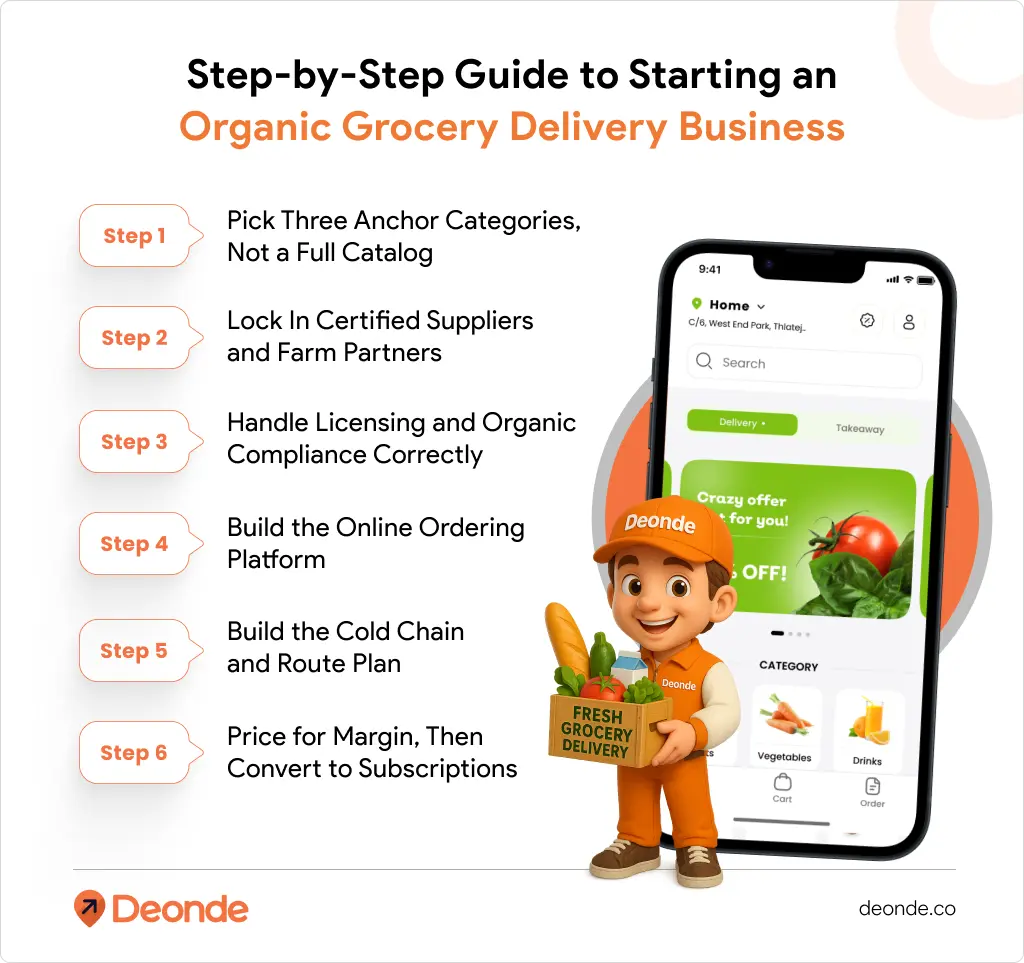
Step 1: Pick Three Anchor Categories, Not a Full Catalog
Do not open with 500 SKUs. Choose produce, dairy and eggs, and dry pantry staples, then build depth inside those three.
A tight catalog cuts shrink, simplifies cold storage, and gives you negotiating weight. Add a fourth category only once the first shows steady weekly reorders.
Step 2: Lock In Certified Suppliers and Farm Partners
Source from USDA-certified organic farms, regional distributors, or co-ops. Always request the certificate and checking its expiration date lapsed certification is the most common compliance gap here.
Sign two suppliers per category. Single-source dependency breaks trust in week three, when one farm has a bad harvest, and you have nothing to ship.
Step 3: Handle Licensing and Organic Compliance Correctly
In the US, a retail food establishment including a delivery service selling sealed, already-labeled organic products is generally exempt from USDA organic certification under 7 CFR 205.101. What you still owe is documentation: confirm and retain records of every supplier’s certification status.
Certification becomes mandatory the moment you repack, relabel, or portion products under an organic claim. Separately: a business entity, a state or county retail food license, a sales tax permit, and commercial insurance.
Outside the US, the equivalent gatekeepers are a Defra-approved control body such as Soil Association Certification in the UK, MOCCAE plus municipal food trade licensing in the UAE, and FSSAI registration with NPOP for own-label claims in India.
Step 4: Build the Online Ordering Platform
You need four connected pieces: a branded customer app or website, an admin panel for catalog and inventory, a driver app, and payments with live order tracking.
Building that from scratch means four to six months and a six-figure budget. A white-label platform skips the decision; white-label grocery delivery software from Deonde ships all four modules under your brand at zero per-order commission, starting near $49/month. That keeps capital in inventory and acquisition, where it compounds.
Step 5: Build the Cold Chain and Route Plan
Organic produce skips post-harvest chemical treatments, so it moves faster. Budget for a 34–40°F chiller, insulated totes, and gel packs for dairy runs.
Batch orders into fixed windows 7–10 a.m. and 4–7 p.m. instead of on-demand drops. Slot routing cuts cost per delivery and keeps produce out of a hot vehicle.
A driver app with live GPS tracking and dispatch plus hyperlocal delivery zone management automates batching past roughly 30 orders a day.
Step 6: Price for Margin, Then Convert to Subscriptions
Organic retail supports 35–50% gross margin on shelf-stable pantry goods and 20–30% on fresh produce. Benchmark against local natural-food retailers, not conventional supermarkets; your buyer already accepts the premium.
Then move shoppers onto a weekly or biweekly box. Subscription and recurring delivery software with pause, skip, and prepaid wallet turns unpredictable demand into a forecastable purchase order, your biggest lever on waste.
How Much Does It Cost to Start an Organic Grocery Delivery Business?
A lean single-zone launch in the US typically runs $12,000 to $35,000, with opening inventory and chilled storage taking the largest share. Software is the most controllable line: white-label platforms start near $49 per month, while custom builds routinely pass $60,000.
| Cost item | Lean launch (USD) | Notes |
|---|---|---|
| Entity, licenses, permits, insurance | $800 – $2,500 | Varies by state and county |
| Opening inventory (40–60 SKUs) | $4,000 – $9,000 | Buy shallow, reorder often |
| Chilled storage and packing setup | $3,500 – $12,000 | Used equipment halves this |
| Online ordering platform | $600 – $2,400/yr | White-label, not custom build |
| Delivery (leased van or contract drivers) | $2,000 – $6,000 | Contract drivers first |
| Launch marketing (first 90 days) | $1,500 – $4,000 | Community-led, not broad paid ads |
What We’ve Learned From Early-Stage Organic Grocery Sellers
Based on the organic delivery businesses we’ve supported through their first year, the ones that grow steadily do three things early: cap their starting product range, publish a delivery cutoff time and keep it, and personally call their first 20 customers after their first order.
The businesses that struggle most usually over-invest in product variety before validating demand, or under-invest in delivery reliability — a single late or spoiled delivery damages trust more than a slightly higher price ever will.
Pro-Tip: Track your “on-time, unspoiled” delivery rate starting week one. For organic and perishable goods, this single number predicts repeat-purchase rate better than review scores or total order volume.
Marketing Strategies to Attract Your First Organic Grocery Customers
New organic grocery delivery businesses grow fastest through hyperlocal search visibility, referral incentives, and partnerships with health-focused communities gyms, yoga studios, pediatric clinics rather than broad paid advertising. Most early customers come from a two-mile radius, so local trust outperforms generic marketing spend.
- Optimize your Google Business Profile and website for online health food grocery shopping plus your city name — this is often how new customers first find a local organic delivery option.
- Run a “first order” referral discount; organic shoppers trust peer recommendations more than ads.
- Partner with two or three local health-focused businesses for cross-promotion instead of competing with national brands on price.
- Share short videos of your sourcing farm visits and supplier visits since transparency is a bigger trust signal for organic shoppers than discounts.
- Add your delivery radius and product categories to your listings and site copy local, category-specific searches convert far better than your business name alone.
Organic Grocery Delivery Business: Quick Questions
Do I need a physical store to start an organic grocery delivery business?
No. Many organic grocery delivery businesses start from a home kitchen, a shared commercial kitchen, or a small storage unit, fulfilling orders placed through an online store rather than a walk-in shop.
How long does it take to become profitable?
It varies by market and model, but most lean, single-category operations start covering their costs within 3 to 6 months, provided delivery routes stay batched and supplier costs stay predictable.
Can I run an organic grocery delivery business part-time?
Yes, especially at the start. Many founders begin with two or three delivery days a week alongside other work, then expand toward daily delivery once order volume justifies it.
Real Unit Economics: What 30 Orders a Day Actually Looks Like
At 30 orders a day and an $85 average basket, an organic delivery operation generates about $76,500 monthly revenue and roughly $24,500 gross profit at a 32% blended margin. Shrink, not basket size, decides whether that profit survives.
Now subtract operating costs: delivery at $6.50/order ($5,850), chilled rent ($2,800), platform fees ($300), packaging at $1.50/order ($1,350), and two part-time staff ($5,200). That leaves roughly $9,000 before marketing.
In my experience, the line that decides this business is never basket size — it is shrinking. The cost of goods at this volume runs about $52,000 a month, so every percentage point of waste costs you roughly $520. Run 12% instead of 4%, and you hand back more than $4,000 monthly, nearly half the profit line.
Conclusion: Start Lean, Win on Freshness
The organic grocery delivery businesses that win in 2026 aren’t the ones with the biggest catalogs; they’re the ones that deliver fresh, on-time, every time. Start with 40–60 SKUs, one chilled hub, and pre-order cutoffs to kill waste.
Lock in two certified suppliers per category, batch your deliveries, and move customers to subscriptions fast. That’s how you turn a small launch into a profitable, recurring-revenue brand.
Ready to launch your organic grocery delivery business?
Skip the custom build and go live faster with Deonde’s white-label grocery delivery platform: customer app, driver app, admin panel, and live tracking under your brand, with zero per-order commission.