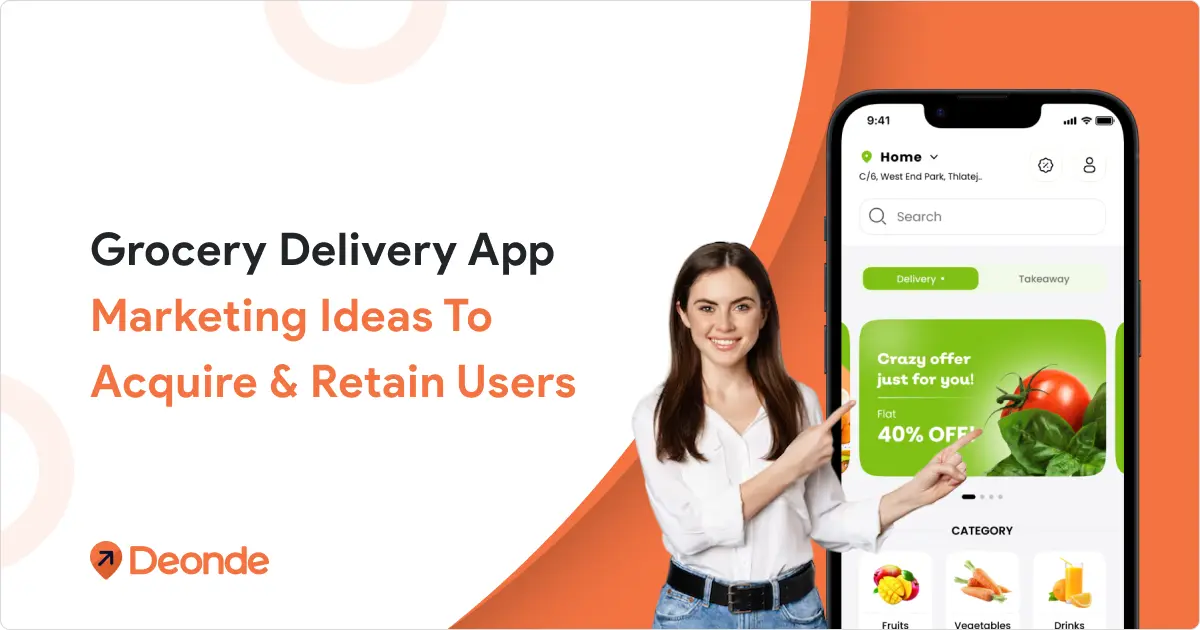
Market a grocery delivery app using a three-layer strategy: acquisition, retention, and revenue. The most effective grocery delivery app marketing ideas start with App Store Optimization (ASO) for free organic traffic, then layer in referral programs, subscription models, and hyperlocal campaigns — each feeding into the next.
The US online grocery market hit $228 billion in 2025 and keeps climbing (Capital One Shopping). But here’s the problem most founders miss — grocery delivery has brutal churn.
According to our reseach nearly 40% of users uninstall within 30 days without seeing clear value. And the typical delivery loses money if you don’t build density fast enough.
You need a grocery delivery app marketing strategy that doesn’t just chase downloads. It needs to pull in the right users — the ones in your delivery zones who’ll actually reorder — and keep them coming back long enough for the unit economics to work.
This article gives you 15 specific, tested strategies. Some focus on getting users through the door.
Others are built for keeping them. And a few are designed to squeeze more revenue out of every order you already have. Pick the ones that fit your stage and budget.
What Are Grocery Delivery App Marketing Ideas? (And Why You Need a Plan)
Grocery delivery app marketing ideas are the specific strategies and tactics you use to get people to download your app, place their first order, and keep coming back.
They cover everything from how you show up in app store searches to how you convince a mom in your delivery zone to try your service instead of Instacart.
Most grocery app founders focus 80% of their energy on acquisition. That’s a mistake. According to our reseach, increasing customer retention by just 5% can increase profits by 25% to 95%. A user who orders weekly for six months is worth 10x a user who orders once and disappears.
Layer 1: Acquisition Ideas (Get Users In)
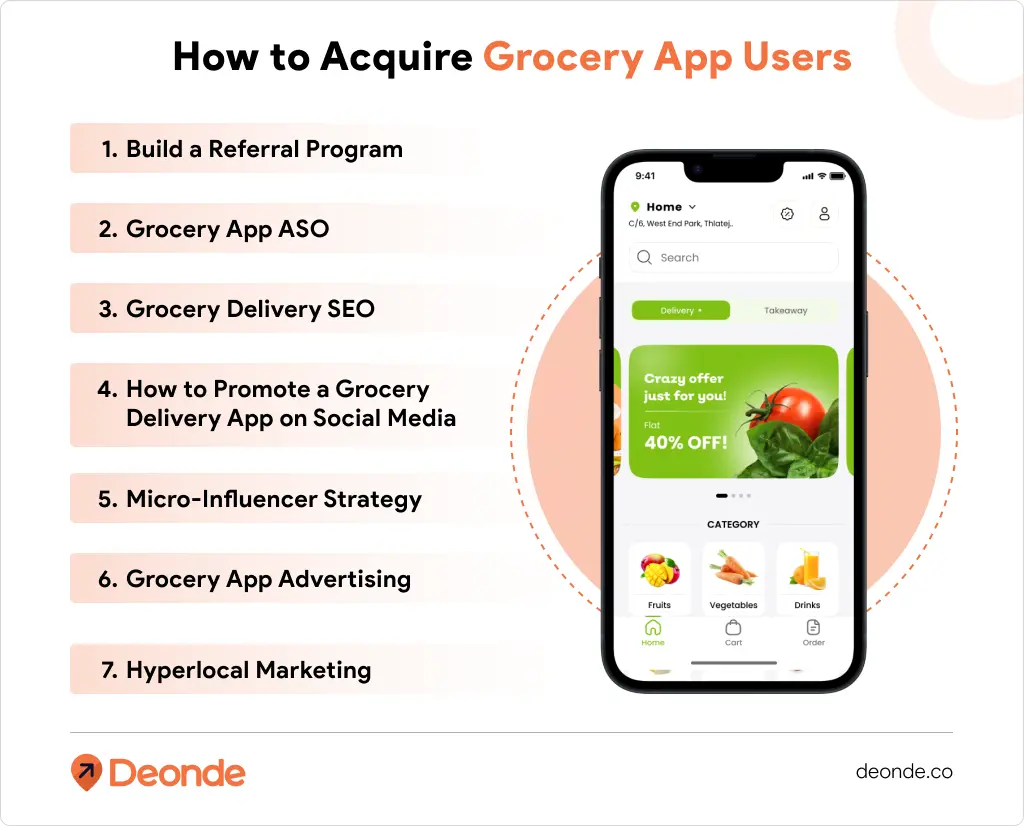
1. Build a Referral Program That Uses Grocery’s Natural Virality
Grocery delivery app referral program ideas don’t need to be complicated. The simpler they are, the better they work.
Grocery has a natural advantage here: people talk about food. “Where do you get your groceries delivered from?” is a real conversation between neighbors, coworkers, and parents.
Give the referrer $10 off their next order and the new user $10 off their first. No points. No tiers. No waiting periods. DoorDash and Instacart both proved this model — their referral programs drove 15-20% of new user growth at their peak.
Target your referral incentives to users who’ve already ordered 3+ times. A one-time user who refers to someone rarely converts well. A loyal weekly shopper? Their referrals convert at a much higher rate.
2. Grocery App ASO: The 3 Actions That Drive 40%+ Organic Installs
Grocery app ASO (App Store Optimization) is the highest-ROI channel for grocery delivery apps because it’s free traffic — if you do it right.
The app stores drive 65% of all app discovery. If your app isn’t showing up for “grocery delivery near me,” you’re leaving money on the table.
- Keyword-optimized title: Include “Grocery Delivery” in your app name, not just your brand. Example: “FreshCart — Grocery Delivery” ranks way better than “FreshCart” alone.
- Custom Product Pages (CPPs): Apple now allows up to 35 CPPs that appear in organic search. Create separate pages for different user personas — “Grocery Delivery for Families,” “Organic Grocery Delivery,” “Same-Day Grocery Delivery.”
- Review velocity: Apps with 4.5+ stars and a steady flow of recent reviews rank higher. Prompt satisfied users for a review after their 3rd successful delivery — not the first.
These grocery delivery app app store optimization tips alone can move you from page 3 to page 1 in the search results within 60-90 days.
3. Grocery Delivery SEO: Rank for “Grocery Delivery Near Me”
Grocery delivery SEO is the web-side cousin of ASO. People search Google for “grocery delivery near me” thousands of times every day. According to Google, 46% of all searches have local intent.
- Google Business Profile — Claim, verify, and include your exact delivery zone. Post weekly updates with fresh inventory.
- Location pages — Create a dedicated page for each neighborhood you serve. Include a list of nearby stores and estimated delivery times.
- Local schema markup — Use LocalBusiness schema to tell Google exactly where and how you deliver.
This is one of the best marketing channels for grocery delivery app because the intent is sky-high. Someone searching “grocery delivery near me” is ready to order right now.
4. How to Promote a Grocery Delivery App on Social Media (Without Being Boring)
Most grocery apps make the same social media mistake: they post Fruits photos and discount codes. That content gets ignored.
How to promote a grocery delivery app on social media effectively means showing what happens behind the delivery. The shopper selecting avocados. The driver navigating a tricky street. The customer unboxing their order.
- Instagram/TikTok — Post short recipe videos (under 60 seconds) using ingredients available in your app. Partner with local food bloggers. The “Shop the Recipe” funnel — post a recipe video, link to a pre-built cart in your app, one-tap checkout — is the highest-converting social format for grocery.
- Facebook — Join neighborhood community groups. Become the reliable “local delivery” resource who answers questions honestly.
- Reddit — Participate in subreddits like r/mealprep, r/EatCheapAndHealthy. Answer questions with real expertise.
5. Micro-Influencer Strategy (4x Higher Conversion)
Paid celebrity endorsements don’t work for grocery delivery. But micro-influencers — people with 5,000 to 50,000 followers — convert 4x better for hyperlocal services.
Find local food bloggers, meal-prep accounts, and mommy bloggers in your delivery zones. Offer them a free monthly delivery credit ($50-100 value) in exchange for honest, unscripted content showing their delivery experience.
Give each influencer a unique discount code for their followers. Track redemptions per code. Pay a small commission on repeat orders from referred users, not just first orders.
This is the core of any grocery delivery app influencer marketing strategy — authenticity over reach. A single post from a 10,000-follower local account can generate 20-40 first orders in a specific zip code.
6. Grocery App Advertising: Where to Spend and Where to Save
Grocery app advertising is expensive. The average cost per install for food and drink apps in North America ranges from $3.50 to $5.00 .
Where to spend: Google App Campaigns (optimize for “first order,” not install), Facebook/Instagram Dynamic Ads (retarget website visitors), Apple Search Ads (low-competition keywords like “grocery delivery app”).
Where to save: Broad display networks (low intent, high waste), YouTube pre-roll (expensive for grocery’s thin margins).
The key insight: grocery delivery app advertising ideas work best when paired with retention mechanics. Don’t spend $5 to get an install if you haven’t built a system to keep that user ordering.
7. Hyperlocal Marketing (Neighborhood by Neighborhood)
Hyperlocal marketing for grocery delivery apps means conquering one zip code at a time — not launching city-wide and hoping for the best.
- Flyer drops — In dense residential areas, a well-designed flyer with a unique first-order discount code drives 2-5% conversion. Track each code to a specific neighborhood.
- Apartment building partnerships — Offer the building manager a free weekly delivery in exchange for placing flyers in every unit’s mailbox. One partnership can give you access to 100+ households overnight.
- Local event sponsorship — Sponsor a little league team or farmers market stall. Your brand becomes a local fixture.
Hyperlocal is slow and labor-intensive. But it builds density — and density is what makes your delivery economics work. Instacart started city by city. You can start street by street.
Layer 2: Retention & Loyalty Ideas (Keep Users Ordering)
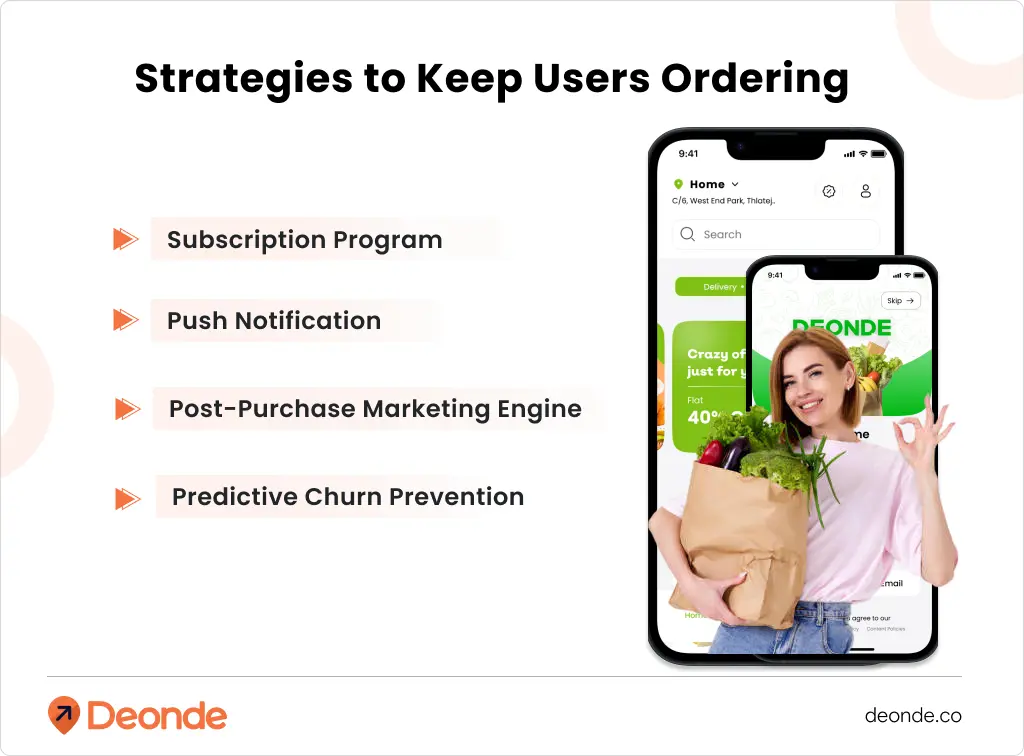
8. Go Subscription-First: The 84% Retention Model
If you do one thing from this list, make it this.
Subscription models in grocery delivery achieve 84% retention rates at 90 days compared to 71% for standard app users (industry benchmark data). That 13-point gap is enormous. Subscribers order more frequently, have higher average order values, and churn at half the rate of non-subscribers.
- Free delivery subscription — $9.99/month for unlimited free delivery on orders over $35. Modeled after Walmart+ and DashPass.
- Members-only pricing — Subscribers see lower prices on 100+ staple items.
- Bundle subscription — $19.99/month includes free delivery + 5% cashback on all orders.
Offer the trial after the user’s first successful delivery, not at signup. This is one of the most effective grocery delivery app customer retention strategies you can deploy.
9. Push Notification Campaign Strategy (Timing Is Everything)
Grocery delivery app push notification campaign strategy isn’t about sending more notifications. It’s about sending the right ones at the right time.
- Replenishment alerts — Timed to day 7-8 after last order: “You’re probably running low on coffee. Reorder in 2 taps.”
- Restock alerts — “Your favorite white or brown rice is back in stock” — only for items the user has bought before.
- Time-sensitive offers — “Free delivery if you order in the next 2 hours.”
Segment by behavior, not demographics. Open rates for well-timed, personalized grocery push notifications average 15-25%.
10. Post-Purchase Marketing Engine
The moment after delivery is the highest-intent moment you’ll ever have with a customer. Their fridge is stocked. They’re happy. They’re already thinking about next week.
- Thank-you email with recipe ideas — “Here are 3 meals you can make with what you just bought.”
- Next-order prefill — One tap to reorder the exact same basket. Reduce friction to zero.
- Review request — Ask for a review 48 hours after delivery, not immediately.
Post-purchase marketing quietly drives 15-25% of repeat orders. Most grocery apps ignore it entirely. A simple automated post-delivery sequence costs nothing to set up and can lift reorder rates significantly.
11. Predictive Churn Prevention
The best way to keep a user is to know they’re about to leave before they do.
Churn signals: Order frequency drops below personal average, push notification opens stop, app opens 3+ times without cart adds, negative review left.
Interventions: “We miss you” offer ($5 off), waived delivery fees for next 3 orders, curated shopping list of most-bought items with one-tap reorder.
According to RetentionCheck, grocery delivery apps average 8.7% monthly churn — meaning you lose roughly two-thirds of your users annually if you don’t intervene. Predictive systems can reduce churn by 15-20% in the first 90 days.
Layer 3: Revenue & Growth Ideas (Maximize Every Order)
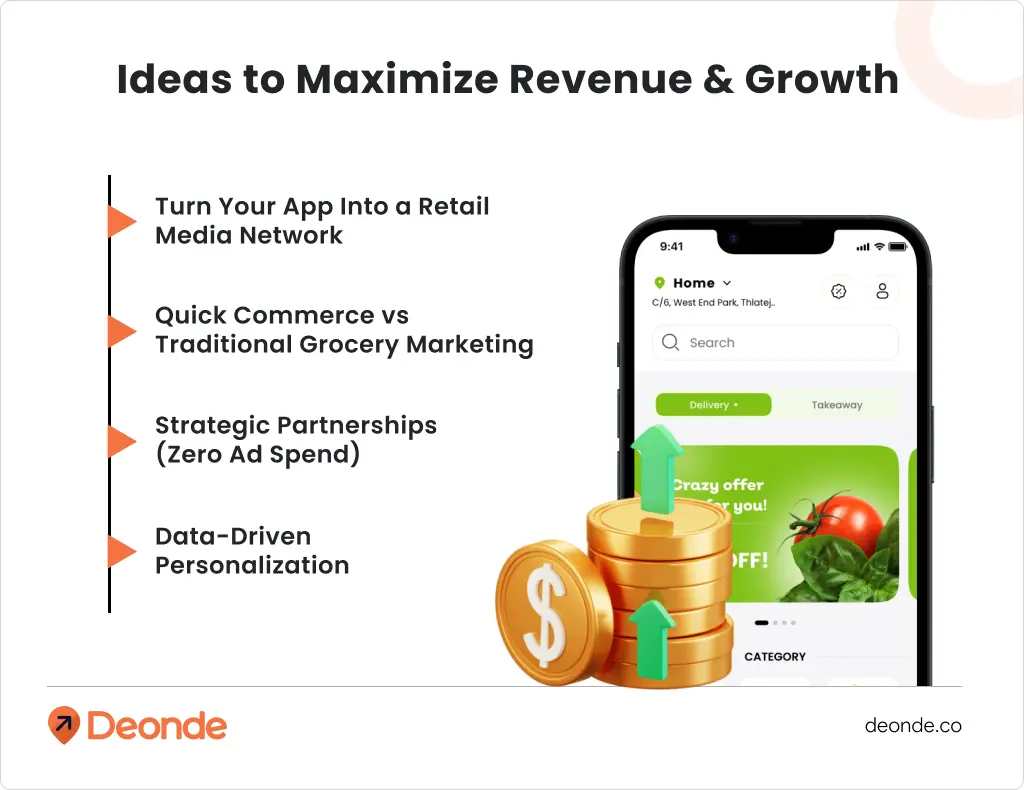
12. Turn Your App Into a Retail Media Network
Retail media networks are the hottest trend in grocery e-commerce. Amazon made $47 billion from advertising in 2024. Instacart generates over $1 billion annually from brand ads.
The concept is simple: brands pay you to feature their products inside your app. Sponsored product listings, category banner ads, and targeted promotions.
Start by approaching local CPG brands in your area — local kombucha makers, bakeries, specialty food producers. Offer them a sponsored slot in your “Recommended” section for $200-$500/month. Track the lift in sales and show them ROI. Even 5,000-10,000 monthly active users is valuable to local brands.
13. Quick Commerce vs Traditional Grocery Marketing
Quick commerce (delivery in under 30 minutes) requires a completely different grocery delivery app marketing strategy than traditional grocery (next-day delivery).
Quick commerce: Speed as the hero (“From store to door in 15 minutes”), emergency inventory focus (diapers, medicine, dinner ingredients), dark store density (market only where you have fulfillment).
Traditional grocery: Selection and price (“Your full weekly shop, delivered free”), scheduling flexibility, bulk and value bundles.
If you want to launch a quick commerce app, speed isn’t just a feature — it’s the entire value proposition. Traditional grocery apps should never pretend to be quick commerce.
14. Strategic Partnerships (Zero Ad Spend)
Partnerships are the ultimate low cost marketing ideas for grocery delivery app. You trade value instead of spending money.
- Meal kit companies — Cross-promote. Their customers need ingredients; yours need recipe ideas.
- Local gyms — Offer their members 10% off first delivery in exchange for a newsletter mention.
- Pet stores — Pet food is heavy. Partner to offer grocery delivery of pet supplies with revenue share.
- Office buildings — Offer dedicated lunchtime delivery windows. One B2B partnership can bring 50+ weekly orders.
15. Data-Driven Personalization
Personalization in grocery isn’t “Hi [First Name].” It’s knowing that Sarah orders organic spinach every Tuesday and has a dairy intolerance.
- Personalized home screens — Show categories and products each user buys most. Amazon reports 35% of its revenue comes from personalized recommendations.
- Dynamic pricing — Offer discounts on items the user has bought before but hasn’t purchased recently.
- Smart shopping lists — Auto-generate based on purchase history: “Your usual weekly shop is ready — review and checkout in 30 seconds.”
Be transparent: “We recommend items based on your order history.” Always offer a preference center.
Track These KPIs to Know If Your Marketing Is Working
You can’t improve what you don’t measure. These four metrics will tell you if your grocery delivery app marketing ideas are actually working.
Customer Acquisition Cost (CAC)
Total marketing spend divided by new users acquired. If your CAC exceeds your average order profit, your math is broken. Target a CAC under $5 in the first 3 months.
Lifetime Value (LTV)
Average order value × average orders per month × average customer lifespan. If LTV isn’t at least 3x CAC, your business model needs work.
Repeat Rate
Percentage of users who place a second order within 30 days. Aim for 30%+ in year one. If below 20%, focus your grocery delivery app retention strategies that work on improving delivery experience and follow-up communication.
Install-to-First-Order Conversion
Percentage of downloads that result in a paid order. If below 15%, your onboarding is failing. Fix your welcome flow, simplify signup, and offer a first-order incentive.
Best marketing strategies for grocery delivery startups always include a weekly dashboard of these four numbers. Don’t get distracted by vanity metrics like total downloads.
Conclusion: Start with One Idea, Win One Neighborhood
Marketing a grocery delivery app isn’t about having a big budget. It’s about building a system where every channel feeds into the next. ASO brings in organic users. Your referral program turns them into advocates. Your subscription model keeps them ordering. And your post-purchase marketing turns orders into habits.
None of this requires a massive budget. It requires consistency, attention to your local market, and a willingness to measure what works and kill what doesn’t.
Your next step is simple: pick one idea from this list and execute it this week. Start with your best grocery delivery software setup — make sure your app and ordering flow are ready for the traffic you’re about to generate.
Then launch your first micro-influencer campaign or set up your referral program. One delivery at a time, one neighborhood at a time.
The market is $204 billion and growing. Your piece of it starts with the first user who opens your app and thinks, “This is exactly what I needed.”
If you’re exploring how to start your online grocery delivery business or looking for the right grocery ordering software to power your platform, start there — get the infrastructure right first, then layer marketing on top.