Opening a restaurant in the United States is an exciting journey. But before you start serving your first meal, there’s a lot of paperwork to handle.
One of the most important steps is getting the proper restaurant permits and licenses in USA. You risk heavy fines, legal action, or even being shut down without them.
Think of these permits and licenses as your restaurant’s legal “permission slips.” They ensure that your business operates safely, fairly, and legally, protecting both your customers and your employees.
Skipping this step isn’t an option; operating without proper documentation can lead to hefty fines, forced closures, and even serious legal problems.
The biggest challenge? There isn’t one single list for the entire United States. What you need and how much it costs change dramatically depending on where your restaurant is located specifically, the state, county, and even the city you choose.
This guide will walk you through the major types of permits and licenses you’ll likely encounter, explaining why each one is important and giving you an idea of potential costs.
A Step-by-Step Guide to Restaurant Permits and Licenses You Need in the USA
Step 1: Federal Rules (The Absolute Basics for Every Business)
Every business in the U.S. has to meet a few national rules. These are your starting points.

Employer Identification Number (EIN):
- What it is: This is like a Social Security number for your business, a special nine-digit number from the IRS (the U.S. government’s tax agency).
- Why you need it: You’ll use it to file federal taxes, especially if you plan to hire employees. Most banks will also ask for an EIN to open a business account. It’s the primary way the IRS identifies your business for tax purposes.
- Cost: It’s FREE. Be cautious of third-party websites that charge a fee for this service; the official IRS application is always free.
- How to get it: You can get it quickly and easily through the official IRS website: Apply for an EIN Online.
Federal Tax ID (for Very Specific Products – Not for Most Restaurants):
- Heads up: The EIN is the only federal rule you’ll deal with for most restaurants. But if your business makes, sells wholesale, or imports special products like certain types of alcohol or tobacco, you might need extra permits. These come from agencies like the Alcohol and Tobacco Tax and Trade Bureau (TTB).
A Quick Note on the FDA & USDA
You might wonder where federal agencies like the Food and Drug Administration (FDA) fit in. Here’s the simple breakdown:
- The FDA regulates most food sold across state lines (interstate commerce).
- The U.S. Department of Agriculture (USDA) regulates meat, poultry, and certain egg products. Specifically, the USDA’s Food Safety and Inspection Service (FSIS)official IRS website is the agency that inspects these processing plants to ensure the products are safe before they are sold.
Step 2: State Rules (Broad Laws for Businesses in Your State)
Every U.S. state has its own rules for businesses working within its borders. Here are some common ones for restaurants:
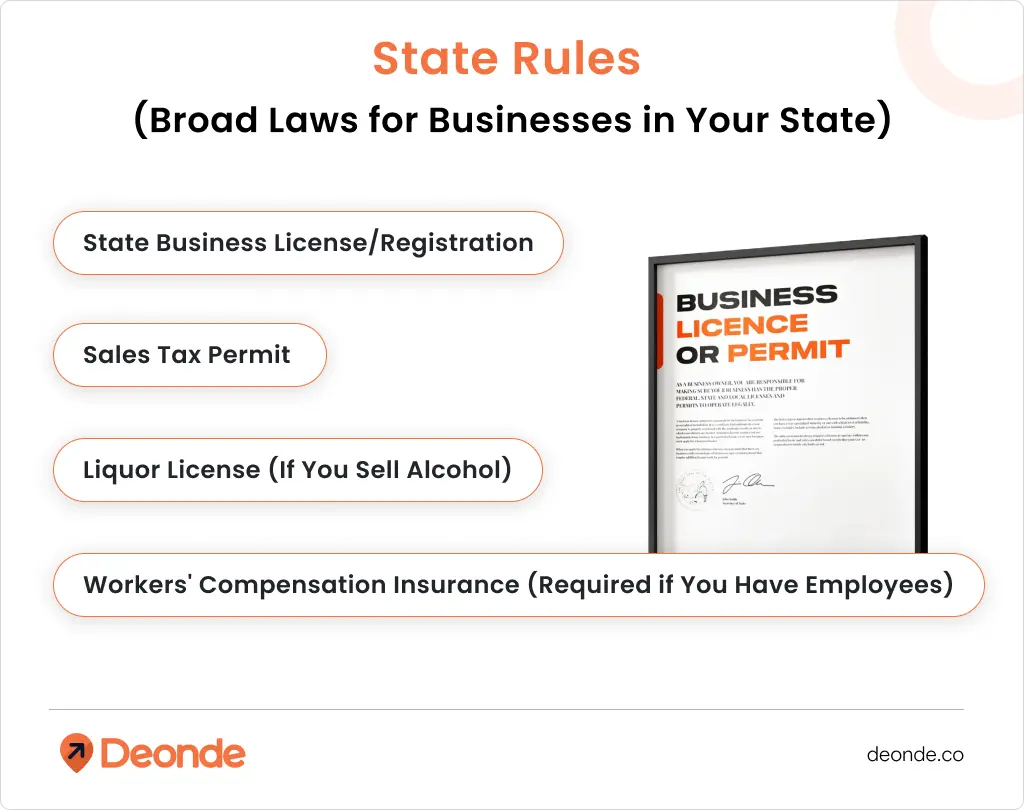
State Business License / Registration:
- What it is: This is your basic permission to legally run any business in that state. It often means registering your business name and type (like a Limited Liability Company (LLC) or a Corporation) with the state.
- Cost: It changes a lot by state, from a small fee (like $50-$200) to more, depending on your business type and size.
- Where to get it: Usually from your state’s Secretary of State’s office or a similar state business office.
- Good to know: The exact rules and how often you need to renew it will be different in each state.
Sales Tax Permit (or Seller’s Permit / Sales Tax License):
- What it is: This permit lets your restaurant legally collect sales tax from your customers when they buy food and drinks. It also often comes with a Resale Certificate.
- Why you need it: You need this permit to legally collect sales tax from your customers and send it to the state. The resale certificate is important because it lets you buy things you’ll sell again (like food ingredients) without paying sales tax. This stops you from paying tax twice and saves your business money.
- Cost: Often FREE, but some states might have a small fee (like $0-$50) or ask for a safety deposit.
- Where to get it: From your state’s Department of Revenue or tax office.
Liquor License (If You Sell Alcohol – This is a Big One!):
- What it is: If you plan to sell any alcoholic drinks (beer, wine, spirits), this is a highly controlled and often very expensive license. There are different kinds of licenses for different types of alcohol. For instance, a ‘beer and wine’ license is often much cheaper and easier to get than a ‘full liquor’ license that includes spirits.
- Why you need it: It gives you the legal right to buy, store, and sell alcohol. Selling alcohol without a license is illegal and has serious penalties. It makes sure your business follows state alcohol laws, like checking IDs.
- Cost: This cost varies dramatically. It could be a few hundred to hundreds of thousands or more. This depends on the state, the type of alcohol, and how many licenses are available in your area. This can often be the most expensive permit you get.
- Where to get it: Usually from your state’s Alcoholic Beverage Control (ABC) board or a similar alcohol control office. Local approvals are also often needed.
Workers’ Compensation Insurance (Required if You Have Employees):
- What it is: While not a “permit,” this is required in most states if you have employees. Insurance helps pay employees who get hurt or sick because of their job.
- Why you need it: It protects your employees and business from big costs if someone gets hurt at work. Nearly every state requires this if you have employees, though the exact rules vary. For example, Texas does not require it for most private employers. Always check your specific state’s labor laws.
- Cost: This is an ongoing cost, not a one-time fee. It depends on how many employees you have, their pay, and how risky their jobs are (restaurants have higher rates due to kitchen work).
Step 3: The Most Important for Restaurants: County and City Permits (Local Rules for Health and Safety)

These are the most specific and important permits for restaurants. They focus on public health, safety, and local building rules.
Food Service License (Health Permit Your #1 Permit):
- What it is: This is the most vital license for any place that makes and serves food. It confirms that your kitchen and restaurant meet all local health and cleanliness rules.
- Why you need it: It proves to customers and authorities that you follow strict health and safety standards to prevent foodborne illness.
- Cost: Usually a few hundred dollars to over a thousand dollars each year, depending on the size of your restaurant.
- Where to get it: From your local (city or county) health department.
Certificate of Occupancy (CO – Building Safety Check):
- What it is: This paper proves that your restaurant building is safe, follows all building and fire codes, and is legally approved to be used as a restaurant.
- Why you need it: It makes sure your building is strong and safe for its purpose (a restaurant), protecting customers and staff. Without a valid CO, you cannot legally run your business in a building.
- Cost: Varies, from a few hundred dollars to several thousand, especially if big inspections or updates are needed.
- Where to get it: From your local building or zoning department.
Food Handler’s Permit / Employee Health Permit (For Your Staff):
- What it is: Often, individual employees who handle, prepare, or serve food need their own special certificate. This shows they’ve taken a food safety course and passed a test.
- Why you need it: It ensures your staff knows basic food safety rules, lowering the risk of food contamination and keeping everyone healthy.
- Cost: Usually low, from $10 to $50 per employee for the course and certificate.
- Where to get it: From local or state health departments or approved training groups like ServSafe.
- Good to know: Rules change. Some places need all food staff to have this, while others only require managers to be certified.
Fire Department Permit (Fire Safety Check):
- What it is: This makes sure your restaurant follows local fire safety rules. This includes fire alarms, sprinklers, emergency exits, and fire extinguisher placement.
- Why you need it: To keep everyone in the building safe in a fire. It protects lives and property.
- Cost: Varies, usually a few hundred dollars annually or every two years.
- Where to get it: From your local fire department. Expect them to inspect regularly.
Sign Permit (For Your Restaurant Sign):
- What it is: Permission to put up any signs outside your restaurant.
- Why you need it: To make sure your sign follows local rules about how big it can be, where it can be placed, and how it looks. This keeps things safe (like not blocking traffic) and makes sure signs fit in with the neighborhood.
- Cost: From tens to hundreds of dollars, depending on the sign’s size, its complexity, and whether it’s illuminated.
- Where to get it: From your local planning or zoning department.
Waste Disposal / Grease Trap Permits (For Trash and Grease):
- What it is: Special permits for removing your restaurant’s trash, especially grease from cooking. Restaurants often need a “grease trap” that must be cleaned regularly.
- Why you need it: Stop pollution, follow cleanliness laws, and prevent expensive sewer clogs caused by grease.
- Cost: A few hundred dollars yearly for permits, plus more for trap installation and cleaning.
- Where to get it: From your local sanitation or public works department.
Live Entertainment / Music License (If You Play Music):
- What it is: If you plan to play copyrighted music (even background music) or have live bands, you’ll need licenses from Performing Rights Organizations (PROs) like ASCAP, BMI, SESAC, and GMR.
- Why you need it: To legally play copyrighted music and avoid big fines for breaking copyright laws. These groups make sure artists and writers get paid for their music.
- Cost: Yearly fees, usually a few hundred to a few thousand dollars, depending on your restaurant’s size and how much music you play.
- Where to get it: Directly from ASCAP, BMI, and SESAC (they are not government offices).
Outdoor Seating / Sidewalk Cafe Permit (If You Have Outdoor Tables):
- What it is: You need this to use public sidewalk space for outdoor tables.
- Why you need it: To legally use public property for your business and make sure people can still walk safely on the sidewalk.
- Cost: Varies a lot, from a few hundred to several thousand dollars yearly, often based on how much space you use.
- Where to get it: From your city’s planning or public works department. These often have specific rules about how your outdoor area should look.
Building Permits (For New Construction or Big Remodels):
- What it is: If you’re building a new restaurant or making big changes to the structure, plumbing, or electricity, you’ll need these permits before you start work.
- Why you need it: To make sure all your construction follows safety rules and is inspected to be strong and safe. It’s the law for most major building work.
- Cost: Can be expensive, from hundreds to many thousands of dollars, depending on how much work you’re doing.
- Where to get it: Usually handled by your local building department.
Zoning Approval / Conditional Use Permit (Very Important for Your Location):
- What it is: Even before you rent or buy a space, you need to check if the area’s zoning laws allow for a restaurant. Sometimes, if a restaurant isn’t usually allowed, you might need a “Conditional Use Permit” (CUP), which gives special permission under certain rules.
- Why you need it: Ensure your business fits the local neighborhood plan. If you don’t get this, you might not be able to open in that spot.
- Cost: Varies, from application fees for zoning checks to higher costs for CUPs, which might even involve public meetings.
- Where to get it: Your local planning or zoning department.
What Happens During Inspections
Inspections are a regular part of having a restaurant. Knowing what inspectors look for can help you be ready.
- Health Department Inspection:
- They’ll check for things like:
- Proper food storage temperatures (cold food cold, hot food hot)
- Correct handwashing procedures and prevention of cross-contamination
- Cleanliness of food prep surfaces, equipment, and floors
- Proper management of trash and pests
- Many of these local rules are based on the FDA’s model Food Code, which sets the national standard for food safety.
- They’ll check for things like:
- Fire Department Inspection:
- They’ll check:
- Clear and accessible emergency exits
- Working fire alarms, smoke detectors, and sprinkler systems
- Properly placed and charged fire extinguishers
- Posted maximum occupancy limits
- They’ll check:
- Building Inspection:
- They’ll check:
- Structural safety and integrity
- Properly installed and functioning plumbing and electrical systems
- Accessibility for people with disabilities (ADA compliance)
- Adequate ventilation
- They’ll check:
Where to Find More Help (Free Resources!):
- Small Business Administration (SBA.gov): This is a great government website with lots of info and help for small businesses.
- Your State’s Small Business Development Center (SBDC): These centers often offer free advice and help for small businesses, including how to find permits. See: national SBDC directory
- Local Restaurant Associations: Groups for restaurants in your state or city often have special advice and workshops about local rules.
- City / County Business Licensing Departments & Health Departments: These are the official places to go for local permits. Their websites usually have all the forms and contact info you need.
- A Business Lawyer or Consultant: While not free, consulting with a professional who specializes in hospitality can save you time and money by ensuring you don’t miss a critical step.
Check out How to Start a Restaurant Business.
Build Your Restaurant Dream with a Strong Start!
It might seem like a lot of paperwork, but getting all your permits and licenses is essential for opening a successful and legal restaurant in the USA. By carefully researching the requirements for your specific location and securing the proper paperwork, you’re not just following the law; you’re building a strong and safe base for your restaurant dream to grow and do well.
So, perfect those yummy recipes and get your dining room ready but make sure those “permission slips” are all sorted out first! Start today by visiting your local city or county website to find your personalized permit checklist!