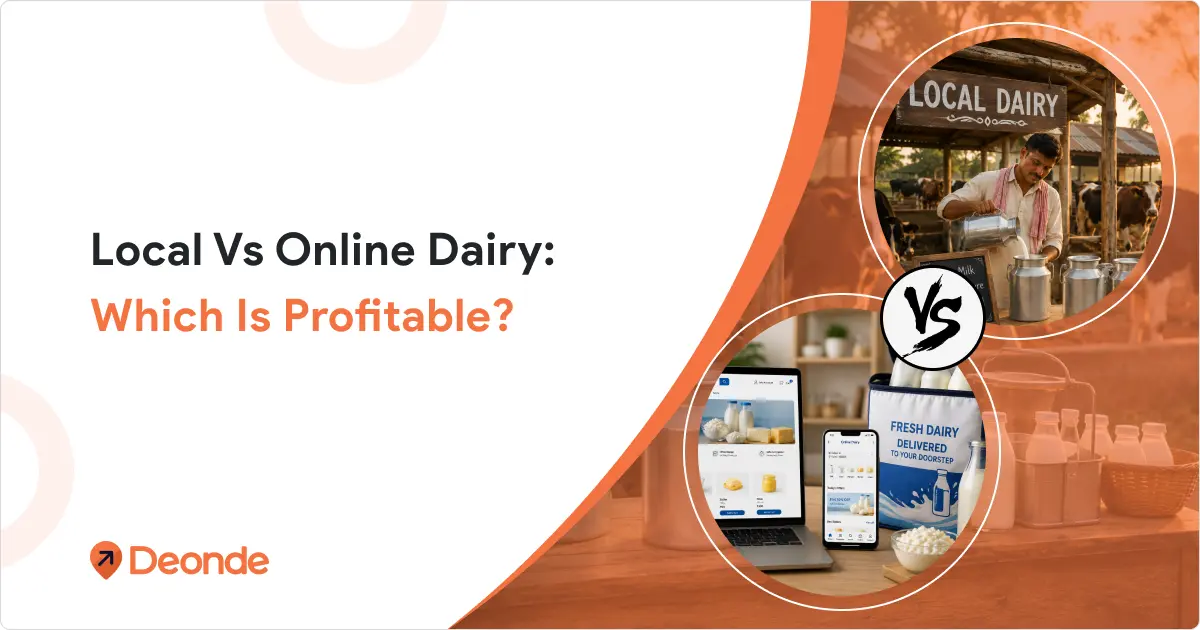
You’re staring at two very different paths. One is the traditional local dairy — the milkman route your grandfather might recognize.
The other is an online dairy business with apps, subscriptions, and automated routes. Both can make money, but the gap in profitability is wider than most people realize.
If you’re weighing up the local vs online dairy business profitability question, you’re not alone — it’s the single biggest decision new dairy entrepreneurs face.
By the end of this article, you’ll know exactly which model wins on margins, scalability, and long-term earning potential, and how to build the one that fits your goals.
The Two Paths: Local Dairy vs. Online Dairy Business — How They Work
Before we compare numbers, you need to understand what each model actually looks like on the ground.
What is a Local Dairy Business?
A local dairy business operates within a fixed geographic radius — usually a neighborhood, a few apartment complexes, or a small town.
The milkman delivers fresh milk door-to-door, often on a bicycle or a small truck, collects cash at the end of the month, and manages everything on paper or basic spreadsheets.
Customers are loyal but limited. You know every face, and they know you. But your growth is capped by how far your legs (or your single delivery vehicle) can reach.
What is an Online Dairy Business?
An online dairy business replaces the paper ledger with an ordering website and a customer mobile app. Customers subscribe, pause deliveries, or place one-time orders — all from their phone.
Instead of collecting cash, payments happen automatically through prepaid wallets or monthly billing cycles. Drivers follow optimized routes generated by the system.
A platform like a deonde handles subscriptions, automated billing, and route planning — eliminating the manual work that kills margins in local operations.
The difference isn’t just digital vs. physical — it’s capped vs. scalable, manual vs. automated, cash-heavy vs. predictable recurring revenue.
Profit Margin Comparison — How Much Can You Really Make?
Let’s get straight to the numbers, because this is the heart of the local vs online dairy business profitability debate.
Local Dairy Profit Margins
Traditional local dairy businesses operate on thin margins. Data from the retail food sector shows that local milk shops and dairy delivery services typically earn 5–15% net profit margins (Financial Model Excel, 2025). The reasons are predictable:
| Cost Factor | Impact on Margin |
| Manual record-keeping errors | 2–4% leakage |
| Cash collection inefficiencies | 1–3% lost |
| No route optimization | 15–25% excess fuel |
| Single product focus (milk only) | Low average order value |
A local milkman serving 200 households at ₹60/litre with a 10% margin earns roughly ₹36,000/month profit. It’s a living — but it’s not scalable wealth.
Online Dairy Profit Margins
Online models flip the script. According to Sid’s Farm founder Krian Iyengar (AFN, Dec 2025), their online milk delivery business profit margin sits at 35%+ gross margins on direct-to-consumer sales, with a path to 15% EBITDA by 2028.
The math works differently online:
- 80/20 product strategy: Milk is the loss leader (thin margin, high frequency). Value-added products like ghee, paneer, yogurt, and high-protein milk carry 40–70% margins and boost average order value by 15–25%.
- Subscription revenue: Prepaid wallets and auto-billing eliminate collection costs and reduce revenue leakage to near zero.
- Route density: Software clusters deliveries in the same area, cutting per-stop delivery costs by 30–40%.
The result? Online dairy businesses routinely hit 25–35% net margins at scale — roughly 2–3x higher than local operations.
If you’re serious about capturing these margins, you need the right infrastructure to start a milk delivery business the digital way.
Cost Comparison — Startup Investment & Monthly Operations
The assumption that “local is cheaper to start” is true — but misleading.
Initial Investment
| Cost Category | Local Dairy | Online Dairy |
| Delivery vehicle | ₹50,000–1,00,000 | ₹0 (use existing) or lease |
| Milk sourcing & storage | ₹30,000–50,000 | ₹30,000–50,000 |
| Software platform | ₹0 (pen & paper) | ₹49–99/month (SaaS) |
| Customer app | ₹0 | One-time setup fee |
| Marketing | ₹0 (word of mouth) | ₹5,000–15,000/month |
| Total first-year cost | ₹80,000–1,50,000 | ₹1,00,000–2,50,000 |
A full cost comparison local dairy vs online dairy business shows that online starts slightly higher — but the ROI flips fast.
The cost to develop a milk delivery app from scratch can run ₹40–60 lakhs, which is prohibitive. But with a white-label SaaS platform like Deonde, you bypass that entirely.
Deonde pricing starts at $39/month (roughly ₹2,000) — a fraction of building custom software.
Monthly Operating Expenses
Local operations bleed money in invisible ways: uncollected cash, wrong quantities delivered, time spent manually reconciling ledgers.
Online operations automate all of this. A 2025 study by Simple Dairy found that local dairy businesses spend 12–15 hours per week on manual billing and collection alone — time an online business redirects to growth.
Milk delivery profit improves the moment you digitize. Even a 5% reduction in revenue leakage from cash mismanagement adds ₹15,000–25,000/month to a 200-customer operation.
Scalability — Which Model Grows Faster?
A local dairy business is physically capped. You can serve roughly 300–500 households before you need another delivery vehicle, another person managing accounts, and another layer of coordination.
Beyond that, costs scale linearly — every new customer adds nearly the same cost as the last.
An online dairy business scales exponentially. Country Delight serves 1.5 lakh+ daily orders across 25+ cities from a single centralized platform.
Their D2C dairy business profitability analysis shows that fixed technology costs remain nearly flat while revenue grows — a textbook example of operating leverage.
The reason is simple: the marginal cost of serving one additional online customer trends toward zero. The app, the route software, and the payment system cost the same whether you have 100 customers or 10,000.
| Metric | Local Dairy | Online Dairy |
| Max customers (single operator) | 300–500 | 10,000+ |
| New city expansion cost | ₹2–5 lakhs | ₹50,000–1 lakh (software + local hub) |
| Revenue per customer (monthly) | ₹1,200–1,800 | ₹1,800–3,000 (value-add upsells) |
| Time to 1,000 customers | 3–5 years | 12–18 months |
Revenue Streams — Where the Money Actually Comes From
Local Dairy Revenue Streams
The typical local dairy has one revenue stream: selling milk. Maybe some curd or buttermilk. That’s it. Every rupee comes from fluid milk, and fluid milk is a low-margin, high-volume commodity — the worst combination for profit.
Online Dairy Revenue Streams
Online businesses diversify aggressively:
- Milk subscriptions (the hook — drives daily frequency)
- Value-added dairy — ghee (40–70% margin), paneer, yogurt, flavored milk
- Non-dairy essentials — Country Delight expanded into fruits, vegetables, eggs, and pulses. These items carry higher margins and boost basket size.
- Subscription upsells — high-protein milk, organic options, add-on plans
The 80/20 rule in a dairy business model comparison online vs offline becomes crystal clear: milk brings customers through the door; value-added products generate actual profit.
Online businesses also benefit from a feature local operations can’t match: automated milk subscription management. Customers can pause, skip, or modify deliveries from their phone — reducing churn and keeping revenue predictable.
A multi-product dairy delivery app lets you bundle paneer, ghee, and curd with every milk delivery, instantly lifting average order value by 30–50%.
Technology & Efficiency — How Automation Shifts Profitability
Here’s the dirty secret of local dairy that nobody talks about: cash leakage.
Every month, local milkmen lose money to:
- Customers who “forgot” to pay
- Handwritten ledgers with arithmetic errors
- Extra litres handed out that were never billed
- Time wasted on collections instead of serving more customers
These small leaks add up to 5–10% of revenue — enough to erase an entire quarter’s profit.
Online dairy eliminates this entirely. A milk delivery software platform auto-bills customers, tracks every delivery in real time, and sends payment reminders.
Dairy management software handles inventory, expiry tracking, and supplier management from one dashboard. And an ordering website for dairy lets customers place and modify orders 24/7 — no phone calls, no missed messages.
The milk delivery apps revolutionizing the dairy industry are doing more than adding convenience — they’re structurally changing the unit economics.
Route optimization alone cuts fuel costs by 20–30%. Auto-billing eliminates the 2–3% leakage from cash transactions. Subscription models convert one-time buyers into 12–18 month recurring customers.
| Efficiency Gain | Local Dairy | Online Dairy |
| Billing accuracy | ~90% (manual errors) | 99.9% (automated) |
| Collection time/week | 10–15 hours | 0 (auto-debit) |
| Route fuel cost | Full cost | 20–30% less (optimized) |
| Customer churn/year | 30–40% | 15–25% (subscription stickiness) |
Real-World Case Studies — Local vs Online in Action
Country Delight (Online D2C)
Revenue: ₹1,380 Crore (FY24) | Cities: 25+ | Daily orders: 1.5 lakh+
Country Delight started with a simple insight: urban Indians wanted unadulterated milk but didn’t trust the supply chain. Their online-only, subscription-based model bypassed middlemen entirely.
They now source directly from partner farmers and own their cold-chain delivery fleet.
While they’re still investing heavily in growth (net loss of ~₹250 Cr in FY24), their gross margins are healthy, and their path to profitability is clear as they expand into higher-margin products like ghee, high-protein milk, and fresh produce.
Sid’s Farm (Online D2C)
Revenue: ~$20M (₹168 Cr FY25) | Target Gross Margin: 35%+
Sid’s Farm operates in Hyderabad, Bengaluru, and Pune. Founder Krian Iyengar told AFN that raw material margins sit at 45–48%, and with factory costs around 10%, their target gross margin exceeds 35%.
They’ve already demonstrated 8% EBITDA profitability at lower scale and aim for 15% by 2028.
The key? Expanding the product range so excess milk gets converted into long-shelf-life products like ghee and yogurt instead of being sold in bulk at lower prices.
The Local Milkman
A typical local milkman in a mid-sized Indian city serves 150–250 households. Average monthly revenue: ₹2–3 lakhs. Average profit: ₹20,000–40,000/month. Margin: 8–12%. After 10 years, the business looks the same — just with older equipment.
The Hybrid Model (Local + Online)
Some smart operators start local and layer on technology. A dairy in Pune began with 80 local deliveries, added a basic ordering website, and within 18 months grew to 650 daily orders with 22% margins — nearly 3x better than their purely local competitors.
These examples make the local vs online dairy business profitability picture real: the local milkman vs app-based milk delivery profit comparison isn’t even close at scale. Online wins, decisively.
Decision Framework — Which Model Should You Choose?
Choose Local Dairy If…
- You have extremely limited capital (under ₹50,000)
- You want to test the business before investing in technology
- Your target area has very low smartphone penetration
- You’re fine with a small, stable income rather than aggressive growth
Choose Online Dairy If…
- You have ₹1–2.5 lakhs to start properly
- You’re targeting urban or semi-urban areas with high smartphone usage
- You want to scale beyond one neighborhood or city
- You care about automation, data, and predictable recurring revenue
Start Local, Go Digital — The Hybrid Model
This is the smartest path for most entrepreneurs. Start with a small local base to validate the unit economics.
Then — and this is critical — layer on digital ordering before you hit 100 customers, not after. The moment you onboard a white-label food delivery platform like Deonde, your business model changes: you go from cash to prepaid, from paper to automated billing, from word-of-mouth to systematic customer acquisition through a customer app for milk delivery.
The question “is online dairy business more profitable than local dairy” has a clear answer — yes, by a factor of 2–3x on margins and unlimited on scale — but the best path is local foundation, digital acceleration.
The Hybrid Model — Best of Both Worlds
You don’t have to pick one or the other. The hybrid model works in four stages:
Step 1: Start local. Serve 50–100 households. Perfect your milk quality, sourcing, and delivery timing. Keep costs lean.
Step 2: Add digital ordering. Introduce an ordering website and a customer app. Move existing customers from cash to prepaid wallets. This alone bumps margins by 3–5% by eliminating leakage.
Step 3: Automate operations. Use software for route optimization, auto-billing, inventory tracking, and subscription management. Your 10–15 hours/week of manual work drops to zero.
Step 4: Scale. Expand to new neighborhoods. Onboard delivery partners. Add value-added products. Your digital infrastructure — which costs the same at 100 customers as at 10,000 — becomes your growth engine.
The technology lever is what makes this possible. A platform like Deonde provides the entire digital stack — ordering website, customer app, driver app, admin panel — starting at $39/month.
The same infrastructure that powers Country Delight’s 1.5 lakh daily orders is available to a single dairy entrepreneur serving 100 households.
The Final Verdict — Which One is More Profitable?
When you put the numbers side by side, the local vs online dairy business profitability comparison leaves little room for debate.
Local dairy is viable — it puts food on the table and serves an important role. But online dairy, even at moderate scale, delivers 2–3x higher margins, 10x the growth ceiling, and fundamentally better unit economics driven by automation, subscription revenue, and diversified product lines.
The most profitable move isn’t either/or. It’s both — start local to build trust and validate demand, then layer on digital infrastructure before you hit the growth ceiling. That hybrid approach combines the best of both worlds: local reliability with online scalability.
Ready to build your dairy business the profitable way? Deonde gives you a fully branded, white-label ordering and delivery platform — including your own app, website, and admin panel — starting at just $39/month with zero commission on orders.
No coding, no development delays, no middlemen taking a cut. Start your free trial today and launch your online dairy business in 3 days.

FAQ Section
Q: Which is more profitable — local dairy or online dairy?
Online dairy is significantly more profitable, typically earning 25–35% net margins compared to 5–15% for local dairy. Automation, subscription billing, and value-added product upsells drive the gap.
Q: How much does it cost to start an online dairy delivery business?
You can start with ₹1–2.5 lakhs (1,200–3,000) using a white-label SaaS platform like Deonde ($39/month). Custom app development would cost 20–50x more.
Q: Can I run a local dairy business and an online dairy business at the same time?
Yes — this hybrid model is actually the smartest approach. Start local to validate demand, then add digital ordering to automate billing, reduce leakage, and enable scaling.
Q: What profit margin do online milk delivery businesses make?
Online milk delivery businesses report 25–35% gross margins, with top operators targeting 15% EBITDA. Local operations typically see 5–15% net margins.
Q: Is the milk delivery market growing?
Yes. The global milk delivery service market was valued at $11.4 billion in 2025 and is projected to reach $22.8 billion by 2034, growing at 8% CAGR (DataIntelo, 2026).
Q: What technology do I need to start an online dairy business?
You need an ordering website, customer app, driver app, and admin panel — all available as a white-label SaaS from platforms like Deonde. No coding required.
Q: How many customers can a local milkman serve?
A single operator can serve 300–500 households before hitting physical limits. Online operations regularly serve 10,000+ customers across multiple cities.
Q: What’s the biggest cost in dairy delivery?
Delivery logistics is the biggest cost for both models. Online operations reduce it by 20–30% through route optimization software — technology local operations lack.