You built a milk delivery app. Customers are signing up. But your drivers are burning fuel, missing windows, and your margins are shrinking. The culprit? Poor milk delivery route optimization.
For milk — where products spoil in hours and customers expect delivery before sunrise — getting routes right is everything.
If you are currently comparing the profitability of a local vs. online dairy business, mastering these logistics is usually the deciding factor that protects your margins. Here is how to build, optimize, and scale your routes.
Why Route Optimization Makes or Breaks a Milk Delivery App
Every minute on the road costs money — fuel, wages, and cold chain risk. Without a smart system, those minutes add up fast.
The Problem with Manual Route Planning
Most dairy startups use spreadsheets or the driver’s memory. This works for 20 deliveries. At 50, it cracks. At 100, it falls apart — longer routes, missed stops, no data to fix it. Manual planning also cannot adapt when a customer pauses or modifies their subscription.
What Makes Milk Delivery Different from Food Delivery
Food delivery is one-off. Milk delivery is recurring — the same 100 households need milk every morning. Some pause on Sundays, some double on Saturdays, some skip a week. Your dairy route planning must handle daily variability while maintaining a stable base route.
This is a fundamentally different problem — and generic route optimization software often fails where dedicated milk delivery software excels.
How Delivery Zone Management Affects Route Efficiency
Your delivery zones define everything. Get them right, and your routes practically optimize themselves.
Setting Up Profitable Delivery Zones
A good zone is dense enough that a driver can complete 40–60 stops within a 3-hour window. Map your customer locations and cluster them by proximity. A zone with 50 scattered stops across 15 km will lose money. A zone with 50 stops within 3 km will print money.
Start with one zone, prove the economics, then replicate.
Zone-Based vs. Open Routing — Which Works for Milk?
Zone-based routing assigns drivers to fixed geographic areas. They learn the streets, the apartment gate codes, and the customer who always wants milk left in the shaded spot. This builds speed and reliability.
Open routing lets the software assign the closest driver to each stop daily. While efficient on paper, it sacrifices consistency — and in milk delivery, consistency builds subscriber trust.
For milk round planning, zone-based routing almost always wins. Drivers finish faster, customers get their milk at the same time daily, and spoilage drops.
Using Admin Panel Tools to Define Zones
Your admin panel should let you draw delivery zones on a map, set max stops per route, and assign drivers. Deonde’s platform includes these tools out of the box — you define the zones, the system handles the rest. As you add customers, the system automatically redistributes them within your zones.
Building Efficient Daily Routes for Subscription Milk Delivery
Subscription milk delivery is a daily puzzle. Every customer’s order changes slightly, and your routes need to reflect that without confusing drivers.
Handling Pause, Skip, and Modify Requests Without Breaking Routes
When a customer pauses their subscription, the route should auto-adjust. That stop drops off, the remaining stops resequence, and the driver saves 3–5 minutes. Over 60 stops, that is 3 hours saved per week per route.
Good milk subscription management software handles pause, skip, and modify requests automatically. The driver never thinks about it — their app just shows the updated route.
Dynamic Routing for Your Delivery Fleet
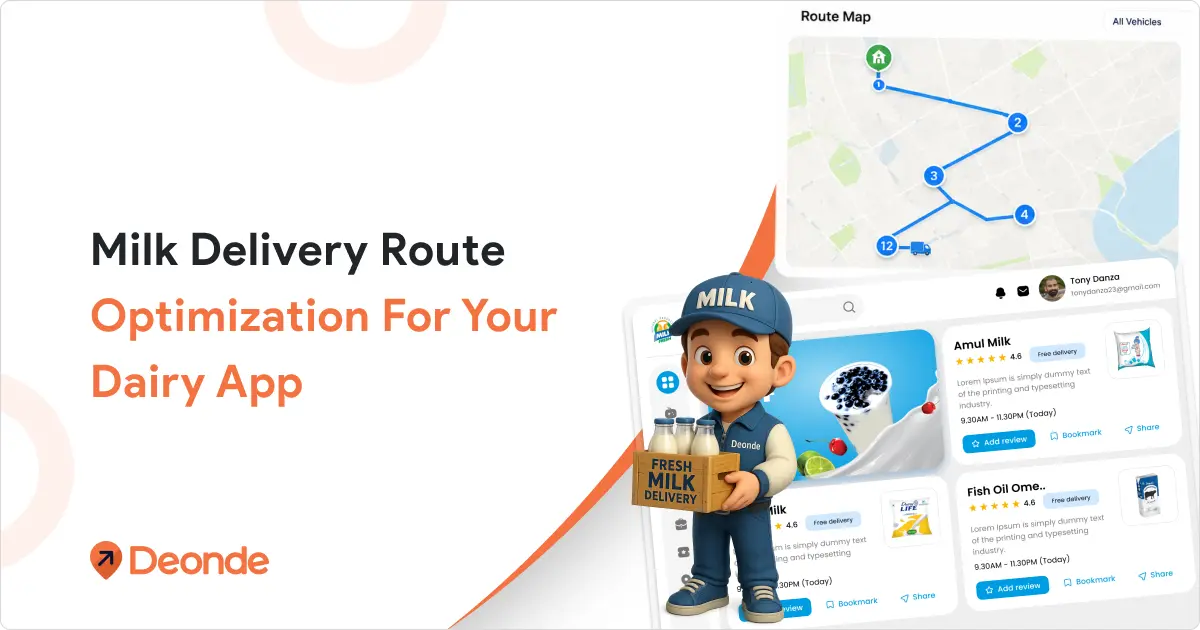
Static routes work for the base subscription. But real life throws curveballs — traffic jams, road closures, weather. Dynamic routing recalculates the optimal stop sequence in real time based on current conditions. If a driver hits a 15-minute delay, the system reorders remaining stops to minimize total lateness.
How the Driver App Keeps Routes on Track
Your driver app is the execution layer. It should show turn-by-turn directions, display stop order, log delivery confirmations, and flag exceptions. When a driver opens the app at 5 AM, they should see their optimized route, know their first stop, and be on the road within 60 seconds.
Real-Time Route Optimization — What Your Driver App Can Do
The route plan is only as good as the driver’s ability to execute it.
Live GPS Tracking and Route Adjustment
Real-time delivery tracking gives you a live view of every driver on a map. You can see who is ahead of schedule, who is falling behind, and where bottlenecks form. When a driver gets stuck, you can reroute them — or dispatch another driver to split the load.
Reducing Fuel Costs with Smarter Stop Sequencing
Stop sequence is the single biggest lever for fuel efficiency. A route with 50 stops can be sequenced in thousands of ways. The right sequence cuts 15–25% off total driving distance. That translates directly to lower fuel costs and more deliveries per hour.
Track your dairy route optimization cost savings by measuring miles per stop before and after implementing smart sequencing.
Customer Notifications and ETA Accuracy
When customers know their milk arrives at 6:15 AM, they stop texting the driver. Automated notifications Your delivery is 3 stops away reduce driver distraction and improve customer satisfaction. It also builds trust in your subscription service, which directly reduces churn.
Scaling Your Milk Business with Route Data
As you grow from 5 routes to 20, the complexity multiplies. Data becomes your best tool.
Using Admin Analytics to Spot Inefficient Routes
Your admin dashboard should flag routes where drivers consistently exceed estimated time, where fuel cost per stop is above average, or where stop density is too low. These metrics tell you exactly which zone needs restructuring or which driver needs support.
When to Add More Drivers vs. Optimize Existing Routes
The instinct when deliveries grow is to hire another driver. However, figuring out how to increase delivery volume without hiring more delivery drivers is entirely possible. But often you can absorb 20–30% more stops into existing routes with better sequencing. Only add routes when your average stop density drops below 35 stops per route-hour. Until then, optimize what you have.
Expanding to New Zones Without Losing Efficiency
When you expand to a new area, start with a pilot zone. Run 20–30 subscriptions in that zone for two weeks. Measure fuel cost, delivery time, and customer satisfaction. Only then expand. This controlled approach ensures your dairy delivery optimizatio scales without breaking.
Global Route Optimization Comparison
Milk delivery route optimization varies by region. In North America, focus on minimizing highway miles. In Europe, prioritize time-window compliance in dense urban routes. India & SE Asia need hyper-dense clustering with lightweight vehicles for narrow lanes. Australia & NZrequire flexible capacity for 40%+ seasonal volume swings.
How to Choose the Right Route Optimization Approach

Here is a simple framework:
Step 1 — Identify your route type Are you doing doorstep subscriptions, wholesale retail, or both? Each needs a different approach.
Step 2 — Match software to complexity under 5 routes? Manual sequencing with a smart driver app may be enough. Beyond that, you need automated dairy route planning.
Step 3 — Calculate ROI Model your current fuel cost and spoilage rate. A 15% improvement typically pays for route optimization software within 4 months.
Step 4 — Pilot, measure, scale run optimized routes on your worst-performing zone first, then roll out zone by zone.
Conclusion
Milk delivery route optimization is not optional — it is the operational backbone of a profitable dairy business. Zone management, dynamic routing, driver apps, and real-time tracking work together to deliver milk faster, cheaper, and fresher.
Whether you are scaling an existing fleet to 50 drivers, or you are still reading up on how to build a milk delivery app like Milk & More, the operational principles are the exact same: cluster smart, sequence smarter, and let your software handle the daily variability.
Ready to build your own white-label delivery platform? Deonde gives you the route optimization, zone management, driver app, and subscription tools you need to bypass months of custom coding. In fact, leveraging our pre-built SaaS infrastructure is the fastest way to launch a complete milk delivery website in just 24 hours

FAQ
How to plan milk delivery routes efficiently?
Cluster customers into zones of 40–60 stops. Then sequence each zone to minimize total driving distance using software that handles pauses, skips, and daily quantity changes.
What is the best milk delivery route planner for a startup
A platform combining zone management, dynamic routing, driver app, and customer notifications. It must handle subscription logic, not just one-off deliveries, and integrate with your [milk delivery app](/blog/how-does-milk-delivery-app-work).
How does route optimization reduce fuel costs?
By sequencing stops in the shortest possible order, reducing total miles driven. Most dairy businesses see 15–25% fuel savings within the first month of switching from manual to automated planning.
Can route optimization help with subscription pauses?
Yes. Good systems automatically remove paused stops and resequence remaining ones. This lets you increase profit margins without adding driver hours.