Every missed delivery costs you money. Every late order costs you a customer. Real-time delivery tracking gives you visibility over every order, every driver, and every minute. Without it, you are running your delivery operation blind.
96% of customers now actively track their orders, and 83% expect delivery updates without having to ask for them.
When Amazon introduced package tracking in the early 2000s, it was a novelty. Today, it’s table stakes. Companies that can’t provide real-time visibility into their delivery process aren’t just behind the curve—they’re practically invisible to modern consumers.
This guide breaks down what real-time tracking does, where it cuts costs, and how to choose the right system for your business.
What Real-Time Delivery Tracking Actually Does
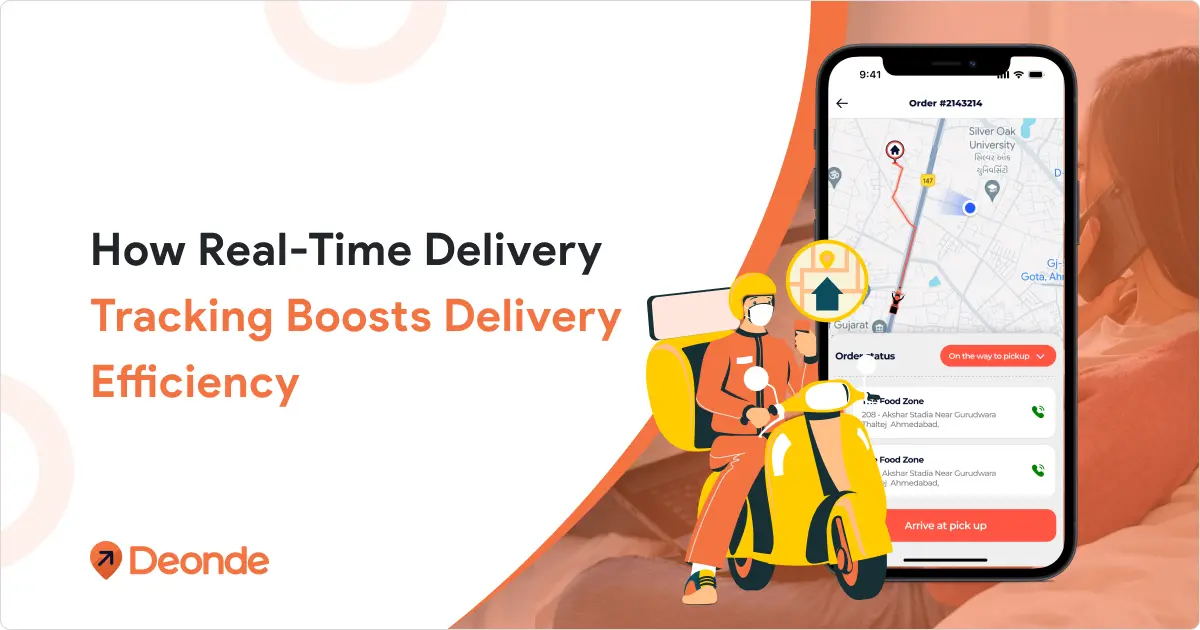
Real-time delivery tracking shows the live location of every driver on a map. You see where each order is, which driver has it, and how long until it reaches the customer.
It uses GPS signals from the driver’s phone or device. The system updates this location every few seconds. Your dashboard reflects this instantly.
The customer also receives live order updates through the app or SMS. They can watch the driver moving toward them. This eliminates “where is my order?” support calls — one of the most common complaints in food delivery.
To understand the technical foundation behind this, see our glossary entry on real-time tracking and delivery tracking.
How Real-Time Tracking Improves Last-Mile Delivery Efficiency
The last mile is the most expensive part of any delivery operation. It accounts for up to 53% of total shipping costs across logistics businesses. Last-mile delivery efficiency depends entirely on what happens in those final minutes between pickup and the customer’s door.
Real-time tracking improves this in three specific ways.
First, it enables instant re-routing. A driver stuck on a blocked road can be redirected before the delay compounds into a failed delivery.
Second, it surfaces patterns. If the same route causes delays three times a week, you see it in the data. You can then restructure your delivery zones to fix the root cause — not just the symptom.
Third, it reduces failed deliveries. A driver who cannot find an address can contact the customer directly through the app. Fewer failed deliveries means lower re-delivery costs and fewer refund requests.
The Role of Delivery Route Optimization in Cutting Delays
Delivery route optimization is about assigning the most efficient path to each driver, something that modern logistics scheduling software helps automate by continuously adjusting routes based on real-time traffic and delivery conditions.
A route planned at 11am may be inefficient by 1pm. Traffic changes, order volume shifts, and driver pace all affect efficiency. A live tracking system adjusts routes based on current conditions — not what was true an hour ago.
For food delivery businesses managing 20 or more daily orders, manual routing does not scale. Route optimization connected to live GPS data can reduce average delivery time by 20–30%. Fewer kilometers driven also means lower fuel spend.
For a business running 10 drivers daily, even a 10% reduction in distance translates to meaningful monthly savings. Read our full guide on how to optimize delivery routes using a ready-made food delivery app for a practical implementation breakdown.
How Driver Management Software Uses Live Tracking Data
Driver management software does more than show where your drivers are. It uses live tracking data to improve how you run your entire fleet.
You can monitor driver speed, idle time, and time spent at each stop. If a driver is consistently slow between pickups, you can identify this and address it early.
You can also track performance over time. Which drivers complete the most orders per shift? Who has the fewest failed deliveries? This data helps you reward your best performers and support those who need improvement.
Live tracking also improves driver accountability. Drivers who know their location is monitored stay on route and meet time targets. This is not about surveillance — it is about giving your team a clear, measurable standard to work to.
Deonde’s driver management software gives you real-time visibility over your entire driver fleet from a single dashboard. Driver settlements, performance data, and live location are all in one place.
What Customers Expect From a Food Delivery Tracking System
Customer expectations around delivery have shifted. A food delivery tracking system is no longer a premium feature — it is a baseline expectation.
Research shows that 93% of customers want proactive updates at every stage of their order. They want confirmation, preparation updates, pickup alerts, and an arrival estimate. Live tracking satisfies all four stages automatically.
This matters because it reduces anxiety. Anxious customers contact support. They leave negative reviews. They do not reorder. A tracking system that keeps customers informed removes all three of those outcomes.
If your delivery app does not offer live tracking, customers will compare you unfavorably to apps that do. This is one of the most direct causes of churn in food delivery today.
For more on how delivery automation affects customer experience, see our guide on delivery automation and smart technology.
Real Costs You Save With Live Tracking
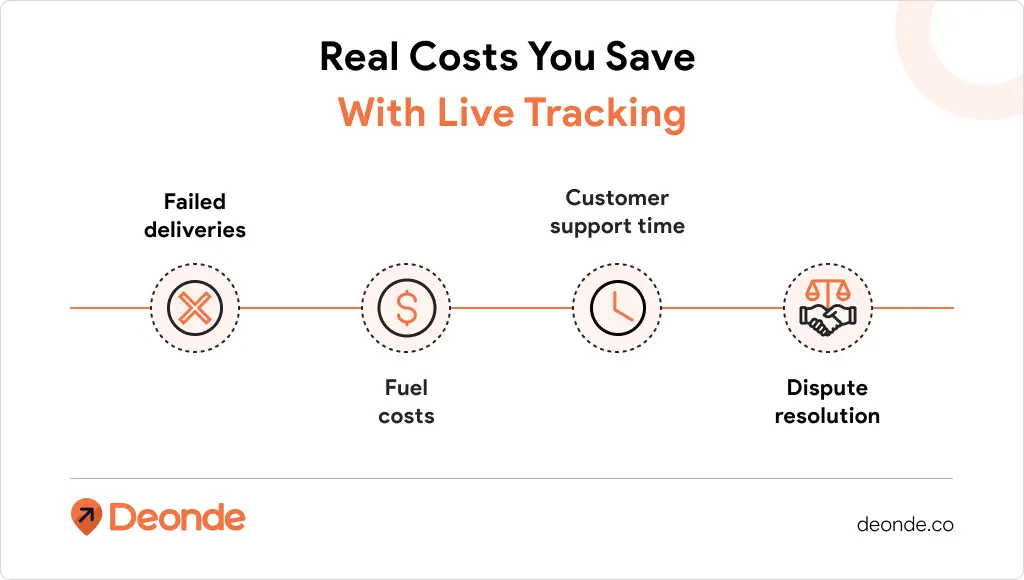
Real-time delivery tracking has a direct impact on operating costs. Here is where the savings are clearest.
Failed deliveries
Each failed delivery costs an average of $17.20 to reattempt. Live tracking reduces failures by keeping customers informed and enabling real-time problem-solving between dispatcher and driver.
Fuel costs
Optimized routes mean shorter distances. Even a 5% reduction in fuel spend across a fleet adds up significantly over a month of operations.
Customer support time
Fewer inbound calls about order status frees up staff hours. For a business handling 200 orders per day, this can save 2–3 hours of support time daily.
Dispute resolution
When a customer claims an order was not delivered, live tracking provides a timestamped location log. This protects your business from false claims and costly refunds.
For a full view of how tracking data connects to business performance, Deonde’s analytics and reporting dashboard links delivery metrics to revenue outcomes.
How to Choose the Right Real-Time Tracking Tool for Your Business
Not every tracking system is built for food delivery. Here is what to evaluate before you commit.
GPS update frequency
The system should update driver location every 5–10 seconds. Anything slower creates visible lag for customers and dispatchers.
Customer-facing tracking page
Customers should track their order without downloading a separate app. A live tracking link sent via SMS or in-app notification is the current standard.
Integration with your ordering system
“A tracking tool that does not connect to your order management system creates data gaps. Choose a platform where orders, drivers, and tracking operate together — not separately. Having this unified architecture ready is a major technical advantage when you start a food delivery startup.
Driver app compatibility
Your drivers need a lightweight app that works on both Android and iOS. Complex tools increase errors on the road. Deonde’s driver appis built specifically for delivery operations — GPS-enabled, fast to load, and easy to use mid-shift.
Delivery zone controls
Pairing live tracking with clearly defined delivery zones ensures your drivers never operate outside your service area. This prevents wasted trips and keeps operations focused and profitable.

FAQ: Real-Time Delivery Tracking and Delivery Efficiency
1. How does real-time tracking improve delivery efficiency?
Real-time delivery tracking gives dispatchers live visibility over every driver. This allows instant re-routing when delays occur, reduces failed deliveries, and cuts average delivery time. The result is more orders completed per shift with fewer resources wasted.
2. What is the impact of GPS tracking on food delivery operations?
GPS tracking connects your drivers, dispatchers, and customers in real time. Dispatchers can manage exceptions the moment they arise. Customers stay informed without contacting support. Operations become measurable — and anything measurable can be improved.
3. How does live order tracking reduce delivery costs?
Live tracking reduces failed deliveries, shortens routes to cut fuel spend, and lowers customer support volume. Each of these areas represents a direct, recurring cost saving for your delivery business.
4. Can real-time tracking improve customer satisfaction in food delivery?
Yes. Customers who receive live updates are less likely to contact support and more likely to leave a positive review. Live tracking is one of the highest-impact features for customer retention in the food delivery industry.