Every order placed through a third-party app costs you 15% to 30% in commission. On a $40 order, that’s $6 to $12 gone before you cover food, labour, or packaging.
If your restaurant runs a 10% net margin, a single 30% commission wipes out three times your profit on that order. Owning your delivery platform changes this math entirely.
It puts revenue back in your hands, gives you full customer data, and builds a business asset — not a dependency.
Quick Answer
- Third-party delivery platforms charge 15–30% commission per order. Hidden fees push the true cost above 40% in many cases.
- Restaurants with their own direct ordering system eliminate per-order commissions and keep 100% of each sale.
- Owning your platform gives you customer data, loyalty control, and delivery cost management — three levers third-party apps never give you.
What Is Eating Your Restaurant’s Delivery Profit Right Now?
Most restaurant owners see the headline commission rate. They miss the rest.
The actual cost of third-party delivery can exceed 40% of your revenue when hidden fees are factored in. These hidden costs include payment processing fees (2.9–3.5%), paid placement and marketing charges, and in some markets, additional service fees passed partially back to the restaurant.
If a restaurant operates with a 10–15% profit margin, a 30% commission can quickly erase any potential earnings.
There is also a brand problem. Studies show that 43% of customers cannot recall the restaurant name after ordering through a delivery app. Your food builds their loyalty — but the app gets the relationship.
This is the core issue. Third-party platforms give you volume. They take your margin and your customers in return.
How Does a Direct Ordering System Cut Your Costs?
A direct ordering system means customers place orders through your own website, app, or social channels — not a marketplace. You pay a flat platform fee. You keep the commission.
Here is what the numbers look like in practice:
- Third-party order at $40: Platform takes $8–$12. You net $28–$32 before costs.
- Direct order at $40: You pay a flat monthly platform fee. You net the full $40 before costs.
At 200 orders per month, the difference is $1,600 to $2,400 in reclaimed revenue — every single month.
Many restaurants are seeking alternative delivery models, such as working directly with delivery services or building in-house systems, to reduce reliance on high-commission third-party platforms.
Switching to direct ordering does not mean abandoning third-party apps. It means using them for customer acquisition — and converting those customers to your own platform over time.
Switching to direct ordering does not mean abandoning third-party apps. It means using them for customer acquisition — and converting those customers to your own platform over time.
The hybrid model works like this:
- Use third-party apps for discovery. New customers find you on the platform.
- Fulfil their first order well. Include a card or message with a direct ordering incentive — a discount code or free delivery on their next order.
- The second order comes through your platform. You pay no commission. You now own the customer relationship.
Over six months, this systematically shifts your revenue mix. More orders come direct. Commission exposure shrinks. Margins improve without losing volume.
Learn how this works in practice in our detailed breakdown of commission-free restaurant ordering systems.
Why Does Owning Your Customer Data Increase Revenue?
When customers order through DoorDash or Uber Eats, the data belongs to the platform — not you. You get the order. They get the customer profile, purchase history, and behavioural data.
That data has real financial value. Research shows that owning customer data increases lifetime value by 67% through direct marketing and loyalty programmes.
With your own platform, you can see:
- Which customers order every week vs once a month
- Which menu items drive repeat orders
- Which promotions convert new customers to loyal ones
- When a customer who used to order regularly has gone quiet
This data lets you act. You can send a re-engagement offer to lapsed customers. You can upsell based on order history. You can run targeted promotions to your highest-value customers.
Platforms like Deonde’s restaurant analytics dashboard surface this data automatically. You do not need a data science team to use it.
A practical example: A restaurant identifies its top 200 customers by order frequency. It sends them a “VIP early access” offer for a new menu item before the public launch. Seventy customers order in the first 48 hours. Zero commission paid. Zero advertising spend beyond an SMS message. That is high-margin revenue from data you already own.
Third-party platforms will never give you this ability. It is not in their interest to help you reduce your dependence on them.
How Does a Commission-Free Restaurant Ordering System Work?
A commission-free model replaces per-order fees with a flat monthly subscription. You pay a fixed amount. Every order is yours in full.
The ordering flow works like this:
- Customer visits your branded website, app, WhatsApp, or social channel
- They browse your menu, customise their order, and pay directly
- The order appears on your restaurant dashboard in real time
- Your driver or delivery partner fulfils the order
- Payment settles directly to your account
There is no marketplace middleman. No commission deducted per order. No algorithm deciding how visible your restaurant is today.
Deonde Express is built on this model. It supports ordering across multiple channels — including WhatsApp, Google Food Ordering, and Instagram — all flowing into a single dashboard.
For restaurants choosing between platforms, our comparison of third-party vs direct restaurant ordering breaks down exactly where each model wins and loses.
What Role Does Delivery Route Optimisation Play in Your Margins?
Cutting commission is step one. Reducing your delivery cost per order is step two.
Unoptimised delivery routes cost you in three ways: longer driver hours, higher fuel costs, and slower delivery times that hurt ratings and repeat orders.
Route optimisation software calculates the most efficient path for each delivery. It accounts for traffic, order sequence, and driver location in real time. A driver covering 6 deliveries in 90 minutes instead of 120 minutes cuts your cost per delivery by 25%.
This is where driver management software becomes a direct profit tool — not just an operational one.
Driver settlement is another overlooked area. Manual driver payment calculations cause errors, disputes, and time loss. Automated driver settlement tools eliminate this friction. Drivers are paid accurately. You have full records. Time spent on settlement drops from hours to minutes.
Taken together — route optimisation plus automated settlement — delivery becomes a tighter, more predictable operation. The cost per order falls. Customer satisfaction rises because deliveries arrive faster.
For a practical guide on applying this, read how to optimise delivery routes using a ready-made food delivery app.
How Do Loyalty Programmes on Your Own Platform Boost Customer Lifetime Value?
Customer reorder rates on third-party platforms sit at 15–25%. On a direct platform, they rise to 35–55%.
The reason is simple. Third-party apps show customers competing restaurants every time they open the app. Your platform shows them only you.
A loyalty programme makes this advantage compound. Every direct order earns points. Points create a reason to return. Repeat customers spend more and cost less to retain than new ones.
Deonde’s restaurant loyalty management system lets you build and manage this entirely within your own platform. You set the rules — points per order, redemption thresholds, exclusive member offers. The platform handles the tracking automatically.
The compound effect is significant. A customer who orders twice a month and is enrolled in your loyalty programme typically increases to 2.5–3 orders per month within the first quarter. That additional order comes at near-zero acquisition cost. No new marketing spend. No platform algorithm needed.
Three loyalty tactics that directly improve margins:
1. Points on direct orders only — this incentivises customers to bypass third-party apps. The discount cost to you is lower than the commission you would have paid.
2. Referral rewards — existing customers bring new ones. You acquire customers at the cost of a discount, not a 25% commission.
3. Subscription plans — customers pay a monthly fee for free delivery. They order more frequently to justify the fee. Your revenue per customer rises. Your delivery cost per order falls because volume increases.
What Are the Real Numbers: Own Platform vs Third-Party Delivery?
Here is a concrete comparison for a restaurant doing $20,000 per month in delivery revenue:
|
Metric |
Third-Party Platform |
Own Platform |
|
Commission rate |
25% |
0% (flat monthly fee) |
|
Monthly commission paid |
$5,000 |
~$150–$300 (subscription) |
|
Revenue retained |
$15,000 |
$19,700–$19,850 |
|
Customer data owned |
None |
Full |
|
Repeat order rate |
15–25% |
35–55% |
|
Brand visibility per order |
Marketplace branded |
Your brand only |
The difference is $4,700 to $4,850 retained per month — or $56,000 to $58,000 per year. That figure scales directly with your order volume.
The difference is $4,700 to $4,850 retained per month — or $56,000 to $58,000 per year. That figure scales directly with your order volume.
For some restaurants, delivery accounts for up to 30% of total revenue. At that scale, commission exposure becomes a serious structural risk to the business.
What does improved margin unlock for your business?
- Reinvestment in kitchen quality — better ingredients without raising prices
- Faster break-even on new locations — lower operating cost per location
- Marketing budget — funds to grow your direct customer base further
- Staff wages — margin recovered from commission can improve retention
80% of independent restaurants still rely on third-party delivery services for all or part of their operations. The ones moving off this dependency are not abandoning delivery. They are reclaiming their margin while maintaining their volume.
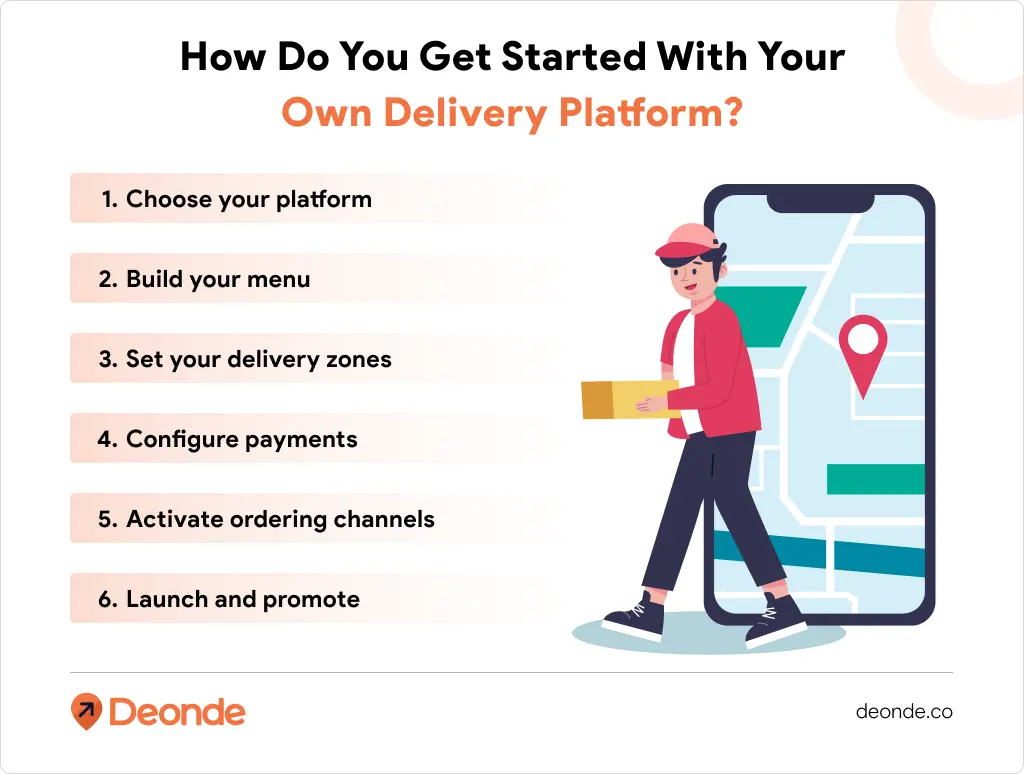
How Do You Get Started With Your Own Delivery Platform?
The barrier to launching your own platform has dropped significantly. You do not need a custom app build or a developer team.
SaaS-based platforms like Deonde let you launch a fully branded ordering system in days — not months. The setup process typically works as follows:
1. Choose your platform — select a plan that fits your order volume and feature needs
2. Build your menu — import or create your menu directly in the platform dashboard
3. Set your delivery zones — define which areas you cover and at what fees
4. Configure payments — connect your preferred payment gateway
5. Activate ordering channels — turn on website, app, WhatsApp, or QR code ordering based on where your customers are
6. Launch and promote — email existing customers, update your Google Business profile, and offer a first-order incentive to switch
Your restaurant’s online presence should also follow Google’s Search Essentials to ensure your ordering page is indexed correctly and discoverable in search results. Enabling Google Discover eligibility by publishing quality content ensures your restaurant surfaces to new customers actively browsing food-related content.
Platform accessibility matters too. Following Google’s accessibility guidelines when setting up your ordering website ensures customers on all devices and abilities can complete orders without friction — directly reducing abandoned carts.
How Do You Tell Customers to Order Directly From You?
Launching your own platform is the first step. Getting your existing customers to use it is the second.
This is the transition most restaurants under-invest in. The platform is built. The menu is live. But customers keep ordering through the app out of habit.
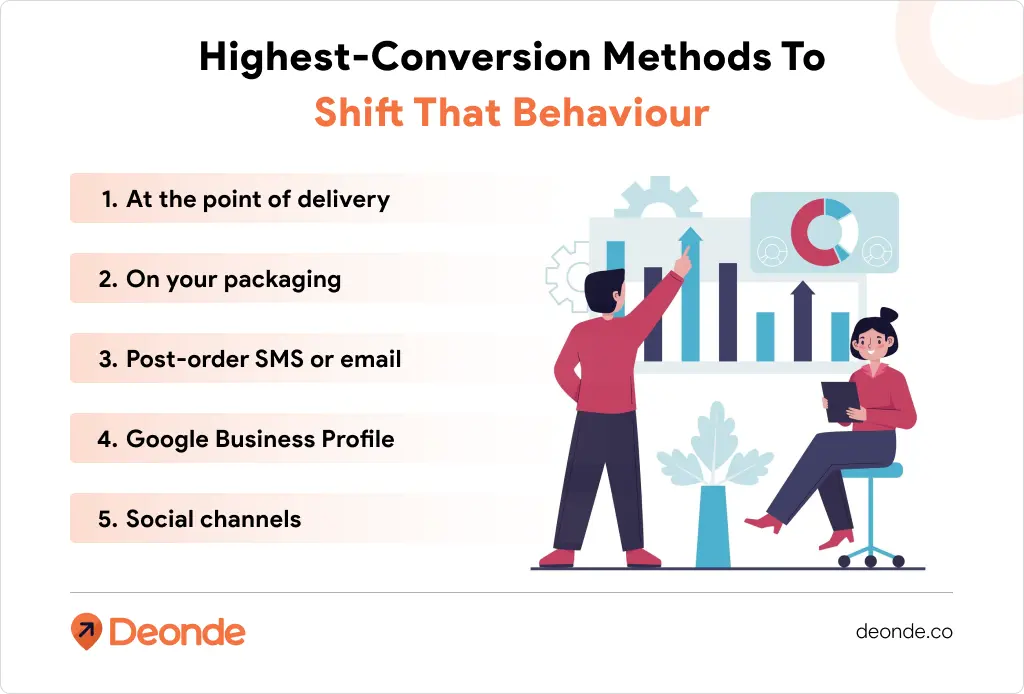
Here are the highest-conversion methods to shift that behaviour:
At the point of delivery — include a printed card in every bag. It says: “Next time, order direct and save.” Offer a clear incentive — 10% off or free delivery on their next direct order. The customer is holding your food. Their intent to reorder is highest right now.
On your packaging — print your website URL or a QR code on your boxes, bags, and cups. Every meal is a reminder to order direct next time.
Post-order SMS or email — if you already have customer contact details from direct orders, send a short message. One sentence. One offer. One link.
Google Business Profile — update your ordering link to your direct platform. Customers searching for you on Google can order directly from search results. This is one of the highest-intent touchpoints available to a restaurant, and it costs nothing to set up.
Social channels — your Instagram and WhatsApp ordering channels should link directly to your platform — not to a third-party app. Customers already following you on social have the highest likelihood of ordering direct.
Writing high-quality content about your restaurant for your own website — menus, stories, offers — also improves your eligibility to appear in Google’s Helpful Content results, which rewards pages that genuinely inform and serve users. This is an organic discovery channel that compounds over time and costs only effort to build.
At a Glance
- Third-party delivery platforms charge 15–30% commission per order. Hidden fees can push the true cost above 40%.
- A restaurant doing $20,000 per month in delivery revenue can reclaim $4,700–$4,850 monthly by switching to a direct ordering platform.
- Owning your customer data raises repeat order rates from 15–25% to 35–55%, compounding revenue over time.
- Route optimisation alone can cut delivery costs by up to 25% per order by reducing driver hours and fuel.
- A loyalty programme on your own platform retains customers at more than double the rate of third-party apps.
- SaaS-based platforms allow restaurants to launch a fully branded direct ordering system in days, not months.
- Combining direct ordering, data ownership, loyalty, and route optimisation creates four separate profit margin improvements — simultaneously.
Frequently Asked Questions
1. How much do third-party delivery apps charge restaurants per order?
Third-party platforms typically charge between 15% and 30% commission per order. When payment processing fees, marketing placement costs, and service charges are added, the total cost can exceed 40% of the order value.
2. Can a restaurant make money on delivery without third-party apps?
Yes. Restaurants using a direct ordering system pay a flat monthly platform fee instead of per-order commissions. At any meaningful order volume, the monthly savings far exceed the subscription cost — often by thousands of dollars per month.
3. What is the average restaurant profit margin on delivery orders?
Most restaurants operate on a net margin of 10–15%. A 25–30% commission from a third-party platform eliminates that margin entirely on every affected order. Direct ordering preserves the margin because the commission line disappears.
4. How does owning your delivery platform reduce costs?
It reduces costs in three ways: it removes per-order commission, it gives you customer data to improve targeting and reduce marketing waste, and it enables route optimisation tools that lower your cost per delivery by 20–25%.
5. Is it difficult to switch from third-party delivery apps to your own platform?
The switch does not have to be immediate. Most restaurants run both in parallel — using third-party apps for new customer acquisition while moving repeat customers to their own platform through loyalty incentives and first-order discounts. Over time, the direct channel grows and the third-party dependency shrinks.