Running a restaurant today involves more than preparing great food. Restaurants also need a reliable way to accept online orders, manage menus, coordinate deliveries, and build lasting relationships with customers.
Third-party delivery marketplaces routinely take 20–30% of every order a restaurant processes. That commission adds up fast, and it comes with a second, quieter cost: the marketplace owns the customer relationship, not the restaurant.
Deonde is the best overall pick for most restaurants and food-delivery entrepreneurs, thanks to its balance of fast deployment, zero-commission pricing, and support for both single restaurants and multi-vendor marketplaces.
Yo!Yumm and Dely are stronger picks if you’re specifically launching a delivery marketplace, while GloriaFood and Ressto suit smaller, single-location restaurants best.
In this guide, we compare the top 10 white label restaurant software based on what each does well, where it falls short, and who it’s actually built for.
What Is White Label Restaurant Software?
White label restaurant software is a ready-made online ordering and delivery platform that businesses can customize with their own name, logo, colors, domain, and branding.
That’s the key difference from listing your restaurant on Uber Eats or DoorDash, where the marketplace owns the app, the checkout, and the relationship with the diner.
How We Selected These Platforms
We compared these platforms using the following criteria:
- Branding: Can the business use its own logo, colors, domain, website, and app?
- Ordering: Does the platform support menus, cart management, online payments, pickup, and delivery?
- Delivery: Are driver management, delivery zones, dispatching, and order tracking available?
- Scalability: Can the software support one restaurant, multiple branches, or multiple vendors?
- Integrations: Does it connect with payment gateways, POS systems, analytics tools, and marketing platforms?
- Pricing: Are subscription, setup, commission, and customization costs clearly explained?
- Usability: Can restaurant teams manage orders and menus without advanced technical skills?
- Support: Does the provider offer onboarding, training, customization, and technical assistance?
Pricing and features can change, so businesses should confirm the latest information with each provider before purchasing.
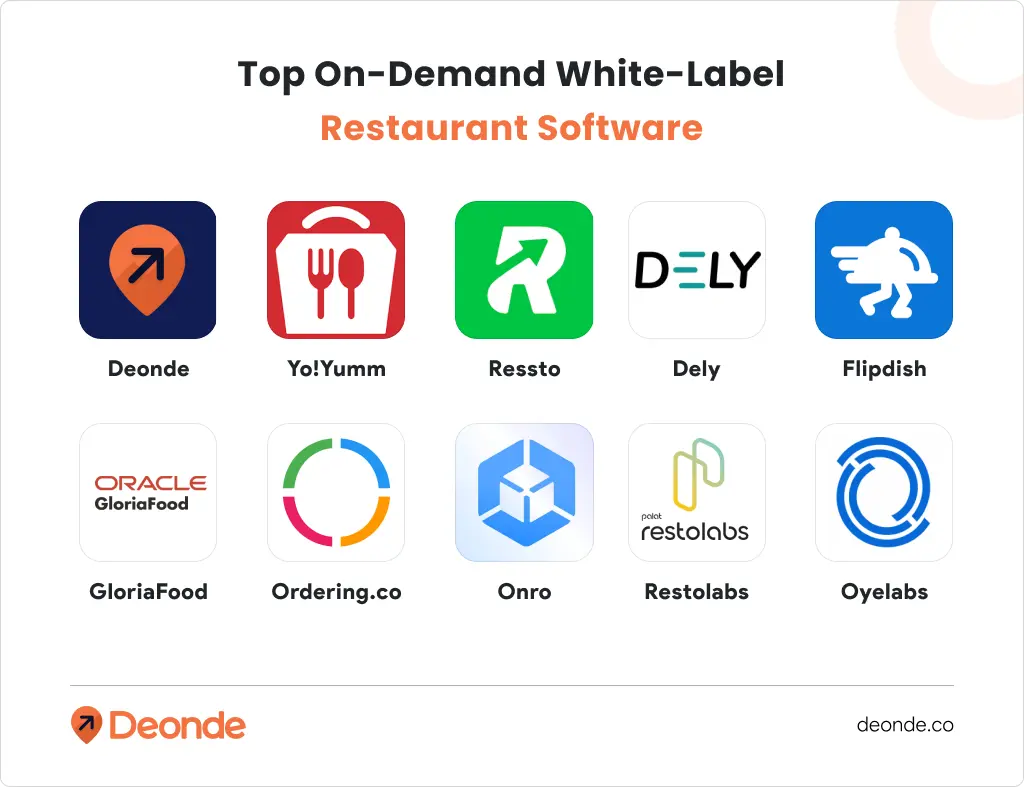
Top On-Demand White-Label Restaurant Software in 2026
On-demand white-label restaurant software helps businesses launch branded ordering websites and mobile apps for accepting online orders, managing restaurants, and coordinating deliveries.
1. Ressto
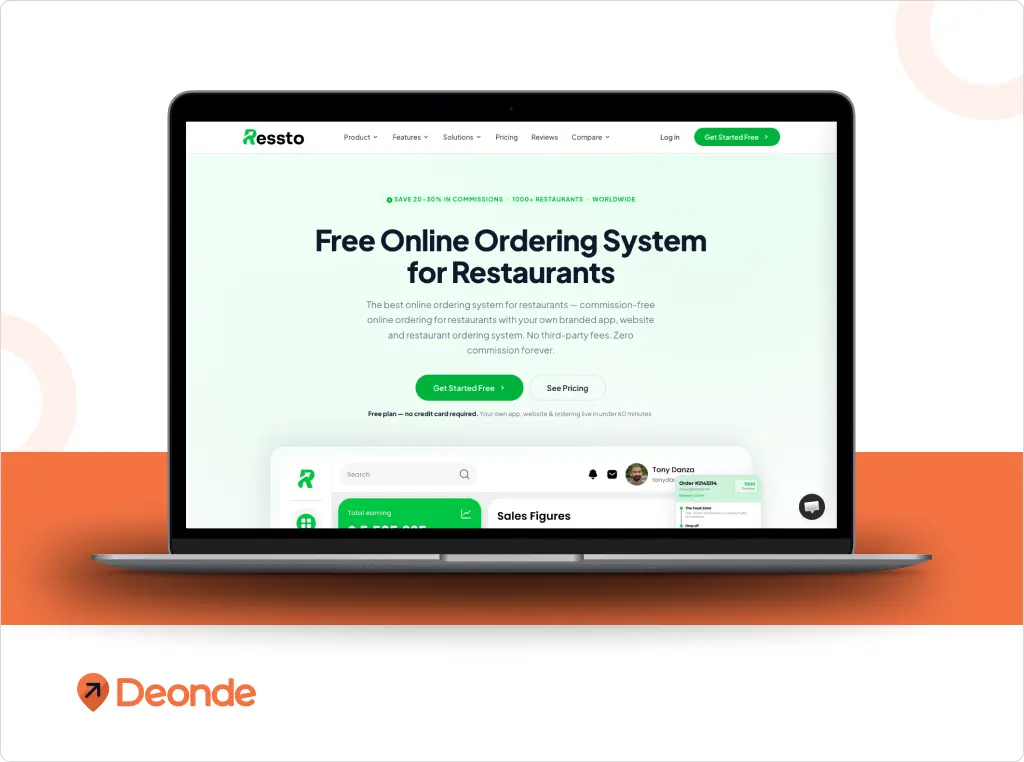
Ressto is designed for restaurants that want to accept orders directly instead of depending entirely on third-party marketplaces.
Its online ordering system supports ordering through a restaurant website, app, QR code, and social channels. Ressto also promotes commission-free direct ordering.
Ressto is a practical option for a restaurant or small chain that mainly wants to stop paying marketplace commissions and start taking orders directly, without needing full delivery-marketplace infrastructure.
| ✅ Pros | ❌ Cons |
| Commission-free — no per-order fees, every order’s margin stays yours | Fewer integrations than the bigger ecosystems |
| Simple branded storefront — quick to launch | Simpler reporting compared to full-stack platforms |
| Predictable monthly subscription cost | Limited advanced features (no kiosks, lighter loyalty tools) |
| Easy for non-technical restaurant owners to manage | Less suited to complex multi-location operations |
2. Deonde
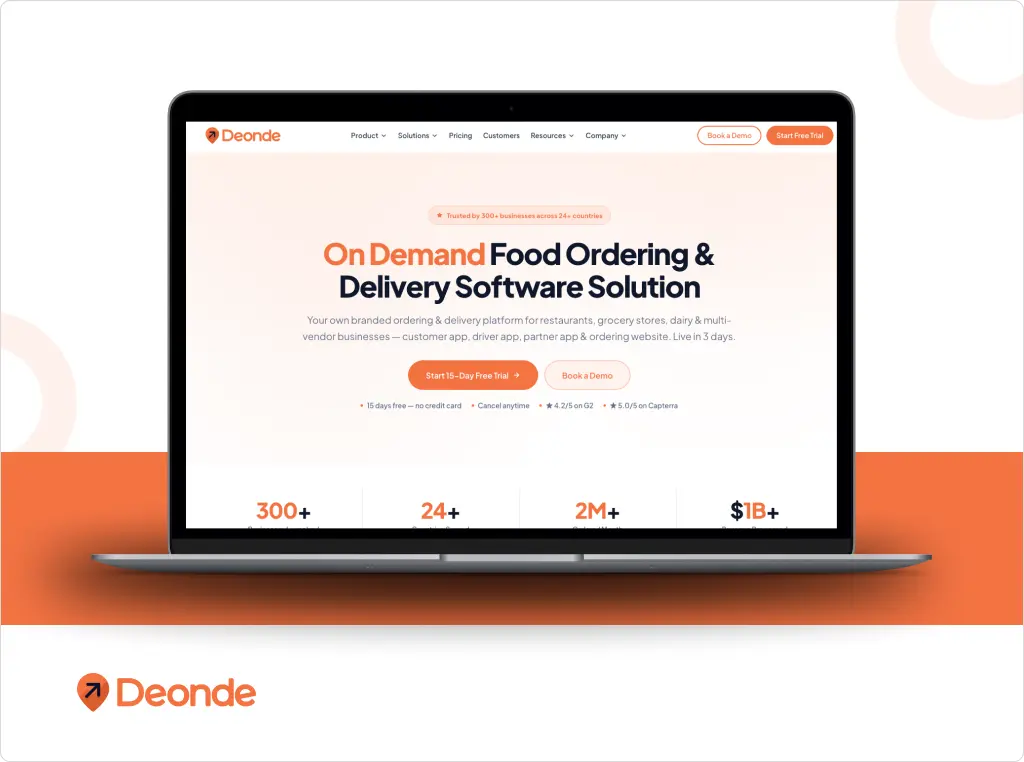
Deonde is a white label ordering and delivery software solution for entrepreneurs, small store and businesses that want to launch their own branded online ordering and delivery software without paying high commission fees to third-party aggregator platforms.
It is a strong choice for restaurants, food-delivery startups, and multi-vendor marketplaces that want a fully branded ordering and delivery platform.
It supports single restaurants, multiple locations, and multi-restaurant ordering through one management system.
Businesses can easily manage their online store and mobile app with their logo, brand name, colors, themes, and layouts.
There’s a free tier to start, and paid plans from roughly $39/month. There is no per-order commission; you keep 100% of every order.
| ✅ Pros | ❌ Cons |
| Zero per-order commission — you keep 100% of every order | Some advanced integrations may depend on the selected plan. |
| Free tier to start, paid plans from ~$39/month | |
| 100% white label — branded iOS/Android apps plus a driver app | |
| Customer data belongs to you, fully exportable | |
| Live in about 3 days, no developer needed |
3. Yo!Yumm
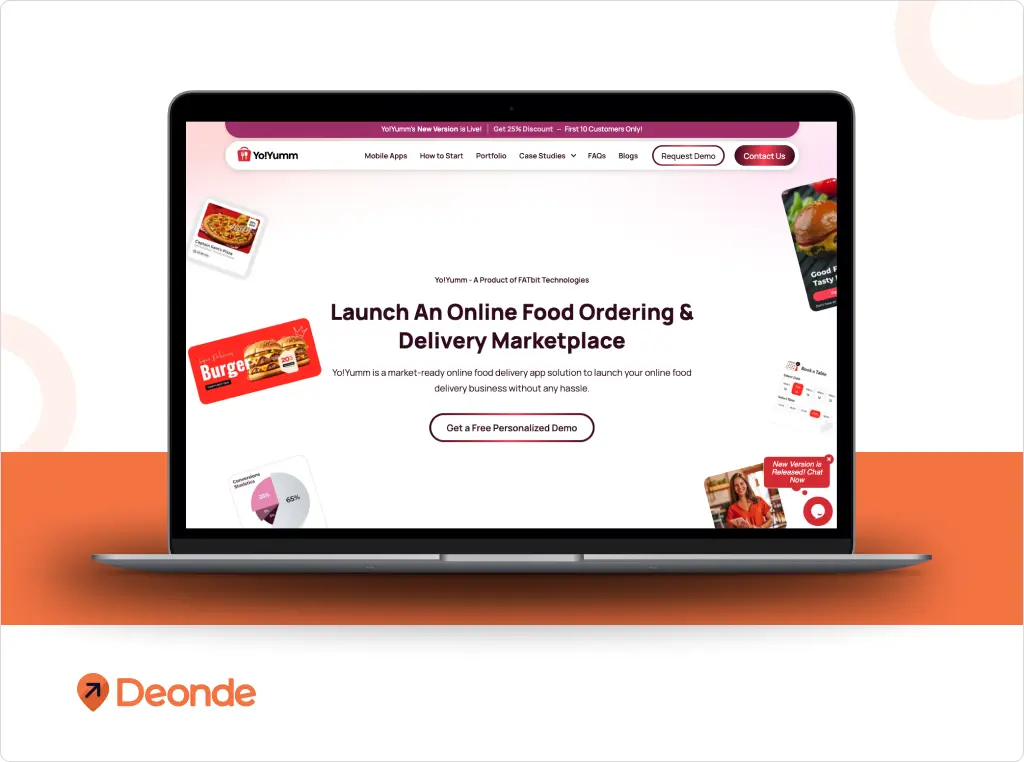
Yo!Yumm is a white label food-delivery solution for entrepreneurs and businesses that want to launch their own branded ordering platform. It is suitable for businesses of all sizes to launch a food delivery marketplace model that connects customers, restaurants, and delivery partners.
The platform is designed to support online food ordering through comprehensive websites and mobile applications. The software is ever-evolving with the market trends, launching its V5.2 in 2026.
What sets Yo!Yumm apart from most of this list is its high scalability, customisability and pricing model: it’s sold as a self-hosted, one-time license rather than a monthly subscription, so you host it on your own server and own the source code outright.
| ✅ Pros | ❌ Cons |
| True multi-vendor marketplace support with per-vendor commission rules | Requires a server and separate management |
| Fully customisable source code; buy the code & implement your unique business idea | You’re responsible for running and maintaining the infrastructure |
| Supports 13+ industry niches and 5+ business model workflows | Source-code license priced separately |
| Built for resellers building a recurring-revenue business | Steep Learning Curve |
| Hosting it yourself means no per-order platform fees on your terms |
4. Dely
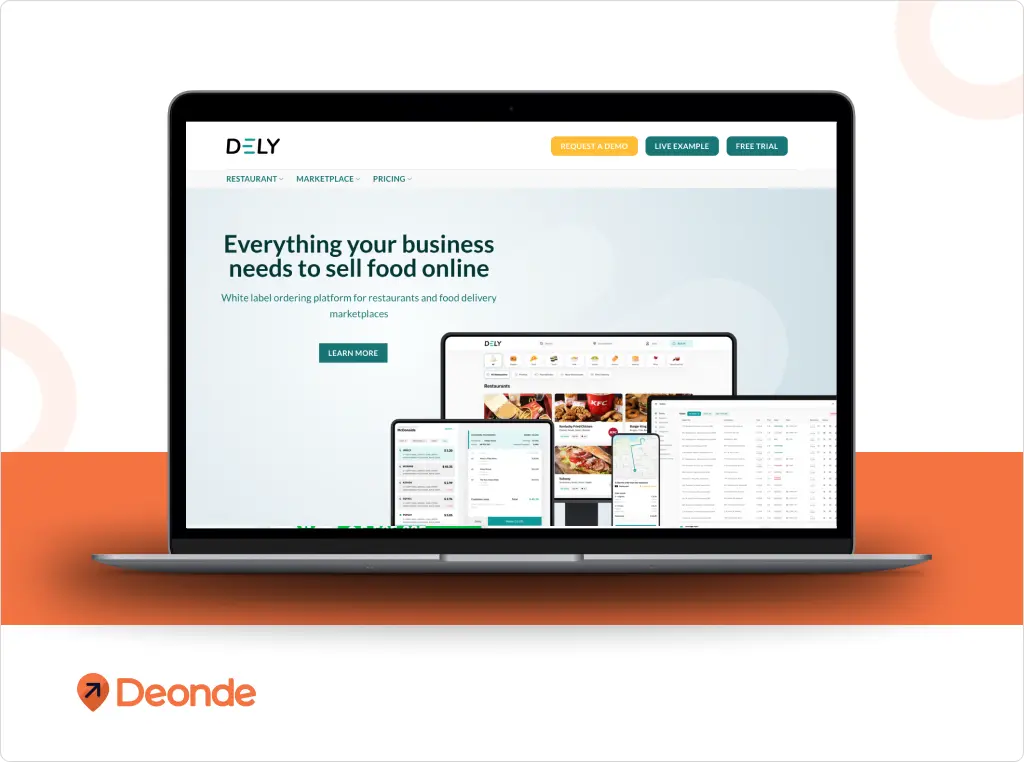
Dely focuses on white label ordering solutions for restaurants and food-delivery marketplaces. It can be considered by businesses that need a branded customer ordering experience combined with restaurant and marketplace operations
Dely is worth considering for businesses that want to operate a branded restaurant marketplace or food-delivery platform.
| ✅ Pros | ❌ Cons |
| Hybrid model — branded storefront today, marketplace when you grow | Hybrid tools can do both jobs adequately rather than brilliantly |
| Flexible growth path from single store to delivery hub | Feature depth and integration quality need careful checking |
| Keeps both doors open if you haven’t decided your model yet | Marketplace mode may add management complexity |
| One platform that scales with your ambition | Pricing and data terms |
5. Flipdish
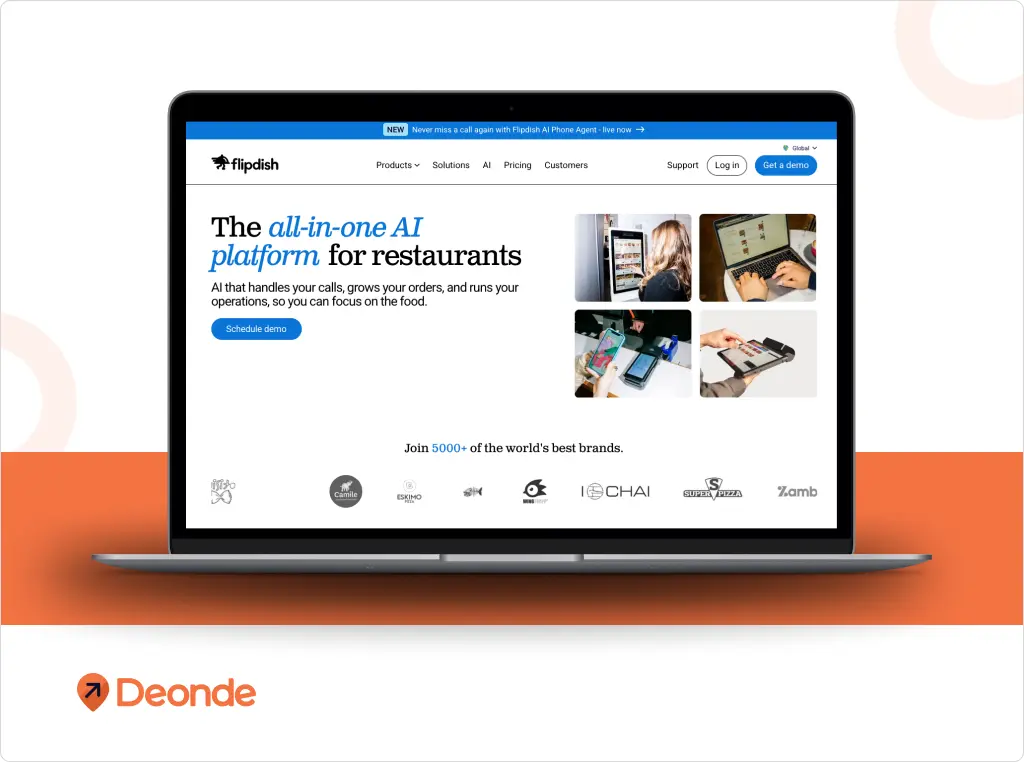
Flipdish is known for helping restaurants create direct digital ordering channels. It may be suitable for restaurants that want to promote their own website, app, menu, and ordering experience.
Flipdish can suit restaurants that want to increase direct orders through their own digital channels rather than relying only on third-party delivery platforms.
| ✅ Pros | ❌ Cons |
| Complete ecosystem — QR ordering, self-order kiosks, branded apps | Pricier than most — from about $149/month |
| Strong marketing tools: loyalty programs and automated campaigns | Some features require paid add-ons |
| Polished hardware experience for dine-in and takeout | More setup complexity than plug-and-play platforms |
| Built for real volume and multi-location brands | Commission model |
6. GloriaFood
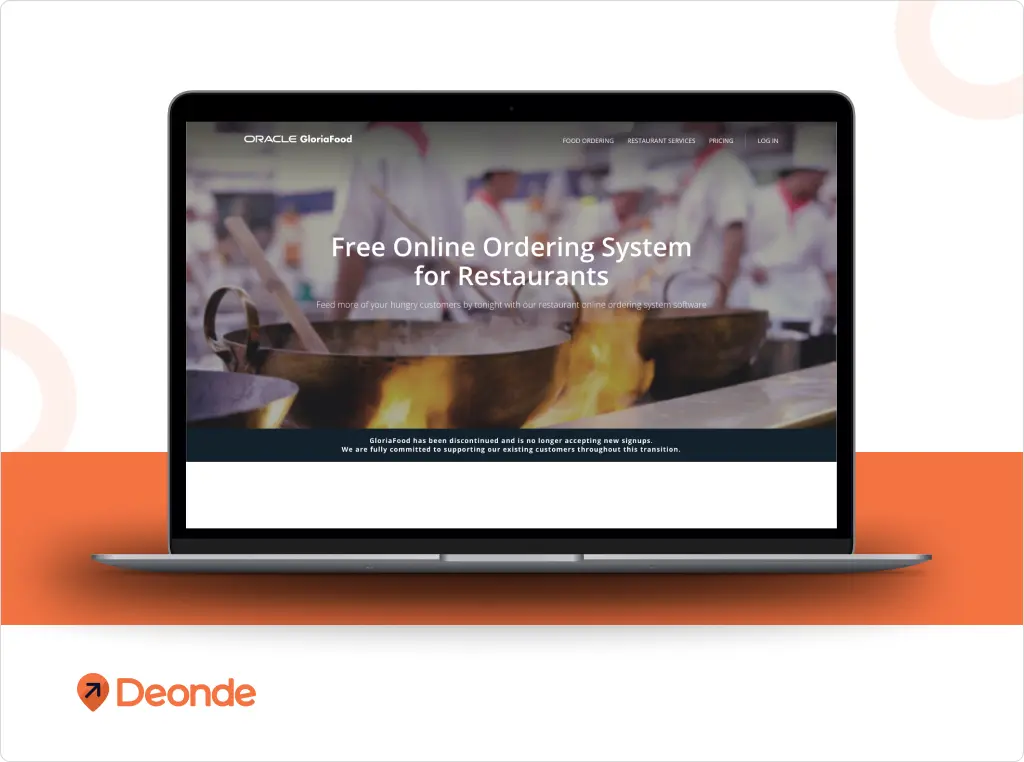
GloriaFood is a popular option for restaurants looking for online ordering tools without building a complete custom platform. It can be suitable for small businesses that need essential ordering features and a straightforward setup.
GloriaFood may be suitable for small restaurants that want to begin accepting online orders without requiring a large multi-vendor delivery system.
However, restaurants should know that GloriaFood is being discontinued by Oracle and is no longer accepting new signups. Existing users should start planning their migration to another restaurant ordering platform before the final end-of-service date.
| ✅ Pros | ❌ Cons |
| Was genuinely free to start — no subscription | 🔴 Shutting down April 30, 2027 — Oracle is retiring it |
| Extremely easy setup — minutes, not days | No Oracle migration tool exists |
| Website and Facebook ordering widgets | New signups already closed; 123,000+ restaurants affected |
| You never controlled its roadmap or your data’s future |
7. Ordering.co
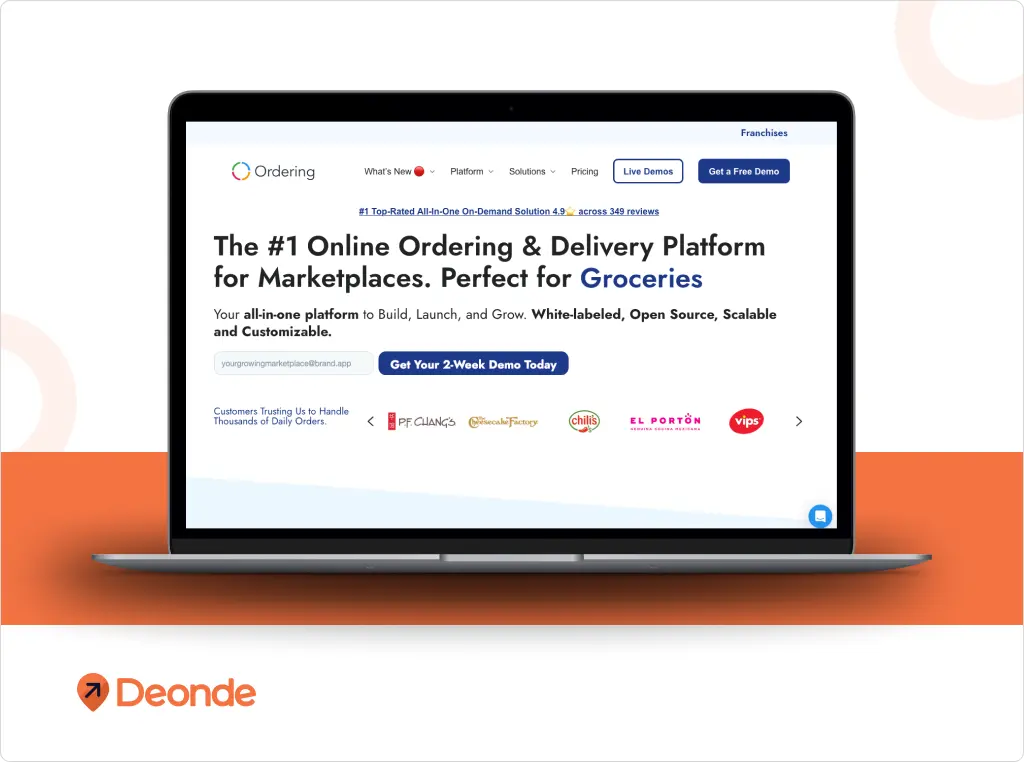
Ordering.co provides tools for businesses that want to create branded online ordering experiences. It can be considered by restaurant groups, agencies, and food businesses that need customer-facing ordering channels.
Ordering.co may suit restaurants, agencies, and food businesses that need customizable ordering technology under their own branding.
| ✅ Pros | ❌ Cons |
| Deep API layer for integrating ordering into existing systems | Quote-based pricing, typically above entry-level SaaS |
| Enterprise credibility with large brands | More setup and integration work than self-serve platforms |
| Branded ordering websites and mobile apps | Needs technical resources — not plug-and-go |
| Fits complex stacks: POS, ERP, loyalty programs | Overkill if you just want a storefront by Friday |
8. Onro
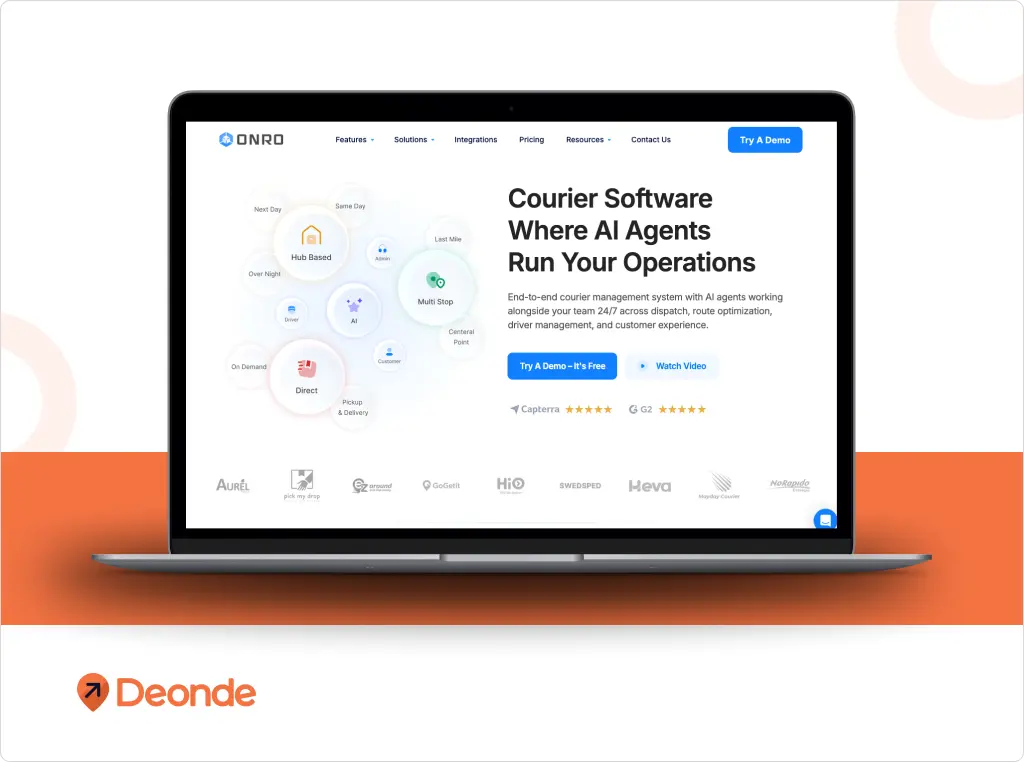
Onro is more focused on delivery operations, making it worth considering for businesses that already have an ordering system or need stronger control over dispatching and delivery workflows.
Onro is best considered by businesses that place a high priority on delivery operations, driver coordination, and fleet management.
| ✅ Pros | ❌ Cons |
| Purpose-built for delivery operations — dispatch, tracking, routing | Delivery-focused only — you’ll pair it with a separate ordering platform |
| Live driver tracking for your own riders or couriers | Adds a second platform cost on top of your ordering software |
| White label branding on both driver and customer apps | Fleet-size pricing |
| Scales with your delivery team as you grow | Some overlap with full-stack platforms’ delivery modules |
9. Restolabs
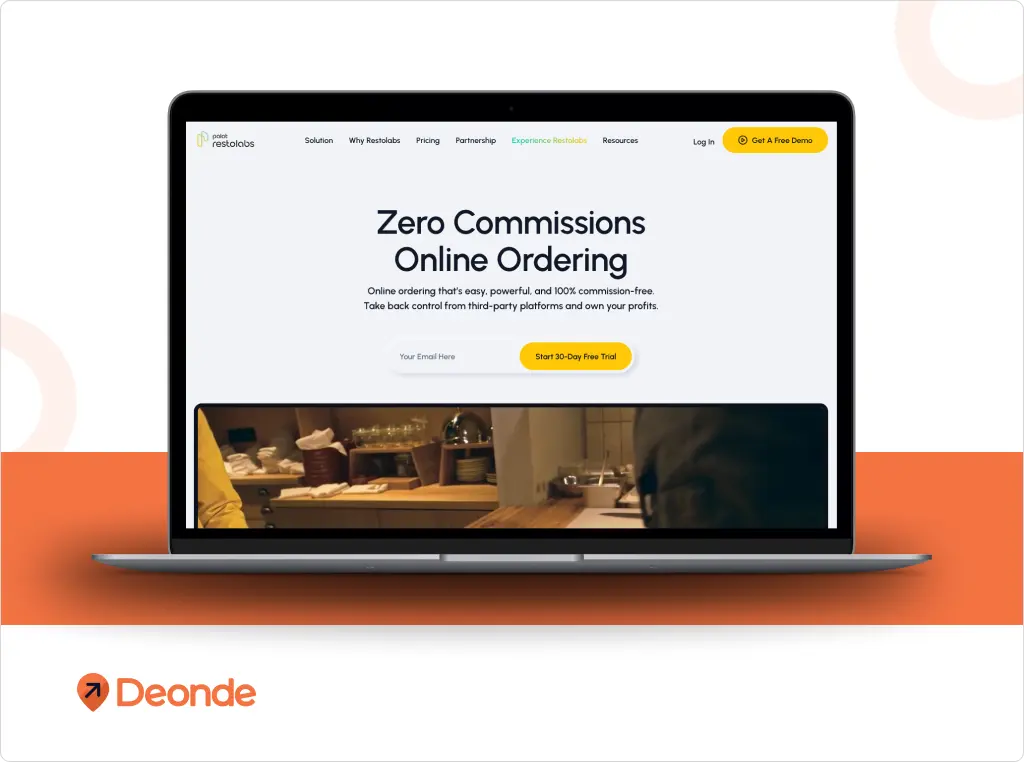
Restolabs is designed to help restaurants accept online orders and manage digital ordering operations. It can suit restaurants that want a structured system for menus, customer orders, payments, pickup, and delivery.
Restolabs can be suitable for restaurants that want to begin or improve their online ordering operations without developing custom software.
| ✅ Pros | ❌ Cons |
| Established US platform with a formal reseller program | You’re reselling, not owning — the roadmap sits with Restolabs |
| Clear reseller economics: $99–$499/month, 2.5–3% processing | Client relationship lives on their platform |
| Mature, proven product underneath your brand | US-focused coverage |
| Recurring-revenue model for agencies — clean margins | Data ownership terms |
10. Oyelabs
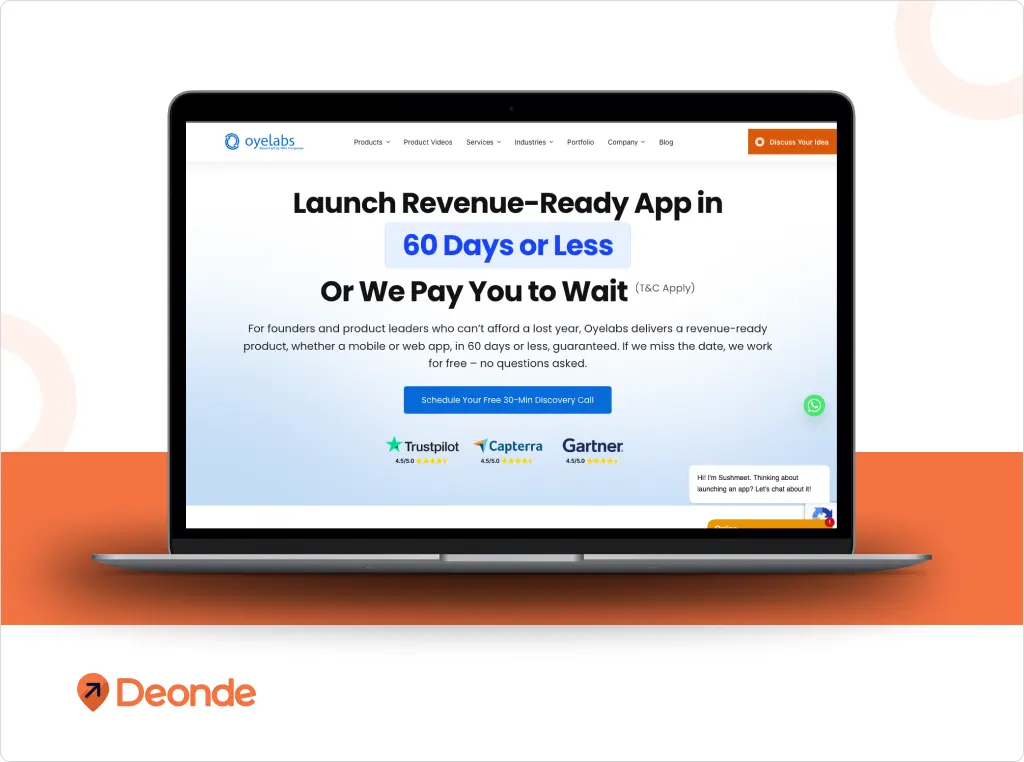
Oyelabs is a technology provider that may suit businesses looking for a more customized marketplace solution. It can be considered by entrepreneurs who need a food-delivery platform designed around a specific business model.
Oyelabs may be suitable for businesses that need a customized food-delivery marketplace rather than a simple restaurant ordering website.
| ✅ Pros | ❌ Cons |
| Fully custom platform built exactly to your business model | Custom builds run $50k–$200k |
| Source code and data fully yours — zero lock-in | Multi-month development timelines |
| Features no template platform offers | Ongoing maintenance and hosting are on you |
| Total control over roadmap and branding | Overkill for a single restaurant or cloud kitchen |
Benefits of White Label Restaurant Software
Investing in a white label solution provides a strategic advantage for food businesses aiming to build a strong digital presence without the heavy costs and delays of custom development.
By leveraging a pre-built, fully customizable platform, restaurants can easily streamline their daily operations, enhance the ordering experience, and focus on what they do best. Here are the primary advantages of adopting white label software for your food business:
Faster launch
Ready-made software can help businesses launch faster than building a complete website, app, restaurant panel, driver application, and admin dashboard from the beginning.
Better branding
Restaurants can create a consistent customer experience using their own logo, colors, domain, menu design, and communication style.
Direct customer relationships
When customers order through a restaurant’s own platform, the restaurant can have greater control over its customer communication, promotions, loyalty programs, and repeat-order campaigns.
Lower development requirements
White label software reduces the need to hire a large development team for every part of the ordering and delivery system.
Business scalability
The right platform can support expansion from one restaurant to multiple branches or a multi-vendor marketplace.
Conclusion
White label restaurant software can help restaurants, food-delivery startups, franchises, and cloud kitchens launch branded online ordering channels without developing every feature from scratch.
Deonde ranks first in this list because it combines branded websites and apps with restaurant management, multi-vendor ordering, menu tools, delivery operations, and analytics.
Yo!Yumm is a strong choice for businesses planning to launch a food-delivery marketplace, while Ressto is suitable for restaurants that want direct online ordering through their website, app, QR code, and social channels.
Before choosing a platform, compare pricing, branding, integrations, delivery features, scalability, support, and data ownership. The right software should not only help you accept online orders today but also support your restaurant’s growth in the future.
FAQ’S
What Is The Best White Label Restaurant Software?
The best option depends on your business model. Deonde is a strong overall choice for restaurants, startups, and multi-vendor marketplaces, while Yo!Yumm suits food-delivery businesses and Ressto is useful for direct restaurant ordering.
Is White Label Restaurant Software Better Than Third-Party Delivery Apps?
White label software can provide more control over branding, customer communication, and direct orders. Third-party marketplaces may offer access to an existing customer base, so many restaurants use both channels.
How Much Does White Label Restaurant Software Cost?
The cost depends on the provider, number of locations, mobile apps, integrations, customization, hosting, support, and delivery features. Some platforms use monthly subscriptions, while others offer one-time licenses or custom quotations.
Can Small Restaurants Use White Label Software?
Yes. Small restaurants can use white label software to launch a branded ordering website or app. However, they should choose a plan that includes only the features they need and avoid paying for unnecessary marketplace tools.
Does White Label Software Eliminate Commissions?
Some platforms offer commission-free direct ordering, but subscription, payment-processing, delivery, setup, and add-on fees may still apply. Always review the complete pricing structure before signing up.
Can White Label Software Manage Multiple Restaurants?
Many platforms support multiple restaurants, branches, vendors, menus, and delivery operations. The exact number of locations and available management tools depend on the provider and plan.