Every month, Brazilians place more than 180 million orders through the iFood platform, which now connects roughly 65 million consumers with over 500,000 partner businesses across more than 2,000 cities.
Having turned 15 years old this year, iFood recently announced a R$24 billion investment plan for Brazil for the fiscal year running from April 2026 to March 2027, a 41% increase over the prior cycle’s R$17 billion.
Pulling the regional breakdown, iFood isn’t just a São Paulo or Rio phenomenon; interest runs nearly as high in states like Roraima, Acre, and Amapá, thousands of kilometers from its Osasco headquarters.
What started as a restaurant-ordering app has become something closer to Brazilian commerce infrastructure: groceries, pharmacies, pet shops, and financial services all run through the same platform now.
That shift is also where most of the interesting money questions live. Here’s how the model actually works: who it connects, how it earns from each side, and where the revenue is really coming from in 2026.
Who Owns iFood and Is It Really a Brazilian Company?
Yes, and also, not exactly. iFood was founded, is headquartered, is staffed, and is run day-to-day in Brazil, and its marketing leans hard into that identity. But the capital behind it is thoroughly international.
Brazilian tech holding company Movile started investing in iFood in 2013 and took majority control in 2014.
From there, South African-listed Naspers and its Amsterdam-listed arm, Prosus, poured in capital for years, while European rival Just Eat Takeaway.com held a separate 33% stake. That co-ownership ended in August 2022, when Prosus paid roughly $1.9 billion to buy out Just Eat Takeaway’s stake and take full control.
The relationship now runs the other way, too. Fabrício Bloisi, the Brazilian entrepreneur who ran Movile and then iFood for years, is today the global CEO of Prosus itself, iFood’s ultimate parent.
When Prosus bought Just Eat Takeaway.com outright for €4.1 billion in early 2025, it installed another Brazilian, former iFood executive Roberto Gandolfo, as that European company’s CEO.
So while a foreign investment group owns iFood on paper, Brazilian operators are now running a meaningful chunk of its global food-delivery empire.
iFood used to operate well beyond Brazil, with businesses in Colombia, Argentina and Mexico. Between 2018 and 2022, those were folded into Delivery Hero-owned rivals PedidosYa and Domicilios.com, or shut down outright.
Today iFood operates exclusively in Brazil, a deliberate single-market focus that’s central to how concentrated (and profitable) its business model has become.
The iFood Business Model, Explained Simply
iFood’s business model is a three-sided marketplace. It connects hungry customers, restaurants that cook, and drivers who deliver, then takes a slice from every transaction between them.
Restaurants get customers without building an app, drivers get flexible work, customers get food in one tap, and iFood sits in the middle collecting the toll.
How the Three Sides Feed Each Other
It’s a simple loop: more restaurants → more choice → more customers → more orders → more drivers → faster delivery → even more customers. Each new restaurant or driver makes the app more valuable to everyone else.
That’s a network effect, and it’s the real moat behind iFood’s 83% market share, not the app design.
Why It Beats the Alternative
A single restaurant can take orders through its own website for zero commission. But it misses iFood’s 60 million customers.
That trade-off is exactly what the model monetizes iFood sells access to demand at 12–30% per order. Restaurants pay for the crowd, drivers pay nothing to join and earn per trip, and iFood earns on both sides of every order.
The Flywheel, in Numbers
- 500K+ restaurants supply the choice
- 360K+ drivers supply the speed
- 60M customers supply the demand
Each side makes the other two more valuable. Break any one leg, and the whole model slows down, which is why iFood defends all three aggressively.
How iFood Makes Money: The 6 Revenue Streams
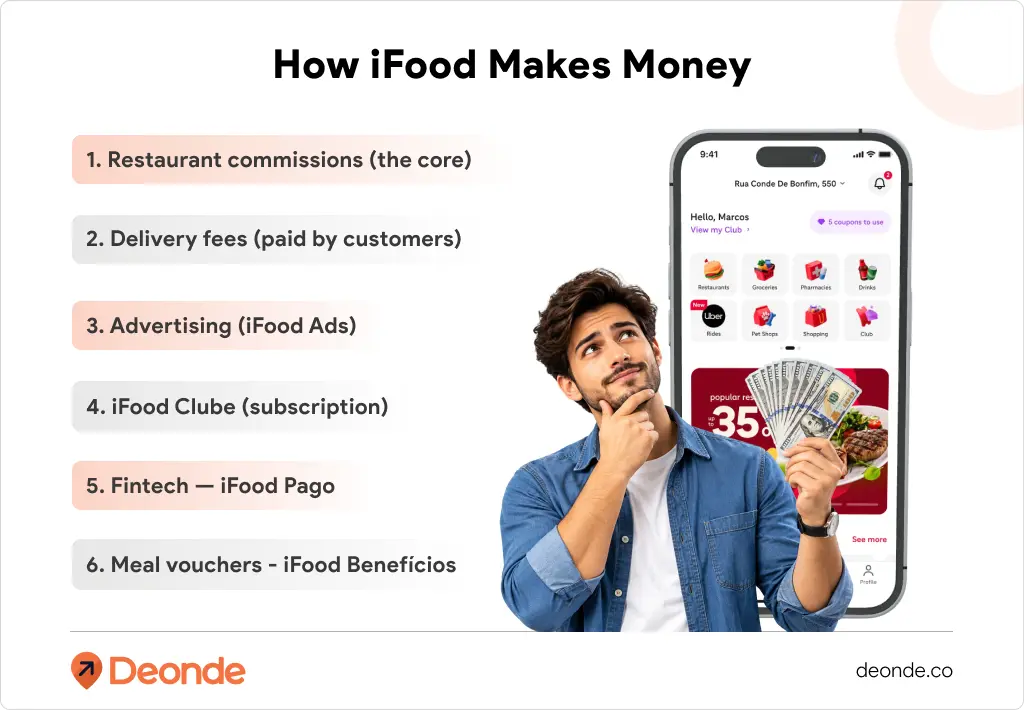
iFood earns from six places: restaurant commissions, customer delivery fees, restaurant ads, the iFood Clube subscription, financial services through iFood Pago, and B2B meal vouchers.
Commission is the base layer; the other five turn one delivery into multiple paychecks.
These sit on top of the standard food delivery business models (aggregator, full-service, integrated), but stacked in a way no competitor copies well.
1. Restaurant Commissions (The Core)
Every order through iFood takes a cut of 12% to 30%, depending on the service tier. At R$140B annual GMV, this alone funds the machine.
2. Delivery Fees (Paid by Customers)
Full-service deliveries carry a per-order fee from the customer. That fee plus the commission funds driver payouts.
3. Advertising (iFood Ads)
Restaurants bid for sponsored placement and banners. Ads run at 70–80% gross margin and are still under-monetized compared to platforms like Meituan (Alyson Lab, 2026).
4. iFood Clube (Subscription)
A paid membership with delivery perks. Members show 75% higher 12-month retention.
5. Fintech — iFood Pago
Digital accounts, credit and payment machines for restaurants and customers. iFood Pago hit EBITDA breakeven in September 2025.
6. Meal Vouchers — iFood Benefícios
Companies load employee cards; iFood earns fees from corporate clients and the 400K+ establishments that accept them.
Is iFood Profitable?
Yes, the core business is. iFood’s restaurant delivery business turned profitable, and the group reported US$226M adjusted EBIT in FY2025, up 178%.
Founder Fabricio Bloisi long chose growth first: “If you pursue profitability too fast, it can kill the business”. The fintech arm only just stopped losing money; the marketplace pays the bills while the rest scales.
How Much Commission Does iFood Charge Restaurants?
iFood charges restaurants 12–30% per order. Self-delivery restaurants (iFood Basic) pay about 12% plus a flat monthly fee. Full iFood Delivery service runs about 27% plus a higher monthly fee. Most current analyses put the blended average at 25–27%, among the highest commission rates globally.
The Two Service Tiers
| Tier | Commission | Monthly fee | Delivery |
| iFood Basic | ~12% | ~$100/mo | Restaurant’s own driver |
| iFood Delivery | ~27% | ~$130/mo | iFood handles it all |
What Restaurants Actually Pay Today
- Typical range: 12–30% depending on tier and contract.
- Current blended average: ~25–27% of gross order value.
- ABRASEL found iFood orders cost consumers 17.5% more than ordering directly from the restaurant
Pro-Tip: Don’t stop at the headline rate. Your effective commission = commission % + monthly fees + promo discounts + ad spend.
A restaurant doing 800 orders/month at 27% with R$400 in fees pays far more than the sticker suggests.
Run this math before signing or compare it against a multi-vendor marketplace commission structure you control yourself.
How Much Do iFood Drivers Really Earn?
iFood publishes no fixed driver pay; drivers earn per delivery, and the amount depends on city, distance, and demand.
The money comes from customer delivery fees plus iFood’s commission. Because courier costs swallow most of that, iFood keeps only about 12–15% net per order after driver payouts.
Where the Driver’s Money Comes From
- Full-service orders: the customer’s delivery fee funds the driver’s payout
- Self-delivery orders: the restaurant’s own driver delivers — iFood just takes its 12%
- Drivers are independent partners (entregadores parceiros) — 360,000+ of them across Brazil.
Why Delivery Margins Stay Thin
A 27% gross commission shrinks to 12–15% net once courier costs and promotions are paid. That’s the honest math behind “delivery apps lose money” headlines and why iFood pushes ads, Clube, and fintech so hard.
Expert Advice: If you’re modeling driver costs for your own platform, budget delivery fees first and treat commission as net income only after courier payouts. Underprice delivery to win market share, and you bleed on every order.
iFood Clube: The Subscription That Boosts Retention
iFood Clube is a monthly subscription feature within its food delivery software, giving members delivery perks like free delivery on eligible orders. It works because members order more often.
Clube users show 75% higher 12-month retention, and iFood targets roughly 40% member penetration.
How Clube Makes Money
Members pay every month whether they order or not predictable recurring revenue on top of variable order income.
Higher retention also means iFood spends less on re-winning lapsed customers, which is exactly why subscription mechanics spread from Netflix into delivery apps.
iFood Pago: Inside the Fintech Flywheel
iFood Pago is iFood’s financial arm: digital accounts for customers and restaurants, receivables anticipation (getting paid early), loans, the Maquinona card machine, and meal vouchers through iFood Benefícios.
It monetizes payment flows iFood already owns. In July 2026, iFood raised R$600M for its lending arm.
Accounts, Credit & the Maquinona
Restaurants that take payments through iFood build a transaction history. iFood Pago uses that data to approve credit that traditional banks won’t, including working capital loans discounted against future order revenue.
The Maquinona machine locks payments into the same ecosystem.
Meal Vouchers (iFood Benefícios)
Brazilian companies give employees meal cards; iFood earns fees from the corporate client and from the 400K+ establishments accepting them. Same network, second toll booth.
Beyond Food: Groceries, Pharmacy & iFood Shopping
iFood sells groceries, pharmacy items, drinks, pet supplies, and electronics. It bought SiteMercado in 2021 to power grocery e-commerce. These verticals plus fintech and benefits now make up 40% of total revenue.
The grocery play (1P + 3P)
iFood both sells its own stock (1P) and lists third-party stores (3P), the same dual model Amazon uses. Grocery orders ride the same driver network, raising utilization per delivery.
Why Adjacent Verticals Matter
Customers order food roughly twice a week, far more often than any e-commerce app. Every pharmacy refill or pet-food run rides that same habit. More baskets per user, same fixed network: that’s where the margin hides.
How Big Is iFood, Really?
Prosus’s last disclosed full-year revenue figure specifically for iFood was R$7.1 billion for fiscal 2023 and both revenue and GMV have been compounding at 25–30%+ a year since. Put together, the scale is hard to overstate for a company operating in a single country:
| Metric | Figure |
| Monthly orders | 180+ million (Sept. 2026) |
| Active consumers | ~65 million |
| Restaurants & merchants | 500,000+ |
| Delivery couriers | 600,000+ |
| Cities covered | 2,000+ (Brazil only) |
| Monthly GMV | R$10+ billion (late-2025 estimate) |
| FY2025 GMV growth | +32% year over year |
| FY2025 adjusted EBIT | US$226 million (+178% YoY) |
| Planned investment, FY2026–27 | R$24 billion (+41% vs. prior cycle) |
| Share of Brazil’s GDP, 2024 (FIPE study) | 0.64% |
Growth has cooled slightly from that pace — GMV growth slowed to around 15% in the first half of fiscal 2026, and that slowdown lines up almost exactly with when two well-funded new rivals showed up.
iFood vs Rappi vs Uber Eats: The Brazilian Market Battle
iFood holds 80–83% of Brazil’s food delivery market. Rappi is the main rival left standing, and Uber Eats quit Brazil in 2022. iFood won on restaurant density, driver networks, and acquisitions, not just app features.
| iFood | Rappi | Uber Eats | |
| Brazil status | Dominant (80–83% share) | Main competitor | Exited 2022 |
| Model | Marketplace + delivery + fintech | Super-app (delivery, errands, RappiPay) | Exit — “no point if you can’t be #1” |
| Revenue streams | Commission, fees, ads, Clube, Pago | Commission, ads, fintech | — |
| Fintech | iFood Pago, credit, vouchers | Rappi Pay | — |
For the full landscape, see the top food delivery apps in Brazil.
Why Uber Eats Left Brazil
Uber CEO Dara Khosrowshahi put it bluntly: “There is no point staying in a market if you cannot be the leader”. With iFood already past 80% share, third place couldn’t pay for itself. Rappi survived by going into super-app deliveries, errands, and payments, not by fighting iFood head-on.
The Monopoly Question: CADE & the 17.5% Price Gap
Brazil’s antitrust court, CADE, has proceedings against iFood over past exclusivity practices with restaurant chains (used roughly 2018–2023).
ABRASEL found iFood orders average 17.5% pricier than ordering direct. That monopoly power is exactly what lets iFood hold high commissions and the opening for alternatives.
The Exclusivity Era
Between 2018 and 2023, iFood pushed exclusive deals on major chains — locking restaurants out of rival platforms. CADE’s review flagged the practice. Exclusivity is how platform leaders defend network effects once they’re ahead.
What the Price Gap Means for Restaurants
When every order costs consumers 17.5% more than going direct (ABRASEL), restaurants carry the blame while iFood collects the commission.
Every month, a 25–27% margin is handed over. The smartest operators keep iFood and build a direct channel they own so the commission becomes optional, not mandatory.
What the iFood Business Model Teaches Entrepreneurs
Three lessons from the iFood business model: charge commission on every transaction, own the restaurant-and-driver network, then add subscriptions and fintech to keep users locked in. You don’t need iFood’s scale; any city-level marketplace can run the same three layers.
The Three Lessons
- Commission funds everything. Set a rate restaurants will accept (iFood’s 25–27% is deliberately high; undercut it and you win sign-ups fast)
- Density beats features. iFood won Brazil with restaurant count and driver supply, not app polish
- Fintech and subscriptions lock the loop. One transaction becomes commission + delivery fee + ad + subscription + credit
How to Build an iFood-Like Platform
Understanding the iFood business model is only the first step. For entrepreneurs, the bigger opportunity is using the same marketplace structure to launch a food delivery platform for a specific city, region, or country.
An iFood clone is essentially a white-label food delivery marketplace inspired by the core functionality of platforms like iFood.
Instead of building every component from scratch, businesses can launch a branded platform using scalable food delivery software to connect customers, restaurants, and delivery partners.
A complete iFood-like platform typically includes four key components:
- Customer app: Restaurant discovery, menu browsing, ordering, payments, promotions, and real-time order tracking.
- Driver app: Order assignments, GPS navigation, delivery status, and earnings management.
- Restaurant panel: Menu management, order processing, operating hours, promotions, and sales tracking.
- Admin dashboard: Restaurant and driver management, commissions, payouts, analytics, promotions, and marketplace operations.
The business model can then be adapted to the local market. For example, platform owners can set restaurant commission rates, configure delivery fees, manage driver payouts, introduce promotional campaigns, and build additional revenue streams around their marketplace.
For businesses targeting Brazil, localization is also important. Portuguese language support, Brazilian Real (BRL), suitable payment integrations, and a delivery workflow designed around local operations can reduce the friction of launching an iFood-like marketplace.
Deonde’s iFood Clone platform, for example, is designed around these requirements and includes customer, driver, restaurant, and admin applications with a built-in commission engine.
Conclusion
The iFood business model proves how a food delivery marketplace can generate revenue through commissions, delivery fees, advertising, subscriptions, and fintech while building a strong network of customers, restaurants, and drivers.
For entrepreneurs, the opportunity is to adapt this model to their own market. With an iFood clone, businesses can launch their own branded food delivery platform and build the foundation for a scalable marketplace.
Disclaimer: iFood is a trademark of its respective owner. Deonde is an independent software provider and is not affiliated with, endorsed by, or connected to iFood. This article is for educational, informational, and technical reference purposes only.