Drizly was the largest alcohol marketplace in North America. Then Uber shut it down in March 2024.
That closure did not kill the alcohol delivery market. It opened a massive gap. Nearly half a billion dollars in online alcohol sales went looking for a new home overnight. Minibar, GoPuff, Instacart, and Uber Eats rushed to fill the space — but no single platform has dominated since.
If you have been thinking about alcohol delivery app development, this is the moment. The global alcohol delivery market is projected to exceed $30 billion by 2032, growing at a compound annual rate of 9.45%. Consumer habits formed during the pandemic have not reversed. People want beer, wine, and spirits at their door — and they want it fast.
This guide covers everything: how the market works, what features your app needs, compliance requirements, cost ranges, and the fastest path to launch.
Why the Alcohol Delivery Market Is Open for New Players
The alcohol ecommerce space is fragmented right now. Drizly’s exit left no single dominant platform in most markets outside the US. That creates real opportunity for regional operators, liquor retailers, and delivery startups to build their own branded on-demand alcohol delivery app.
Market conditions also favour new entrants. Many US states and countries have relaxed delivery regulations since 2020. Mobile commerce now accounts for over 60% of global ecommerce transactions. And consumers — especially millennials — overwhelmingly prefer app-based purchasing over in-store visits.
Approximately 70% of online alcohol orders are placed through mobile apps, according to industry research. That share has only grown since Drizly closed.
Choose Your Business Model First
Before a single line of code is written, you need to decide how your alcohol delivery business actually works. The model you choose shapes your feature set, licensing requirements, and revenue structure.
Single-store model: One liquor retailer delivers directly to nearby customers. Lower complexity, lower investment, faster to launch. Best for established stores going digital.
Aggregator / marketplace model: Multiple liquor stores list on one platform. Customers browse and order from any store. You earn through commissions, listing fees, and advertising. This was the Drizly model.
Hybrid model: You operate the platform and control delivery logistics. Closest to GoPuff’s approach. Higher investment, but stronger margins and full customer experience control.
Most startups begin with the single-store model and scale to an aggregator. Either way, your app architecture must support future growth from day one — retrofitting structure later is expensive.
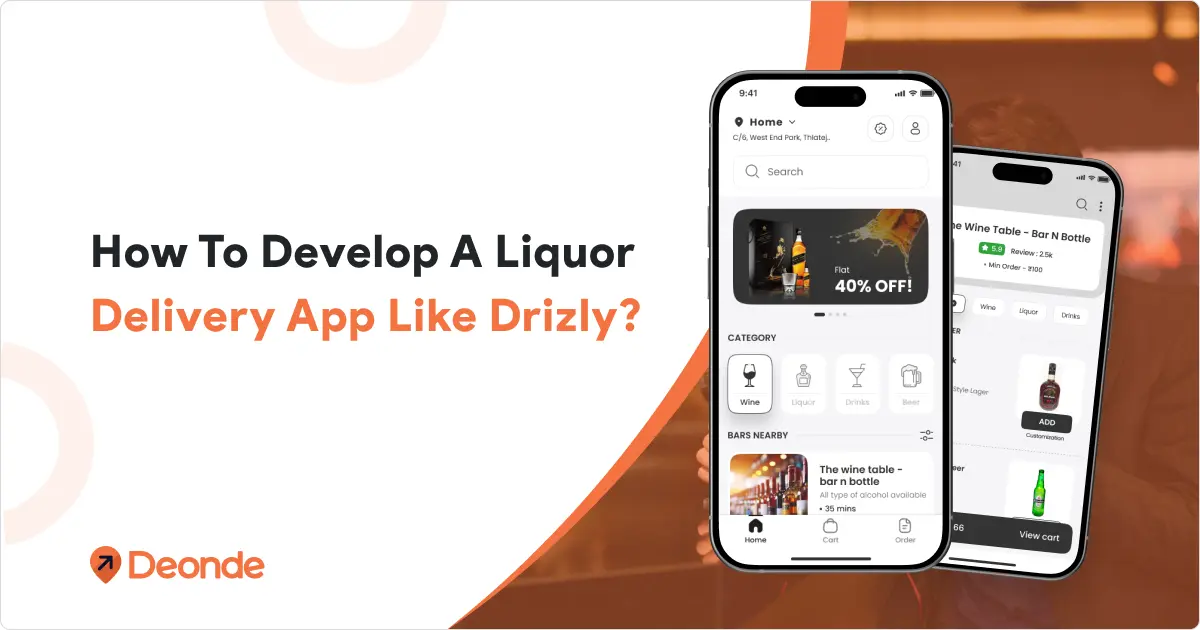
What is drizly application?
It is an eCommerce platform that connects local stores to the final users. The placing of the order of any alcoholic beverage and getting it delivered at the customer’s doorstep within an hour is possible. The compatibility of the Alcohol Delivery App is provided at both the platform Android and IOS. It offers a pleasant experience to the customers who have invested in the application. There is a huge collection of liquor beverages at competitive prices on the application. You need to know everything about it to get desired benefits in developing a liquor delivery application.
How does the drizzly application work?
Drizly is a Liquor Delivery App Development that has developed its application to provide comfort to customers. There is no need for any physical Store for selling and delivery of liquor beverages. It integrates with the inventory management software, which helps in delivery at the right doorstep. The establishing of a good connection with the customers is possible with the application or website. As a customer, you need to log in to the application to purchase your favorite liquor. There is confirmation of an order, and it is delivered within an hour to the doorstep. A guarantee is not provided for the delivery duration because it can be affected by various causes like traffic or rain.
It is a reliable company with a good reputation in the market. The application has won the trust of people. A quality check is also done on the online store related to product range and storage capacity. It will provide customers assurance of the best quality. The on-demand alcohol delivery application is increasing opportunities for liquor retailers. More than 50% of the customers are investing in the Alcohol Delivery App solutions for purchasing their favorite liquor beverage. An online delivery application development is getting good response from both the parties retailers and customers.
Must-Have Features for Your Alcohol Delivery App
Modern alcohol delivery app features expected by customers in 2026 are far more comprehensive. Here is what your platform needs across three panels.
Customer App Features
- Age verification at signup Every customer must confirm their age before browsing or ordering. This is a legal requirement in every market — not a UX preference. Digital ID verification APIs handle this at the point of registration.
- Smart product catalog with filters Customers should filter by type (beer, wine, spirits), brand, price, alcohol content, and ratings. A disorganised or slow catalog kills conversion before checkout.
- Real-time order tracking Show exactly where the delivery driver is on a live map. This single feature cuts customer support queries dramatically and builds platform trust quickly.
- Flexible payment options Credit cards, digital wallets (Apple Pay, Google Pay), and cash-on-delivery where legally permitted. Every payment option you remove is a reason for a customer to abandon their cart.
- Scheduled delivery Allow customers to order ahead for parties and events. This feature alone can drive 20–30% of weekend order volume for most platforms.
- One-tap reorder If a customer ordered a case of Heineken last month, they should repeat it in one click. Reorder functionality is one of the highest-ROI features for retention — it costs nothing per transaction once built.
- Loyalty rewards Points per order, birthday bonuses, referral credits. Alcohol buyers tend to be brand-loyal. Rewarding that loyalty keeps them on your platform instead of a competitor’s.
- Push notifications Order confirmation, dispatch alerts, delivery updates, and promotional offers. Well-timed push notifications increase repeat purchase rates and average order values.
- Wishlists and favourites Let customers save products for quick access and receive restock alerts. This keeps passive users engaged between purchases.
Store / Merchant Panel Features
- Real-time inventory management Stock updates should reflect instantly across the platform. Out-of-stock orders are one of the most common reasons customers leave negative reviews and never return.
- Order management dashboard Accept, prepare, dispatch, and track every order from one screen. Merchants should not need to check multiple tools or switch between tabs to operate.
- Pricing and promotions control Stores must update prices, run flash sales, and apply discounts without contacting your support team. Self-service pricing is non-negotiable at scale.
- Merchant analytics Sales by product, peak order times, delivery performance metrics. Good data helps merchants optimise their menu and staffing — which directly improves their service quality on your platform.
Driver App Features
A purpose-built driver app is non-negotiable for any delivery operation. Drivers need turn-by-turn navigation, proof-of-delivery capture (photo or signature), in-person age verification confirmation, and instant earnings summaries.
Poor driver tools slow down deliveries. Slow deliveries generate bad reviews. Bad reviews reduce order volume. The driver experience is directly tied to customer satisfaction — treat it accordingly.
Admin Panel Features
The admin panel gives you oversight of the entire operation. Merchant management, driver settlement, delivery zone management, compliance tracking, and platform analytics all live here.
Without a strong admin layer, scaling beyond your first 100 daily orders becomes chaotic. Build it right from the start.
Age Verification and Compliance: The Part Most Guides Skip
We are going to be specific — because getting compliance wrong can shut your business down.
Alcohol delivery is regulated differently in every country, state, and sometimes city. Your app must handle three layers of compliance.
Layer 1 — Digital age verification at signup Collect date of birth during registration. Use ID verification APIs — Veriff, Onfido, or Stripe Identity — to confirm the customer’s age before their first order is processed. Never allow browsing or ordering to begin before verification is complete.
Layer 2 — In-person verification at delivery Drivers must check physical ID at the door before handing over any alcohol. Your driver app should require the driver to log a confirmation action — a photo of the ID or a verification checkbox — before marking the order as delivered. This creates a digital audit trail.
Layer 3 — Licensing compliance Depending on your market, you may need a liquor license, a delivery license, or both. In the US, requirements vary by state — some states prohibit alcohol delivery entirely. In the UK, you need a premises licence. In Australia, rules differ by territory. Build your compliance map before you launch in any new region.
Drizly itself faced FTC sanctions over a data breach that exposed 2.5 million users. The company’s failure to protect customer data was a contributing factor in Uber’s decision to shut it down. Build your app with compliance and security as a foundation.
Why Did the Drizly App Shut Down?
In 2021, Uber acquired Drizly for a massive $1.1 billion. Fast forward to March 2024, and Uber officially pulled the plug on the standalone app. Why did such a giant fail? It came down to two main factors: consolidation and security baggage.
First, Uber realized that consumers increasingly prefer an “everything app.” Rather than maintaining Drizly as a standalone platform, Uber strategically decided to fold alcohol delivery directly into Uber Eats. This allowed them to cross-sell food, groceries, and liquor in a single checkout flow, keeping users locked into one ecosystem.
Second, Drizly carried heavy reputational and legal baggage. A massive data breach had previously exposed the personal information of 2.5 million users, leading to severe Federal Trade Commission (FTC) sanctions. The platform’s failure to protect customer data made maintaining Drizly as a separate entity a costly liability for Uber.
What We Can Learn From Drizly: Mistakes to Avoid When Launching
Drizly’s rise and fall offer a masterclass in what not to do. If we are looking to start an alcohol delivery business today, here are the critical mistakes to avoid before launching an app or web platform:
- Treating Data Security as an Afterthought: Drizly’s fatal flaw was its lax security infrastructure. Never launch without enterprise-grade encryption and secure data handling. Your customers’ trust—and your legal standing—depend entirely on how safely you store their personal IDs and payment data.
- Failing to Localize Compliance: Drizly constantly battled the complex patchwork of local liquor laws. Do not assume a one-size-fits-all approach. Your platform must have flexible, built-in compliance tools to handle varying local laws regarding age verification, delivery hours, and licensing across different zip codes.
- Ignoring the Web Experience: While mobile apps drive the majority of repeat sales, web platforms are critical for SEO and acquiring first-time customers. A major mistake is restricting your launch strictly to mobile; you need a seamless web-to-app funnel to capture Google search traffic.
- Lacking a Strategy to Increase Order Value: Drizly strictly sold alcohol. Uber shut it down because bundling alcohol with other items is far more profitable. When planning your business, consider how your platform can eventually partner with complementary local businesses (like snack retailers, ice suppliers, or party shops) to increase the average order value.
Custom Development vs White-Label: Which Path Is Right for You?
Most entrepreneurs underestimate the true cost of building from scratch. It is not just the initial build — it is 12–18 months to reach a stable product, an ongoing engineering team, and compliance updates every time a regulation changes in a new market.
White-label platforms have matured significantly since 2020. The best ones offer full branding, customer apps, driver apps, admin dashboards, and built-in compliance tools out of the box.
For most startups and independent liquor retailers, a white-label delivery platform is the faster, lower-risk path to market. You can validate your business model and generate revenue while custom features are only added once you know what actually drives growth.
For large enterprises with complex, multi-region requirements and proprietary business logic, custom development may be justified. But even then, building on top of a proven white-label foundation is faster than starting from zero.
How a Regional Retailer Launched an Alcohol Delivery Platform in Under 2 Weeks
To illustrate what this looks like in practice, consider a mid-size liquor retailer operating three physical stores in Southeast Asia.
Faced with rising foot traffic costs and growing customer demand for home delivery, the owner evaluated custom app development. Quotes came in at $60,000–$80,000 with a 6–8 month timeline.
Instead, the team launched on a white-label on-demand delivery software platform in 12 days. Within 90 days, the platform was processing 400+ orders per month across all three stores. Driver management, age verification, and customer loyalty features were all handled through the same admin dashboard. Marketing budget went toward customer acquisition — not debugging software.
This is an illustrative example based on typical outcomes reported by multi-store retailers using white-label delivery platforms. Results will vary by market, operator, and execution.
The Bottom Line
Drizly’s closure was not a sign that alcohol delivery is dying. It was a consolidation event in a market that is still growing fast.
The entrepreneurs who move now — with the right platform, solid compliance, and a clear business model — are well-positioned to build the regional alcohol delivery brands that will define the next decade.
If you want to launch an alcohol delivery business without the cost and timeline of custom development, explore what a white-label solution can do for your operation. Check our pricing or book a demo to see the full platform in action.

FAQs: Building a Liquor Delivery App Like Drizly
1. Is Drizly still available in 2026?
No. Drizly officially shut down in March 2024. Uber, which acquired Drizly in 2021 for $1.1 billion, closed the standalone platform to consolidate alcohol delivery under Uber Eats. The gap Drizly left has created significant opportunity for new regional and branded platforms.
2. What age verification method should my alcohol delivery app use?
We recommend a two-layer approach: digital ID verification at signup using APIs like Veriff or Onfido, and mandatory in-person ID check at delivery logged through the driver app. This satisfies most regulatory requirements and creates a digital audit trail that protects your business.
3. How long does it take to build an alcohol delivery app from scratch?
Custom development takes 6–18 months depending on complexity, team size, and compliance requirements. A white-label platform can be configured and launched in 7–14 days. Most businesses validate demand on white-label first, then invest in custom features once they understand what their customers actually use.
4. Do I need a liquor license to run an alcohol delivery marketplace?
Licensing requirements vary significantly by country and state. As a marketplace platform, you may not need a license yourself — the partner stores typically hold the licences. However, you must verify that every merchant on your platform is properly licensed before they go live. Consult a local legal advisor before entering any new market.
5. What is the best alternative to building a Drizly-style app today?
White-label delivery platforms offer the fastest path to market. They come with customer apps, driver apps, admin dashboards, age verification, and payment integration pre-built. For entrepreneurs who want to own their delivery channel without building from scratch, this is the most cost-effective and time-efficient option available.