The cost to build a medicine delivery app typically ranges from $15,000 – $65,000, depending on features, complexity, and development approach. Simple apps with basic functionality lean toward the lower end, while feature-rich, custom-built apps with AI integration can hit the higher end or beyond.
The demand for medicine delivery apps is skyrocketing. With people prioritizing convenience and pharmacies racing to go digital, these apps are no longer a luxury but a necessity.
Everyone wants a slice of this growing market, from startups to established pharmacy chains. But here’s the burning question: How much does building a medicine delivery app cost? It’s a question that keeps entrepreneurs, pharmacy owners, and healthcare providers up at night.
This blog will discuss the factors that influence total investment, key features, and innovative alternatives to reduce time-to-market. Whether you’re a startup founder or an established healthcare player, you’ll walk away with actionable insights to make informed decisions.
Average Cost to Build a Medicine Delivery App by Region
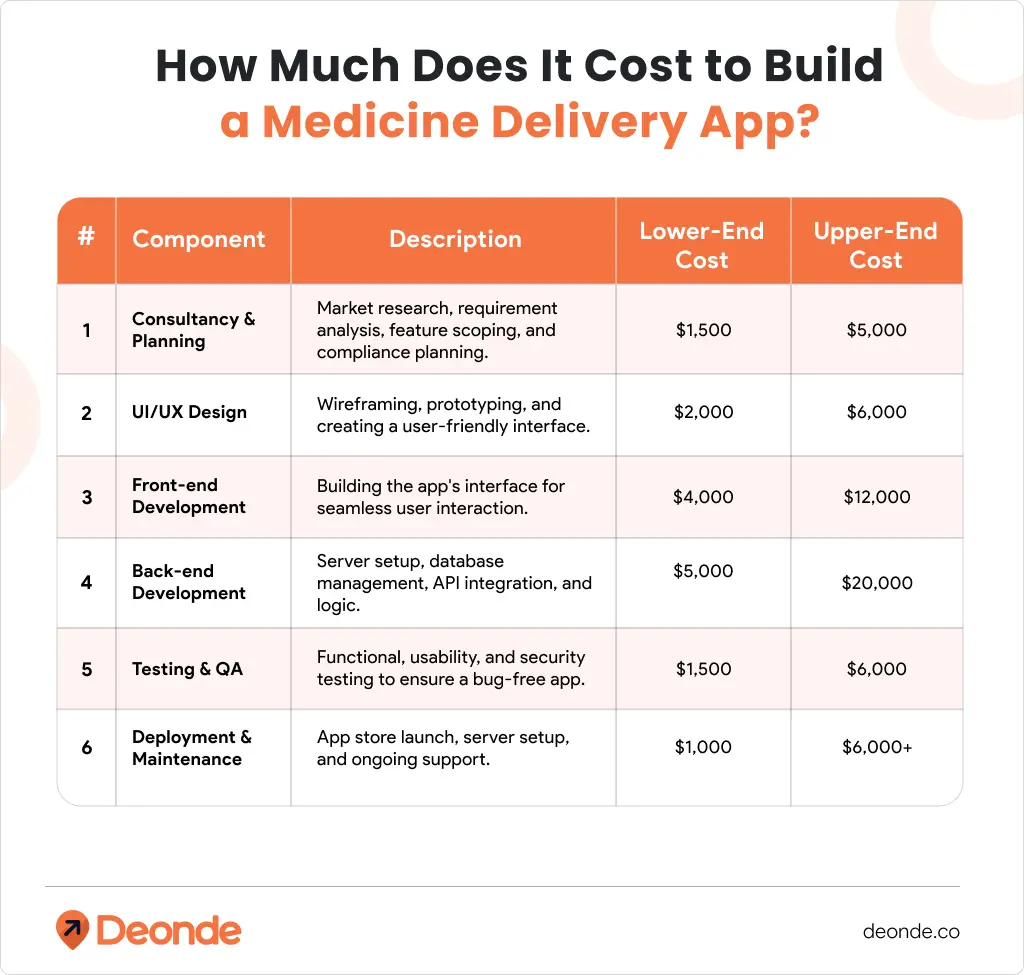
The cost to develop a medicine delivery app typically ranges between $15,000 – $65,000+.This price covers everything from planning and design to development, testing, and deployment. Let’s break down the individual components of this cost:
Development costs vary significantly based on the region you choose for development, driven primarily by local developer hourly rates, compliance complexity, and team size.
Custom App Development Cost
| Region | Average Hourly Rate | Total Cost Range | Typical Timeline |
| USA / North America | $100 – $180 / hr | $80,000 – $150,000+ | 6 – 10 months |
| UK & Western Europe | $80 – $140 / hr | $60,000 – $120,000 | 6 – 10 months |
| Eastern Europe / Ukraine | $40 – $75 / hr | $40,000 – $80,000 | 5 – 9 months |
| Vietnam / Southeast Asia | $25 – $50 / hr | $25,000 – $50,000 | 5 – 10 months |
| India | $20 – $45 / hr | $15,000 – $35,000 | 4 – 8 months |
Key Takeaway: Development charges account for the core logic and code. You must also budget for UI/UX design (10–15% of build cost), Quality Assurance (8–12%), DevOps setup, and regulatory compliance features (HIPAA, GDPR, prescription validation, and local pharmacy licensing).
Ready-Made Solution (Like Deonde) Cost
Ready-made platforms reduce upfront investment and time-to-market. Costs typically include setup/branding, subscription, and optional add-ons. Actual pricing depends on the vendor, plan, and customization level.
For startups and pharmacy chains seeking rapid market entry without the high upfront capital expenditure of a custom build, pre-built white-label solutions offer ready-to-deploy infrastructure.
| Solution Type | Setup & Customization Cost | Launch Timeline | Key Benefits |
| Pre-Built / White-Label Platform | $49 | In just 7 days | Production-ready infrastructure, built-in prescription workflows, real-time dispatch, and minimal upfront risk. |
For startups and pharmacy chains that want to launch quickly, ready-made solutions can cut initial spend by 50–80% compared to fully custom builds, while still allowing branding, configuration, and phased feature rollouts.
Note: on Consultancy & Planning: The cost for this component significantly depends on whether you engage an external agency, which will have its own charges. If you have an in-house team managing these aspects, the cost would typically be lower, primarily reflecting the salaries of your internal staff involved in this phase.
Ongoing Costs After Launch: What the Build Price Doesn’t Cover
The $15,000–$65,000+ range above gets your app live. Running it is a separate, recurring budget and it’s the line item most first-time builders forget until the first bill arrives.
Cloud Hosting & Infrastructure
Expect $100–$500/month early on for servers, database, storage, and push notifications, scaling to $1,000–$3,000+/month as your order volume and user base grow. Hosting costs track usage, not app complexity. A quiet month costs little, a busy one costs more.
Third-Party API & Integration Fees
- Payment gateway: typically 2–3% + a small fixed fee per transaction, not a flat monthly cost
- SMS and push notifications (order updates, OTPs): roughly $50–$300/month at moderate volume
- Maps and delivery-route APIs: roughly $100–$500+/month, scaling with order volume
- OCR/prescription-verification AI: usually billed per scan, so cost tracks how many prescriptions get uploaded
App Store & Platform Fees
Apple’s Developer Program renews at $99/year; Google Play is a $25 one-time fee. Small numbers, but the Apple renewal is easy to miss until an app suddenly disappears from the App Store.
Maintenance & Updates
Across the industry, annual maintenance typically runs 15–25% of the original build cost. Because you’re handling prescriptions and health data, expect to sit toward the higher end of that once compliance and security patching are factored in.
Applied to your own $15,000–$65,000+ build range, that’s roughly $2,250–$16,000+ a year just to keep things running, patched, and compliant.
Customer Support
Founder-handled support costs time, not money, in the early days. Once you outsource it, budget roughly $500–$2,500+/month for a small setup — helpdesk software plus part-time or shared agents.
Security & Compliance Reviews
Because prescriptions and health data are involved, a periodic security review or penetration test is worth budgeting separately, typically $2,000–$10,000+ per review, done annually or after major updates.
Put together, most small-to-mid medicine delivery apps run roughly $5,000–$30,000+ a year in hosting, APIs, and maintenance once they’re live before support staffing or periodic audits.
Skipping this budget line is the fastest way to launch an app you can’t afford to keep running.. Skipping this budget line is the fastest way to launch an app you can’t afford to keep running.
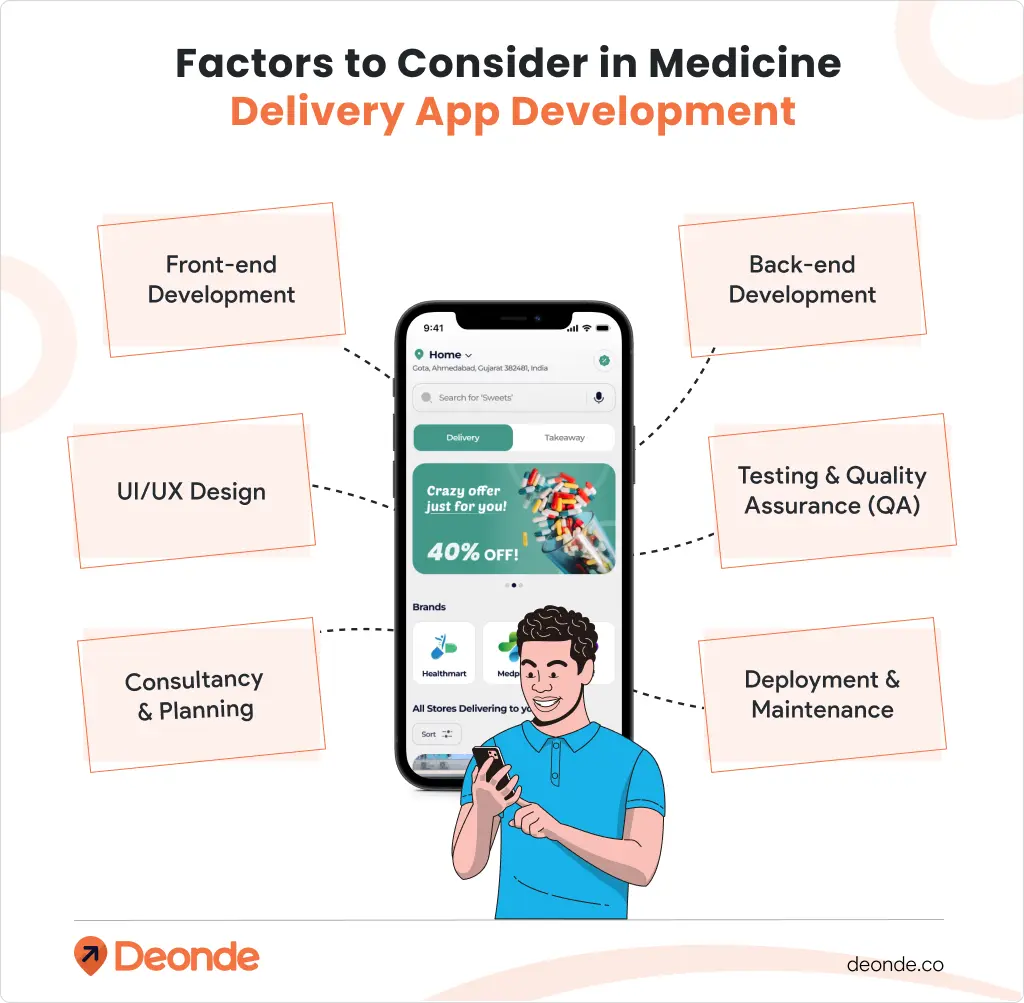
Factors to Consider in Medicine Delivery App Development
1. Consultancy & Planning
The success of an app is built upon a strong foundation of detailed planning. This phase sets the stage for your app’s success by aligning your vision with market needs.
- Market Research involves analyzing the market, identifying user needs, and studying competitors. It ensures your app fills a gap in the market, making it stand out and driving user adoption.
- Client Requirements & Analysis: We work closely with you to list your app’s must-have features, ensuring the development team stays on track with your goals.
- Feature Scoping: Deciding which features to include (e.g., order tracking, payment integration) and which to save for later helps manage costs and timelines effectively.
- Compliance Planning: Adhering to healthcare regulations like HIPAA is non-negotiable. This step ensures your app is secure, trustworthy, and compliant, avoiding costly legal issues.
Why it matters: Proper planning prevents costly rework and ensures your app meets user expectations and legal standards.
2. UI/UX Design
A visually appealing and intuitive design is critical for user engagement. The design phase significantly impacts the medicine delivery app cost due to its role in shaping the user experience.
- Information Architecture (IA): This organizes content logically, making navigation effortless for users. Think clear menus, easy-to-find buttons, and a smooth flow from browsing to checkout.
- Wireframing & Prototyping: Wireframes outline the app’s basic structure, while prototypes simulate user interactions for testing and refinement.
- Visual and Interaction Design: This creates a consistent, brand-aligned look and ensures intuitive interactions, like tapping to add medications to a cart.
Why it matters: A well-designed app keeps users returning, reducing churn and boosting satisfaction.
3. Front-end Development
The front-end is what users see and interact with. It’s about creating a fast, responsive, and engaging interface.
Key aspects include:
- Choosing frameworks like React Native or Flutter for cross-platform compatibility.
- Ensuring responsive design for seamless performance across devices.
- Optimizing performance to reduce load times and enhance user experience.
- Incorporating accessibility features to make the app usable for all.
Why it matters: A polished front-end requires more development time and expertise, especially for custom designs or animations, which can increase costs.
4. Back-end Development
The back-end engine powers your app, handling everything from user data to order processing.
Key components include:
- Server-Side Logic: Manages core functionalities like order placement and user authentication.
- Database Setup: Securely stores user profiles, medication inventories, and order histories.
- API Integration: Connects your app to third-party services like payment gateways (e.g., Stripe) or delivery tracking systems.
- Scalability: Ensures the app can handle growing user numbers without crashing.
Why it matters: A robust back-end requires skilled developers and reliable infrastructure, which drives up costs for complex apps.
5. Testing & Quality Assurance (QA)
Testing ensures your app is bug-free, secure, and user-friendly. This phase includes:
- Functional Testing: Verifies that all features work as intended.
- Usability Testing: Ensures the app is intuitive and easy to navigate.
- Security Testing: Protects sensitive user data, like health information, from breaches.
- Bug Fixing: Resolves issues before launch to avoid poor reviews.
Why it matters: Skipping thorough testing can lead to costly fixes post-launch and damage your brand’s reputation.
6. Deployment & Maintenance
The final step is launching your app on platforms like the App Store or Google Play and keeping it running smoothly.
- Deployment: Involves setting up servers, securing domains, and paying app store fees.
- Maintenance: Includes regular updates, bug fixes, and performance monitoring to keep the app competitive.
Why it matters: Ongoing maintenance ensures your app stays relevant and functional, adding to long-term costs.
App Complexity & Features: What Do You Need?
The heart of your medicine delivery app lies in its functionality. Cramming in every possible feature sounds great until you see the cost. Focus on what’s necessary to start and scale later.
User Panel(Customer-Facing)
- Registration/Login: Easy email, phone, or social media sign-up.
- Profile Management: Store personal details, addresses, and payment methods.
- Search & Filter: Browse medicines by name, category, or condition with filters for price or availability.
- Prescription Upload: Allow users to upload prescriptions for verification.
- Order Placement: Add medicines to the cart and place orders seamlessly.
- Order Tracking: Real-time updates on delivery status.
- Payment Gateway Integration: Secure options like credit cards, digital wallets, or cash on delivery.
- Reviews & Ratings: Let users rate pharmacies or delivery services.
Pharmacy Panel
- Order Management: Accept, process, or cancel orders.
- Inventory Updates: Real-time stock tracking to avoid overselling.
- Dispatch Management: Assign orders to delivery drivers.
- Communication Tools: Notify users about order updates or delays.
Admin Panel
- Dashboard: Overview of orders, users, and revenue.
- User Management: Monitor customers, pharmacies, and drivers.
- Analytics & Reporting: Track sales, popular medicines, and user behavior.
- Content Management: Update app content like banners or promotions.
Delivery Driver Panel
- Order Assignment: View and accept delivery tasks.
- Route Optimization: GPS-based navigation for efficient deliveries.
- Order Confirmation: Mark orders delivered with proof (e.g., e-signatures).
- Earnings Tracker: Monitor payments or tips for drivers.
Each panel adds development time and cost. For example, a basic app with just a user and admin panel might cost $20,000-$40,000, while adding pharmacy and driver panels could push it to $50,000-$80,000.
Affordable Medicine Delivery App Development with Deonde Solutions
At Deonde Solutions, we specialize in creating secure, compliant, and user-friendly medicine delivery apps tailored to your needs all while keeping costs manageable. Our expert team ensures your app meets industry standards and delivers a seamless user experience.
Let’s explore each development component to understand what drives the cost of building a medicine delivery app.
The Role of AI in Medicine Delivery Apps and How It Impacts Cost
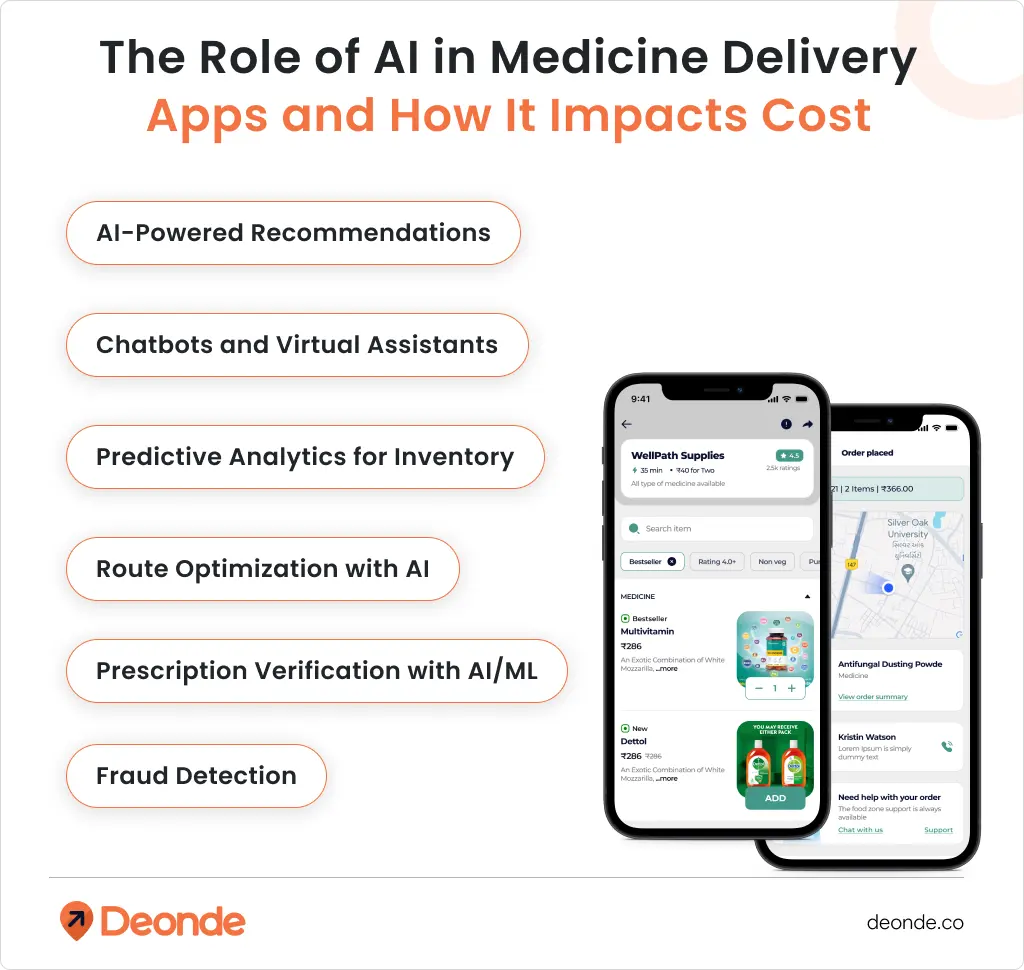
Artificial intelligence (AI) is transforming medicine delivery apps, making them more innovative and efficient. While AI adds to the upfront cost of building a medicine delivery app, it can save money in the long run by automating tasks and improving user experience. Here’s how AI impacts functionality and cost.
AI-Powered Recommendations
AI can analyze user purchase history, prescriptions, and common health conditions to suggest relevant medicines. For example, if a user regularly orders diabetes medication, the app could recommend glucose monitors or related supplements. This personalization boosts user engagement but requires complex algorithms, adding $10,000-$25,000 to development costs.
Chatbots and Virtual Assistants
AI-powered chatbots handle customer queries about order status, refunds, or pharmacy hours. They reduce the need for human support, saving operational costs over time. Developing a basic chatbot costs $5,000-$15,000, while advanced ones with natural language processing (NLP) can cost $20,000-$40,000.
Example: A user asking, “Where’s my order?” receives an instant update with delivery status and estimated arrival time, reducing calls to customer service.
Predictive Analytics for Inventory
Pharmacies often struggle with overstocking or running out of medicines. AI-driven predictive analytics can forecast demand based on historical data, seasonal trends, or local health patterns. This feature minimizes waste and ensures availability but requires sophisticated data models, adding $15,000-$30,000 to the budget.
Example: AI predicts a surge in demand for cold remedies in winter, prompting pharmacies to stock up in advance.
Route Optimization with AI
Basic GPS navigation is standard, but advanced AI models optimize delivery routes by factoring in traffic, weather, and multiple drop-offs. This ensures faster deliveries and lower fuel costs. Depending on the complexity, implementing AI-driven route optimization can cost $10,000-$20,000.
Example: A driver delivering to multiple addresses in a city gets a route that avoids rush-hour traffic and prioritizes urgent orders.
Prescription Verification with AI/ML
Manually verifying prescriptions is time-consuming and error-prone. AI-powered optical character recognition (OCR) can scan and validate prescriptions in seconds, improving efficiency and compliance. This high-value feature costs $15,000-$35,000 due to the need for machine learning models and integration.
Example: A user uploads a prescription image, and AI extracts details like drug name and dosage, flagging any discrepancies for review.
Fraud Detection
AI algorithms can flag suspicious orders, like unusually large quantities or mismatched prescriptions. This protects pharmacies and users but requires advanced development, costing $10,000-$25,000.
While AI features increase the initial investment, they enhance scalability and user satisfaction, making them worth considering for competitive apps.
Example: AI flags an order for a huge quantity of painkillers, prompting manual review to prevent misuse.
Ready-Made Solution vs. Custom App Development
One major decision that impacts your budget is choosing between:
|
Feature/Aspect |
Ready-Made Solution |
Custom App Development |
|
Initial Investment |
Lower upfront cost (license fees, subscription, setup) |
Higher upfront cost (design, development, testing) |
|
Development Time |
Faster (weeks to a few months for setup/branding) |
Slower (several months to over a year) |
|
Customization |
Limited (pre-built features, branding options) |
High (build exactly to specific business needs) |
|
Scalability |
Depends on the provider’s infrastructure and plans |
Highly scalable if built with future growth in mind |
|
Features |
Standard, often generic features; add-ons may cost extra |
Unique, specific features tailored to your market/business |
|
Maintenance & Updates |
Handled by the provider (included in subscription) |
Your responsibility (ongoing cost, dedicated team/vendor) |
|
Ownership |
You license the software, with limited intellectual property |
Full ownership of the code and intellectual property |
|
Flexibility |
Less adaptable to unique workflows or integrations |
Highly adaptable; can integrate with any system |
|
Monetization Models |
May be limited to the provider’s supported models |
Implement any desired monetization strategy (e.g., ad-based, subscription) |
|
Security |
Relies on the provider’s security measures and practices |
Your responsibility is to ensure robust security practices |
|
Market Uniqueness |
May lack unique selling points compared to competitors |
Can build features that differentiate you in the market |
|
Long-Term Cost |
Predictable monthly/annual fees; can add up over time |
Higher initial, but potentially lower per-feature long-term if well-maintained |
|
Integration with Existing Systems |
Often limited to pre-built APIs or manual processes |
Seamless integration with existing inventory, CRM, and EHR systems |
Regional Market Opportunity in 2026
The global e-pharmacy market is expanding rapidly, but opportunity is not evenly distributed. In 2026, some regions lead in market size, while others are growing faster due to digital adoption, chronic disease burden, and supportive regulations.
| Region | Market Share (2026) | Growth Trajectory |
|---|---|---|
| USA & Canada | ~38–40% | Dominated by Amazon Pharmacy, CVS, Walgreens, and Walmart – whitespace remains in regional players, specialty drugs, and integrated telehealth + insurance workflows. |
| UK & Western Europe | ~18–20% | Mature but fragmented by country; strong growth in e-prescriptions and cross-border online pharmacies, with room for GDPR-first, multi-language platforms. |
| Eastern Europe | ~5–7% | Fast digitization and rising cross-border pharmacy usage; opportunity for cost-effective, compliance-aligned platforms serving multiple countries from one tech base. |
| India | ~8–10% | One of the fastest-growing e-pharmacy markets globally; driven by smartphone adoption, chronic diseases, and tier-2/3 city expansion – ideal for high-volume, low-margin models. |
| Southeast Asia | ~7–9% | Young, mobile-first population with rapidly growing on-demand health services; strong potential for super-app integrations (payments, teleconsults, insurance). |
| Middle East | ~4–6% | Government-backed digital health initiatives and high smartphone penetration; opportunity for Arabic-first, premium urban delivery and insurer/hospital partnerships. |
| Latin America | ~5–7% | Fragmented offline pharmacy networks and rising digital payments; strong potential for marketplace models with local payment methods and transparent pricing. |
| Australia | ~2–3% | Small but high-value market with strong trust in regulated platforms; opportunity in premium services, rural delivery, and integration with local health systems. |
Final Thoughts: Is a Medicine Delivery App Worth the Investment?
Building a medicine delivery app is a smart move in today’s digital-first world, but the cost to build a medicine delivery app can vary widely based on your needs.
Whether you’re a startup on a budget or a pharmacy chain aiming for a feature-packed app, understanding the key cost drivers features, development approach, and AI integration will help you make the right choice.
A basic app might cost as little as $15,000, while a robust, AI-powered solution could top $65,000+. The key is to balance your budget with your long-term goals.
Start by defining your must-have features and deciding between a ready-made platform like Deonde or a custom-built app.
Don’t forget to factor in ongoing maintenance and compliance costs to keep your app running smoothly. With careful planning, your medicine delivery app can meet customer needs, streamline operations, and give you a competitive edge in the booming healthcare market.
Ready to get started? Reach out to a trusted development team or explore platforms like Deonde to bring your vision to life. The future of pharmacy is digital—don’t get left behind!