I’ve been tracking food delivery platforms for years. But nothing prepared me for what I witnessed when Wonder bought Grubhub—it wasn’t just an acquisition, it was a complete reimagining of how we think about food, technology, and customer experience in the digital age.
The biggest shake-up in food delivery isn’t about faster robots or flying drones. It’s about one smart move that completely changed how we think about ordering food. When Wonder bought Grubhub for $650 million, they weren’t just buying another delivery app—they were building something totally new.
Grubhub is no longer just a delivery app fighting a losing war against DoorDash. Under Wonder, it is transforming into the logistics backbone of a “Fast Fine” dining empire.
This blog breaks down the Grubhub business model, explores its revenue model, and analyzes the future impact of Marc Lore’s super app strategy and the fast-casual dining concept.
What Is Grubhub?
Grubhub is one of America’s original food delivery platforms, launched back in 2004 when ordering takeout meant calling restaurants and reading your credit card number over the phone. I remember those days—fumbling through paper menus, dealing with busy signals, and hoping the restaurant got your order right.
Grubhub changed all that. They digitized restaurant menus, stored payment information, and made ordering food as simple as clicking a button. The company actually started as two separate platforms—Grubhub in Chicago and Seamless in New York—before merging in 2013 to create what became the dominant online food ordering platform.
Today, it connects diners with local restaurants through an innovative technology platform.
- Merchants: Over 375,000 partners.
- Reach: 4,000+ U.S. cities.
- Network: Available across a broad swath of the U.S. population.
The Shocking Price Drop: From $7.3 Billion to $650 Million
I remember when Just Eat Takeaway paid $7.3 billion for Grubhub in 2021. Everyone thought it was expensive then. Four years later, I watched Wonder scoop it up for just $650 million, and I realized I was witnessing one of the most dramatic value destructions in tech history
This wasn’t market volatility. This was a company that got stuck in 2015 while the world moved on. I saw Grubhub’s quarterly orders drop from 91 million to 67 million over three years, and I knew something fundamental had broken in their business model.
The brutal math tells the story I’ve been following: While DoorDash and Uber Eats figured out how to make money and grow, Grubhub remained trapped in a single-service mindset that treated food delivery like a utility instead of an experience.
GrubHub operates a three-sided marketplace business model that connects customers, restaurants, and delivery drivers through a digital platform. The company acts as an intermediary, facilitating food orders and deliveries while earning money from multiple revenue streams.
What is GrubHub’s Business Model?
GrubHub’s business model is a three-sided digital marketplace that connects hungry customers with local restaurants and delivery drivers through a technology platform.
GrubHub operates as a middleman platform – it doesn’t own restaurants, cook food, or employ delivery drivers. Instead, it creates a digital space where:
- Customers can order food from multiple restaurants
- Restaurants can reach customers beyond their location
- Drivers can earn money delivering orders
The company makes money by taking a percentage from each transaction while providing the technology that makes everything work smoothly.
How Grubhub’s Business Model Actually Works?
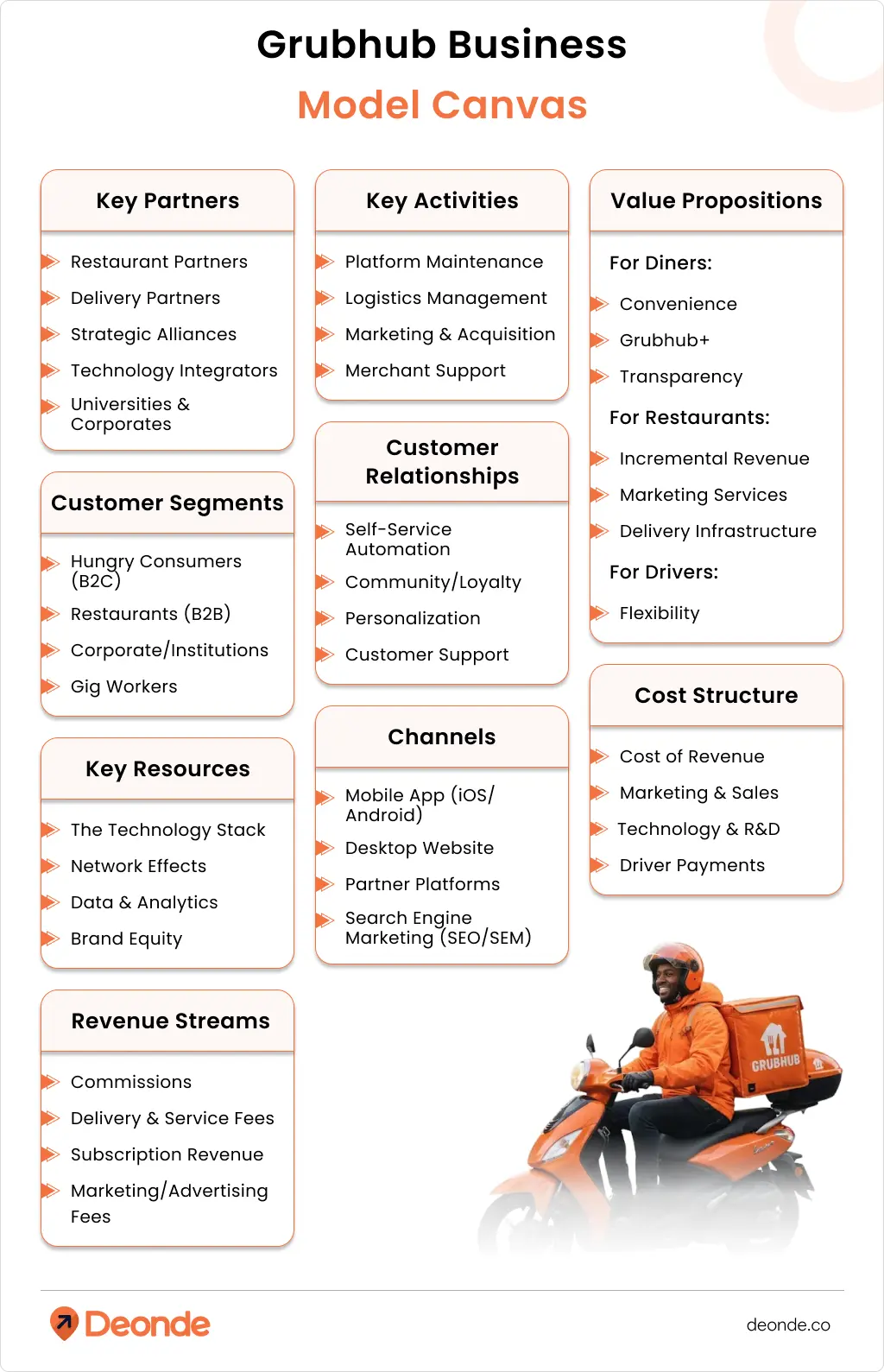
The Marketplace Structure
At its heart, GrubHub’s business model is built on platform economics. The company creates value by reducing friction between buyers (customers) and sellers (restaurants) while adding a third layer of service providers (drivers) to complete the transaction.
- Customer Side: People use GrubHub’s app or website to browse restaurant menus, compare options, place orders, and track deliveries. They pay through the platform and rate their experience.
- Restaurant Side: Food establishments receive orders through GrubHub’s system, prepare meals according to specifications, and hand them off to drivers. They gain access to customers beyond their physical location.
- Driver Side: Independent contractors accept delivery requests, pick up prepared orders from restaurants, and deliver them to customers. They earn money per delivery plus tips.
Business Model Mechanics
Order Flow Process
- Customer places order through GrubHub app/website
- Restaurant receives order via GrubHub tablet/integration
- Restaurant confirms order and preparation time
- GrubHub assigns driver based on location and availability
- Driver picks up completed order from restaurant
- Customer receives real-time tracking updates
- Driver delivers order to customer location
- Payment processed automatically through platform
Technology Infrastructure
- Mobile applications for customers and drivers
- Restaurant dashboard for order management
- Logistics algorithms for driver assignment and routing
- Payment processing system for secure transactions
- Customer support platform for issue resolution
Customer Acquisition and Retention Model
Acquisition Strategy
GrubHub attracts customers through:
- Convenience value proposition: Easier than calling restaurants
- Selection advantage: Multiple restaurants in one app
- Promotional offers: Discounts for first-time users
- Referral programs: Existing customers bring new ones
Retention Mechanisms
The platform keeps customers through:
- Habit formation: Storing payment info and addresses
- Personalization: Learning preferences and making recommendations
- Loyalty programs: Rewards for frequent ordering
- Switching costs: Inconvenience of starting over with competitors
Restaurant Partnership Model
Value Proposition for Restaurants
GrubHub offers restaurants:
- Market expansion: Reach customers beyond physical location
- Digital presence: Online ordering without building own platform
- Operational support: Order management and payment processing
- Marketing tools: Promotional opportunities and customer insights
Partnership Structure
Restaurants integrate with GrubHub through:
- Menu digitization: Converting physical menus to online format
- Order management systems: Tablets or POS integration for receiving orders
- Performance tracking: Analytics on sales, customer ratings, and trends
- Marketing participation: Featured placement and promotional campaigns
Driver Network Model
Independent Contractor Framework
GrubHub’s driver model relies on independent contractors rather than employees:
- Flexible scheduling: Drivers choose when to work
- Geographic choice: Select preferred delivery areas
- Earnings transparency: See potential income before accepting orders
- Performance-based system: Better ratings lead to more opportunities
Logistics Optimization
The platform optimizes driver efficiency through:
- Smart matching: Assigning orders based on location and capacity
- Route optimization: Minimizing travel time and distance
- Batch deliveries: Multiple orders in single trips when possible
- Predictive positioning: Suggesting where drivers should wait for orders
Quality Control and Trust Model –
Multi-Layered Rating System
GrubHub maintains quality through:
- Customer ratings: Reviews of restaurants and drivers
- Restaurant performance metrics: Order accuracy and preparation time
- Driver performance tracking: Delivery time and customer satisfaction
- Platform monitoring: Automated detection of issues and anomalies
Dispute Resolution Framework
The platform handles problems through:
- Automated refunds: Quick resolution for common issues
- Customer service escalation: Human support for complex problems
- Partner accountability: Performance consequences for restaurants and drivers
- Insurance and guarantees: Protection for customers when things go wrong
Competitive Differentiation Strategy
Market Focus Approach
GrubHub differentiates through:
- Suburban market emphasis: Serving areas competitors might ignore
- Local market expertise: Deep knowledge of specific metropolitan areas
- Restaurant relationship quality: Long-term partnerships vs. transactional relationships
- Operational efficiency: Optimized logistics in core markets
Technology Advantages
The platform’s technical strengths include:
- Predictive analytics: Better delivery time estimates
- Personalization engines: Improved restaurant recommendations
- Logistics optimization: Efficient driver routing and assignment
- Integration capabilities: Seamless connection with restaurant systems
Risk Management and Adaptation
Operational Risks
GrubHub manages risks through:
- Diversified restaurant portfolio: Reducing dependence on any single partner
- Flexible driver network: Scaling capacity based on demand
- Technology redundancy: Backup systems for critical operations
- Geographic diversification: Multiple markets reduce local risk
Regulatory Adaptation
The platform adapts to changing regulations by:
- Labor law compliance: Adjusting driver classification as needed
- Local regulation adherence: Meeting city-specific delivery requirements
- Data privacy protection: Complying with consumer protection laws
- Tax obligation management: Handling complex multi-jurisdiction requirements
Future Evolution Potential
Technology Integration
GrubHub’s model could evolve through:
- Autonomous delivery: Reducing driver costs with robots or drones
- AI-powered optimization: Better prediction and routing algorithms
- Voice ordering integration: Seamless ordering through smart speakers
- Augmented reality features: Enhanced restaurant discovery and menu browsing
Ecosystem Expansion
The business model might expand into:
- Grocery delivery: Leveraging existing logistics network
- Alcohol delivery: Adding beverage options to food orders
- Catering services: Serving business and event customers
- International markets: Replicating the model globally
Grubhub Revenue Model: How They Make Money
Grubhub’s revenue engine is complex. It isn’t just “delivery fees.” To understand the valuation, you must understand the cash flow. Here is a detailed breakdown of their revenue streams.
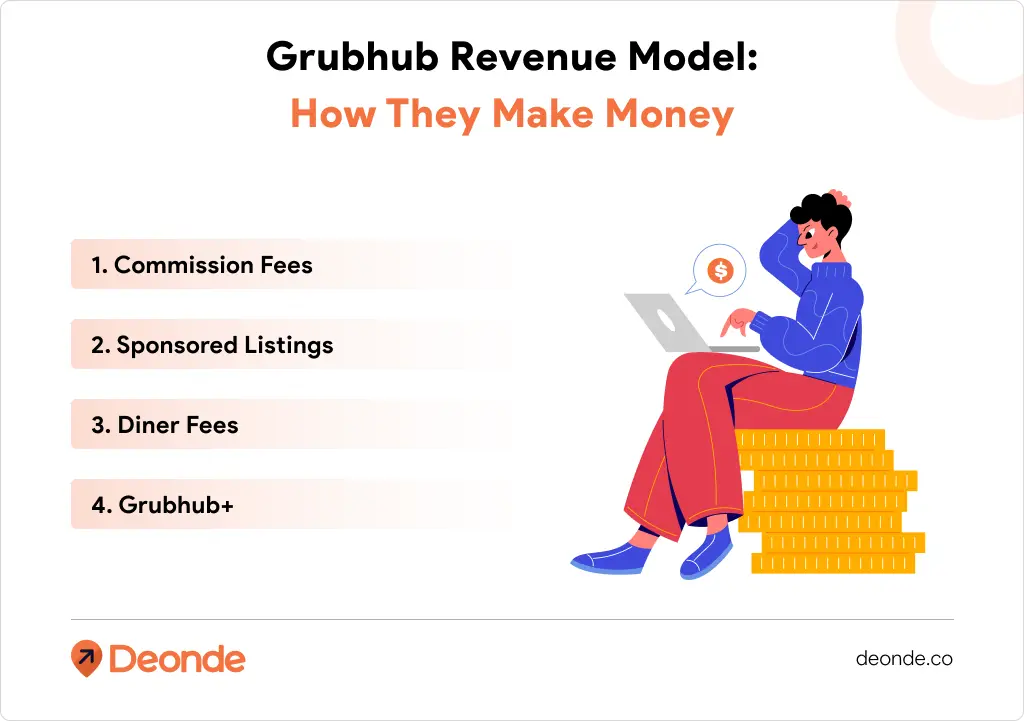
Restaurant Commissions
Primary Revenue Stream – GrubHub charges restaurants 15-30% commission on every order processed through the platform. This percentage varies based on service level, marketing participation, and delivery method (GrubHub delivery vs restaurant’s own delivery).
Delivery Fees
Customer-Paid Charges – Direct fees charged to customers for delivery service, typically ranging from $1.99 to $4.99 per order. These fees vary based on distance, demand, weather conditions, and time of day.
Service Fees
Platform Usage Fees – Additional charges of 3-5% applied to the order subtotal, covering payment processing, customer support, and platform maintenance costs.
Grubhub+ Subscription ($9.99/mo) + Amazon Prime Integration
Recurring Revenue – Monthly subscription service offering unlimited free delivery on orders over $12, exclusive deals, and lower service fees. The Amazon Prime integration provides additional subscriber acquisition through bundled services.
Sponsored Listings + Performance Advertising
Restaurant Marketing Revenue – Restaurants pay for premium placement in search results, featured positioning on the homepage, and targeted promotional campaigns. This includes pay-per-click advertising and sponsored restaurant recommendations.
Campus & Corporate Institutional Contracts
While B2C food delivery is volatile, Grubhub’s B2B institutional contracts provide the ultimate financial moat.
- Corporate Accounts: Grubhub Corporate allows enterprise businesses to set up employee meal stipends, customized catering rules, and tax-exempt ordering. This guarantees high-volume, massive Average Order Value (AOV) transactions that stabilize revenue during B2C downturns.
- College Campuses (Grubhub On Site): Grubhub dominates the university sector by integrating directly into student meal plans. Students can use their university ID cards to order via mobile or self-serve kiosks, and Grubhub handles the complex logistics—including deploying autonomous delivery robots across campus. This effectively builds brand loyalty with Gen Z before they even graduate.
Restaurant SaaS, POS Integration Tools + NRS Retail Network
Technology Services Revenue – Software-as-a-Service offerings including point-of-sale system integrations, order management tools, analytics dashboards, and inventory management solutions. The NRS (National Restaurant Solutions) retail network provides additional technology and payment processing services to restaurant partners.
That’s GrubHub’s business model in its essence – a technology-powered marketplace that brings together customers, restaurants, and drivers to make food delivery happen efficiently, while generating revenue from multiple streams across all participant groups.
Grubhub vs DoorDash vs Uber Eats vs Instacart
In 2026, the food delivery market is no longer in its “growth at all costs” phase. It has matured into a brutal game of logistics, razor-thin margins, and ecosystem lock-in.
When you strip away the flashy ads, the competition between Grubhub, DoorDash, and Uber Eats looks like a battle of three completely different business models.
| Platform | U.S. Share (2025) | Revenue Model | Actual Differentiator in 2026 | Subscription |
|---|---|---|---|---|
| DoorDash | ~68% | 15–30% commission + DashPass subsidy | Suburban and rural geographic coverage unmatched by any rival; DashMart owned convenience stores; merchant services and Wolt international expansion. | DashPass $9.99 |
| Uber Eats | ~24% | 15–30% commission + Uber One bundle | Rider-to-eater conversion at zero acquisition cost; active in 45+ countries; Avride robot partnership in Jersey City (competing directly with Grubhub). | Uber One $9.99 |
| Grubhub (Wonder) | ~8–10% | 10–30%; NYC hard-capped at 15% | University meal plan lock-in (360+ campuses); 10,000+ corporate accounts; Amazon Prime distribution; Wonder food hall content; Claim loyalty; Instacart grocery access. | Grubhub+ $9.99 |
| Instacart | Grocery vertical | Retail markup + fulfillment fees + ads | 1,800+ retail banners across North America; now also Grubhub’s grocery fulfillment partner — simultaneously a competitor in grocery and an infrastructure provider to Grubhub. | Instacart+ $9.99 |
Why Wonder Bought Grubhub
- Instant Scale – GrubHub brought Wonder 375,000 restaurant partners and millions of active customers overnight, providing immediate national reach that would take years to build organically.
- Delivery Infrastructure – Wonder gained access to GrubHub’s established driver network, logistics technology, and delivery operations across major U.S. markets.
- Market Timing – With GrubHub’s valuation at historic lows, Wonder acquired proven technology and market presence at a significant discount.
- Customer Base Expansion – GrubHub’s customer data and ordering patterns provide Wonder with insights to optimize its ghost kitchen concepts and food hall locations.
- Cross-Selling Opportunities – Wonder can introduce GrubHub customers to its owned restaurant brands, meal kits, and physical locations, increasing customer lifetime value.
- Technology Platform – GrubHub’s ordering, payment, and logistics systems become the foundation for Wonder’s broader food ecosystem.
- Market Consolidation – By acquiring a major competitor, Wonder reduces competition while gaining market share in key metropolitan areas.
- Defensive Strategy – Prevents other players like DoorDash or Uber from acquiring GrubHub and strengthening their own positions.
- Vertical Integration Advantage – Wonder can now control both the platform (GrubHub) and the content (Wonder’s restaurant brands), creating unique competitive advantages.
Why Just Eat Sold for a Loss
- Massive Value Destruction – Just Eat Takeaway paid $7.3 billion for GrubHub in 2021 but sold it for only $650 million in 2025, representing a staggering 91% loss in value.
- Market Share Decline – GrubHub consistently lost market share to DoorDash and Uber Eats, making it the third-place player in a winner-take-all market.
- Profitability Struggles – Despite being one of the oldest food delivery platforms, GrubHub never achieved sustainable profitability at scale, burning cash while competitors gained ground.
- Geographic Mismatch – Just Eat Takeaway, a European company, struggled to understand and compete effectively in the U.S. market dynamics.
- Integration Challenges – The company failed to successfully integrate GrubHub with its European operations, missing potential synergies and economies of scale.
- Management Distraction – Running a struggling U.S. business diverted attention and resources from Just Eat’s more successful European markets.
- Commission Pressure – Restaurants increasingly pushed back against high commission rates, while customers became more price-sensitive, squeezing margins from both sides.
The GrubHub acquisition and subsequent sale illustrates how quickly market dynamics can change in the competitive food delivery industry, where scale, local market knowledge, and operational efficiency determine long-term success.
What is Marc Lore’s Super App Strategy?
The acquisition of Grubhub is the final puzzle piece in Marc Lore’s vision to build the “Super App for Mealtime.“
Marc Lore (founder of Jet.com and diapers.com) is not trying to build a better food delivery app. He is trying to build the Amazon of Food. His strategy relies on integrating four distinct verticals into a single app:
1. First-Party Food (Wonder)
This is the high-margin “Fast Fine” food described above. Wonder makes the most money here because they own the food, the kitchen, and the delivery.
2. Third-Party Marketplace (Grubhub)
Wonder knows they can’t cook everything. By acquiring Grubhub, they instantly gain 375,000 restaurants. If you want a specific local pizza that Wonder doesn’t make, you can still order it through the same app. This prevents users from leaving the ecosystem to check DoorDash.
3. Meal Kits (Blue Apron)
Wonder acquired Blue Apron in 2023. This allows them to serve customers who want to cook.
- The Vision: On a Tuesday, you might order a hot “Fast Fine” dinner. On Wednesday, you might order a Blue Apron meal kit to cook yourself. It all happens in one app.
4. The “AI” Kitchen Assistant
Lore has publicly stated that the endgame is an AI-driven interface.
- How it works: Instead of scrolling for 20 minutes, you tell the app: “I want something healthy, high-protein, under $25, and I hate cilantro.”
- The App (powered by Grubhub’s data and Wonder’s kitchen) will instantly curate a personalized menu for you.
By owning the supply (Wonder/Blue Apron) and the logistics (Grubhub), Marc Lore creates a defensive moat that purely logistics companies like DoorDash cannot easily cross.
Conclusion: The Future is More Than Just Delivery
Food delivery is finally growing up. For years, the industry was just about moving a bag from a restaurant to your door, but that model often led to cold food and high fees. The focus is now shifting to owning the whole experience, from the kitchen to the customer.
This new approach solves the biggest complaint we all have: quality. By controlling the cooking process instead of just the driving, companies can guarantee hot, fresh meals every time. It turns a hit-or-miss delivery gamble into a reliable dinner option.
We are seeing the rise of the “one-stop shop” for food. Instead of juggling five different apps on your phone, the future is about having one super-smart app that handles groceries, meal kits, and hot dinner all at once.
Planning to launch your food delivery app, cloud kitchen, or fast-fine dining model?
Book a demo and see how your idea can come to life.