
Restaurants and independent food operators lose 15% to 30% of gross order totals to third-party delivery aggregators on every ticket, turning direct ordering software into a basic requirement for protecting margins.
When comparing white-label ordering platforms in 2026, operators frequently evaluate Deonde, ChowNow, and Flipdish.
While all three provide digital ordering without steep per-ticket aggregator commissions, they address fleet tracking, merchant software, and deployment schedules in fundamentally different ways.
For operations requiring a complete branded infrastructure spanning native customer apps, merchant portals, and dedicated driver dispatch applications running within three days Deonde offers the most direct path to scalable, zero-commission delivery.
Quick verdict
Choosing delivery software comes down to whether your operation runs its own drivers, operates multiple storefronts or vendors, and wants pure software ownership versus shared marketplace exposure.
- Deonde provides a turnkey white-label food delivery software that includes branded customer apps, driver dispatch software, merchant tools, and an admin console with zero per-order commission.
- ChowNow serves single-location restaurants in North America that want direct website ordering and exposure on ChowNow’s consumer marketplace, but lack an internal fleet management application.
- Flipdish targets multi-location hospitality brands that require broad in-store hardware setups, such as self-ordering kiosks, alongside online web and app ordering.
The table below contrasts the three platforms across the core operational dimensions that dictate day-to-day kitchen and logistics performance.
What Is the Main Difference Between Deonde, ChowNow, and Flipdish?
ChowNow is a US-focused subscription for commission-free ordering, marketing, and discovery. Flipdish is an Irish all-in-one system combining ordering, POS, and kiosks.
Deonde is a white-label SaaS platform that adds a driver app, fleet dispatch, and multi-vendor marketplace support under your own brand.
Here is how they compare on the factors that decide total cost and control:
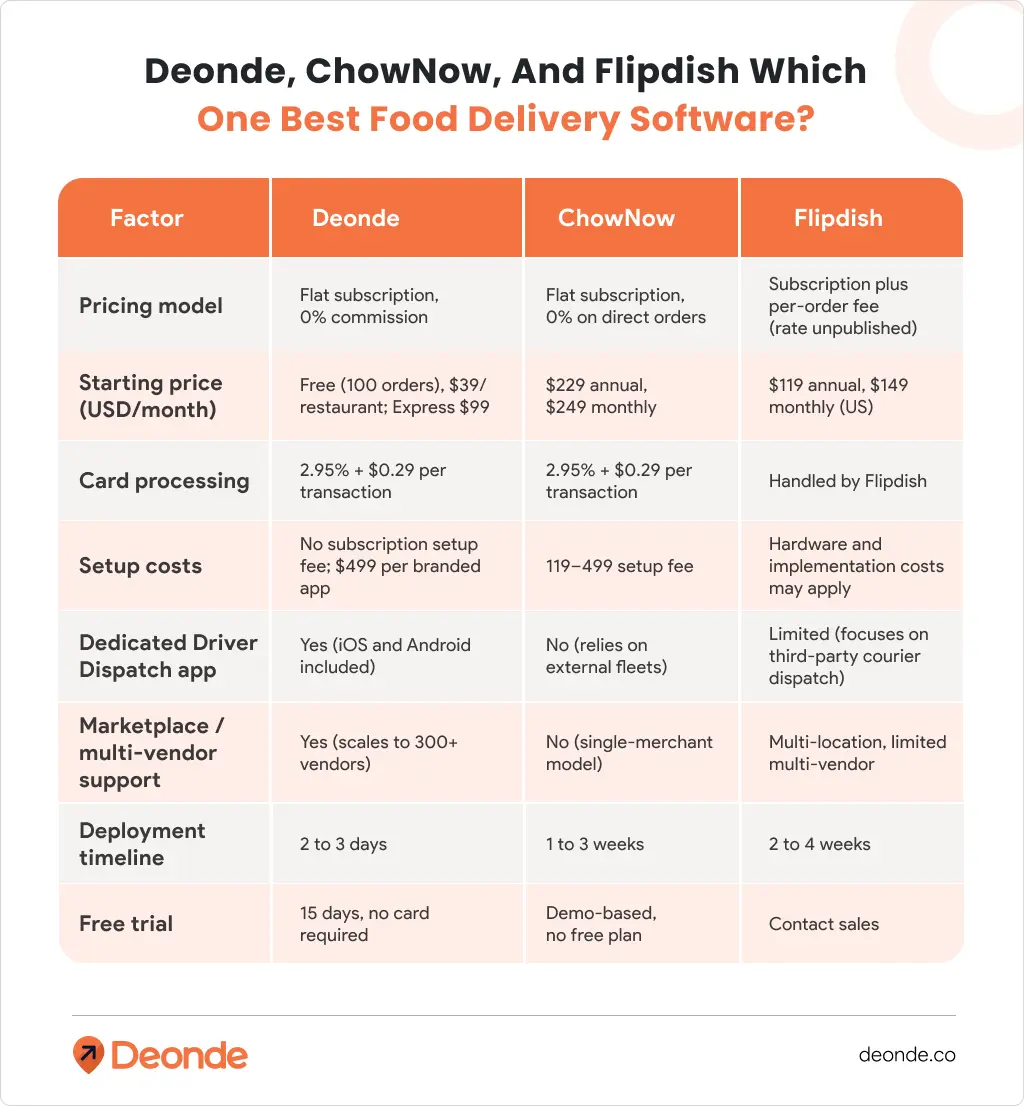
| Factor | Deonde | ChowNow | Flipdish |
| Pricing model | Flat subscription, 0% commission | Flat subscription, 0% on direct orders | Subscription plus per-order fee (rate unpublished) |
| Starting price (USD/month) | Free (100 orders), $39/restaurant; Express $99 | $229 annual, $249 monthly | $119 annual, $149 monthly (US) |
| Card processing | Your own gateway (Stripe, PayPal, Square) | 2.95% + $0.29 per transaction | Handled by Flipdish |
| Setup costs | No subscription setup fee; $499 per branded app | 119–499 setup fee | Hardware and implementation costs may apply |
| Dedicated driver dispatch app | Yes (iOS and Android included) | No (relies on external fleets) | Limited (focuses on third-party courier dispatch) |
| Marketplace / multi-vendor support | Yes (scales to 300+ vendors) | No (single-merchant model) | Multi-location, limited multi-vendor |
| Deployment timeline | 2 to 3 days | 1 to 3 weeks | 2 to 4 weeks |
| Free trial | 15 days, no card required | Demo-based, no free plan | Contact sales |
All three exist to reduce marketplace dependence. For the mechanics, see how a commission-free restaurant ordering system works.
Overview of each platform
Online ordering systems generally fall into two camps: tools designed primarily for menu display and order capture, and end-to-end delivery systems that handle dispatch, order tracking, and vendor management.
Deonde
Deonde is a dedicated white-label ordering and delivery software provider that operates in more than 24 countries.
Rather than routing orders through a shared consumer marketplace, the platform creates an independent, fully branded software footprint for restaurants, grocery stores, cloud kitchens, and multi-vendor delivery startups.
The software package covers every user touchpoint in the fulfillment chain. Operators get a branded customer ordering website, customer mobile apps on the Apple App Store and Google Play Store, a merchant management app for kitchen staff, a driver dispatch app with live GPS tracking, and a central web-based admin control panel.
The company operates on a software-as-a-service model, offering plans without per-order commissions so merchants keep 100% of order value.
ChowNow
Founded in Los Angeles, ChowNow built its reputation helping independent American restaurants establish commission-free direct ordering on their websites.
It gives restaurants a way to bypass third-party fees by embedding digital menus into existing sites, launching branded mobile ordering apps on select pricing tiers, and driving supplemental traffic through the ChowNow consumer app.
ChowNow focuses heavily on the customer acquisition and ordering side of restaurant operations. It coordinates fulfillment primarily through customer pickup or integration with external courier networks, such as its Flex Delivery program.
It does not include a proprietary dispatch application for restaurants operating their own in-house drivers.
Flipdish
Headquartered in Dublin, Flipdish provides digital ordering technology to restaurants, franchise networks, and hospitality groups across Europe and North America.
Its product catalog stretches beyond online ordering to encompass on-premise technology, including self-service kiosks, kitchen display systems, and branded mobile apps.
Flipdish works well for multi-unit chains that want to unify online ordering with in-store dining experiences under a single management system.
However, its implementation cycle is typically longer, and its pricing structures require custom discovery for larger feature sets and physical hardware.
Head-to-head comparison
Evaluating delivery software requires examining how each tool functions under actual service conditions. An operations team must assess ordering friction, driver dispatch mechanics, and setup timelines.
Customer experience and branding
Brand equity deteriorates when regular customers are redirected to a shared platform where competitors bid for their attention. Deonde gives operators complete brand isolation.
The apps on the App Store and Google Play carry only your company name, logo, and visual identity.
Customers track orders live via GPS, select from over 30 payment gateways, and use built-in loyalty programs without seeing other restaurants. Businesses can examine the live ordering experience on the Deonde platform to see how menus and customer accounts function.
ChowNow also supports branded ordering pages and standalone mobile apps on higher-tier plans. However, ChowNow heavily promotes its own consumer marketplace app.
While this can drive occasional discovery orders for US restaurants, it also means customer data and attention are shared within ChowNow’s broader consumer network.
Flipdish offers strong front-end web design and standalone mobile apps. The interface is clean, supports multiple languages, and provides custom loyalty programs.
For brands operating physical stores, Flipdish creates a uniform digital interface across mobile screens and in-store self-ordering kiosks, though its mobile customization can require extensive onboarding back-and-forth.
Driver and fleet orchestration
Managing delivery margins requires control over last-mile fulfillment. The ability to connect live order streams to automated dispatch, real-time driver tracking, and digital proof-of-delivery records directly influences delivery cost per order.
Deonde includes an operational Driver App and dispatch system within its core architecture. Drivers receive instant route assignments, turn-by-turn GPS navigation, and order status updates on iOS and Android.
Dispatchers can assign orders manually or set automated dispatch rules based on driver proximity and batch limits. The system captures proof of delivery through customer signatures, delivery photos, or OTP codes, giving dispatchers complete visibility into driver routes and settlement totals from the admin panel.
ChowNow does not provide a native driver dispatch application for restaurant staff. If a restaurant employs its own delivery drivers, orders must be routed, assigned, and tracked using third-party dispatch software or manual kitchen clipboards.
For restaurants without in-house couriers, ChowNow routes deliveries through contracted third-party fleets, which charge per-delivery fees that must be absorbed by the restaurant or passed to the customer.
Flipdish centers its delivery functionality on integrations with regional courier services and third-party logistics aggregators.
While it can push delivery tickets to external dispatch tools, it does not provide an out-of-the-box driver tracking and payout app built directly into the base platform.
Operators running an in-house fleet must stitch together external software to monitor drivers on the road.
Onboarding and deployment speed
Development timelines frequently derail restaurant tech updates. Building custom delivery apps from scratch requires months of engineering and tens of thousands of dollars. White-label systems shorten this window, but onboarding speed varies widely.
Deonde uses a deployment structure managed by dedicated onboarding specialists. Because the codebase, server environments, and app store configurations are standardized, typical go-live time runs between two and three days.
This timeline includes branding the web portal, configuring menus and delivery zones, setting up payment processors, and submitting customer and driver apps to the app stores under the client’s developer credentials.
ChowNow typically requires one to three weeks to deploy custom-branded apps, depending on the tier selected and the responsiveness of menu setup teams. Basic web-ordering widgets can go live faster, but full mobile app store releases require standard submission cycles.
Flipdish implementations take anywhere from two to four weeks. Multi-location setups, hardware shipping for kiosks, and deep point-of-sale integrations require detailed scoping calls and technical verification before opening to live traffic.
How Much Do ChowNow, Flipdish, and Deonde Cost in 2026?
Software expenses in the food and delivery sector must be weighed directly against order volume. A small percentage fee on every ticket can quickly surpass the cost of a flat software subscription once a restaurant handles steady volume.
ChowNow costs $229–$409 per month on annual billing, plus setup and card fees. Flipdish starts at $119 per month (US) plus an unpublished per-order fee. Deonde runs from free to $99 per restaurant on Ressto, or $99–$399 per month for Express marketplaces, with no commission.
ChowNow: $229– $449 Per Month Plus Fees
- Launch: $229 per month billed annually ($249 monthly).
- Grow: $319 annually ($349 monthly).
- Elevate: $409 annually ($449 monthly).
- Extras: $119–$499 setup, $99 yearly Apple developer fee for branded apps, $250–$420 for a printer, $7.98 per Flex Delivery order.
The plan list includes a discovery network (Google, Apple Maps, Yelp), 20+ POS integrations, and 24/7 phone and chat support.
Flipdish: From $119 Per Month (US)
- Website: $119 per site per month billed annually ($149 monthly).
- Website & Mobile App: $199 annually ($249 monthly).
- Self-service kiosk: $79 annually ($99 monthly), hardware extra.
- UK pricing: from £49 per month billed annually.
Flipdish processes every card payment itself. Third-party reviews report a per-order fee of roughly 2–7% plus processing. Get the exact figure in writing.
Deonde: Free to $99 Per Restaurant, or $99–$399 for Marketplaces
- Ressto Basic: free, 100 orders per month, cash payments only.
- Ressto Growth: $39 per restaurant per month, unlimited orders, custom domain, 20+ payment gateways.
- Ressto Scale: $99 per restaurant per month adds a branded iOS and Android app, delivery management, a driver app, and loyalty.
- Express: $99, $249, or $399 per month for 2,000, 5,000, or 9,000 orders, then $0.10 per extra order.
- Extras: $499 one-time per branded app; INR plans start at ₹1,999.
Deonde offers a 15-day free trial with no credit card. Compare order limits and add-ons in the full Deonde Express and Ressto pricing plans.
Real-World Example: 1,000 Direct Orders a Month
Take one restaurant with 1,000 direct orders a month at a $30 average ticket, or $30,000 in monthly sales.
| Annual cost | Deonde Ressto Growth | ChowNow Launch | Flipdish Website (US) |
| Subscription (12 months) | $468 | $2,748 | $1,428 |
| One-time setup | $0 | 119–499 | Varies |
| Per-order platform fee | $0 | $0 | Not published |
| Card processing | Your gateway’s rate | $14,100 (2.95% + $0.29) | Set by Flipdish |
At ChowNow’s assumed 22% average marketplace commission, the same sales would cost $6,600 a month, or $79,200 a year.
The plans are not identical, and ChowNow and Flipdish use annual-billing prices. ChowNow adds marketing automation and discovery listings. Deonde’s Scale tier ($1,188 a year) adds the app, drivers, and delivery tools.
Expert Advice: Based on the price sheets I checked on September 29, 2026, card processing is the largest line item. On ChowNow, it runs about five times the Launch subscription at this volume. Every platform passes processing through, so compare rates and whether you can bring your own gateway.
Who should choose what
No single piece of software fits every operational setup. Selecting the right platform depends on your existing delivery staff, physical footprint, and geographic location.
Choose Deonde if…
- You run an in-house fleet of delivery drivers and need a built-in dispatch and tracking app without paying for an external fleet management system.
- You operate a food delivery marketplace, cloud kitchen network, or local delivery collective connecting multiple independent vendors under one umbrella.
- You operate outside the United States and require multi-currency, multi-language support, and integrations with regional payment gateways.
- You want your system deployed quickly: Deonde’s dedicated food delivery software goes live in two to three days.
- Real client deployments validate this operational model: Debaditya Chaudhury, founder of multi-location restaurant chain Chowman, noted that launching a branded ordering app created a measurable operational difference, while Doni Riba, CEO of delivery service HungryJi, launched operations in under a week to handle growing sales volumes.
Choose ChowNow if…
- You are an independent, single-location restaurant located in the United States without delivery drivers of your own.
- Your priority is simple web ordering integrated with your existing website, combined with secondary exposure through ChowNow’s consumer marketplace.
- You rely on third-party on-demand drivers for fulfillment and do not plan to manage your own courier fleet.
Choose Flipdish if…
- You operate a regional hospitality chain or franchise that wants to unify digital web ordering with in-store self-service ordering kiosks.
- You require deep European market support and customized multi-location enterprise configurations.
- You want an all-in-one front-of-house technology vendor that supplies hardware alongside ordering software, and your timeline accommodates a multi-week setup process.
Step-by-Step: How to Switch Delivery Software Without Losing Orders
Switch in five steps: export your menu and customer data, connect payments and POS, configure delivery zones, launch your branded website and app, then move marketplace customers to direct ordering. Run the new platform in parallel with the old one until test orders succeed.
Step 1: Export your menu, customers, and order history
Pull item names, modifiers, prices, and photos, plus your customer list and 90 days of order history. Ask each vendor, in writing, who controls your customer data and how you export it.
Re-entering a large menu by hand is slow. Deonde’s assisted migration from your current ordering platform covers menu imports, zone setup, and configuration while you stay live on your old system.
Step 2: Connect payments and your POS
Connect a payment gateway whose rates you can negotiate, then confirm POS syncing before launch. ChowNow lists 20+ POS integrations, and Deonde supports 30+ gateways, with POS integration on Scale.
Step 3: Set up delivery zones and dispatch
Draw zones, set minimums and fees, and decide between couriers and your own riders. Building dispatch from scratch is slow; Deonde’s Scale plan ships with delivery management and a driver app ready to assign orders.
Step 4: Launch your branded website and app
Publish your ordering website first, then your iOS and Android apps. Custom builds need developers and store approvals.
Deonde’s branded ordering website builder for restaurants goes live in about 3 business days, and its white-label customer app for iOS and Android is published in 5 – 15 days.
Step 5: Move marketplace customers to direct ordering
Put a QR code and a direct-order offer in every third-party delivery bag. Keep marketplaces for discovery, and steer repeat customers to your own site.
Final verdict
Direct ordering is no longer a peripheral channel for food businesses; it is the foundation of operational independence from aggregator fees.
ChowNow remains a solid option for US restaurants that want a simple web-ordering widget and outsourced courier routing without building their own logistics operations. Flipdish excels at complex in-store kiosk installations and enterprise hospitality footprints across European markets.
However, when an operator needs a complete, self-contained delivery ecosystem combining branded customer apps, kitchen merchant controls, and native driver dispatch tools on flat monthly software pricing, Deonde is the superior platform.
By eliminating order commissions, providing multi-vendor capability, and completing deployment in two to three days, Deonde gives growing food and delivery businesses complete ownership over their customer relationships and delivery margins.
Need a longer checklist? Use these questions to ask before choosing a restaurant ordering system.