
Online grocery delivery businesses have skyrocketed, especially after the pandemic.
As a result, supermarkets and e-commerce players have focused heavily on strengthening their online delivery chains and workflows.
Online SaaS-based grocery apps, in particular, have seen an increase in usage across the global markets.
These apps have enhanced user convenience, enabling them to receive orders at the click of a button. As more customers opt for doorstep delivery, the demand for these online grocery delivery apps has increased.
As a result, the scope of developing grocery delivery applications across mobile operating systems has also broadened.
In this blog, we’ll uncover the workings, advantages, and a few examples of some of the best online grocery delivery apps in the United States.
So, let’s get started.
How Does An Online Grocery Delivery Business Work?
The on-demand grocery business has been tremendously successful because of widespread accessibility and convenience.
The on-demand grocery delivery model allows retailers and wholesalers to cater to a vast online market.
This business model comprises grocery retailers, app users, and delivery partners. The grocery delivery platform serves as an intermediary between them.
Typically, the grocery delivery platform establishes partnerships with various retailers, from large chains to local stores. These partnerships involve agreements on pricing, product availability, delivery zones, and commission structures.
These retailers are also responsible for preparing orders for pickup once a customer orders through the platform.
On the other hand, customers use the grocery delivery mobile app to browse available stores, select items, and place orders.
The app displays product details, pricing, and estimated delivery times. Then, customers make payments securely through the app using various digital methods. Customer app Features like real-time order tracking keep customers informed of their order’s status, and the app facilitates communication with the delivery partner or retailer if needed.
Lastly, delivery partners pick up prepared orders from retailers and deliver them to customers’ doorsteps. The grocery delivery app also provides navigational cues to ensure efficient deliveries.
The key to success in this business lies in providing customers with reliability, convenience, and ease of use.
Now that you know about the working model of an online grocery delivery business, let’s talk about who makes up our list of the Best Online grocery delivery apps in the USA.
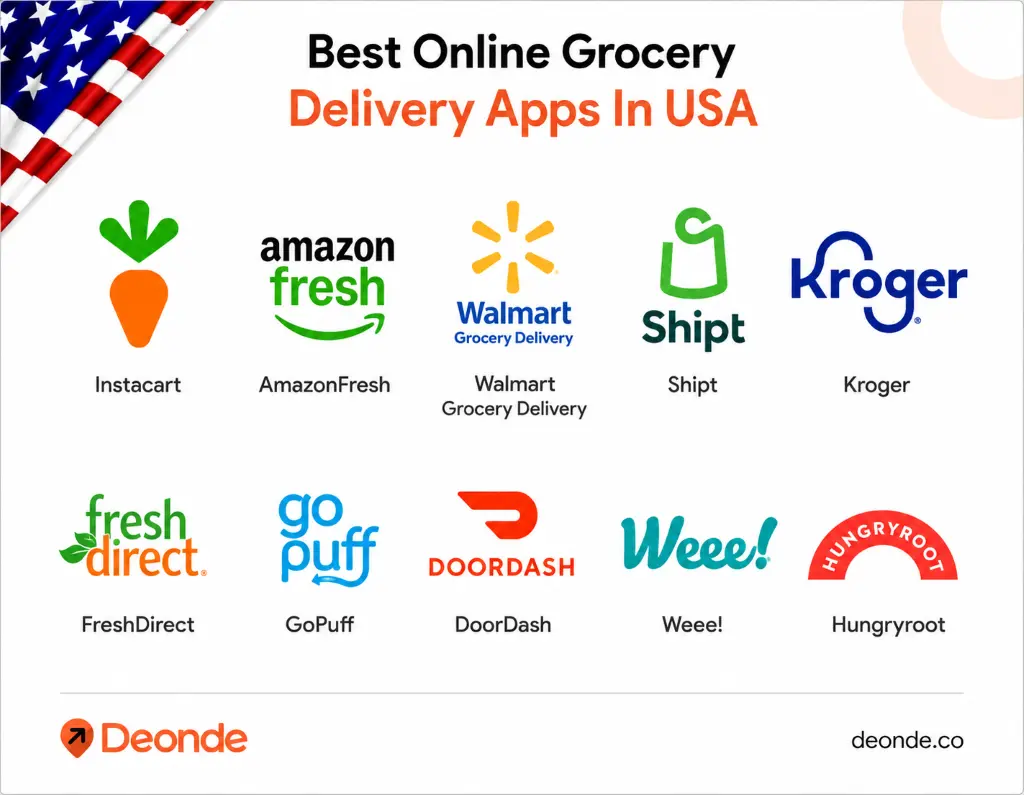
Top 10 Grocery Delivery Apps in the USA
Here is a list of online grocery delivery apps in the US.
1. Instacart

Instacart is one of the most downloaded grocery delivery app in the USA, with over 10 million downloads nationwide. Their delivery network has grown to reach about 98% of households across the U.S. and Canada.
Even with that download lead, brand awareness tells a different story — Walmart, Costco, and Uber Eats all rank ahead of Instacart when it comes to overall recognition among U.S. grocery shoppers.
Instacart’s tie-ups with grocery giants like Whole Foods, Costco, Safeway, and several others have helped them deliver over 300,000 items.
They have grown their retail network to more than 1,800 retail partners across the U.S. and Canada, now reaching about 98% of households in both countries.
Instacart went public on Nasdaq in September 2023, and as of mid-2026, the company holds a market valuation of roughly $11 billion.
Instacart’s success lies in its customer-centric approach. Incentives, like free deliveries, help Instacart stand out from the rest.
Additionally, their partnerships with a majority of US grocery giants allow customers to buy groceries from multiple stores. Hence, Instacart users can compare prices from multiple stores and make smarter purchases.
Along with this, features like multiple discounts, offers, and a membership option further help them penetrate the market.
Instacart+ members get $0 delivery fees on eligible orders $10 or more per retailer. Service fees apply. Costco orders $35+; restaurant orders $25+.
2. AmazonFresh
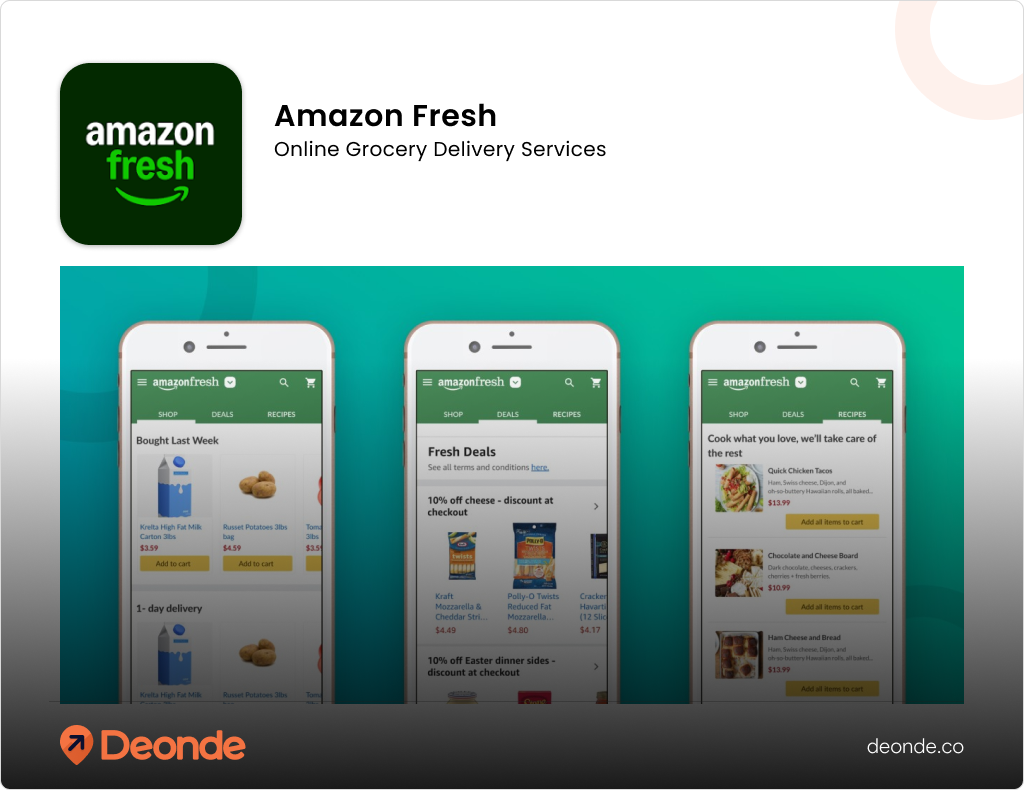
Introduced by Amazon, this on-demand grocery delivery service started out as an extension to Amazon Prime membership, and it’s grown a lot since then — though not without some big changes.
In January 2026, Amazon announced it was closing all of its Amazon Fresh and Amazon Go physical retail stores — affecting 72 locations — to focus more on its online grocery delivery network and its investment in Whole Foods Market.
Amazon said it hadn’t found the right business model to scale the physical Amazon Fresh format at large, so many of those locations are being converted into Whole Foods Market stores instead.
That doesn’t mean Amazon Fresh is gone — the online brand and delivery service are still very much active, just no longer tied to standalone physical stores.
Amazon’s online grocery reach has actually grown far beyond what the old Amazon Fresh stores ever covered: more than 2,300 cities and towns now get Same-Day Delivery on fresh groceries, and Amazon overall ranks among the top three grocers in the United states, with over $150 billion in gross sales and more than 150 million customers buying groceries annually.
Amazon has also rolled out Amazon Now, a 30-minute delivery service for groceries and everyday essentials. It’s widely available in Atlanta, Dallas–Fort Worth, Philadelphia, and Seattle, with rapid expansion into cities like Austin, Houston, Minneapolis, Orlando, Phoenix, Denver, and Oklahoma City.
U.S. Prime members pay a discounted delivery fee of $3.99 per order (versus $13.99 for non-Prime), with a small extra fee on orders under $15.
For standard Amazon Fresh orders, Prime members get free delivery on orders over $100, pay $6.95 for orders between $50–$100, and $9.95 for orders under $50. Non-Prime members pay between $4.95 and $13.95 depending on order size.
3. Walmart Grocery Delivery
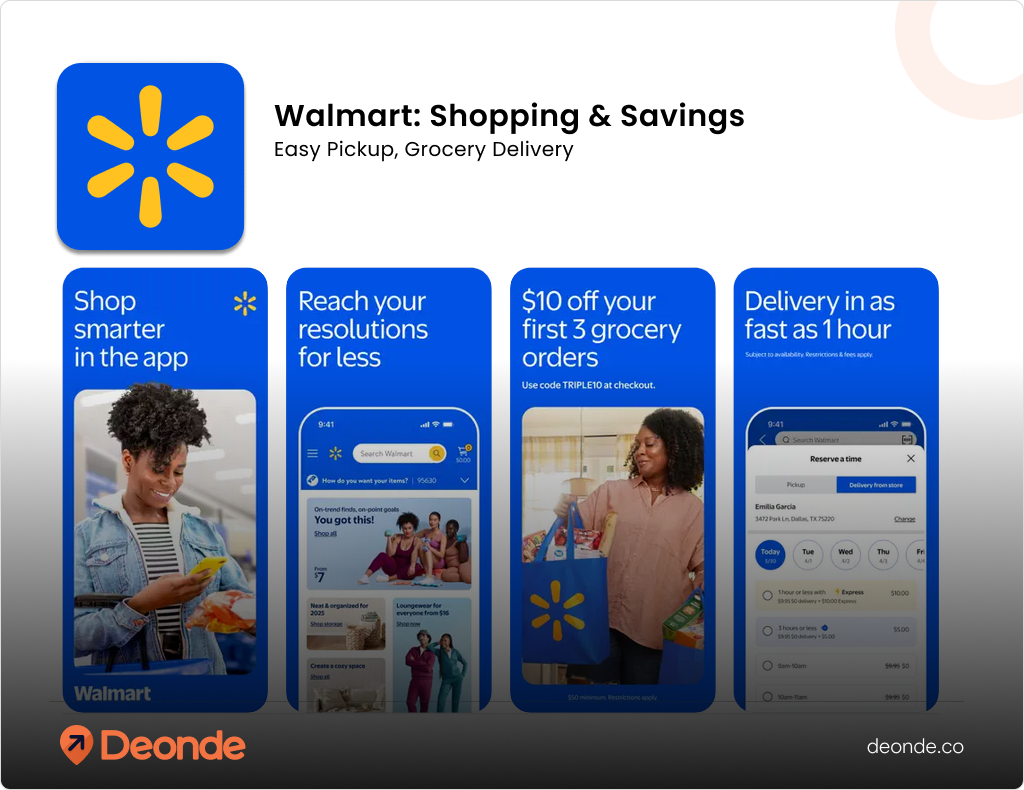
Walmart’s grocery delivery service integrates with its network of retail stores, extending store inventory to customers’ homes.
Walmart uses its roughly 4,600 U.S. stores as fulfillment points, with about 90% of the U.S. population living within 10 miles of a location. This allows the company to reach customers in rural areas that some competitors do not cover as consistently.
Walmart has not only maintained its position in U.S. online grocery through 2025 and 2026, but has continued to widen its lead over competitors. Industry estimates put Walmart’s share of the U.S. online grocery market at over 30%, with some analysts placing it as high as 35%+, ahead of Amazon and other rivals.
As per our research walmart to be the most widely used online grocery retailer overall, with 59.2% of online grocery shoppers reporting purchases through Walmart in the past year — well ahead of Amazon, which came in second at 45.1%.
The grocery e-commerce landscape has also shifted during this period — moving away from a pickup-focused model toward faster, delivery-first competition, with Walmart and Amazon both investing heavily in same-day and ultra-fast delivery.
The Walmart grocery delivery service offers a selection of products mirroring in-store inventory, letting customers browse and order groceries for home delivery. Customers can select preferred delivery time slots, with a standard delivery fee of $7.95–$9.95 per order for non-members.
Walmart+ membership costs $12.95 per month or $98 per year and includes free delivery on orders of $35 or more, along with other benefits like fuel discounts and free shipping.
This service underscores Walmart’s commitment to providing instant grocery delivery, prioritizing convenience and accessibility for its customers.
4. Kroger
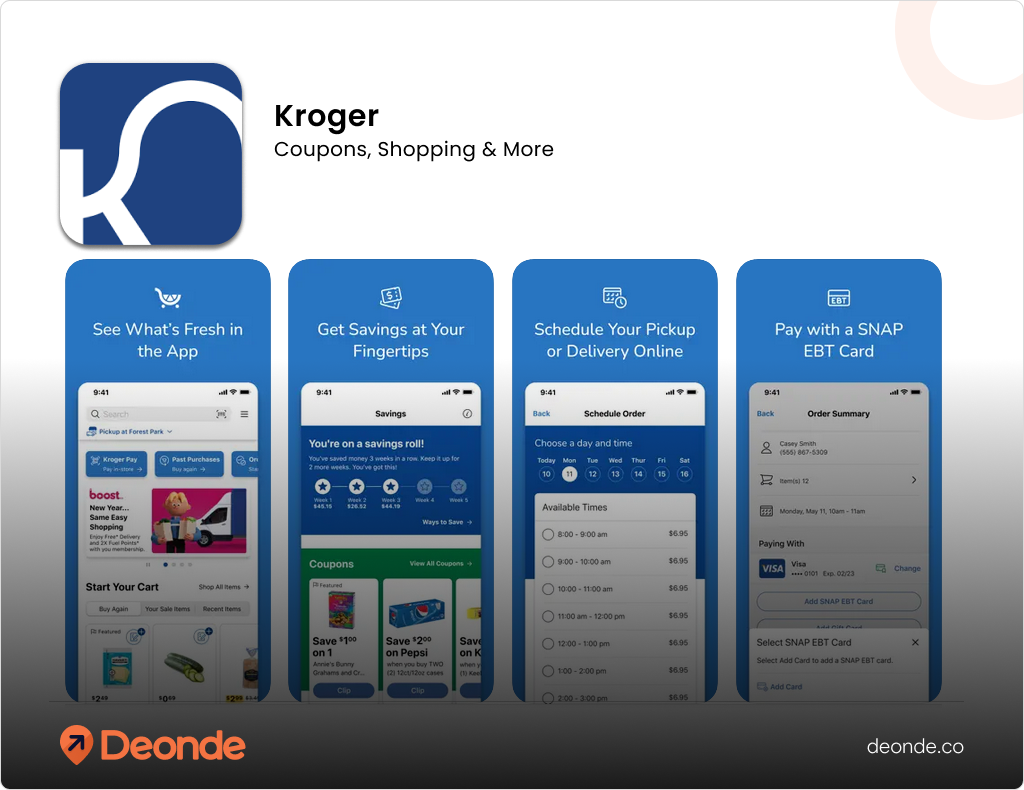
The Kroger Co. is America’s largest supermarket chain by revenue, operating thousands of grocery stores, marketplace locations, and pharmacies across the United States.
Kroger operates in 35 states with more than 2,700 stores across various banners. It is America’s largest supermarket chain by revenue (Walmart sells more groceries overall but is classified as a mass merchandiser, not a supermarket).
Kroger’s website is the most visited site in the grocery category in the country, accounting for 8.17 percent of desktop traffic. Instacart follows right behind at 6.83 percent.
The app delivers fresh groceries at competitive prices, with delivery starting at $6.95 through third-party partners.
Kroger’s app is tied closely to its loyalty program, offering digital coupons that can be clipped instantly.
Kroger previously invested heavily in robotic warehouse automation through a partnership with Ocado. That bet didn’t pay off — the program led to a $2.5 billion impairment charge in fiscal year 2025, and Kroger has since shifted its focus to store-based e-commerce fulfillment instead.
In July 2026, Kroger announced a $1.65 billion deal to acquire regional grocery chain Giant Eagle, adding about 197 supermarkets and 11 pharmacies across Ohio, Pennsylvania, West Virginia, Maryland, and Indiana. It’s Kroger’s first major acquisition since its attempted merger with Albertsons fell through in 2024.
5. Shipt
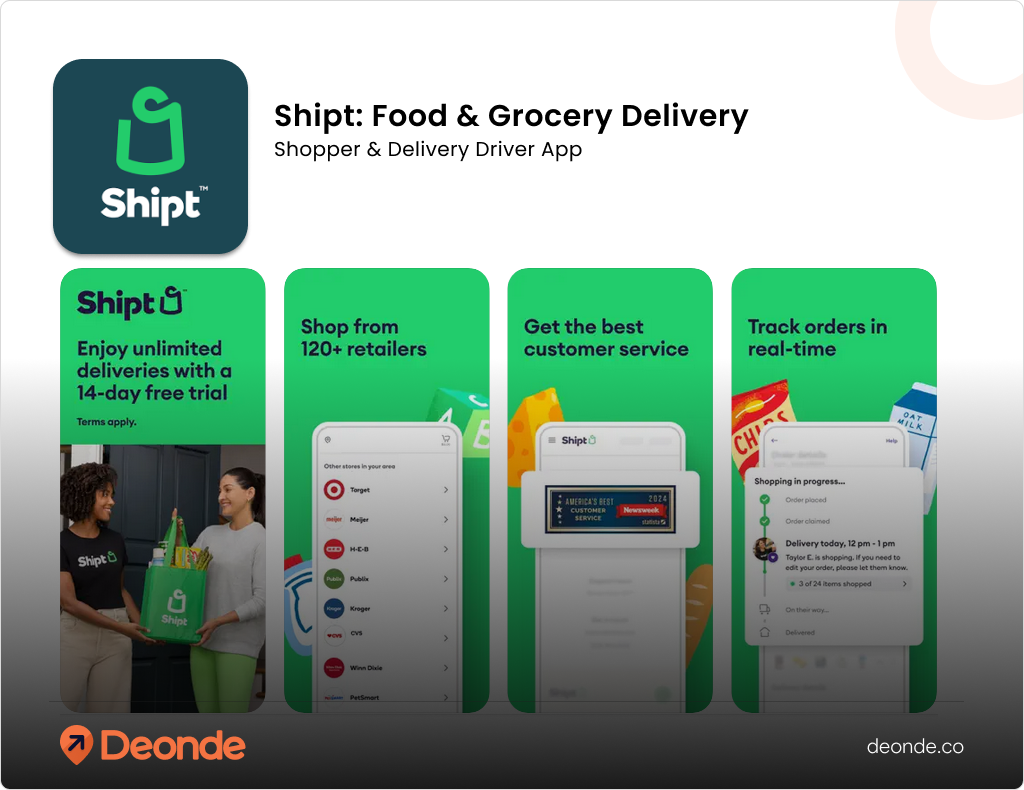
Shipt With over 50,000 shoppers and an estimated annual revenue of $1 billion, Shipt is a growing same-day grocery delivery platform. It has partnered with major retailers like Target, Whole Foods, Publix, and many more.
Shipt now operates in more than 5,000 U.S. cities, reaching about 80% of the U.S. population. A workforce of over 5,211 employees supports its delivery operations.
Shipt offers unique features, including the facility to browse sale items and request products not listed in stores. Its ‘Buy Again’ feature allows users to repurchase previously ordered items, making weekly grocery shopping more convenient.
In June 2026, Shipt introduced Shipt Kits, a one-click feature that groups items into pre-built bundles for specific occasions, such as game-day spreads, watch parties, and backyard cookouts. Instead of building a cart item by item, customers can add an entire themed bundle to their order in a single click.
The app can be accessed with a $15 monthly fee or a $99 annual membership fee.
6. FreshDirect

As the name implies, FreshDirect focuses on providing fresh products to its customers. Their target audience consists of people who are conscious about what they consume and where their food is sourced from.
Founded in 1999 by Joe Fedele, Jason Ackerman, and David McInerney, FreshDirect has changed ownership more than once. Ahold Delhaize USA acquired a majority stake in January 2021, then sold the company to Turkish ultrafast-delivery firm Getir in December 2023.
Despite the ownership changes, FreshDirect still operates under its own name — the brand, website, and delivery trucks have stayed the same for customers.
Getir kept the FreshDirect name and logo intact, given its 20-plus years of brand loyalty in the New York tri-state area.
FreshDirect continues to fulfill orders out of its 640,000-square-foot distribution hub in the Bronx, without merging warehouses with its parent company.
Customers still order through the FreshDirect website or app, while the parent company handles corporate backend operations, tech updates, and executive leadership.
Notably, even after Getir exited the U.S. rapid-delivery market entirely, it kept FreshDirect operating independently.
FreshDirect currently serves customers across seven Northeast states — New York, New Jersey, Connecticut, Pennsylvania, Delaware, Maryland, and Virginia — with its core markets centered on New York City, Philadelphia, and Washington, D.C.
A majority of their farm-fresh products come with information about their source. They have shorter supply chains than most supermarkets, meaning the produce delivered today was often harvested just a day or two earlier.
The delivery fee for an order varies by location, generally ranging from $6 to $20. FreshDirect has also partnered with Uber Eats to offer same-day and on-demand delivery, and in 2025 it opened its first physical retail location, a seasonal pop-up store in Southampton, New York.
7. GoPuff
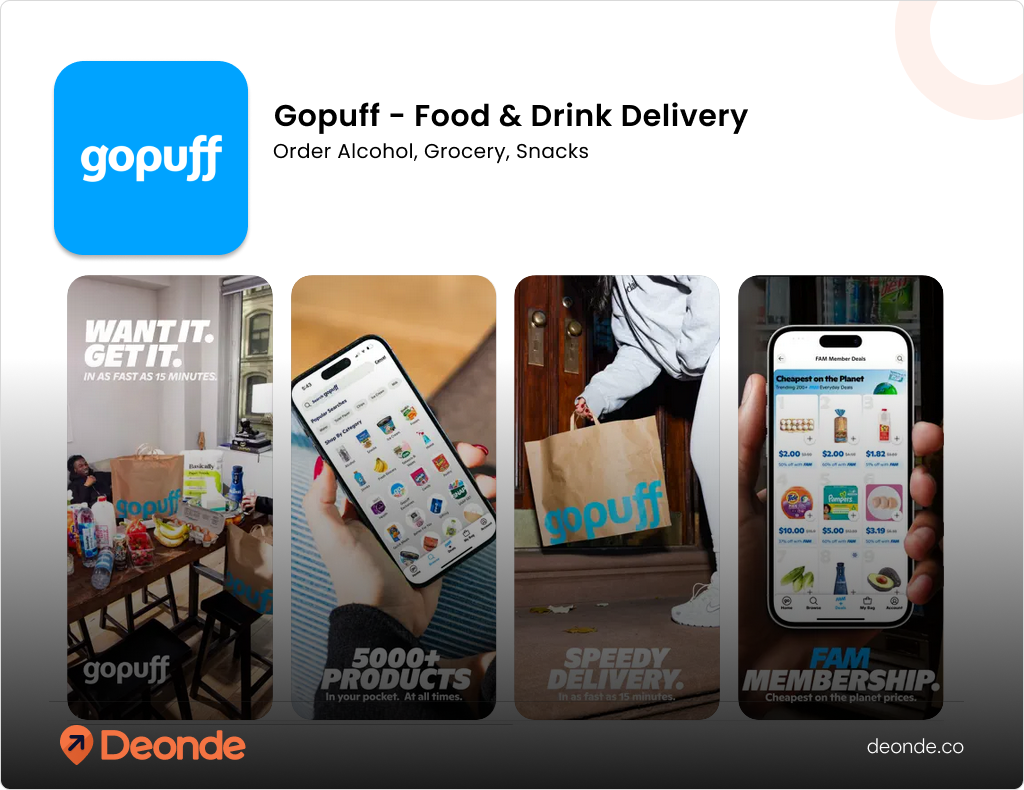
GoPuff is not a grocery store — it’s a digital convenience store. Unlike Instacart, GoPuff owns its inventory and stores it in micro-fulfillment centers (“dark stores”) across the U.S.
GoPuff is a rapid grocery delivery service that focuses on delivering everyday essentials and convenience items to customers’ doors in minutes.
It operates by establishing its micro-fulfillment centers in various locations. Customers can order through the Gopuff mobile app, and these deliverables are picked up by Gopuff’s own employed drivers.
This vertically integrated model — owning inventory, warehousing, and delivery — gives GoPuff more control over speed and margins compared to marketplace-style competitors like Instacart.
GoPuff’s offerings have expanded well beyond snacks to include groceries, alcohol (via its BevMo! acquisition), prepared foods, and over-the-counter medications in some markets.
It has also introduced Basically, a private-label product line aimed at improving margins.
Between 2022 and 2024, GoPuff went through several rounds of layoffs and closed a number of dark stores as it worked toward profitability, following the broader pullback in venture funding for rapid-delivery startups.
Since then, the company has taken a more disciplined, profit-first approach, and in November 2025 it raised $250 million in new funding.
With several early rapid-delivery competitors having exited the U.S. market entirely, GoPuff is now considered the last major scaled dark-store player in the space.
8. DoorDash
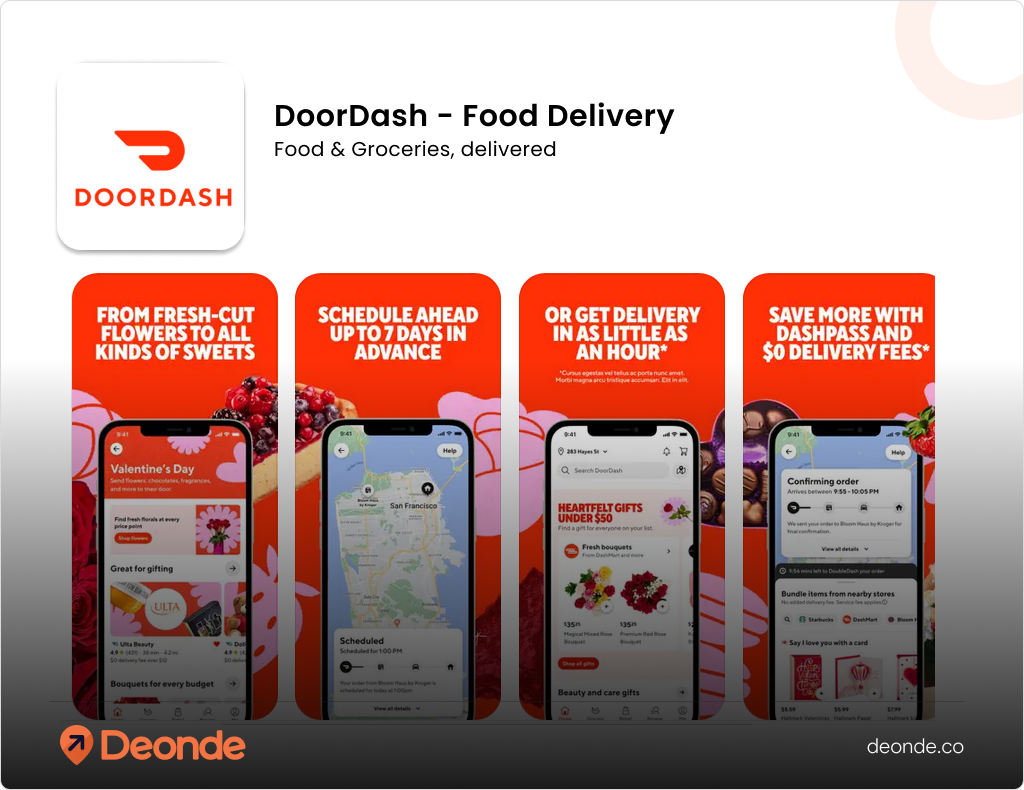
Doordash is a popular food ordering platform that also delivers essentials, snacks, beverages, and household items.
Now DoorDash has aggressively expanded into grocery with DashMart in united states
It now partners with over 55,000+ grocery and retail stores across North America, including giants like Albertsons, Sprouts, and regional favorites.
Along with Dashmart, it offers a fast and convenient shopping experience, often delivering orders within minutes.
By delivering items like groceries, personal care products, cleaning supplies, and pet food, they help get rid of traditional grocery shopping.
To further enhance the user experience, DashPass members get free delivery and are charged lower service fees on orders over $12.
9. Weee!
Weee! is America’s largest online e-grocer specializing in Asian and Hispanic foods platform in North America. Founded by Larry Liu in 2015, it caters to communities looking for authentic ingredients that are hard to find in mainstream American supermarkets.
If you are looking for specific Asian and Hispanic groceries that typical supermarkets don’t stock, Weee! is the undisputed leader in 2026. It has carved out a massive niche by delivering hard-to-find ethnic ingredients—like live seafood, exotic fruits, and specialty snacks—directly to your door.
Unlike standard apps, Weee! specializes in fresh produce and meats sourced directly from suppliers, allowing them to offer “everyday low prices” without a mandatory subscription fee.
In 2025, they even launched MásGusto, a dedicated platform specifically for Latino groceries, expanding its reach beyond its original Asian grocery focus.
They have also integrated SNAP/EBT payments with item-level eligibility checks, making culturally authentic food accessible to everyone. For users who love cooking global cuisines, Weee! is an indispensable tool.
As of 2025, Weee! has fulfilled more than 50 million orders and offers over 300,000 products sourced from countries including China, Japan, Korea, Vietnam, the Philippines, and Thailand.
10. Hungryroot
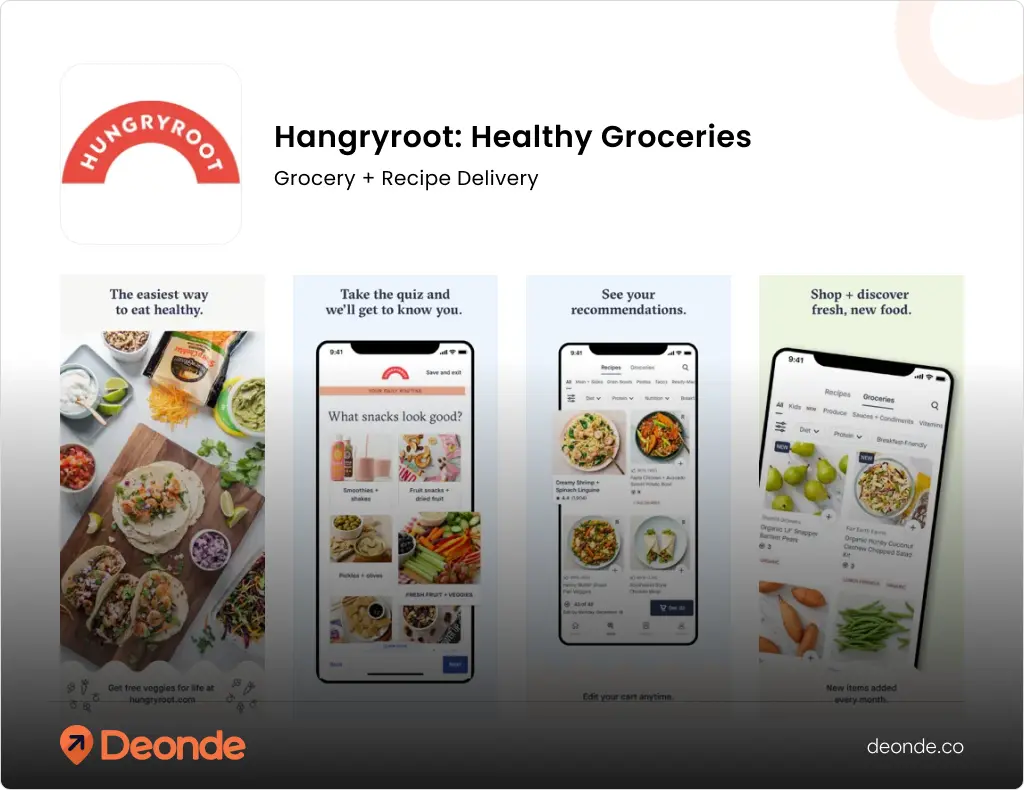
Hungryroot stands out because it isn’t just a grocery delivery app; it’s an AI-powered personalized meal planner. When you sign up, you take a quiz about your dietary preferences, and the app builds a cart for you with healthy groceries and simple recipes that use those exact ingredients.
It creates a bridge between meal kits and grocery shopping. You don’t just get ingredients; you get a plan on how to use them.
In 2026, their predictive modeling has become even sharper, helping users save hours on meal planning. While it operates on a flexible subscription model, the convenience of having your weekly menu and groceries automated is worth the cost for many busy professionals.
Additional Grocery Delivery Service Provider Apps Are Gaining Popularity in the USA in 2026.
While the giants listed above dominate the market, a new wave of grocery delivery services in the USA is gaining serious attention in 2026.
Misfits Market
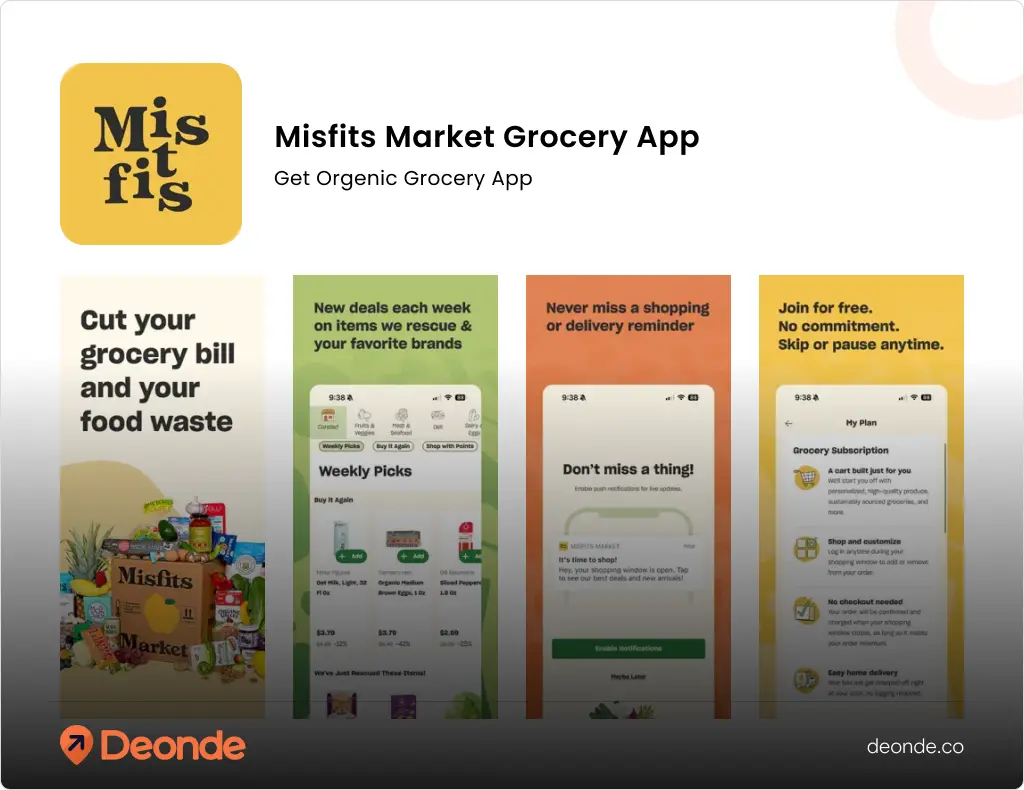
Misfits Market has revolutionized the way we think about grocery aesthetics and sustainability. Originally known for selling “ugly” organic produce, they have evolved into a full-service sustainable grocer, especially after their massive integration with Imperfect Foods.
This merger solidified their position as the ultimate eco-friendly grocery option. The app allows you to build a custom box of organic produce, high-quality meats, and pantry staples that might otherwise go to waste due to minor cosmetic flaws or surplus inventory.
It’s a win-win scenario: you save money (often up to 30% off grocery store prices), and you actively help reduce global food waste.
Aldi USA

Aldi has always been the king of budget-friendly shopping, and their digital footprint in 2026 is stronger than ever. Known for their no-frills approach and incredibly low prices, Aldi allows customers to order groceries for delivery primarily through partnerships.
The big highlight is their nationwide partnership with Uber Eats, which has made their low-cost groceries available on-demand to millions more customers.
This integration, combined with their existing Instacart availability, makes Aldi the most accessible and affordable instant delivery option for households across the USA looking to save on their weekly grocery bill.
Quick Comparison: Best Grocery Shopping Apps in USA
If you need a quick answer, here is how the top players compare in 2026.
| App | Coverage Area | Delivery Fee | Minimum Order | Best For | Best For Dietary Restrictions |
|---|---|---|---|---|---|
| Instacart | Nationwide, 85,000+ stores | From ~$3.99; $0 delivery fee on grocery orders of $10+ with Instacart+ membership ($99/year or $9.99/month) | $10 minimum to qualify for delivery | Widest retailer selection, fastest availability | Broad — shop specialty grocers (Whole Foods, Sprouts) on the same app for organic/GF/vegan needs |
| Amazon Fresh | 2,300+ cities and towns | Free for Prime members on orders over $25 (small-order fee below that); $9.95 for Whole Foods orders;$12.99–13.95 without Prime | ~$25 for free delivery (Prime) | One-cart shopping for Prime members | Strong via Whole Foods — organic, gluten-free, vegan selections |
| Walmart Grocery | Nationwide, ~4,700 stores | $7.95–$9.95, waived for Walmart+ members | $35 for free delivery; $6.99 fee below that | Everyday low prices, true one-stop shop | Budget-friendly; expanding organic/gluten-free private label |
| Kroger | ~35 states (Kroger, Ralphs, Fred Meyer, QFC, King Soopers, Harris Teeter, etc.) | $6.95–$14.95 depending on speed; free with Boost membership | $35 order minimum for free delivery | Loyal shoppers who want fuel points + rewards | Simple Truth brand — solid organic & gluten-free range |
| Shipt | Nationwide (Target + partner retailers like CVS, Meijer, Petco) | $0 for members on orders $35+; $7 for members under $35; $10 for one-time non-member delivery | No hard minimum; $35 for free delivery | Target shoppers who want a dedicated personal shopper | Depends on retailer chosen (Target, CVS, Meijer, Costco) |
| FreshDirect | Northeast only — NYC’s five boroughs plus parts of NJ, CT, PA, DE | Roughly $5.99–$15.99, | $35 for standard residential orders | Premium fresh produce & prepared foods in the NYC metro | Deep specialty/organic/local selection, curated for foodies |
| GoPuff | 1,000+ US cities/metro zones | $3.95 for non-members; free with FAM membership ($7.99/month or $79.99/year) | $10.95 ka minimum checkout basket | Ultra-fast (15–30 min) snacks, alcohol, and essentials | Limited — convenience-store style items, not health-food focused |
| DoorDash | Nationwide, 6,000+ grocery and retail stores including Albertsons, Safeway, Meijer, ALDI | Varies by store; $0 on eligible grocery orders of $25+ with DashPass ($9.99/month or $96/year) | Varies by merchant | One app for restaurants + groceries + retail; SNAP/EBT accepted | Depends on which retailer you order from within the app |
| Weee! | Major US metro areas | Varies by region; free above the local threshold | Around $35, though it varies by location | Asian, Hispanic & specialty groceries, hard-to-find imports | Best for cultural/cuisine-based diets, not allergen filtering |
| Hungryroot | 48 contiguous U.S. states | $6.99 for orders under $70; free for orders of $70+ | ~$60 recommended to get a useful box | Personalized healthy eating with almost no meal-planning effort | Excellent — explicit vegan, vegetarian, gluten-free, and keto filtering |
| Misfits Market | ~44 states (excludes AK, HI, and a few others) | About $5.99 shipping plus a $1.99 operations fee; free shipping with Misfits+ ($69/year) | As low as $15, though it can vary by location | Discounted organic/sustainable groceries, less food waste | Organic-first sourcing; some allergen-friendly items, no dedicated diet filter |
| Aldi USA | ~38 states, mostly Midwest & East Coast | $3.99 for 2-hour delivery, $5.99 for 1-hour; free with Instacart+ on $35+ orders | $10 minimum via Instacart | Rock-bottom grocery prices with delivery layered on top | Live GFree (gluten-free) and SimplyNature (organic) private-label lines |
Note: Delivery fees, minimums, and SNAP/EBT acceptance are subject to change and may vary significantly by ZIP code and local store policy.
What to Look for in a Grocery Delivery App
With so many grocery delivery apps competing for U.S. shoppers, picking the right one comes down to a few practical factors. Here’s what to check before you commit to one.
Delivery Coverage in Your Area
Not every app serves every zip code. Some, like Instacart and DoorDash, cover the vast majority of U.S. households, while others — like FreshDirect or Weee! — focus on specific regions or communities. Always confirm service is available where you live before comparing prices.
Delivery Fees and Minimum Order Requirements
Fees vary widely, from flat rates under $5 to $10 or more per order, and many apps waive fees only above a minimum order size (often $35). Factor in service fees and tipping, since these can add up quickly on smaller orders.
Membership and Subscription Value
If you order groceries online regularly, a paid membership (like Instacart+, Walmart+, or Shipt) can pay for itself through waived delivery fees. Compare the annual cost against how often you’d realistically use it.
Product Selection and Freshness
Some apps pull from a wide network of retailers, giving you access to multiple stores in one order. Others operate their own inventory and warehouses, which can mean fresher produce but a narrower selection. Consider what matters more for your shopping habits.
Delivery Speed
Delivery windows range from ultra-fast (15–30 minutes) to scheduled same-day or next-day slots. Faster delivery is convenient for last-minute needs, but scheduled delivery is often cheaper and better suited to a full weekly shop.
Payment Flexibility
If you use SNAP/EBT benefits, check that the app supports them — not all do, and some only support select items. Apps like Walmart, Amazon, and Weee! have expanded EBT support in recent years.
Reliability and Customer Support
Look for apps with clear substitution policies, responsive customer support, and satisfaction guarantees in case items arrive damaged, missing, or incorrect.
Key Advantages Of Using Deonde’s White-Label Grocery Delivery Solution
- Faster Time to Market: Launch your app in weeks or months, not years.
- Reduced Development Costs: Avoid the hefty expenses of custom app development.
- Proven Technology: Benefit from a platform that’s already been tested, used, and refined by customers across the globe.
- Customization Options: Tailor the app to your specific branding and business needs.
- Focus on Core Business: Concentrate on building your brand, marketing, and customer acquisition, rather than technical development.
- Scalability: Easily scale your operations as your business grows.
Final Thoughts
The online grocery delivery market is experiencing explosive growth, driven by changing consumer habits, increased convenience demands, and tech advancements.
This rapid expansion presents a significant opportunity for entrepreneurs and investors looking to enter a dynamic and profitable industry.
By launching your own grocery delivery app, you can directly enter this market and capture a share of the expanding customer base.
However, building a successful grocery delivery app from scratch can be complex and time-consuming. It requires significant investment in development, design, infrastructure, and logistics.
This is where white-label solutions like Deonde’s offering become invaluable.
Deonde’s white-label grocery delivery software solution a cost-effective and efficient way to launch your own branded grocery delivery service.
Instead of starting from scratch, you leverage a pre-built, customizable platform with essential features and functionalities.
This significantly reduces development time and costs, allowing you to get your business up and running much faster.
FAQs:
1. What is the Most Used Grocery Delivery App in the USA?
Instacart remains the dominant market leader due to its massive reach. It covers over 85% of US households and partners with major chains like Costco, Kroger, and Wegmans. However, Walmart Grocery is a close competitor, especially for customers looking for everyday low prices without service fees.
2. Why Choosing The Right Grocery Delivery App Matters?
Online grocery shopping has become a daily habit for many customers in the USA. People now want faster delivery, easier ordering, better prices, and a smooth app experience that saves time. That is why choosing the right grocery delivery app matters more than ever.
3. What Makes Instacart a Popular Choice For Grocery Delivery?
Instacart’s popularity in the United States stems from its extensive network of retail partner stores. As a consequence, it has a wide product selection that can cater to multiple consumer segments. Besides, it also has a user-friendly interface and advanced features like price comparison and personalized recommendations.
4. What Is a White-Label Grocery Delivery App?
A white-label grocery delivery solution is a pre-built, customizable app platform allowing you to launch your branded grocery delivery service quickly and cost-effectively without developing it from scratch.
5. What Are The Advantages Of Using A Grocery Delivery App?
Grocery delivery apps offer numerous benefits, including the convenience of shopping from home, time savings, saving you from making numerous trips to the store, a wider selection of products, price comparison, finding the best deals, and often faster delivery than traditional shopping.