
Building an app like GoPuff means running three operations at once. You manage inventory. You operate local dark stores. You deliver in under 30 minutes. Most entrepreneurs plan for the app. They underestimate the infrastructure behind it.
The global quick commerce market is valued at $199.92 billion in 2026. It is projected to reach $385.36 billion by 2034. The US market alone is expected to hit $55.68 billion this year. That is not a niche opportunity. It is a structural shift in how people buy daily essentials.
This guide gives you a step-by-step plan to build an app like GoPuff. You will learn the required features, the technology stack, and realistic cost ranges. You will also learn when a GoPuff app builder outperforms building from scratch.
What is a GoPuff-style app? It is an instant delivery platform that owns its inventory. It stores products in local micro-fulfillment centers and delivers to customers in under 30 minutes. The platform connects four components in real time: a customer app, a warehouse picker panel, a driver app, and an admin dashboard
What Makes the GoPuff Model Work
GoPuff does not pick up from restaurants or retailers. It stocks its own products in dark stores — small, private warehouses placed inside dense urban areas. When a customer orders, a warehouse picker pulls the items. A driver delivers them. The full process takes under 30 minutes.
This dark store model gives GoPuff three operating advantages over marketplace-style apps. First, it eliminates third-party vendors from the supply chain. Second, it gives GoPuff full control over product availability, quality, and pricing. Third, it delivers consistent sub-30-minute fulfillment across every order.
GoPuff holds approximately 30% of the US quick commerce market. Its private-label line now appears in nearly 20% of all orders. These numbers reflect what happens when an operator controls both inventory and last-mile delivery.
To understand how GoPuff monetizes this model — delivery fees, subscriptions, advertising, and product margins — read the full GoPuff Business & Revenue Model
Steps to Create Your Own App Like Gopuff
Building a complex delivery platform requires a clear roadmap. You cannot just guess your way to success. You need to follow a proven process to avoid expensive mistakes.
Step 1: Validate Your Market Before You Write a Line of Code
No tech decision matters until you confirm demand in your target city. GoPuff did not expand everywhere at once. It perfected one dense urban market before replicating the model.
Run three checks before starting development.
Check 1: Who is your customer? GoPuff’s core users are 18–35-year-olds buying snacks, drinks, and household essentials. Your niche may differ. A pharmacy-focused instant delivery app targets a different buyer than a drinks-and-snacks platform. Define your customer before you define your product catalog.
Check 2: Can your dark store radius support the model? A single micro-fulfillment center covers a 3–5 km delivery radius reliably. Map your first location. Count the residential population within that radius. A minimum of 50–100 orders per day is the threshold where the economics begin to work. Below that, driver costs exceed delivery revenue on most orders.
Check 3: Who are your real competitors? In most cities, you will face at least one funded quick commerce player — Blinkit, Zepto, Gorillas, or a regional equivalent. Study their product range, delivery time promises, and pricing. Find the category or demographic they are not serving well. That gap is your entry point.
Validation takes 2–4 weeks. It prevents 8–12 months of building the wrong product for the wrong market.
Step 2: Build the Right Feature Set for Your GoPuff Clone App
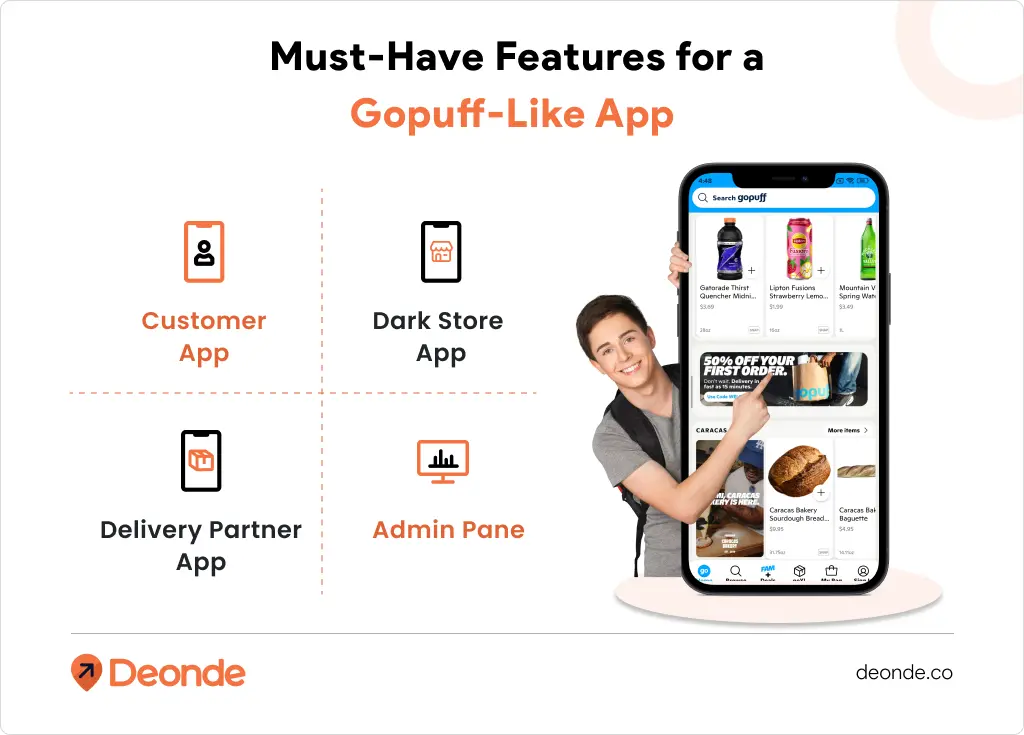
A GoPuff clone app is not a single application. It is four interconnected panels. If any panel is missing, the fulfillment chain breaks.
Customer App — What Buyers See
- Product catalog with category filters and search
- Real-time order tracking with live driver location on a map
- In-app payments (cards, digital wallets, cash on delivery)
- Order history with one-tap reorder
- Push notifications for order confirmation, packing, and dispatch
- Promo codes and referral rewards
- Scheduled delivery option for non-urgent orders
Driver App — What Delivery Staff Use
- Incoming order alerts with warehouse pickup address and item summary
- Optimized delivery route guidance
- Proof of delivery via OTP confirmation or customer signature
- Daily earnings dashboard and payout history
- In-app support for order issues
Warehouse Picker Panel — What Fulfillment Staff Use
- Real-time order alerts with complete item lists
- Bin location guidance for faster picking
- Inventory count management per SKU
- Low-stock alerts and restock request workflow
- Packing confirmation before driver assignment
Admin Dashboard — What Operators Control
- Full order management across all dark store locations
- Real-time delivery zone monitoring
- Driver fleet tracking and manual dispatch override
- Product catalog management with bulk pricing tools
- Revenue reports, driver settlement, and payout processing
- Customer analytics — retention rate, average order value, top products
Every feature in this list exists for an operational reason. Removing any panel creates a gap that only manual work can fill — and manual work does not scale.
Step 3: Quick Commerce App Development — Build From Scratch or Use a Platform
This is the most consequential decision in your build plan. It determines your launch timeline, your upfront cost, and how quickly you can adapt after launch.
Path 1: Custom Development You engage a development team — in-house or outsourced. They build all four panels from scratch. This path gives you full technical control and a codebase you own outright.
The real cost: 8–14 months of development time. A budget of $65,000–$160,000 depending on team size and geography. Ongoing maintenance of $3,000–$8,000 per month after launch.
More critically: you cannot acquire your first customer until month 9 or later. A competitor using a white-label platform is already running operations in your target city. Your team is still in sprint planning.
Path 2: GoPuff App Builder (White-Label Platform) A white-label on-demand delivery app development platform gives you all four pre-built, tested panels. You configure your brand identity, delivery zones, product catalog, and payment settings. Then you launch.
Timeline: 7–14 days instead of 8–14 months. Cost: a monthly subscription of $300–$1,500 — with no large upfront payment.
The capital you save on development goes to dark store setup, inventory, and driver acquisition. That is the spending that actually drives growth.
For most founders entering this space, the white-label path is the strategically correct starting point. You validate the business model with real customers before committing to custom infrastructure.
Explore Deonde’s quick commerce software solution to see what a ready-built platform includes.
For a full cost comparison between custom development and a platform approach, read How Much Does It Cost to Develop an App Like GoPuff.
Step 4: Technology Stack for Custom On-Demand Delivery App Development
If you choose the custom build path, your development team must make the right architecture decisions from day one. Poor stack choices create expensive rewrites six months in.
Frontend
Customer App and Driver App React Native is the standard for cross-platform on-demand delivery app development. One codebase runs on both iOS and Android. This cuts build time by 30–40% compared to building two separate native apps.
For the warehouse picker panel, a web-based interface in React.js works better than a mobile app. Pickers use tablets mounted inside the warehouse. A web panel is faster to update and easier to manage at scale.
Backend
Node.js handles real-time events effectively. Order placements, driver location updates, and status changes all happen concurrently. Node.js manages high-concurrency workloads without performance degradation.
Pair it with PostgreSQL for relational data — orders, users, products, transactions. Add Redis for real-time caching and queue management. Redis handles the driver dispatch queue: matching new orders to available drivers in under a second.
Real-Time Tracking
Firebase Realtime Database or Socket.io handles continuous GPS updates between the driver app and the customer app. Every 5–10 seconds, the driver’s position updates on the customer’s tracking map. Without this infrastructure, your delivery tracking displays estimated position — not actual movement.
Mapping and Route Optimization
Google Maps API for customer-facing delivery tracking. Add an open-source routing engine — OSRM or OpenRouteService — for driver route optimization. This reduces average delivery time and fuel cost as order volume scales.
Payments
Stripe or Braintree for card transactions. Add local payment gateways based on your target market: Razorpay for India, PayTabs for the Middle East, Paystack for Africa, Square for North America.
Cloud Infrastructure
AWS or Google Cloud with auto-scaling groups configured from day one. Quick commerce platforms face severe demand spikes — Friday evenings, public holidays, and local events. Infrastructure that does not auto-scale crashes precisely when you need it most.
Why This Stack Is Complex?
Each component requires specialist knowledge to configure, secure, and scale correctly. A backend developer who knows Node.js may not know how to configure Redis for delivery queue management. A React Native developer may not know how to optimize battery usage on a GPS-active driver app running continuously in the background.
This architecture complexity is the strongest argument for starting with a white-label delivery platform. The architecture has already been stress-tested across real delivery operations at scale.
Step 5: Dark Store Setup — the Infrastructure Behind the App
GoPuff’s actual competitive advantage is not its app. It is its fulfillment infrastructure. The app is the customer-facing surface. The dark store is the engine.
Location Choose a ground-floor commercial space between 500–2,000 sq ft. Proximity to dense residential areas matters more than rent cost. You do not need a high-footfall location — no customer ever visits in person. Prioritize your 3–5 km delivery radius over street address.
A single well-placed dark store can process over 100 orders per day when the picker workflow is optimized. Globally, the most efficient dark stores complete the picking process in 3–4 minutes per order. That speed is the result of organized bin systems — not fast pickers.
Starting Inventory Begin with 200–400 SKUs. Do not stock 2,000 items in month one. Stock the 200 products your target demographic orders most frequently. Restock daily using your order data — your admin dashboard shows exactly what sold out and when.
Orders above $28 basket value generate positive contribution margins in a well-run GoPuff-style operation. Design your product catalog and minimum order value to push customers above that threshold from the start.
Picker Workflow Your picker should pull and pack a standard order in under 3 minutes. Organize shelves by category with bin location labels. Every SKU has a fixed bin address. The picker walks directly to the item — never searching.
A disorganized warehouse destroys the sub-30-minute delivery promise before a driver ever leaves the building.
Staffing at Launch A single dark store at launch needs 2–3 pickers per active shift. Plan for 4–6 drivers covering your delivery zone. Start lean. Analyze weekly order volume data. Add staff when daily orders consistently exceed 60–70 per day.
How Much Does It Cost to Build an App Like GoPuff
The financial case for a white-label approach is not about cutting corners. It is about deploying capital where it generates returns. Every dollar saved on development is available for dark store rent, opening inventory, and driver acquisition. Those three areas drive your first 100 daily orders.
5-Step Action Plan to Build an App Like Gopuff (Using the Smart Path)
You came here to learn how to launch a quick commerce business. Here is your actionable, 5-step plan for launching your business in the next few weeks.
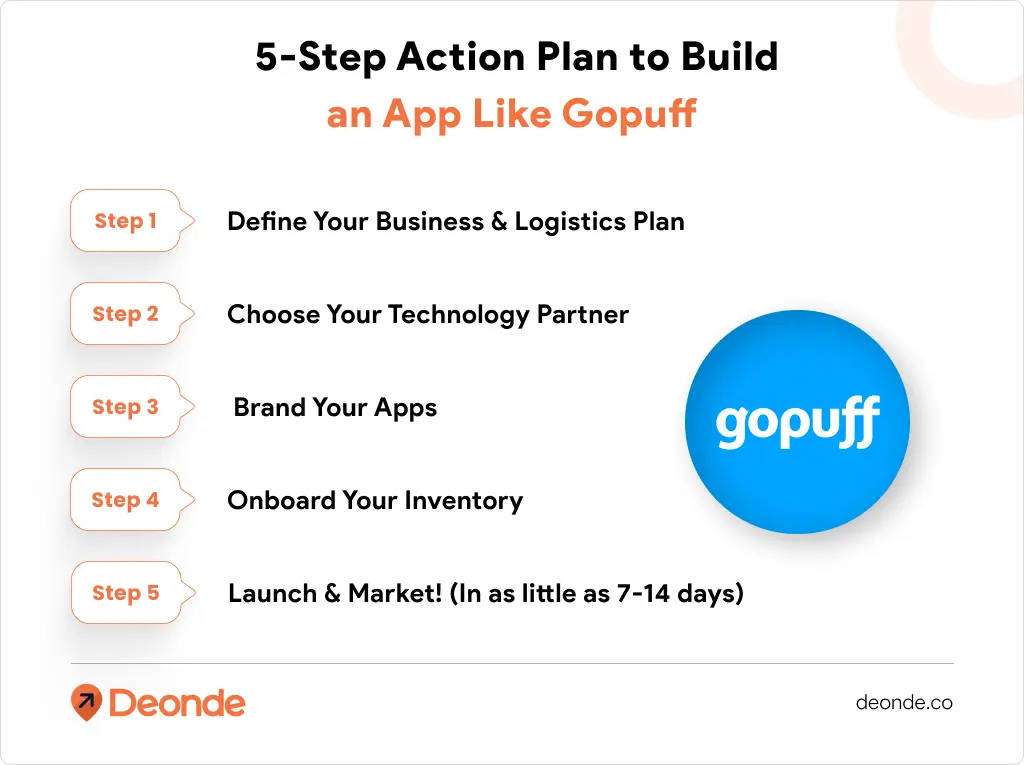
Step 1: Define Your Business & Logistics Plan
Stop thinking about code. Start thinking about the business.
- What is your niche? (Snacks? Groceries? Pharmacy? Alcohol?)
- What is your delivery zone? (Typically a 3-5 mile radius from your MFC to ensure speed).
- Where will you set up your first Micro-Fulfillment Center (MFC)? (This can be a small rented warehouse, the back of an existing store, or even a garage to start).
- How will you source your inventory? (What are the minimum order quantities? What are the payment terms with suppliers?)
Step 2: Choose Your Technology Partner
This is your most important decision. You need a partner, not just a product. You need a platform that is proven, stable, and ready to scale with you. This is the moment you research and schedule demos. When evaluating them, ask about their pricing models, support levels, update frequency, and scalability.
Step 3: Brand Your Apps
Once you’ve chosen a partner, the fun begins. You will provide your logo, your brand colors, and your company name. Their team will then get to work, using their ready-made solution to build your unique, branded apps for the Apple App Store and Google Play Store.
Step 4: Onboard Your Inventory
Using the powerful Admin Dashboard, you will start uploading your products, setting your prices, and managing your inventory. You can start building your digital store immediately, with most businesses fully onboarding their initial inventory within a few days.
Step 5: Launch & Market! (In as little as 7 days)
The moment your branded apps are live, you can start your marketing (social media, local flyers, Google My Business optimization, and local partnerships) and start taking your first orders. You are now a business owner.
Three Mistakes That Kill GoPuff-Style Businesses at Launch
Mistake 1: Overbuilding the app before validating demand You do not need fifty features on launch day. You need fast delivery and accurate inventory. Build the core. Add features after your first 500 verified orders confirm the model works in your specific market.
Mistake 2: Setting a delivery radius that breaks your time promise A 10 km delivery radius sounds like more coverage. It destroys your 30-minute guarantee. One driver cannot cover 10 km and return in time for the next order at any meaningful order volume. Start with a 3–5 km radius. Expand when your driver fleet and order density support it.
Mistake 3: Scaling before unit economics work Do not open three dark stores until the first one consistently generates positive contribution margins. GoPuff closed multiple stores in 2022 after expanding before the economics were profitable. Test one market completely before replicating.
Conclusion
The demand for instant delivery is not just a trend; it is the new standard. Customers value their time more than ever. They are willing to pay for speed. This creates a massive opportunity for entrepreneurs like you.
Don’t fall into the “perfection trap” of believing you must build everything from scratch to be successful. It is a slow, expensive, and high-risk path that distracts you from your real job: serving your customers.
Experience shows that the entrepreneurs who succeed fastest are those who focus. They don’t try to be a tech genius and a marketing genius and a logistics expert. They build their business by focusing on their strengths—like marketing and local relationships—and partnering with an expert for their weaknesses.
By letting a dedicated, expert technology partner provide their powerful, white-label solution, you can launch your own branded business in as little as 7 days.
You focus on building your brand. You focus on curating your products. You focus on building a business that lasts.
Stop planning and start doing. Define your niche, choose your partner, and launch your business. The market is waiting for the next big player in your city. Why shouldn’t it be you?

FAQ
How much does it cost to build a GoPuff-like app?
Custom development costs $65,000–$160,000 and takes 8–14 months. A white-label GoPuff app builder costs a monthly subscription of $300–$1,500 and launches in 7–14 days. Most startups choose the second path to protect capital for dark store operations, inventory, and driver acquisition.
What features does a GoPuff clone app need?
The minimum viable feature set spans four panels. First, a customer app with real-time tracking and in-app payments. Second, a driver app with route guidance and proof of delivery. Third, a warehouse picker panel with order alerts and inventory management. Fourth, an admin dashboard with order management, driver fleet tools, and revenue reporting. All four are non-negotiable.
Can I launch a quick commerce app without custom development?
Yes. White-label quick commerce platforms include all four panels pre-built and tested. You configure your brand, delivery zones, and product catalog — then launch within 7–14 days. This is how most instant delivery startups enter the market today.
How long does it take to build an app like GoPuff?
Custom development takes 8–14 months with a full team. A white-label GoPuff app builder reduces this to 7–14 days. The difference is not just time. It is the customer acquisition advantage you gain by operating 6–12 months earlier than a custom-build competitor.