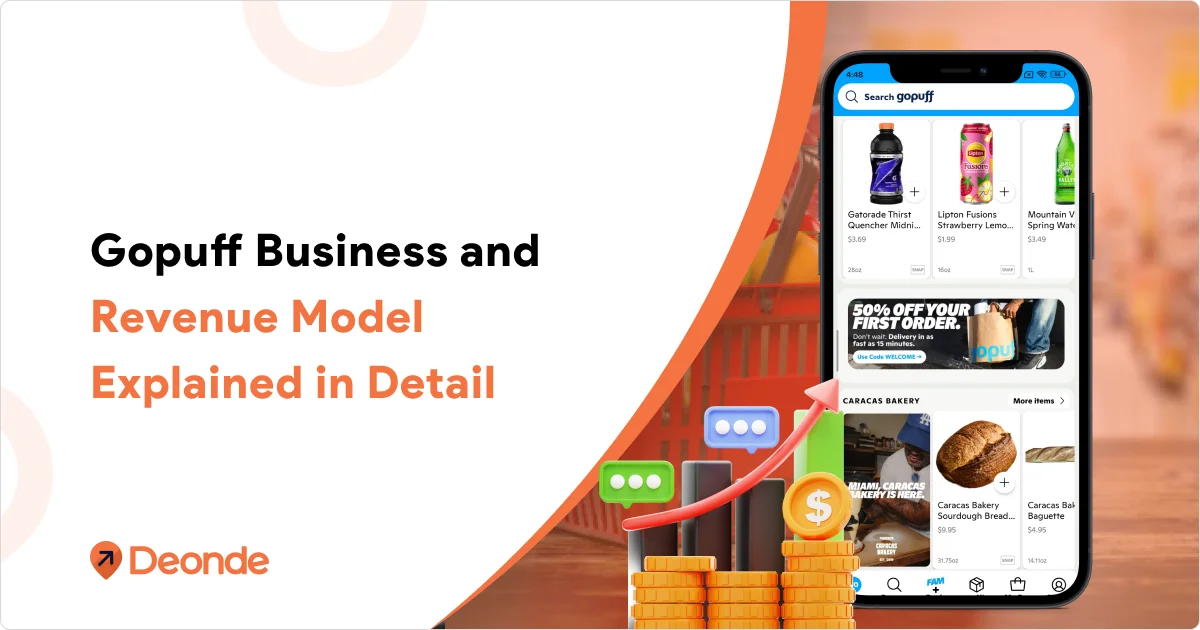
Quick commerce, or “q-commerce,” promises delivery of everyday items in minutes. At the forefront is Gopuff, a company that has attracted billions in capital by mastering this high-speed convenience.
The core question for any strategist is simple: how can this model be profitable? The unit economics of delivering a single, low-cost item in 15 minutes seem fundamentally broken.
This is the central challenge of the Gopuff business model. Unlike aggregators like DoorDash, Gopuff is not just a platform; it’s a full-stack, vertically integrated retailer.
This means it controls the entire supply chain, from purchasing products wholesale to operating its own network of micro-fulfillment centers (MFCs), commonly known as “dark stores.”
This blog will dissect the complete Gopuff revenue model. We will move beyond the customer-facing app to analyze the machine beneath: its supply chain, its subscription service, and its high-margin advertising business.
We will answer the critical question for any founder in this space: How does Gopuff make money, and is its model a sustainable blueprint for the future of convenience?
What is Gopuff and How Does it Redefine Convenience?
Gopuff is a leading quick commerce (or “q-commerce”) company that delivers a wide range of convenience items, groceries, alcohol, and everyday essentials directly to consumers, often in 15 minutes or less.
Founded in 2013 by two Drexel University students, Yakir Gola and Rafael Ilishayev, Gopuff began by delivering snacks and essentials to college campuses.
It has since grown into a massive international operation through billions in venture capital funding and strategic acquisitions, most notably acquiring BevMo! (a large US alcohol retailer) and Dija (a European q-commerce startup).
Its core value proposition is speed and reliability. Customers can open the app, choose from thousands of items—ranging from ice cream and alcohol to cleaning supplies and baby products—and have them delivered to their doorstep, often in 15 minutes or less. This model effectively replaces the last-minute “corner store run” with a digital-first experience.
What is the Gopuff Business Model?
Gopuff’s entire operation is built on a fully integrated model. This means it controls the entire supply chain, from purchasing and warehousing to last-mile delivery, pick and pack.
This model stands in sharp contrast to the aggregator model, where a company simply provides the technology platform to connect customers, retailers, and gig workers.

Why Choose Vertical Integration?
This strategic choice is Gopuff’s biggest strength and its greatest challenge. The primary benefits are:
- Total Inventory Control: Gopuff buys products directly from suppliers at wholesale prices. It acts as a direct retail partner for CPG giants like Unilever, PepsiCo, P&G, and Coca-Cola. This means it controls its own stock, virtually eliminates the problem of “item substitution,” and has real-time visibility into what’s available.
- Full Margin Capture: Because Gopuff is the retailer, it captures the entire retail margin on every product sold. It doesn’t have to share a cut with a grocery store partner.
- End-to-End Experience: The company controls the entire customer experience, from the app interface to the warehouse efficiency to the delivery driver’s performance.
The “Dark Store” or Micro-Fulfillment Center (MFC)
The heart of the Gopuff model is its network of hundreds of Micro-Fulfillment Centers (MFCs), commonly known as “dark stores.”
These are not retail stores open to the public. They are small, strategically located warehouses in dense urban and suburban neighborhoods, optimized purely for delivery.
Inside an MFC, items are arranged for maximum picking efficiency, not for customer browsing. This allows warehouse staff (or “pickers”) to assemble an entire order in just a few minutes. Once the order is bagged, it’s handed off to a delivery driver (often a gig worker, but sometimes a part-time employee) who manages the “last mile delivery” to the customer’s location.
How Does Gopuff Make Money? An Analysis of the Gopuff Revenue Model
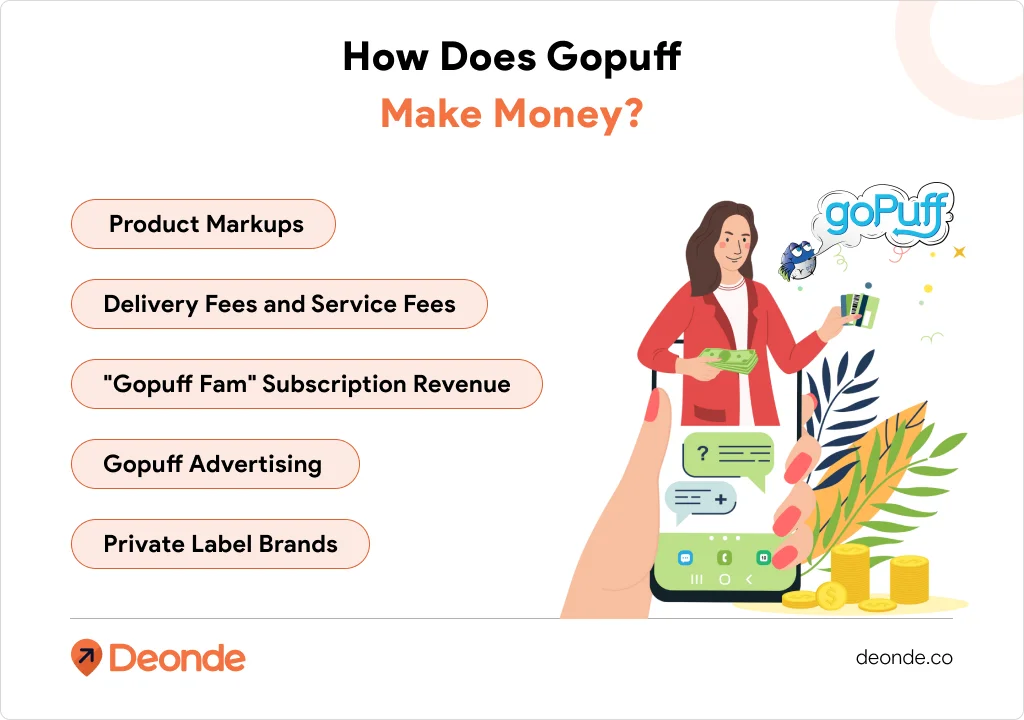
The Gopuff revenue model is not a single stream. It’s a multi-layered system designed to maximize the value of every order, customer, and brand partnership.
1. Product Markups
This is the primary and most important revenue stream. Because Gopuff is the retailer, it captures the full gross margin on every product it sells.
- How it works: Gopuff buys products directly from brands at wholesale rates and sells them at retail prices on its app
- Example: Gopuff buys a pint of ice cream for $3.00. It sells it to the customer for $5.50. The $2.50 difference is Gopuff’s gross profit on the product.
- Strategic Importance: This margin is what pays for the product itself and provides the initial contribution toward covering the high costs of labor, rent, and delivery.
2. Delivery Fees and Service Fees
For any customer who is not a subscriber, Gopuff charges a flat delivery fee (e.g., $3.95) and sometimes a small service fee on each order.
- Strategic Importance: This fee does not cover the full cost of delivery. Its real purpose is twofold:
- It provides a partial offset to the last-mile delivery cost (driver pay, insurance).
- It creates a “pain point” that actively encourages customers to subscribe to the “Fam” membership to avoid the fee, thus creating a more predictable customer.
3. “Gopuff Fam” Subscription Revenue
This is Gopuff’s recurring revenue engine, and it is critical to the model’s long-term success. For a monthly fee (e.g., $7.99/month), “Fam” members receive benefits like free delivery on all orders.
- How it works: This is a classic subscription (SaaS) model applied to retail. The fee is high-margin, predictable revenue.
- Strategic Importance: This is all about Customer Lifetime Value (LTV).
- Predictable Cash Flow: The subscription fee is collected regardless of order volume.
- Higher Order Frequency: Subscribers order significantly more often than non-subscribers because the “friction” of the delivery fee is gone.
- Customer “Lock-in”: It builds a loyal user base that is less likely to switch to a competitor.
4. Gopuff Advertising (The High-Margin Profit Lever)
This is the hidden gem of the Gopuff business model and a key to its future profitability. Gopuff’s app is not just a store; it is valuable digital real estate. CPG brands will pay enormous amounts of money to get their products in front of customers at the exact moment of purchase.
- How it works: Brands pay Gopuff for:
- Sponsored Search: Paying to be the #1 result when a user searches “energy drink.”
- Homepage Banners: Premium placement on the app’s front page.
- In-Bag Sampling: Paying Gopuff to place a free sample of a new product into a customer’s delivery bag.
- Strategic Importance: This is an extremely high-margin revenue stream (often 80-90%+ profit). This advertising revenue is what can turn a slightly profitable order into a highly profitable one.
Crucially, the same CPG giants (like PepsiCo) that sell products to Gopuff also pay Gopuff for advertising, creating a powerful dual relationship.
5. Private Label Brands
Like Costco with “Kirkland,” Gopuff has launched its own private label brands, such as “Basically,” for items like snacks, water, and home essentials.
- Why? Higher Margins. By controlling the entire supply chain, Gopuff can sell its “Basically” water for less than a name brand, while capturing a significantly higher profit margin on each unit sold.
How Gopuff Connects Consumers and Products?
Here is the step-by-step flow of a typical Gopuff order, which highlights the vertical model:
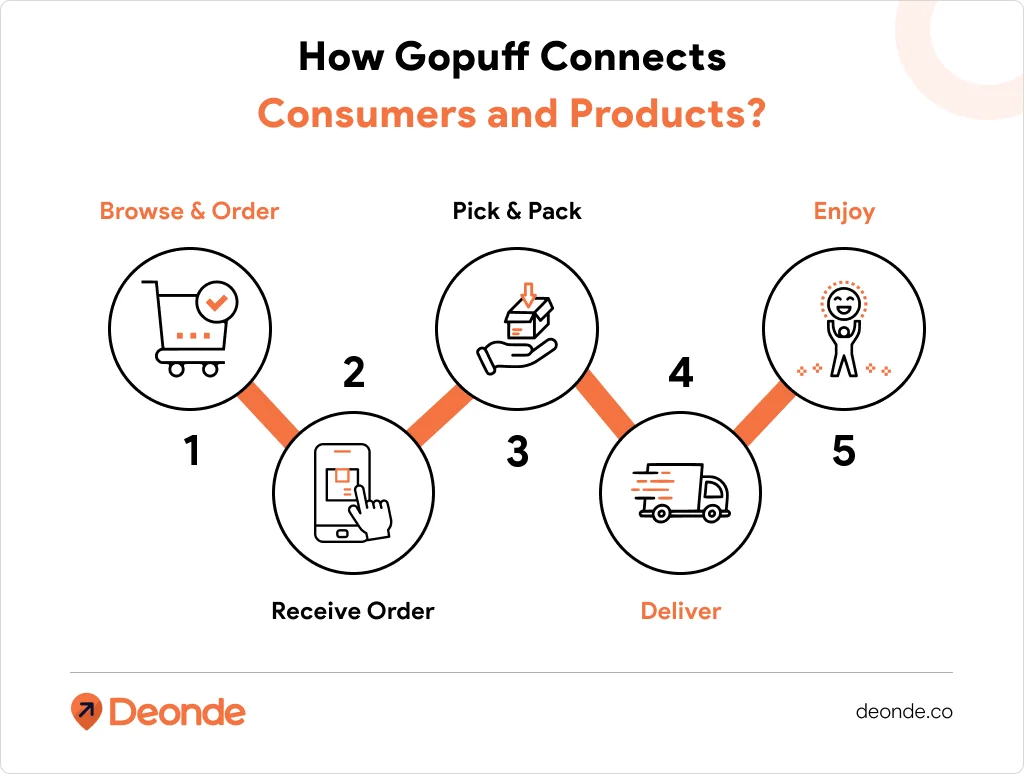
1. Browse & Order: It all begins with the consumer. You open the Gopuff app and browse a selection of 3,000-5,000 items. Crucially, you are browsing the live inventory of the single MFC closest to you.
2. Receive Order: Once you place the order, it is received instantly at that local Gopuff MFC—not by a third-party restaurant or store.
3. Pick & Pack: A Gopuff MFC employee immediately begins “picking” your items from the shelves and “packing” them into a bag. The entire process is optimized by technology to take just a few minutes.
4. Deliver: The packed bag is handed off to a delivery driver (either an employee or independent contractor) who is already waiting at the MFC. The driver delivers only your order, directly to your door.
5. Enjoy: You receive your items, often within 15 minutes of placing the order.
What is the “Unit Economics” Challenge for a Business Like Gopuff?
This is the hard part. For a startup founder planning a similar business, understanding Unit Economics (the profit/loss on a single order) is everything.
The model is a constant, brutal war between Average Order Value (AOV) and Cost of Fulfillment.
The “Cost” Side of a Single Order
A single order has numerous costs:
- Cost of Goods Sold (COGS): The wholesale price Gopuff paid for the items.
- Fulfillment Costs:
- Picker Pay: The pro-rated wage of the MFC employee who picked and packed the order.
- Driver Pay: The fee paid to the delivery driver for that specific trip.
- Warehouse Overhead: The pro-rated cost of rent, utilities, and shrinkage (damaged/stolen goods) for the MFC.
- Customer Acquisition Cost (CAC): The pro-rated cost of the marketing (“$25 off your first order”) that got the customer in the first place.
Why Average Order Value (AOV) is Everything
The only way to make the math work is to increase the AOV.
- Bad Order (Loss): A customer orders one $8 pint of ice cream.
- Revenue: $8 (item) + $3 (fee) = $11
- Costs: $4 (COGS) + $5 (driver) + $2 (picker/rent) = $11
- Profit: $0 (And this doesn’t even include marketing or tech costs).
- Good Order (Profit): A customer orders ice cream, a 12-pack of soda, Tylenol, and dog food. The AOV is now $45.
- Revenue: $45 (items) + $3 (fee) = $48
- Costs: $25 (COGS) + $5 (driver) + $3 (picker/rent) = $33
- Contribution Margin: $15
This $15 margin is what’s left over to pay for marketing, R&D, tech, and (eventually) profit.
This is why Gopuff is aggressively expanding into categories like alcohol, fresh groceries, and home goods. These high-AOV items are essential to subsidizing the low-AOV convenience trips.
Gopuff’s Strategy for Profitability: From AOV to Advertising
Knowing that AOV is everything, Gopuff’s entire strategy is designed to solve the unit economics problem and ensure the Gopuff revenue model is sustainable long-term. It does this in three primary ways.
1. The Strategy to Increase Average Order Value (AOV)
Gopuff is actively developing features and categories to make every basket larger.
- Expanding into Fresh Groceries: The company has launched a “Recipe Hub,” a content-first experience where customers can watch cooking videos from creators and instantly add all the necessary fresh ingredients to their cart. This transforms a “snack” order into a “full meal” order.
- Encouraging Group Orders: The “GoGroup“ feature allows multiple users to add items to a single, shared cart. This is designed for parties, families, and group events, combining several small orders into one large, efficient delivery.
- Capitalizing on Key Events: Gopuff’s model thrives on high-demand moments. During the 2024 “Big Game,” orders increased by 14% over a normal Sunday. More importantly, AOV-driving categories exploded, with alcohol up 75% and party-sized snacks like Tostitos up 332%.
2. Building a High-Margin Advertising Powerhouse
Gopuff is monetizing its data and digital real estate by turning its app into a powerful advertising platform for CPG brands.
- Proving Its Value with Data: Gopuff uses its sales data to prove its effectiveness. It releases consumer reports (like its “National Ice Cream Day” survey) to establish itself as a trend expert. More powerfully, it can show brands a direct sales lift: during the “Big Game,” orders for Lindor Chocolate spiked 231% in the hour after its TV ad aired, as viewers immediately turned to Gopuff to buy.
- Launching New Ad Tech: The company is moving beyond simple banners. It has launched Brand Shops (dedicated brand storefronts) and new partnerships (like with AdAdapted) that allow customers to add products to their Gopuff cart from other websites.
- Innovating Shoppable TV: In a major collaboration with Disney, Gopuff now powers “The Concession Stand,” a new commerce experience on Hulu, ESPN, and Disney+. Viewers can order snacks and drinks from a CTV (Connected TV) ad for instant delivery, bridging the gap between seeing an ad and making a purchase.
3. Deepening Brand Partnerships & Exclusivity
Gopuff uses its platform to launch exclusive products, driving dedicated traffic. For example, it partnered with energy wellness brand GORGIE to launch a limited-edition “Sparkling Cosmic Berry” flavor, available only on Gopuff. This strategy targets specific demographics (like Gen Z) and makes Gopuff a destination, not just a utility.
Conclusion
Viewing Gopuff’s expansion into the UK, entrepreneurs should see it as a validation of the q-commerce model. If you’re planning to launch your own service, your most crucial first step is securing a powerful foundation. A robust and scalable Online Ordering & Delivery System in UK is the key to mastering your operations, from live tracking and payments to customer management, right from day one.
There is no denying that Gopuff has successfully established itself as a leading player in the on-demand quick commerce industry. Through its innovative vertical integration, powerful advertising model, and high-speed ‘dark store’ network, it has fundamentally challenged the traditional corner store.
As the company continues to develop its ad-tech and optimize unit economics, it is poised to maintain its dominance in the market and shape the future of convenience.
For entrepreneurs and investors, this analysis provides a crucial blueprint. The market opportunity is proven, but the winning strategy often lies in innovation, not just imitation. You can leverage these same q-commerce principles to target a niche category or a less saturated geographic market.
The infrastructure for your venture is ready. With a powerful and 100% white-label quick commerce software for instant deliveries, you can launch your own marketplace like Gopuff, built on the proven mechanics we’ve outlined. The market is waiting for the next innovator.
Frequently Asked Questions (FAQ)
1. What are Gopuff’s operating hours?
Gopuff operates 24/7 in many major cities, and “late-night” in all other areas, allowing you to place orders at almost any time of day or night.
2. Where does Gopuff operate?
Gopuff operates in over 1,000 cities, primarily across the United States and in parts of the United Kingdom (UK).
3. How does Gopuff handle out-of-stock items?
Because Gopuff owns its inventory, this rarely happens. What you see in the app is a live view of the “dark store’s” stock, so you almost always get exactly what you ordered.
Source: