You’re hungry. You open an app, order groceries, and boom—they’re at your door in 15 minutes.
Sounds like magic, right?
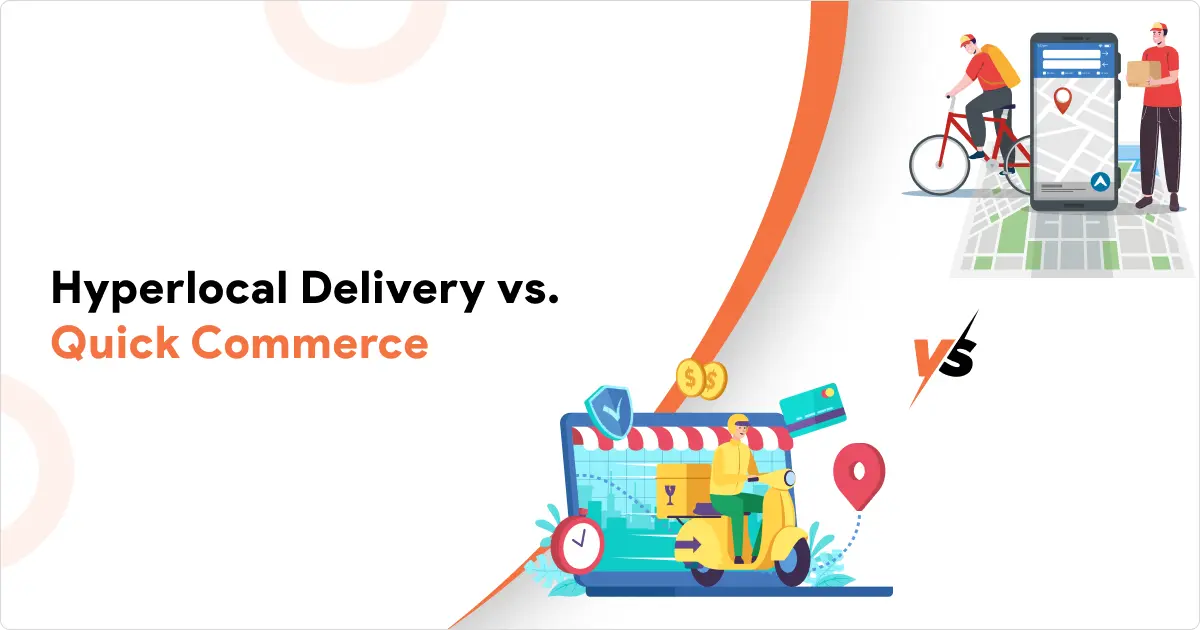
But here’s where it gets interesting: Is that hyperlocal delivery or quick commerce? Most people use these terms interchangeably, but they are different beasts with different strategies, economics, and customer promises.
I’ve spent years analyzing on-demand delivery models, and trust me—understanding the difference between hyperlocal delivery and quick commerce isn’t just semantics. It’s the key to understanding why some delivery startups thrive while others burn through millions before shutting down.
Let’s break down what separates these two models, which one’s better for different situations, and what this means for you as a consumer or business owner.
What is Hyperlocal Delivery? (The Neighborhood Hero)
Hyperlocal delivery is precisely the kind of delivery that you might expect – very local deliveries from businesses operating within a small geographical area, usually 3-5 kilometers.
You can imagine it this way: The local bakery you love in an area is delivering freshly baked croissants to customers located within a 2-mile radius. That’s a hyperlocal delivery working.
How Hyperlocal Delivery Works:
- Existing local businesses (restaurants, pharmacies, grocery stores) partner with delivery platforms
- Orders come through a hyperlocal delivery app like DoorDash, Uber Eats, or Swiggy
- Delivery riders pick up from the actual store and deliver to nearby customers
- Delivery times typically range from 30-60 minutes
Real-world example: Your corner pharmacy joining Instacart. They don’t change anything about their operations; they just get access to customers who want medicine delivered to their doorstep.
What is Quick Commerce?
Quick commerce (also known as q-commerce) simply goes beyond the ordinary. Deliveries within 10-15 minutes, in some cases even less, are what we are talking about.
However, if you think that the operations are the same, then you are mistaken. In order to deliver that crazy speed, quick commerce companies have to redo the supply chain from top to bottom.
How Quick Commerce Delivery Works:
- Companies set up dark stores (micro-fulfillment centers) in high-density areas
- These aren’t regular stores—they’re warehouses optimized purely for speed
- Products are pre-stocked based on demand prediction
- When you order, items are picked, packed, and dispatched in minutes
- Delivery partners are stationed nearby for instant deployment
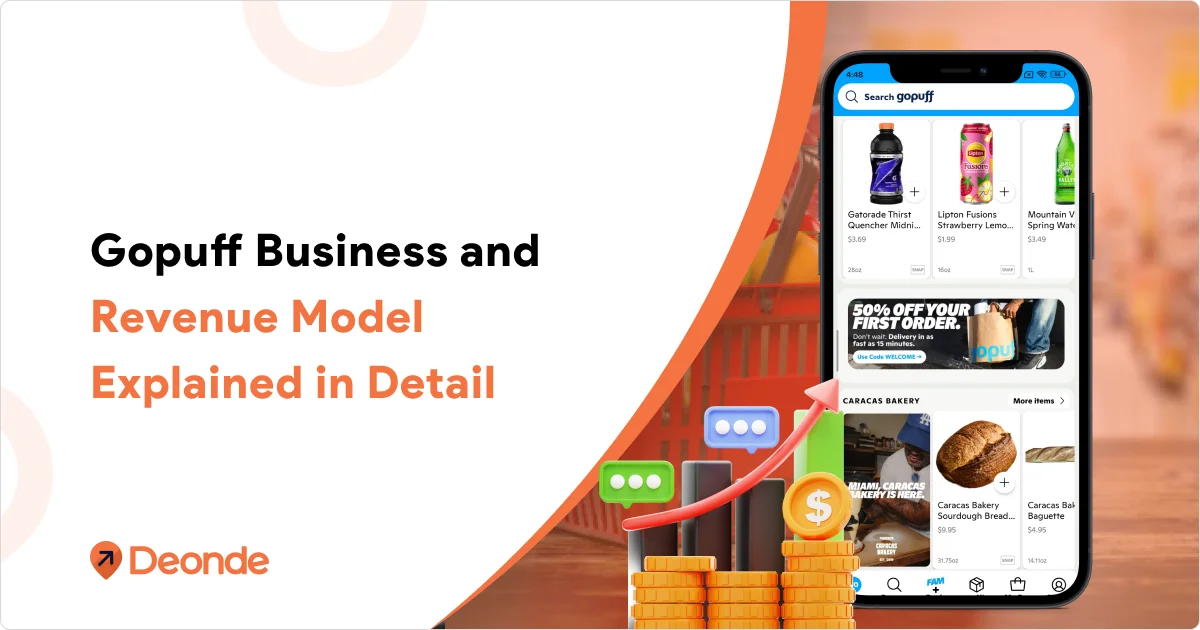
Real-world example: Gopuff, Getir, or Zepto. These aren’t marketplaces—they own the entire process from inventory to delivery.
5 Key Differences: Hyperlocal Delivery vs Quick Commerce
If you are trying to decide which model suits your business, or you just want to understand where the venture capital money is going, here is the breakdown.
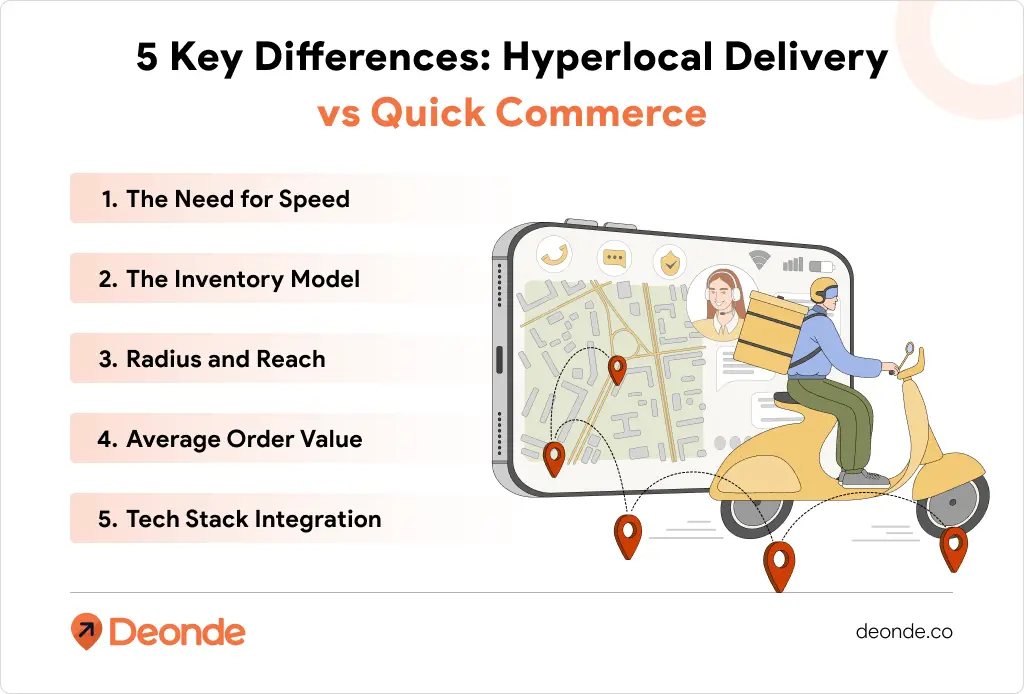
1. The Need for Speed
This is the most obvious differentiator.
- Hyperlocal: Delivery usually takes 45 minutes to 2 hours. The courier has to travel to the store, park, walk in, wait for the order to be packed (or pack it themselves), and then drive to you.
- Quick Commerce: Delivery takes 10 to 30 minutes. Because the inventory is in a dark store controlled by the app, the “picking” time is under 60 seconds. The rider is already waiting at the door.
2. The Inventory Model (Asset-Light vs. Asset-Heavy)
This is where the unit economics get tricky.
Hyperlocal is generally asset-light. The platform (like DoorDash) doesn’t own the inventory. They don’t worry about the milk expiring or the bananas going brown. That risk sits with the retailer. The platform is just a logistics layer.
Quick Commerce is asset-heavy. The Q-commerce company usually buys the inventory. They own the dark store. They pay for the electricity, the shelving, and the stock. If nobody buys those avocados, the Q-commerce company loses money.
3. Radius and Reach
- Hyperlocal: Covers a wider radius (3-8 miles). Since the delivery time isn’t the only selling point, riders can travel further.
- Quick Commerce: extremely tight radius (1-2 miles max). To hit a 15-minute promise, the rider cannot be stuck in traffic crossing town. This limits Q-commerce to high-density urban areas. You won’t see 10-minute delivery in the suburbs anytime soon.
4. Average Order Value (AOV)
- Hyperlocal: Higher AOV. People might do their full weekly grocery shop via a hyperlocal app.
- Quick Commerce: Lower AOV. It’s driven by impulse and distress purchases. “I need ice cream now,” or “I forgot diapers.” You aren’t buying a new TV or a week’s worth of food in 10 minutes.
5. Tech Stack Integration
In hyperlocal, the app has to sync with the inventory systems of thousands of different mom-and-pop shops. This is a nightmare. Often, you order something only to get a text 10 minutes later saying, “Sorry, they are out of stock.”
In Q-commerce, the app is the inventory system. The stock counts are real-time because the app owns the warehouse.
Hyperlocal vs Q-Commerce: Which Is Better?
Here’s my honest take: It depends on what you’re optimizing for.
Choose Quick Commerce If:
- You’re a customer who values instant gratification over everything
- You’re a business targeting urban millennials and Gen Z
- You have deep pockets and can sustain losses while building market share
- Your focus is on a curated selection of high-velocity items
Choose Hyperlocal Delivery If:
- You want sustainable unit economics (relatively speaking)
- You’re leveraging existing retail infrastructure
- You need broader geographic coverage
- You’re focused on building a marketplace with diverse merchants
Pro Tip:
The smartest players are actually doing both. Companies like Swiggy and Zomato offer regular delivery AND quick commerce through separate verticals (Swiggy Instamart, Blinkit). They’re hedging their bets because the market’s still figuring itself out.
|
Feature |
Hyperlocal Delivery |
Quick Commerce (Q-Comm) |
|
Primary Promise |
Convenience & Variety |
Speed |
|
Timeframe |
45 mins – 24 hours |
10 – 30 minutes |
|
Inventory Source |
Local Retailers / Restaurants |
Dark Stores (Micro-warehouses) |
|
Inventory Risk |
Held by Retailer |
Held by Platform |
|
Service Radius |
3 – 8 Miles |
1 – 2 Miles |
|
Typical Products |
Meals, Full Grocery, Electronics |
Snacks, Drinks, Essentials |
|
Tech Focus |
Aggregation & routing |
Warehouse automation & prediction |
Last-Mile Delivery vs Instant Delivery: The Technical Showdown
Let’s talk logistics for a second.
Last-mile delivery is essentially the step where a product is taken from the local distribution center and delivered to your door. It has always been the most costly and complicated part of the whole logistics process, making up to 53% of the total shipping costs.
Both hyperlocal and quick commerce are trying to solve this problem, just differently:
Hyperlocal approach:
- Reduces last-mile distance by sourcing from nearby stores
- Uses existing retail locations as mini distribution centers
- Focuses on real-time tracking and route optimization
Quick commerce approach:
- Places dark stores within 2-3 km of customers
- Pre-positions inventory close to demand
- Emphasizes fast order processing and instant dispatch
The winner? Depends on density. Quick commerce thrives in Manhattan or Mumbai. Hyperlocal delivery works better in spread-out suburbs.
Real-Time Tracking vs Fast Order Processing: What Customers Actually Care About
Here’s something interesting I’ve noticed: Customers don’t always want the fastest delivery.
What they really want is predictability and transparency.
Real-time tracking (hyperlocal’s strength):
- You know exactly where your order is
- You can plan your day around delivery
- Reduces anxiety—which is critical, given that 91% of consumers actively track their packages.
Fast order processing (quick commerce’s strength):
- Minimal waiting means minimal anxiety
- Instant gratification hits dopamine receptors
- Less chance you’ll cancel or forget about the order
The best on-demand delivery apps combine both: blazing-fast fulfillment and granular tracking every step of the way.
The Economics: Who Actually Makes Money?
I’ve reviewed the profit & loss statements for companies in both sectors. It is brutal out there.
The Hyperlocal Profit & Loss
The margins here are thin, but the capital expenditure (CapEx) is low.
- Revenue: Commission from the merchant (15-30%) + Delivery fee from the customer.
- Cost: Driver payout.
- Challenge: You don’t control the product quality or the prep time. If the restaurant is slow, your driver waits, and you lose money on efficiency.
The Quick Commerce Profit & Loss
The margins are potentially higher on the product, but the operational costs are massive. However, the model has potential: optimized dark stores can reduce delivery costs by up to 23% compared to traditional retail fulfillment.
- Revenue: Product margin (buying wholesale, selling retail) + Delivery fee.
- Cost: Real estate (dark store rent), inventory holding costs, pickers, packers, and riders.
- Challenge: Burn rate. You need massive volume (high order density) to pay for that prime real estate in the city center.
Expert Insight: The “Utilization” Trap
Here is a nuance most people miss: Rider Utilization.
In Quick Commerce, riders are often employees or on hourly retainers because they need to be sitting at the dark store waiting for an order to ensure speed. If they aren’t delivering, you are burning cash.
In Hyperlocal gig models, you only pay the driver when there is an order.
My take: Quick Commerce is a volume game. If a dark store doesn’t hit 1,000+ orders a day, the unit economics rarely work. Hyperlocal is more resilient to low-volume days.
Final Thoughts: It’s All About the Customer’s “Why”
When we debate hyperlocal delivery vs quick commerce, we often get lost in logistics. But for the customer, it’s emotional.
Hyperlocal is about access. It allows me to support my favorite local Thai place or get that specific brand of organic food without driving across town.
Quick commerce is about relief. It solves the immediate pain of running out of something essential.
If you are building in this space, stop asking “How fast can I get there?” and start asking “What problem am I solving?” If you solve the problem, the customer will pay the delivery fee.

Frequently Asked Questions (FAQ)
What’s the main difference between hyperlocal delivery and quick commerce?
Hyperlocal delivery connects customers with nearby existing stores for deliveries typically within 30-60 minutes. Quick commerce operates its own dark stores to deliver in 10-20 minutes with a limited product selection.
Is quick commerce sustainable long-term?
Quick commerce faces significant profitability challenges due to high infrastructure costs, low margins, and expensive last-mile delivery. Long-term sustainability depends on achieving massive scale and changing consumer behavior permanently.
Which is cheaper for customers—hyperlocal or quick commerce?
Prices vary by platform, but quick commerce often charges premium fees or has higher minimum orders to offset operational costs. Hyperlocal delivery can be more cost-effective, especially for larger orders or when using promotional offers.