The organic food market is booming, and entrepreneurs are rushing to secure their place in this $317.18 billion industry through mobile technology. Whether you are a startup founder, an existing grocery business owner, or a tech entrepreneur, organic food delivery app development offers massive potential for growth and profit.
Building a successful platform requires more than just connecting customers with products. It demands a deep understanding of the health-conscious consumer, a robust technical framework that scales efficiently, and smart revenue strategies.
This guide covers the essential features that drive retention, the technical architectures that ensure stability, and the launch strategies required to turn the growing demand for locally sourced food into a profitable venture.
Why Should Startups Invest in Organic Food Delivery Now?
The timing is perfect due to three converging factors: demand, demographics, and digital adoption.
Growing Consumer Demand for Healthy Eating
The organic food market has exploded, driven by a fundamental shift in how people view food and health. Consumers are increasingly willing to pay premium prices for clean, pesticide-free products. With the market growing at 5-6% annually—consistently outpacing conventional food sales—this is no longer a niche trend; it is a mainstream movement.
Millennials and Gen Z are driving this demand. Approximately 73% of global consumers in these demographics are willing to pay more for sustainable products. These digital natives obsessively read labels, research ingredients, and prioritize transparency. They are the prime demographic for organic food ordering app development solutions that align with their values.
Increasing Smartphone Penetration
Mobile commerce in the food sector has grown 300% over the past five years. The average consumer uses 3-4 different food delivery apps monthly, meaning the learning curve for a new white label organic food delivery app is minimal. Users are already comfortable navigating interfaces, comparing prices, and utilizing contactless delivery.
The Post-Pandemic Shift
The pandemic permanently altered grocery habits. Even as restrictions lifted, the preference for contactless delivery remained. Traditional grocery stores often struggle to meet online demand, creating a gap for specialized organic services that focus on quality curation and reliability. This shift has also brought older demographics into the digital fold, expanding your potential target audience to include health-conscious baby boomers.
How Does The Organic Food Delivery App Work?
To run a successful organic delivery business, you need to coordinate four distinct roles. Here is the step-by-step workflow:
1. The Order (Customer) The user browses local farms, checks organic certifications, and builds their cart. They select a delivery slot (or subscription plan) and pay securely via the app.
2. The Preparation (Vendor) The farm or grocery store receives an instant alert. They accept the order, perform a quality check on the fresh produce, and pack it in eco-friendly packaging.
3. The Delivery (Driver) The smart algorithm assigns the nearest driver. The driver picks up the package and follows an optimized route to ensure the food arrives fresh at the customer’s doorstep.
4. The Management (Admin) You, the business owner, watch the entire process from a central dashboard. You track live deliveries, manage inventory levels, and view sales analytics in real-time.
Step-By-Step Development Process: From Concept To Launch
If you still choose full custom development, or you just want to understand what happens behind the scenes of a white‑label platform, it helps to see the standard software build process. Most agencies and in‑house teams follow a six‑phase model that moves from early planning to live operations.
Rather than spending months on a custom build, I highly recommend reading this comprehensive guide to launch a food delivery app in 1 week with our SaaS solution. Because Deonde has already successfully walked through these complex development phases countless times, our platform allows you to bypass traditional coding bottlenecks and take your organic delivery service live in just seven days.
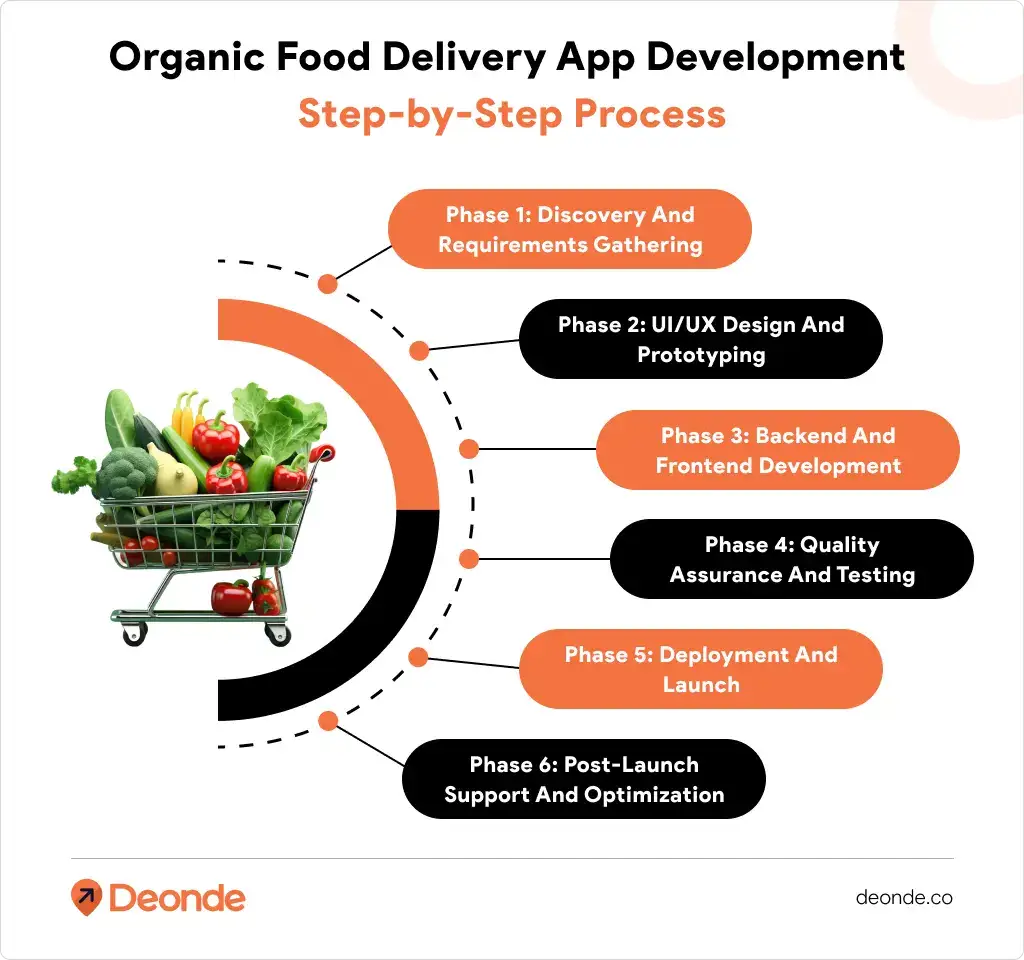
Phase 1: Discovery And Requirements Gathering
In phase one, which usually takes two to three weeks, the team clarifies what you want the app to do. They interview stakeholders, study competitors, define user personas such as busy parents or office workers, and decide which features are essential and which can wait.
The result is a project scope, user flows, and a technical requirement document that guides the rest of the work. With Deonde, much of this is compressed into a focused onboarding call and a few setup forms, since the core business models and feature sets are already proven.
Phase 2: UI/UX Design And Prototyping
Next comes design, often lasting three to four weeks. Designers sketch wireframes for each panel, refine them into polished mockups that match your brand, and then create clickable prototypes. These prototypes go in front of sample users, including customers, vendors, and drivers, to spot confusing flows or missing steps.
Deonde skips most of this heavy design work by providing tested layouts that you can adjust with your own branding, which shortens design time to just a few days.
Phase 3: Backend And Frontend Development
Phase three is where most of the coding happens and can stretch from eight to twelve weeks on a custom project. Backend developers set up databases, build APIs, and connect third‑party services such as payments, maps, and SMS. Frontend developers create the iOS and Android apps, plus the web admin panel and wire everything together so that order events appear in real time across all panels.
Teams usually work in two‑week sprints with regular demos so you can see progress and request adjustments. Because Deonde already has this core engine in place, your setup focuses on configuration rather than coding, which is far faster and much less risky.
Phase 4: Quality Assurance And Testing
Once the first full version is ready, testers try to break it. Over three to four weeks, they click through every screen, place test orders, run load tests that mimic busy Friday nights, and check how the app behaves on different smartphones and networks. Security specialists review payment flows and data storage to guard against breaches.
Deonde keeps this testing running all the time across its platform, so new clients inherit a system that has already passed many real‑world checks.
Phase 5: Deployment And Launch
In the launch phase, the team prepares production servers, tightens security settings, and submits apps to the Apple and Google stores. This stage often includes a soft launch or beta with a small group of customers, which helps catch issues that did not appear in testing. Apple’s review process can take a week or more, while Google usually responds in a few days.
Deonde streamlines this by using pre‑approved templates and guiding you through the final steps, which keeps the full launch window around seven days.
Phase 6: Post-Launch Support And Optimization
After launch, the real learning starts. Developers monitor crashes, slow screens, and bug reports, shipping regular fixes and performance improvements. Product teams watch analytics such as order conversion, cart abandonment, and customer retention, then test new features or offers through A/B experiments. All of this support work continues for the life of the app.
With Deonde, you do not need your own engineering team for this stage, because platform updates, security patches, and optimizations roll out to your instance automatically.
Cost Breakdown: What You’ll Actually Spend On Organic Food Delivery App Development
Budget is usually the biggest question once you decide to own your organic delivery channel. Custom builds can run into six figures, while white‑label systems charge a flat monthly fee that feels closer to a software subscription than a major capital project. This section gives you a realistic view of what custom organic food delivery app developmentcosts and why a ready‑made platform such as Deonde is often far more affordable.
Custom Development Cost Breakdown
A minimum viable product (MVP) covers a basic customer app, a light vendor portal, and a simple admin area with only the most important features. Building this usually takes three to four months and between eight hundred and twelve hundred development hours. At common agency rates, that means about:
- 8,000 to 48,000 dollars with teams in India
- 24,000 to 120,000 dollars in Eastern Europe
- 56,000 to 180,000 dollars in the United States
You also need to plan for cloud hosting, app store fees, support, and marketing after launch. By contrast, a white‑label platform such as Deonde works on a steady subscription that is tiny compared with these one‑time builds and usually lower than what many businesses already pay in monthly commissions to aggregators.
What Essential Features Do Users Actually Want?
To succeed, your app must offer more than just a digital catalogue. It must provide a user experience that builds trust and simplifies the shopping process.
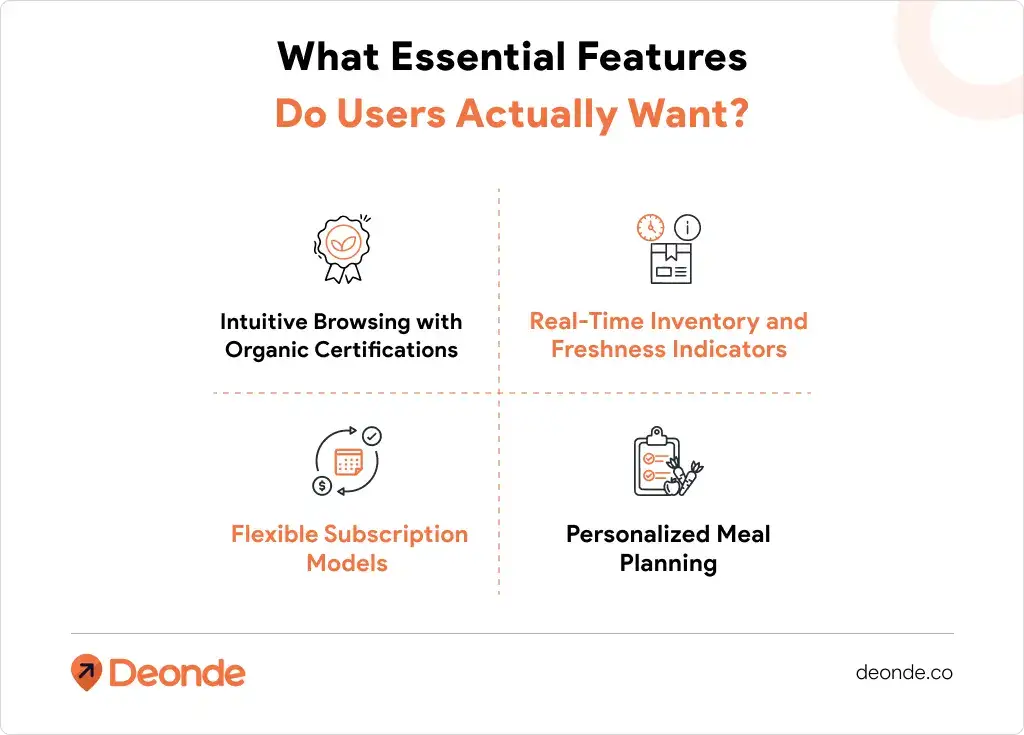
1. Intuitive Browsing with Organic Certifications
Your app’s UI/UX must highlight what makes your products special.
- Certification Badges: Prominently display USDA Organic, Non-GMO Project, and local certification badges on product cards.
- Detailed Traceability: Allow users to filter by farm origin, harvest date, and certification type.
- Visual Inspection: Implement high-resolution zoom features and multiple-angle shots to replicate the experience of inspecting produce in a store.
2. Real-Time Inventory and Freshness Indicators
Nothing kills retention faster than out-of-stock items. Your system needs real-time inventory tracking that updates dynamically based on the user’s delivery zone.
- Freshness Meters: Use colour-coded indicators (Green for peak freshness, Yellow for consume soon) to give visual feedback on product quality.
- Predictive Stocking: If an item is low, use algorithms to suggest high-quality organic alternatives before the user checks out.
3. Flexible Subscription Models
Subscription models are the key to recurring revenue in the organic space.
- Customizable Boxes: Allow users to subscribe to weekly staples like milk, bread, and seasonal produce boxes.
- Pause and Resume: Reduce churn by allowing users to pause subscriptions during vacations easily.
- Seamless Conversion: Make the ordering process identical for one-time purchases and subscriptions to reduce friction.
4. Personalized Meal Planning
Transform your app from a utility into a lifestyle companion.
- Recipe Integration: Partner with nutritionists to create recipes based on currently available stock.
- Smart Suggestions: If a user buys organic kale frequently, the app should prioritize kale-based recipes on their feed.
- Dietary Filters: Ensure suggestions align with vegan, gluten-free, or paleo preferences.
Technical Development Framework
A beautiful interface means nothing without a powerful engine driving it. If you want to avoid app crashes and handle high order volumes during peak hours, you must understand exactly how to choose the right tech stack for your food delivery app. Here is the technical approach required for long-term stability and scale.
Cross-Platform Compatibility
For cost-effective grocery delivery app development, cross-platform frameworks are the industry standard.
- React Native & Flutter: These allow developers to write code once and deploy it to both iOS and Android. React Native shares up to 80% of code between platforms, while Flutter offers exceptional UI rendering performance.
- Native Features: Ensure your framework can access native device features like GPS for tracking and the camera for scanning QR codes on packaging.
Scalable Backend Architecture
As your user base grows, your app must handle the load without crashing.
- Microservices: Use a microservices architecture to break the app into independent services (Order Management, User Auth, Inventory). This allows you to scale specific parts of the app based on demand.
- Cloud Infrastructure: Utilize AWS, Google Cloud, or Azure with auto-scaling capabilities to handle peak ordering hours.
- Database Management: Use PostgreSQL or MongoDB for robust data handling, and Redis for caching to ensure fast load times.
Payment and Logistics Integration
- Gateways: Integrate Stripe, PayPal, or Razorpay to handle secure transactions and PCI compliance.
- Logistics APIs: Connect with DoorDash Drive, Uber Direct, or local courier APIs to manage driver assignment and real-time tracking.
Building Trust Through Transparency
In the organic market, trust is your currency. Consumers are paying a premium for a promise of purity; your app must validate that promise.
Farm-to-Table Tracking
Modern consumers demand to know the source of their food.
- Digital Farm Profiles: Create specific pages for your farm partners featuring photos, stories, and certification documents.
- QR Code Integration: Allow users to scan products to see the exact field location, harvest date, and transportation method.
- Batch Tracking: Differentiate your white label organic food delivery app by allowing customers to trace specific produce batches back to the producer.
Sophisticated Review Systems
Authentic feedback drives conversion.
- Visual Reviews: Allow customers to upload photos of the products they received. This provides “social proof” of freshness.
- Verified Badges: Distinguish reviews from verified purchasers to prevent spam.
- Granular Ratings: Separate ratings for “Product Quality,” “Delivery Speed,” and “Packaging” to give actionable insights.
Quality Guarantees and Return Policies
Remove purchase anxiety with clear policies.
- Prominent Displays: Don’t bury your return policy in the fine print. Feature your “Freshness Guarantee” on the checkout screen.
- Instant Credits: Implement a system where minor quality issues can be resolved via instant wallet credits, reducing the strain on customer support.
How Do Organic Food Delivery Apps Make Money?
How do you maximize profit while maintaining competitive pricing?
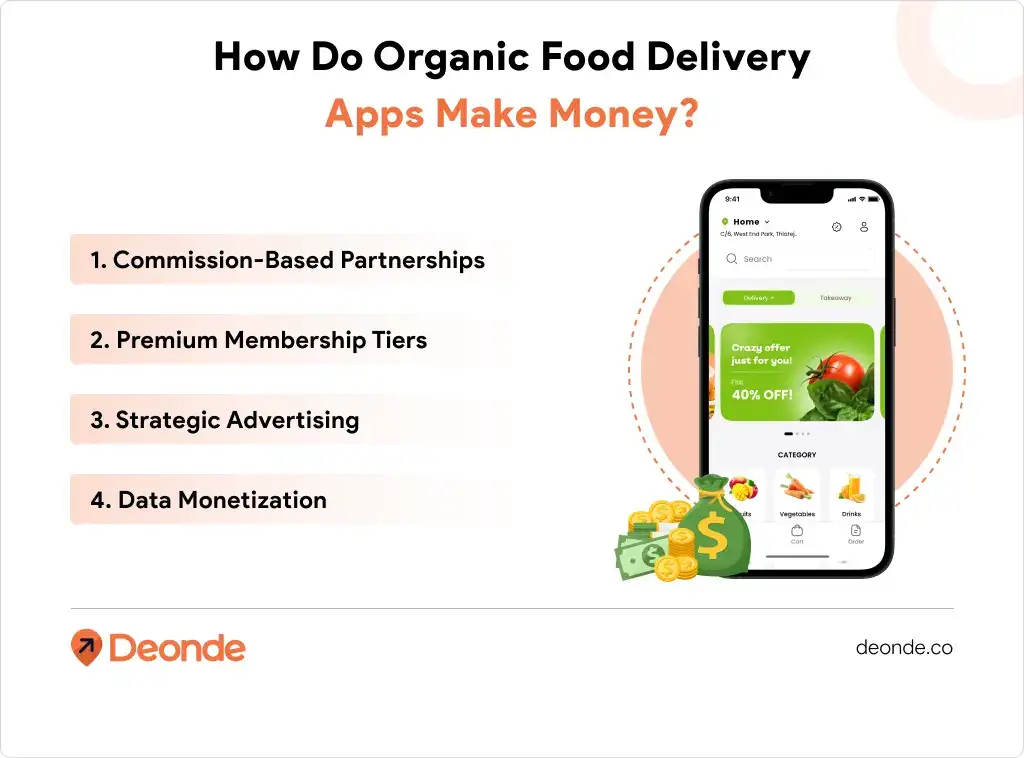
1. Commission-Based Partnerships
This is the standard model. You charge organic suppliers a commission (typically 15-25%) on every order.
- Tiered Structures: Offer lower commission rates to suppliers who hit high volume targets to incentivize their performance.
- High-Margin Items: Focus on artisanal and specialty superfoods, which often command higher margins than basic produce.
2. Premium Membership Tiers
Create predictable cash flow with a membership model (e.g., $9.99/month).
- Benefits: Offer free delivery on orders over $50, early access to seasonal harvest boxes, and exclusive member-only discounts.
- LTV Boost: Data shows premium members order 40% more frequently and have a 60% higher Lifetime Value (LTV).
3. Strategic Advertising
Monetize your traffic without disrupting the user experience.
- Complementary Products: Offer ad slots to brands selling organic cookware, sustainable storage, or eco-friendly cleaning supplies.
- Sponsored Listings: Allow farms or brands to pay for “Featured” placement in search results.
To stand out in the competitive food delivery market, businesses need engaging content. Video ads are particularly effective, and Seedance 2.0 allows you to use text, images, clips, and audio as references to create videos with flawless consistency and realistic physics — a powerful tool to capture your audience’s attention.
4. Data Monetization
Anonymized consumer data is valuable to researchers and manufacturers.
- Trend Analysis: Sell insights regarding organic consumption patterns, seasonal preferences, and regional demand to agricultural researchers or marketing agencies.
Launch Strategy and Market Penetration
Building the app is half the battle; getting users is the other half.
Beta Testing with Early Adopters
Don’t launch to the masses immediately. Start with a focused beta test.
- Recruitment: Find testers at yoga studios, wellness centers, and organic co-ops. These users are forgiving of bugs but critical of product quality.
- Feedback Loop: Run the beta for 4-6 weeks to refine core features like search and tracking.
Partnership Development
Your supply chain is your biggest asset.
- Local Farm Networking: Partner with certified farms within a 50-mile radius. Direct partnerships eliminate middlemen and improve margins.
- Farmer Empowerment: Offer your partners data on sales trends to help them plan crop rotations. This builds loyalty and ensures you have stock when you need it.
Digital Marketing to Wellness Communities
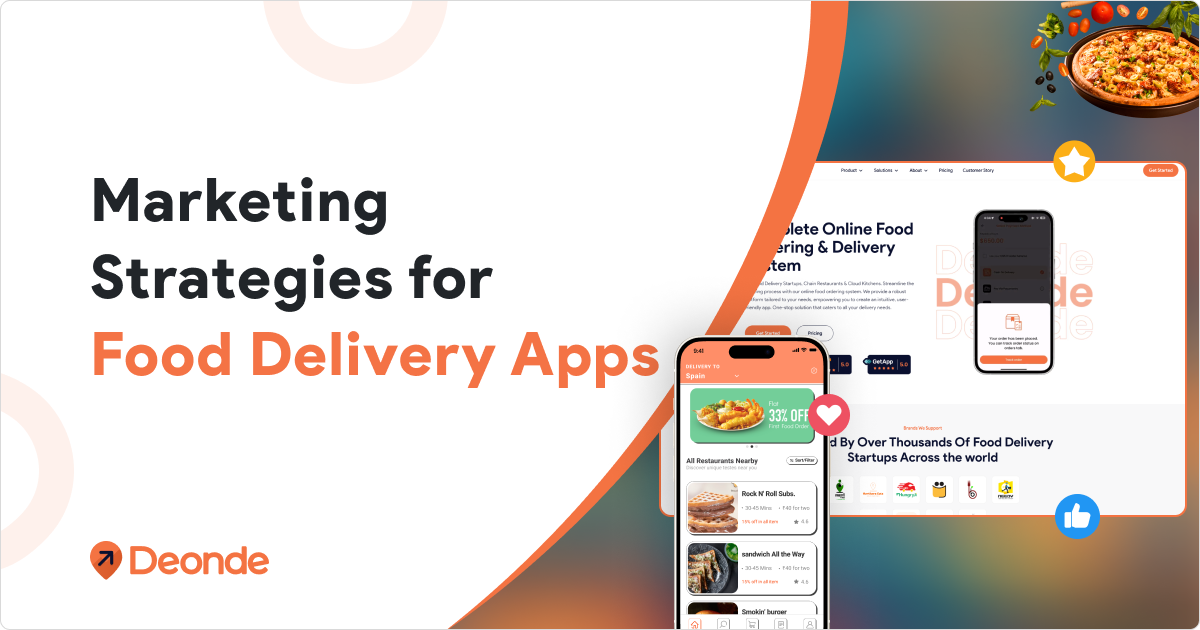
Figuring out how to create marketing strategies for food delivery apps in 2026 requires shifting away from generic ads and focusing strictly on highly targeted wellness groups:
- Content Marketing: Publish blogs and videos about sustainable farming, nutrition, and recipes.
- Influencer Marketing: Partner with local nutritionists and fitness coaches—not just for promotion, but for content creation.
- Retargeting: Use Facebook and Google ads to retarget users who visited the app but didn’t purchase, offering a first-time customer discount.
Conclusion
The organic food delivery market presents a goldmine opportunity for developers and entrepreneurs willing to prioritize quality and transparency. Success in an organic food delivery app system comes down to building a platform that bridges the gap between trust and convenience.
By implementing real-time tracking, ensuring detailed source verification, and offering flexible subscription models, you can create a product that resonates with the modern, health-conscious consumer. Whether you choose a custom build or a white label organic food delivery app solution, the key is to start local, build strong farm partnerships, and maintain an unwavering commitment to quality.
The demand is there. The technology is ready. Now is the time to turn this healthy lifestyle movement into your next profitable venture.