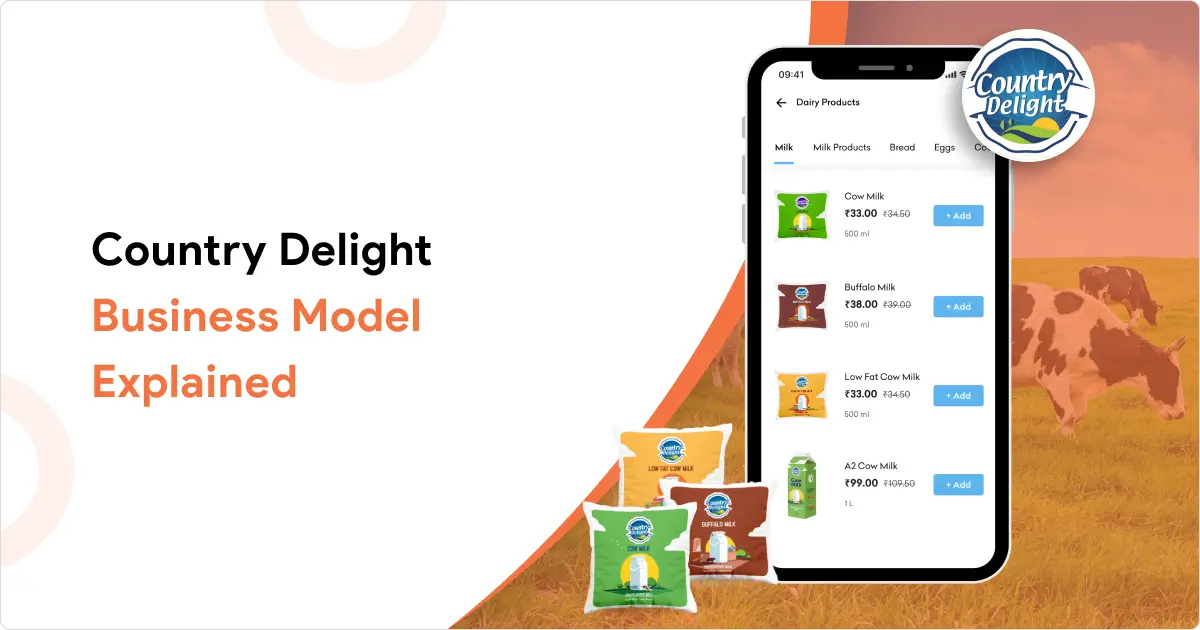
The Country Delight business model is a masterclass in disrupting a legacy industry. While giants like Amul and Mother Dairy dominated the Indian market for decades, Country Delight found a massive gap: trust and freshness.
Country Delight operates on a Direct-to-Consumer (D2C) business model that sources fresh milk directly from farmers and delivers it to customers via a subscription-based app.
It generates revenue by selling premium, unadulterated dairy and kitchen essentials, completely bypassing traditional middlemen to ensure quality.
With a valuation of approx $820 million and FY24 revenue hitting ₹1,380 Crores, Country Delight has successfully disrupted India’s massive unorganized dairy market, serving millions of households.
So, if you are planning to start a subscription-based delivery business or just want to understand the success behind this dairy giant, you have landed in the right place.
What is Country Delight?
Country Delight is a prominent Indian Direct-to-Consumer (D2C) food and grocery brand dedicated to delivering fresh and natural essentials.
Founded in 2015, the company is the brainchild of Chakradhar Gade and Nitin Kaushal, both alumni of IIM Indore.
The story began when the founders, living in the suburbs of Delhi-NCR, realized they couldn’t find fresh, unadulterated milk for their own consumption. They identified that the problem wasn’t the cow or the farmer—it was the cold chain and the middlemen.
They launched Country Delight with a simple, yet ambitious promise: Milk that is tested, pure, and delivered to your doorstep within 24-36 hours of milking.
|
Parameter |
Details |
|
Legal Name |
Beejapuri Dairy Private Limited |
|
Founded Year |
2015 |
|
Founders |
Chakradhar Gade & Nitin Kaushal |
|
Headquarters |
Gurugram, Haryana, India |
|
Industry |
D2C Dairy, FMCG, E-commerce |
|
Business Model |
Inventory-Led Subscription Model (Full Stack) |
|
Key Products |
Milk (Cow/Buffalo), Ghee, Paneer, Curd, Bread, Eggs, Fruits & Vegetables, Coconut Water |
|
Current Valuation |
~$820 Million (Approx.) |
|
Revenue (FY24) |
~₹1380 Crores |
|
Service Areas |
25+ Cities (Delhi-NCR, Mumbai, Bangalore, Pune, Chennai, Hyderabad, Jaipur, etc.) |
|
Key Investors |
Temasek, Matrix Partners, Orios Venture Partners, Elevation Capital |
Who is the “Country Delight” Customer? (Target Audience)
Country Delight doesn’t target everyone; it targets the “Conscious Gatekeeper” of the family. These are the household decision-makers who actively filter out unhealthy options to ensure their family consumes only the best.
- Demographic: Typically Tier-1 and Tier-2 urban households (Delhi, Mumbai, Bangalore, Pune, Hyderabad, etc.).
- Psychographic: These are health-aware consumers who are skeptical of mass-market brands. They read nutrition labels, worry about antibiotics in milk, and are willing to pay a 20-25% premium for verified purity and peace of mind.
- Behavior: They value the convenience of the “Subscribe & Forget” model—setting a daily milk schedule on the app so they never have to run to the store in the morning.
Quick Timeline: From Gurugram to Pan-India
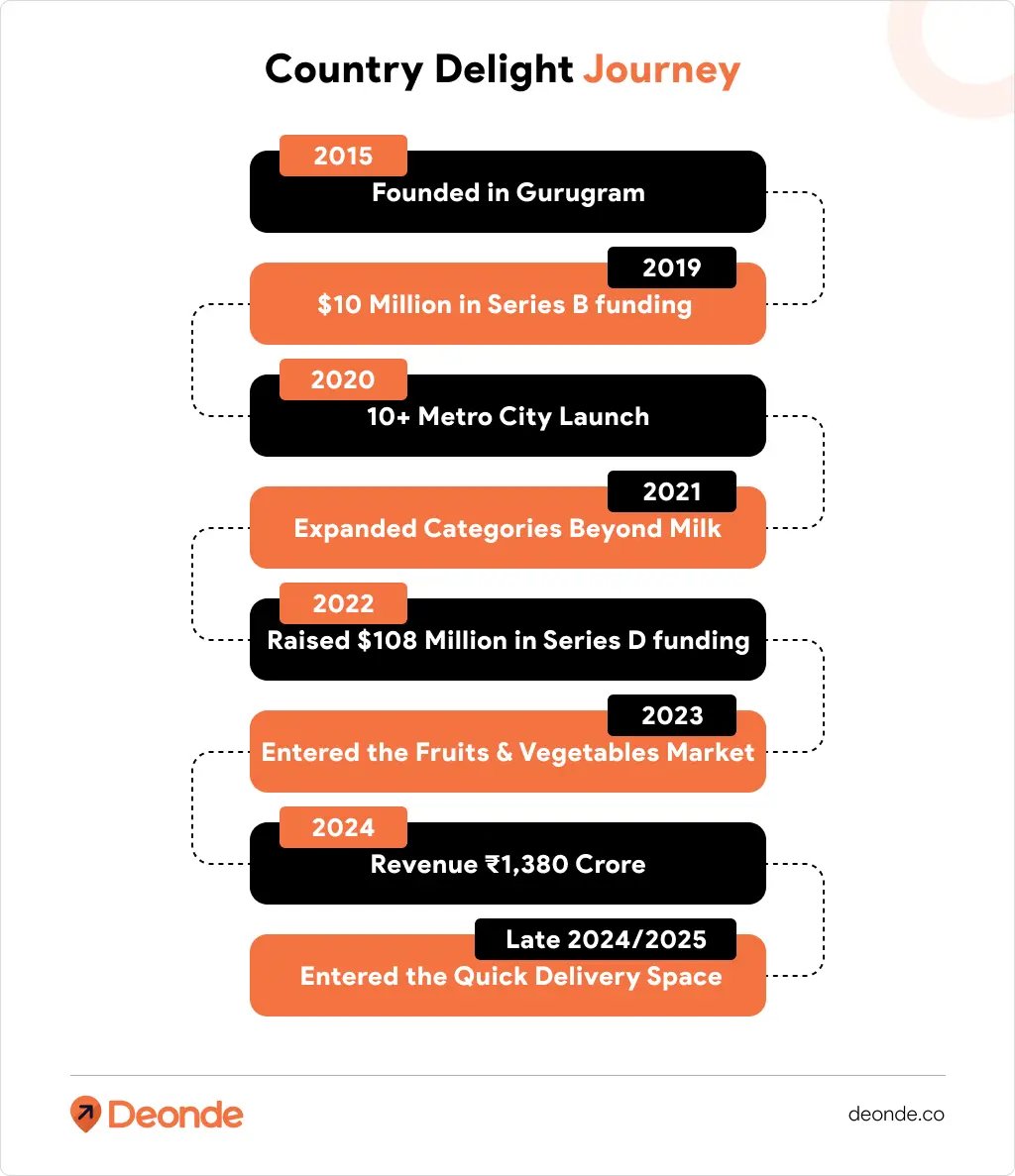
Country Delight’s journey from a small startup in Gurugram to a national D2C giant is nothing short of inspiring. Here is how they scaled year by year:
- 2015: The Beginning – Founded by Chakradhar Gade and Nitin Kaushal in Gurugram with a mission to deliver pure cow and buffalo milk.
- 2019: Funding Boost – Secured $10 Million in Series B funding led by Matrix Partners, allowing them to expand operations beyond Delhi-NCR.
- 2020: Expansion Mode – Launched services in Mumbai, Pune, and Bangalore, taking their farm-to-home model to major metros.
- 2021: Product Diversification – Expanded their catalog beyond milk to include Bread, Eggs, and Ghee, becoming a complete breakfast delivery app.
- 2022: Unicorn Potential – Raised $108 Million in Series D funding, valuing the company at over $600 Million. Launched in Chennai and Hyderabad.
- 2023: Category Expansion – Entered the fresh produce market with Fruits & Vegetables and launched the “Dr. Do” campaign to build trust, focusing heavily on transparency and encouraging customers to verify ingredients themselves.
- 2024: Pan-India Dominance – Crossed ₹1,380 Crore Revenue, now serving 25+ cities and fulfilling over 1.5 Lakh orders daily.
- Late 2024/2025: Entered quick delivery space; launched high-protein milk (2X protein)
- 2025: Further raised $25 million in Series E funding from Temasek
How Did It Start Getting Popular? (The Turning Point)
Country Delight didn’t just grow through Facebook ads. They grew because they exposed the competition.
Their popularity spiked due to three specific strategies:
1. The “DRDO Kit” Viral Campaign This was their masterstroke. Country Delight sent a DRDO-approved milk testing kit to potential customers for free or a nominal fee. They challenged users: “Test your current milk against ours.”
- When users tested their regular milk and saw it turn yellow (indicating adulteration/urea) while Country Delight remained unchanged, the fear factor drove immediate subscriptions. It was a marketing campaign built on proof, not slogans.
2. The “Thick Malai” (Cream) Factor In Indian households, the quality of milk is visually judged by the thickness of the Malai after boiling. Country Delight focused heavily on Buffalo Milk that produced thick, yellow cream.
By avoiding homogenization and keeping processing minimal, they ensured the natural fat layer remained intact just like village milk. Pictures of this “nostalgic” cream flooded social media, convincing the true decision-makers (mothers and grandmothers) to switch.
3. The 7 AM Promise They solved a massive pain point: Unpredictability. They promised that if you order by midnight, the milk will be at your door by 7 AM, no doorbells, no phone calls. For busy urban professionals, this silent, reliable service was addictive, creating a loyal base that rarely churned.
Country Delight Business Model Explained: How Country Delight Works?
To understand how Country Delight has disrupted the market, we must first understand how it is different from other players like Blinkit, Zepto, or Amul.
Most delivery apps are Aggregators (they deliver other people’s products). Traditional dairy companies are Legacy B2B (they sell to distributors, who sell to shops).
Country Delight is a Full-Stack D2C Brand.
This means they control every single step of the journey—from the cow’s udder to your doorstep. They don’t just move the product; they own the product and the entire supply chain.
The 3 Pillars of Country Delight’s Model
1. The Inventory-Led Model (Not Marketplace)
Unlike Quick Commerce apps that pick up items from a dark store or a local partner, Country Delight buys, tests, processes, and stores its own inventory.
- Why it works: Since they own the stock, they have 100% control over quality. They never have to worry about a shopkeeper giving them expired milk.
2. The Subscription-First Approach
Country Delight is not built for “impulse buying” (like craving a chocolate at 2 PM). It is built for “habit buying.”
- The Logic: Milk and bread are daily needs. Once a user subscribes, they don’t need to open the app daily. This creates a “Sticky Customer” who generates revenue for years, not just days.
3. Just-in-Time Sourcing (Zero Preservatives)
The core of their business is speed. They do not store milk for weeks.
- The Cycle: The milk is milked from the cow, tested, pasteurized, packed, and delivered to your home within 24 to 36 hours. This speed allows them to sell natural milk without adding preservatives to increase shelf life.
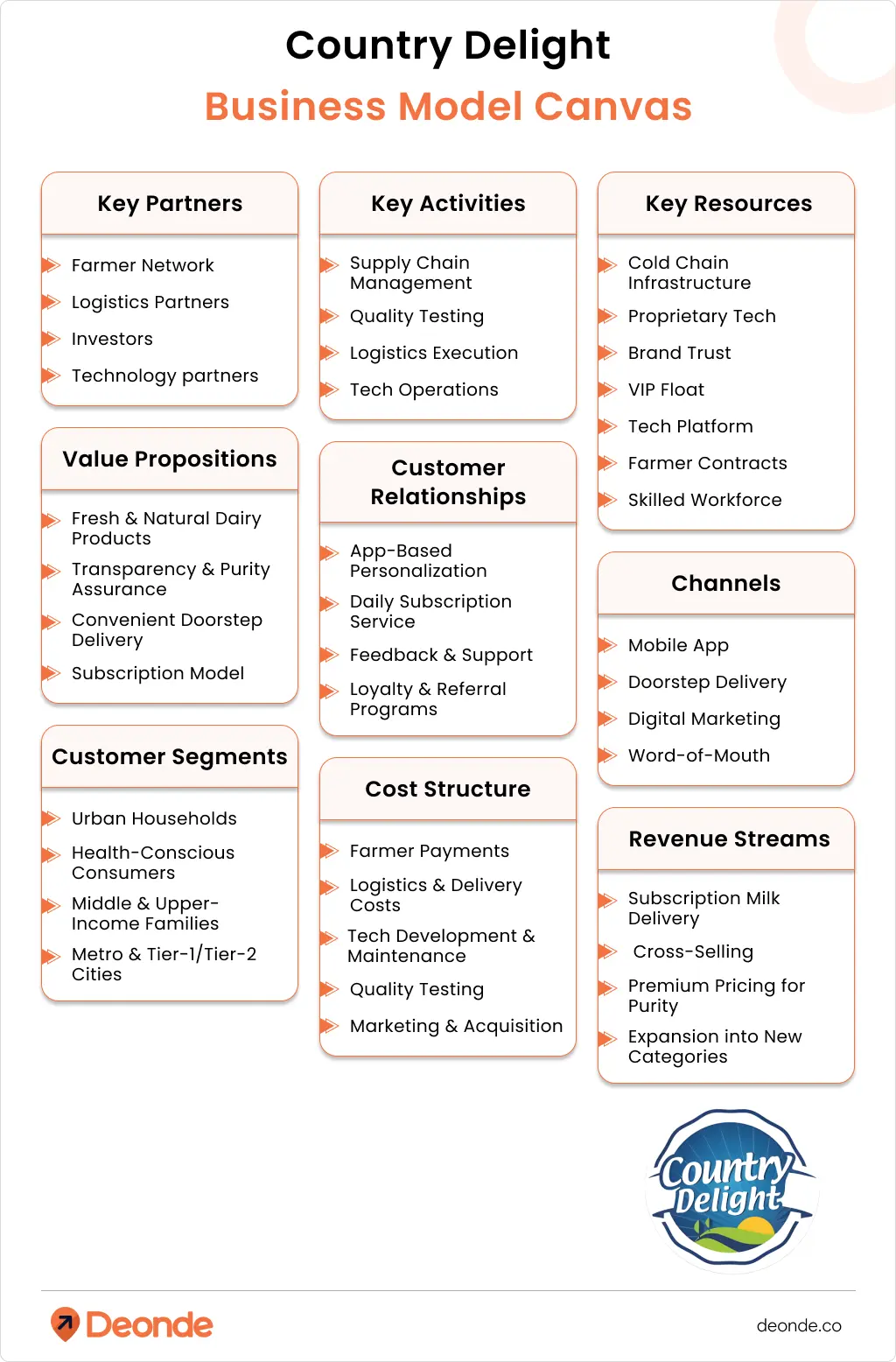
Country Delight Business Model Canvas
How Country Delight creates, delivers, and captures value—connecting rural farmers directly to urban households through technology.
How Country Delight Works: The 6-Step Workflow
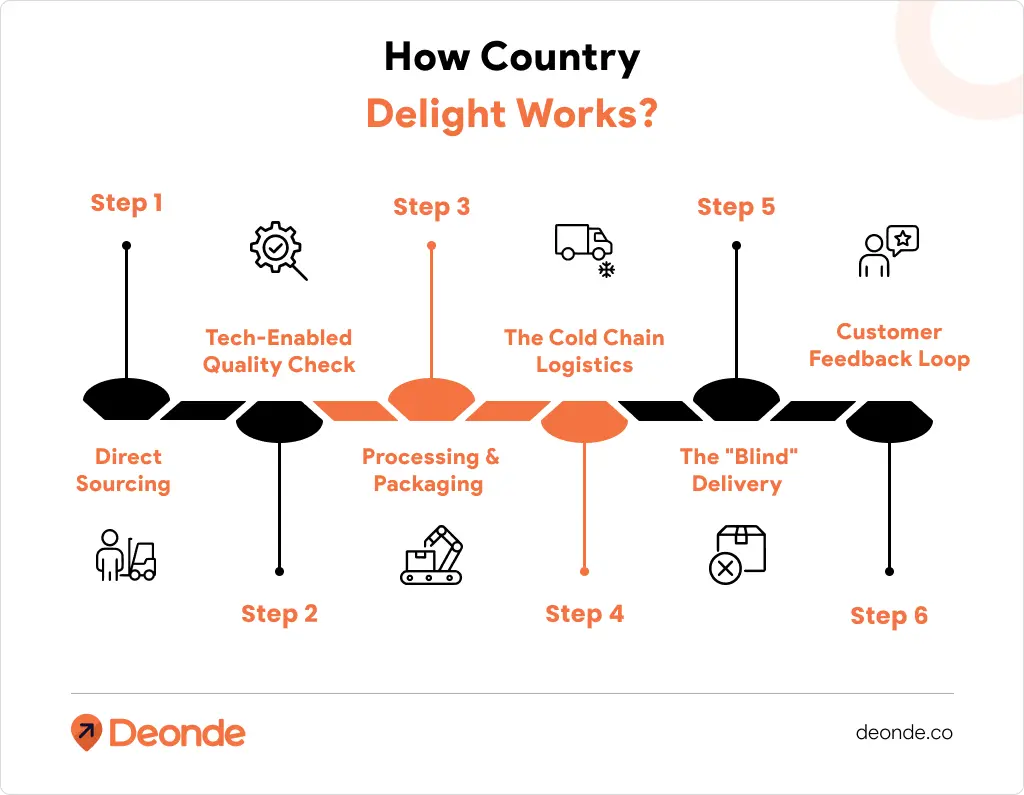
Here is the step-by-step operational flow of their business model:
Step 1: Direct Sourcing (The Farm Level) Country Delight has a network of 5,000+ farmers. They install their own bulk milk chillers in villages. Farmers pour milk directly into these chillers, ensuring no adulteration happens during transport.
Step 2: Tech-Enabled Quality Check Before the milk is accepted, it is tested on key parameters (fat, SNF, adulterants). If the milk fails the test, it is rejected immediately.
Step 3: Processing & Packaging The milk is transported to the nearest processing unit. Unlike commercial milk which undergoes heavy processing (UHT), Country Delight only pasteurizes it to kill harmful bacteria while keeping the natural texture and taste intact.
Step 4: The Cold Chain Logistics The packed products are moved to city warehouses in temperature-controlled trucks. The cold chain is never broken, ensuring the milk stays fresh.
Step 5: The “Blind” Delivery (Last Mile) This is the most unique part. The delivery starts at 5:00 AM. The delivery partners (Champions) have a specific route. They do not ring the doorbell. They quietly drop the packet in the Country Delight bag outside your door and mark the order as “Delivered” on their app.
Step 6: Customer Feedback Loop The customer wakes up, picks up the fresh milk, and if there is any issue, they can report it on the app for an instant refund.
|
Feature |
Traditional Dairy (Amul/Mother Dairy) |
Country Delight (D2C Model) |
|
Middlemen |
Farmer → Aggregator → Plant → Distributor → Retailer → You |
Farmer → Country Delight → You |
|
Delivery Time |
2-4 Days (via retail chain) |
24-36 Hours (Direct) |
|
Testing |
Batch Testing |
Every Tanker Tested + Customer Kit |
|
Ordering |
Offline (Shop) |
Mobile App (Subscription) |
|
Margins |
Low (Shared with distributors) |
High (Retained by company) |
Country Delight Revenue Model: How Does It Make Money?
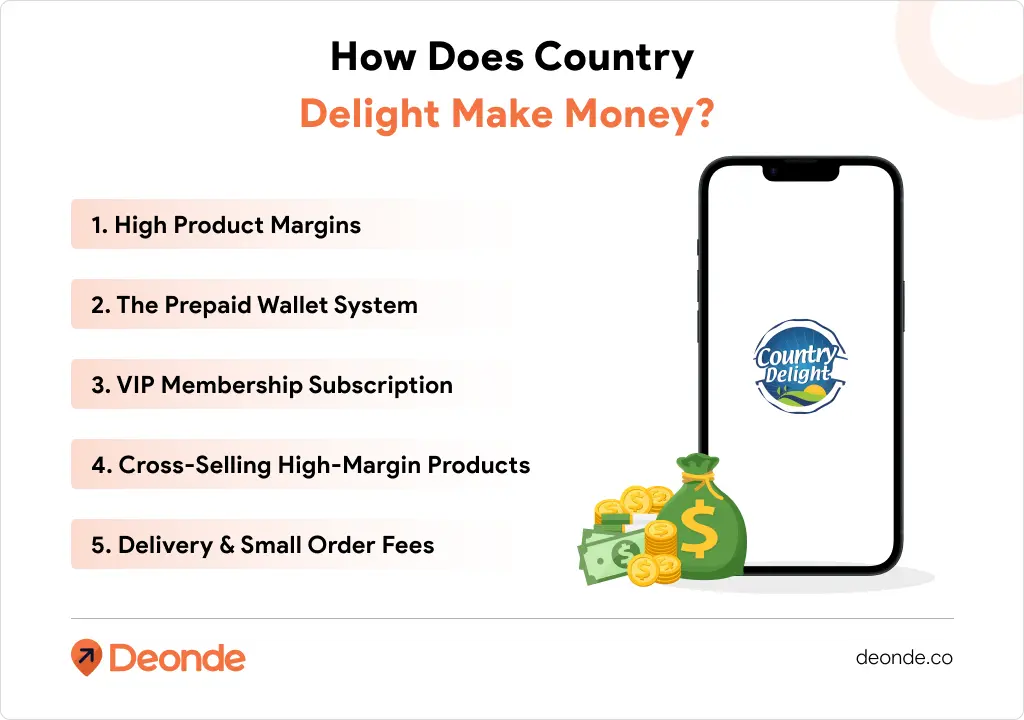
Unlike food delivery aggregators (like Swiggy or Zomato) that earn money primarily through commissions, Country Delight operates on a Full-Stack Inventory-Led D2C Model.
This means they make money by selling the product itself, not just the delivery service. Because they own the entire supply chain from the farm to the doorstep, their financial flow is far superior to traditional dairy companies.
Here is a detailed breakdown of their key revenue streams:
1. High Product Margins (Eliminating Middlemen)
The biggest chunk of Country Delight’s revenue comes from the margin on product sales.
- The Traditional Flow: In the standard dairy supply chain, the profit is split between multiple layers: Transporter → Distributor → Wholesaler → Retailer. Combined, these middlemen take away 25-30% of the product’s final price.
- The Country Delight Flow: By sourcing directly from farmers and delivering to consumers, Country Delight retains this entire 25-30% margin. They buy at fair procurement prices and sell at a premium market price, capturing the full value chain.
2. The Pre-paid Wallet System (Negative Working Capital)
This is the financial genius behind their business model. Country Delight operates on a Pre-paid Wallet System.
- How it works: Customers must recharge their in-app wallet (e.g., ₹500, ₹1000, or ₹2000) before they can schedule deliveries.
- The Revenue Benefit: This creates Negative Working Capital. Country Delight receives the cash from customers days or weeks before they actually deliver the product. This “floating capital” allows them to manage daily operations and pay farmers without relying heavily on external loans.
3. VIP Membership Subscription
Country Delight generates recurring revenue through its VIP Membership Program.
- Customers pay an upfront fee (e.g., Quarterly or Yearly) to join the VIP club.
- Benefits: VIP members get up to 20-30% off on products compared to non-members.
- The Hidden Value: While the membership fee is a revenue source, its real purpose is Retention. A customer who pays for a membership stops buying milk from the local shop to recover their membership cost, significantly increasing their Lifetime Value (LTV).
4. Cross-Selling High-Margin Products
Milk is a “Hook Product”—it has high demand and daily frequency but lower profit margins per unit. Country Delight uses milk to enter a customer’s home every morning. Once they have that access, they cross-sell High-Margin Value-Added Products:
- Dairy: Buffalo Ghee, Paneer, Curd.
- Bakery & Staples: Chemical-free Bread, Eggs, Oils, and Spices.
- Fresh Produce: Fruits and Vegetables.
- Revenue Impact: While milk brings the volume, products like Ghee and specialized breads drive the actual profitability.
5. Delivery & Small Order Fees
To ensure logistics efficiency, Country Delight charges a nominal delivery fee for small basket sizes or non-subscription orders. This creates an ancillary revenue stream that covers the fuel and logistics cost for smaller deliveries.
Must Read: How to Build a Milk Delivery App Like Country Delight
Country Delight Innovations & Updates (2024-2026)
- High-Protein Cow Milk: Launched a special milk with 30g protein (double the normal amount) using natural filtration, not artificial powder.
- Tech Upgrade: Installed IoT Sensors in village milk chillers to monitor milk temperature 24/7 and prevent spoilage.
- AI Demand Prediction: Upgraded their AI to predict exact daily demand, bringing food wastage down to near zero.
- Fresh Oat Milk: Entered the vegan market with preservative-free Oat Milk (unlike other brands that sell long-life boxes).
- HRX Partnership: Partnered with Hrithik Roshan’s brand (HRX) to promote protein-rich milk for fitness lovers.
- Kitchen Staples: Expanded the “Pulse” category with chemical-free Spices, Dry Fruits, and Cold-Pressed Oils.
- 15-Minute Delivery (Pilot): 15-Minute Delivery (Pilot): Started testing instant delivery in Gurugram. This marks a strategic shift from pure “habit buying” (morning milk) to covering “emergency buying” (mid-day needs), directly competing with Zepto and Blinkit.
- All-Day Ordering: Shifted focus from “Order at night” to “Order anytime” for emergency items like bread and eggs.
- IPO Target: Aiming to list on the Stock Market (IPO) by 2026.
Competitor Analysis: Country Delight vs Others
Country Delight faces competition from three main sectors: Traditional Co-operatives (like Amul), Premium Organic Brands (like Akshayakalpa), and Quick Commerce Apps (like Blinkit/Zepto).
Here is a side-by-side comparison of how they operate:
|
Feature |
Country Delight (The Specialist) |
Amul / Mother Dairy (The Legacy Giants) |
Zepto / Blinkit (The Aggregators) |
|
Primary Selling Point |
Purity & Cream (Trust) |
Price & Availability (Scale) |
Speed (10-Min Delivery) |
|
Sourcing Model |
Farm-to-Home (Direct from partner farms). |
Cooperative (Collected from millions of small farmers). |
Retail Aggregator (They buy from Amul/Mother Dairy). |
|
Milk Age (Udder to Door) |
24 – 36 Hours (Fresh). |
2 – 4 Days (Stored in collection centers/silos). |
Variable (Depends on dark store stock). |
|
Processing Tech |
Pasteurized Only (Natural cream layer stays intact). |
Homogenized & Standardized (Fat is broken down/mixed). |
N/A (They just deliver packets). |
|
Quality Check |
Blind Testing (75+ parameters; User gets a kit). |
FSSAI Standards (Internal batch testing). |
None (They rely on the brand’s label). |
|
Cow Milk Price (Approx) |
₹90 – ₹100 / Litre (Premium). |
₹56 – ₹58 / Litre (Budget). |
MRP + Delivery Fees (Surge pricing applies). |
|
Delivery Style |
Silent Drop (By 7 AM, no doorbell). |
Doorstep/Booth (Manual purchase). |
On-Demand (Instant, but requires manual ordering). |
|
Reliability |
100% Guaranteed (Pre-booked stock). |
High (Rarely out of stock). |
Medium (Morning rush often leads to “Out of Stock”). |
Takeaways for Founders Who Want to Build an App Like Country Delight
If you are an entrepreneur looking to enter the D2C or subscription delivery market, Country Delight’s journey offers some critical lessons.
Here is what you should learn from their playbook to build a profitable business:
- Solve a Real “Trust” Problem: Country Delight didn’t just sell milk; they sold purity. If you can solve a massive trust deficit in any industry (like spices, meat, or baby food), you will win.
- Don’t Build from Scratch (Leverage White-Label Tech): Country Delight spent years building their tech, but you don’t have to. Smart founders today prioritize Speed-to-Market. Instead of wasting 6 months and lakhs of rupees coding an app, use a Readymade White-Label Milk Delivery System. This allows you to focus on sourcing and farmers while the tech handles itself.
- Focus on “Habit” Products: Build your business around a product that people need every day (like milk or bread). High frequency leads to high retention and a higher Lifetime Value (LTV).
- Negative Working Capital is King: Try to build a pre-paid wallet model. Getting cash upfront from customers before you deliver the product solves major cash flow headaches for startups.
- Control the Supply Chain: In sensitive categories like food, relying on third-party quality is risky. Owning the sourcing (farm-to-home) builds a defensible moat against competitors.
Conclusion
Country Delight has successfully disrupted a legacy industry by combining the purity of the old days with the convenience of modern technology.
They proved that Indian consumers are not just price-sensitive; they are value-sensitive. People are willing to pay a premium if they are guaranteed health and quality.
The D2C fresh food market is just getting started. If you have an idea to deliver fresh, chemical-free food to Indian homes, now is the time to execute.
Are you ready to build the next Country Delight?
Partner with Deonde today. Our White-Label Subscription Delivery Solution gives you the exact tech stack you need—apps, wallet systems, and route optimization—to launch your business in days, not months.
Let’s build the future of fresh delivery together.