Do you have a fantastic business idea but feel overwhelmed by where to begin your journey online? In the past decade, online marketplaces like DoorDash, Swiggy, Uber Eats, Grubhub, and Blinkit have continued to dominate the global marketplace.
The explosive growth of digital commerce has shifted the way businesses operate, pushing entrepreneurs to explore scalable and future-ready models.
A multi-vendor B2C marketplace is a digital platform where multiple sellers offer their products or services directly to customers, all under one brand. Think of it as an online mall where different shops sell under one roof. From niche product hubs to large-scale platforms, this model empowers owners to build revenue streams without having to own every product in stock.
But here’s the crucial question: Is this powerful model the right fit for your unique vision? How do you know if the advantages of a multi-vendor marketplace make it the best way to turn your entrepreneurial dream into a profitable reality?
The multi-vendor B2C marketplace model isn’t just another trend; it’s a proven business framework that minimizes risk, drives scalability, and unlocks new revenue streams. All without the massive risks and costs associated with a traditional business.
This blog helps you answer that question. We will explore the key advantages of a multi-vendor marketplace and help you determine whether this is the path you should take.
The Core Advantages of Multi-Vendor Marketplaces
Starting a new business is always a risk, but this model helps you mitigate some of the biggest challenges while setting the stage for exponential growth.
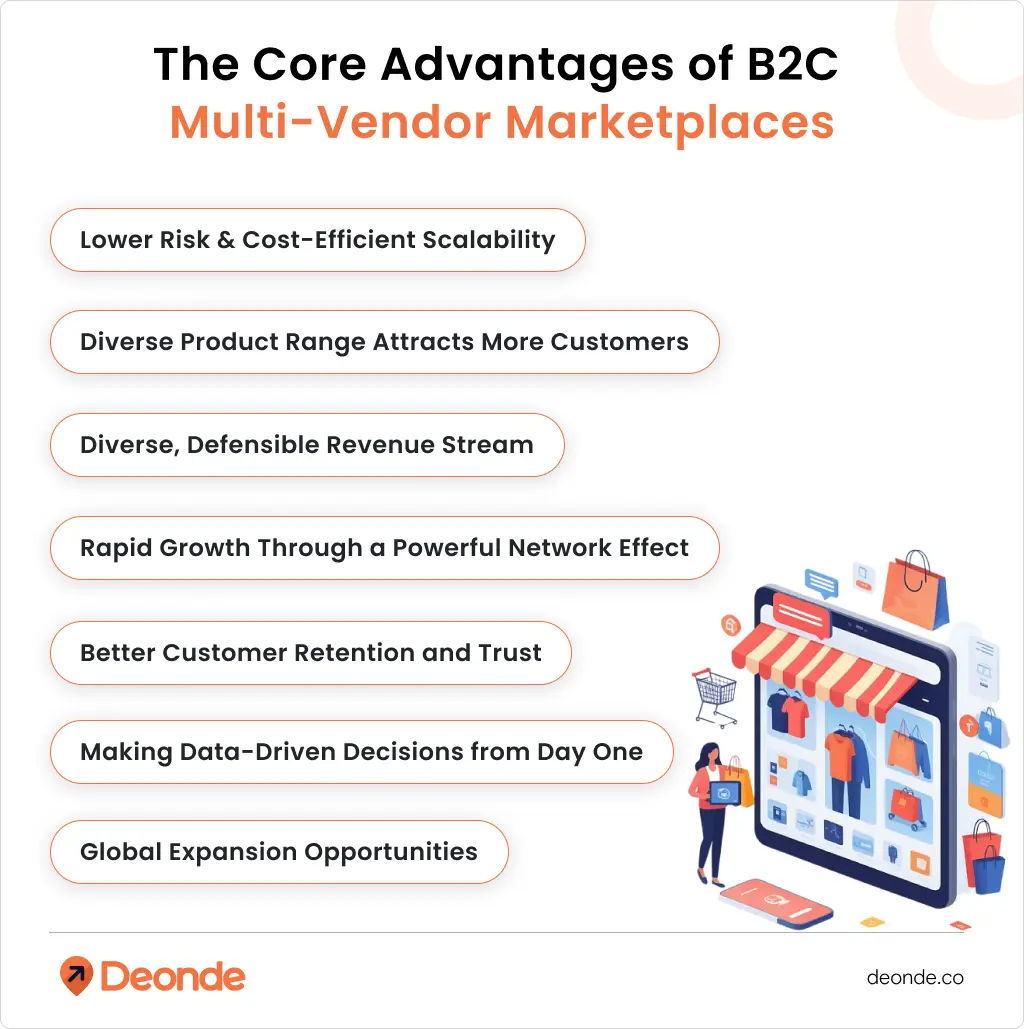
Lower Risk & Cost-Efficient Scalability
Unlike traditional retail models, you don’t need to stock inventory or manage logistics for every product. Vendors handle supply and fulfillment, allowing you to scale rapidly without massive capital investment.
Launching a single-brand store often demands:
- Bulk inventory purchasing
- Warehousing expenses
- Logistics and delivery management
- Handling returns and unsold products
This is a high-risk, high-cost setup, especially if you’re unsure how the market will respond.
With a multi-vendor marketplace:
- No heavy inventory risk: Vendors manage their own stock. You don’t tie up capital in products that may not sell.
- Reduced operational overhead: Warehousing, packaging, and last-mile delivery often remain vendors’ responsibility.
- Scalable without proportional costs: Adding new sellers and categories doesn’t mean exponential increases in costs for you.
- Flexible market entry: You can launch lean, test demand, and scale up only after validating the concept.
Example: Swiggy became one of India’s fastest-growing unicorns because it didn’t own kitchens. Restaurants handled food; Swiggy focused on tech and delivery partners.
Why it matters: For startups or entrepreneurs with limited resources, this lowers barriers to launch and offers safer pathways into online commerce.
Diverse Product Range = Higher Customer Loyalty
The broader the catalog, the higher the customer engagement. Multi-vendor marketplaces offer variety and choice, giving shoppers reasons to return and explore more.
The “One-Stop-Shop” Advantage: A customer can order dinner from a local bistro, add a bottle of wine from a nearby liquor store, and get fresh ingredients from a specialty grocery store, all in one single order.
Increased Traffic: The more variety you have, the more reasons customers have to visit your platform, leading to higher traffic, conversions, and customer satisfaction.
Example: DoorDash built loyalty not by being the best restaurant, but by offering every restaurant in one app. The massive range meant customers always found something to satisfy cravings.
Why it matters: Modern customers expect choice, personalization, and convenience. Offering a wide product ecosystem builds customer loyalty and reduces reliance on one or two buying triggers.
Diverse, Defensible Revenue Stream
Commissions on Each Order
This is the primary business model for almost every food delivery marketplace. The platform charges restaurants a commission percentage on each order. The range varies:
- Smaller/local restaurants may pay higher rates.
- Large global chains negotiate lower commissions.
Commissions are lucrative because:
- They scale automatically with order volume.
- The platform earns without cooking, stocking, or selling food—it monetizes the transaction.
- Commissions incentivize platforms to bring more orders to restaurants, aligning both sides’ goals.
Delivery Charges Paid by Customers
In addition to commissions from restaurants, delivery platforms also charge delivery fees directly to customers.
Factors that influence delivery charges:
- The distance between the restaurant and the customer
- Peak vs. off-peak times (surge pricing)
- Small basket size penalties (extra fee for small orders)
This revenue stream is especially important because it:
- Offsets the cost of paying delivery partners
- Ensures the platform isn’t overly dependent on restaurant commissions
- Gives flexibility for dynamic pricing models (e.g., higher charges during high demand periods)
Subscription & Loyalty Programs
Subscription plans are a proven way to build a recurring, predictable revenue stream. By offering benefits in exchange for a fixed fee, platforms turn casual customers into loyal subscribers.
Some examples:
- Swiggy One – Offers free deliveries, discounts on food and Instamart grocery orders for a monthly/annual fee.
- Zomato Gold (Pro Plus) – Free delivery, faster refunds, exclusive promotions, and priority support.
- Uber Eats Pass – Unlimited free deliveries above a cart value, available in many countries.
Why subscriptions matter:
- They lock users in—the psychology of “I’m paying for this, so I should order more often” increases transaction frequency.
- Subscriptions soften seasonal fluctuations. Even during slow months, subscription fees bring steady income.
- They create a premium tier of customers who spend more than average users.
Sponsored Visibility & Paid Listings for Restaurants
Food delivery marketplaces aren’t only platforms for selling, they’re also advertising ecosystems. Restaurants want visibility and are willing to pay for it.
Some models include:
- Sponsored Listings – Restaurants bid to appear in the top search results (“Best Pizza Near Me”).
- Banner Ads & Placements – Highlighted spots on the homepage or category screens.
- Boost Ads During Peak Hours – Premium placement when orders surge (like lunch/dinner rush).
Why this works:
- Restaurants spend heavily on marketing to stand out in crowded cities.
- Digital visibility inside an app has much higher intent conversion rates than generic ads.
- Sponsored ads scale as the platform grows in vendors.
Exclusive Partnerships & Advertising Deals
Beyond ads and commissions, many platforms monetize deeper partnerships.
Examples include:
- Exclusive Tie-ups with Restaurant Chains – A fast-food chain like McDonald’s or KFC may partner exclusively with one platform in certain geographies, giving that platform differentiation and a revenue boost.
- Brand Collaborations – Soft drink or snack companies may sponsor promotions (“Order a pizza, get a free Coke”).
- In-App Placement for FMCG Ads – Food marketplaces are increasingly selling ad slots to packaged goods brands.
Rapid Growth Through a Powerful Network Effect
This is the secret sauce of a successful marketplace. The network effect is a powerful phenomenon where the value of a platform increases as more people use it. The more sellers and buyers join, the more valuable the platform becomes.
- Sellers Attract Buyers: Every time you onboard a new restaurant, that restaurant’s loyal customers are likely to try your platform.
- Buyers Attract Sellers: As your customer base grows, more restaurants, cafes, and grocery stores will want to join your marketplace to access those customers.
Example: A new food marketplace launches with just five popular local food trucks. Those food trucks bring their loyal followers to the app. When other food trucks see the high customer numbers, they join too, creating a snowball effect of growth.
Why it matters: The network effect creates a self-reinforcing cycle of growth that is incredibly difficult for competitors to replicate. Your business gets stronger and more valuable with every new user.
Better Customer Retention and Trust
Building customer trust is a major hurdle for any online business. A well-managed marketplace acts as a trusted intermediary between buyers and sellers.
- Trusted Curator: You become the trusted source for the best local food and grocery businesses. Customers trust your brand, so they are more likely to buy from a new or unknown vendor on your platform than they would from that vendor’s standalone store.
- Reputation Builds Loyalty: Positive reviews and ratings for both vendors and the overall platform build a strong reputation, leading to better customer retention and a loyal user base.
Example: A customer wants to try a new local bakery but is hesitant. Seeing that the bakery is on a well-known food marketplace with positive reviews, the customer feels confident in placing an order. This loyalty transfers from the vendor to your brand.
Why it matters: A strong brand reputation and loyal customer base are the most valuable assets a business can have. The marketplace model helps you build both more quickly and effectively.
Making Data-Driven Decisions from Day One
Every entrepreneur knows that data is gold. A multi-vendor platform provides you with a treasure trove of data from the moment it goes live.
- Understanding Your Customers: You can instantly see what people are ordering, what time they order, and what trends are emerging. For a cloud kitchen, this data is invaluable for testing new concepts and menus.
- Optimizing Your Business: This real-time information allows you to make smart, data-driven decisions about your business, helping you refine your strategy and target your marketing efforts with pinpoint accuracy.
Global Expansion Opportunities
In a traditional business, global expansion is a massive undertaking that requires physical infrastructure in new countries. With a marketplace, it’s a natural next step.
With the cross-border B2C e-commerce market expected to reach over $4.1 trillion by 2027, you can easily onboard vendors from different regions and sell to a global audience without needing physical locations everywhere. This scalability makes your business truly borderless.
Conclusion: Ready to Build Your Marketplace?
Building a multi-vendor B2C marketplace isn’t just a trend it’s a proven business model. From lowering risks and increasing product diversity to unlocking global expansion opportunities, the advantages make it a compelling choice for modern entrepreneurs and investors.
If your vision is to build a scalable, flexible business that thrives on collaboration and customer trust, then yes this marketplace model may very well be the right foundation for your idea.
FAQ:
Q: What are the biggest challenges of building a multi-vendor marketplace?
A: The main challenges are attracting and vetting high-quality vendors, managing customer support and disputes between buyers and sellers, and ensuring your platform is robust and user-friendly.
Q: What is the difference between a multi-vendor marketplace and a regular e-commerce store?
A: A regular store usually sells only the owner’s products, while a multi-vendor platform allows multiple sellers to list and sell their goods to customers.
Q: How do I attract vendors to my marketplace?
A: Offer incentives such as low commission rates initially, easy onboarding, and quality support. Focus on marketing your marketplace as a channel where sellers can reach more customers.
Q: Can I start small with this model?
A: Yes. Many successful platforms began as niche, targeted marketplaces before scaling into larger ecosystems.
Q: What industries benefit most from this model?
A: Fashion, electronics, niche foods, handmade goods, services, and even digital products like e-books or software thrive in multi-vendor marketplaces.
Q: Is it hard to build a multi-vendor platform?
A: With today’s SaaS solutions, marketplace software, and no-code platforms, it’s easier than ever to launch a marketplace without advanced technical knowledge.
Q: Is a multi-vendor marketplace profitable?
A: Yes, the model is highly profitable due to its diverse revenue streams (commissions, subscriptions, advertising) and low operational overhead. Because you don’t manage inventory, your profit margins can be higher than in a traditional retail business.