The on-demand economy is changing how people shop, work, and move goods every single day. Logistics has become one of the biggest winners of this digital shift.
Think about how we used to move goods just a few years ago:
- Finding a local transporter was hard.
- Pricing was often unclear and unfair.
- Delivery times were unpredictable.
- Manual bookings slowed everything down.
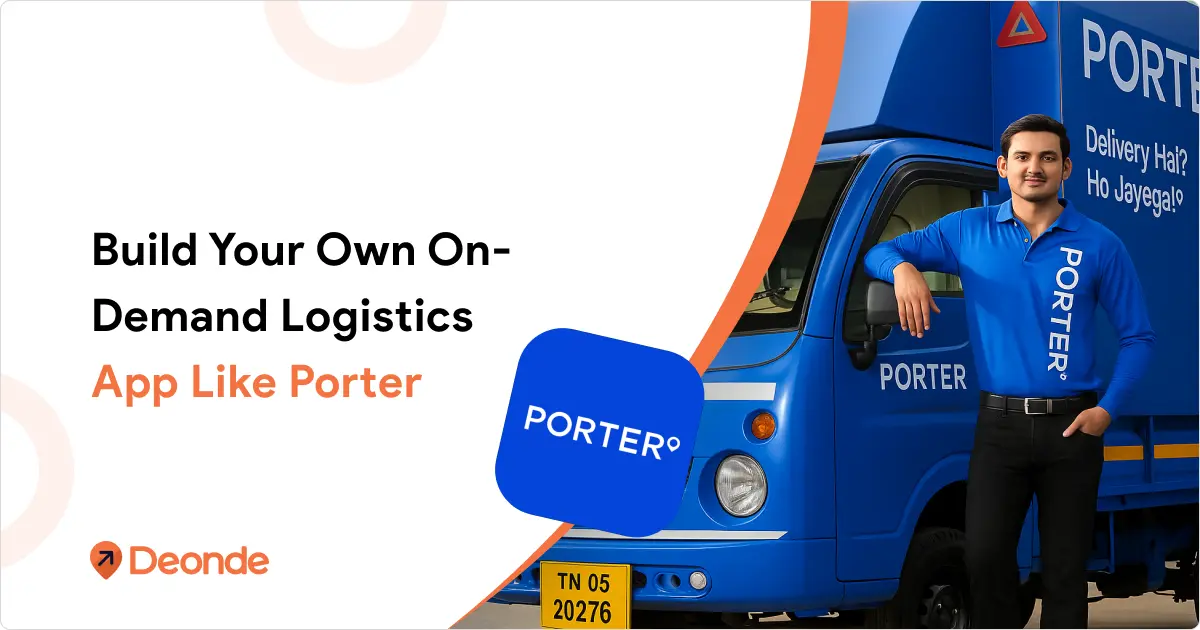
Today, all of this has been replaced by apps like Porter, which offer transparent pricing, instant booking, real-time tracking, and reliable service. Porter is one of the leaders in this space, helping both businesses and individuals move goods quickly and affordably.
If you’ve ever thought about building your own app like Porter, now is the right time. The demand is high, and the market is still growing rapidly.
However, it takes more than just an idea to compete with players like Porter. You’ll need the right business model, strong features, and smart technology decisions.
The good news is that with the right approach, you can launch your own branded logistics platform. Even better, you don’t always need millions of dollars or years of coding.
In 2023, the Asia Pacific region held the largest share of the e-commerce logistics market, accounting for 41.61% of the total market, and the U.S. e-commerce logistics sector is projected to experience substantial growth, reaching a value of $366.19 million by 2032.
This guide will walk you through everything: from choosing a model and niche, to designing features, to picking the right technology stack.
By the end, you’ll know exactly how to start building an app like Porter and take advantage of the booming on-demand logistics industry.
Understanding the Porter Model & Market Opportunity
Before development, you need a clear business strategy. The logistics market is booming due to e-commerce, supply chain demands, and increasing expectations for fast delivery.
Business Models to Consider:
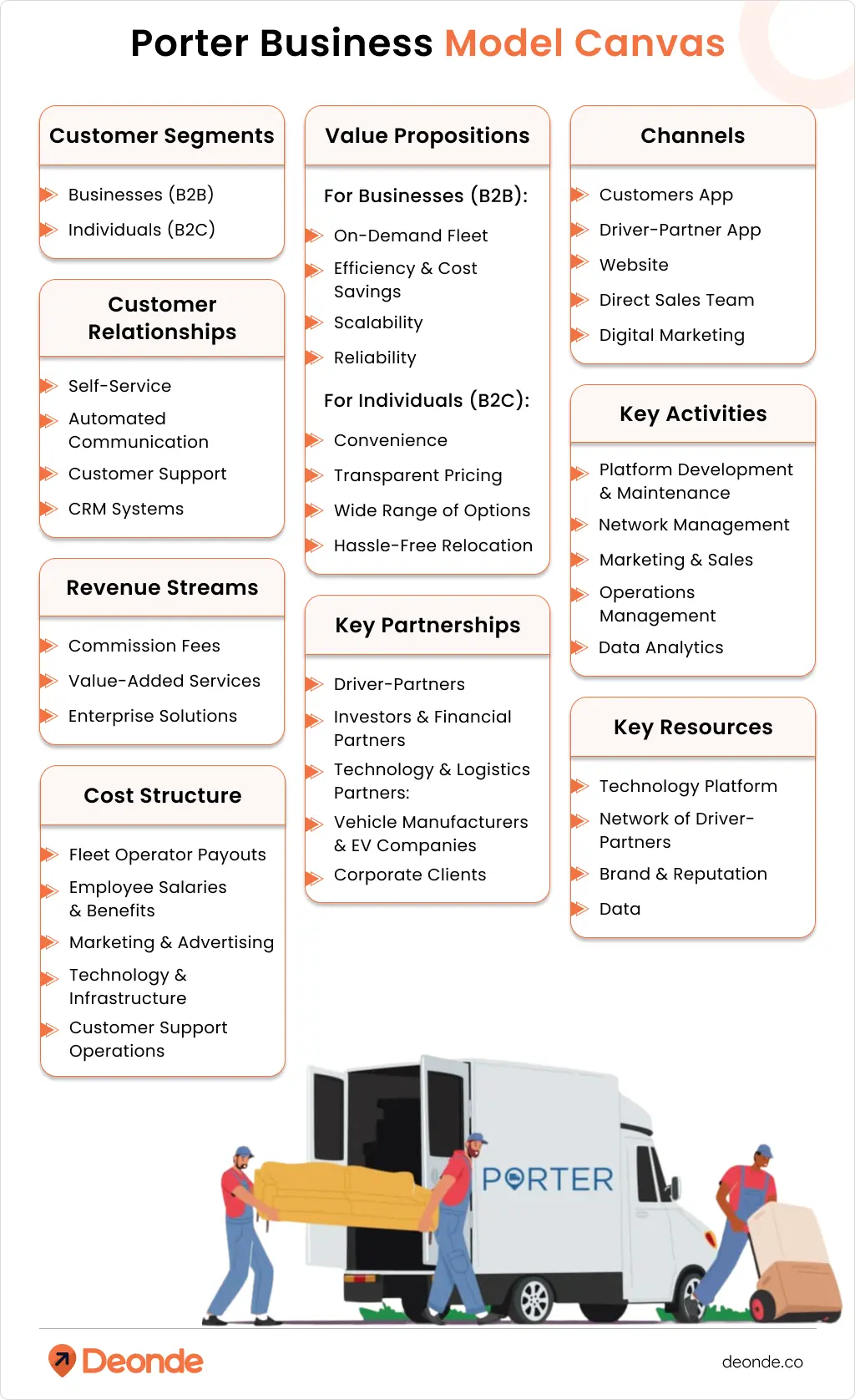
Aggregator Model
This is the most popular, asset-light approach. You act as a central platform connecting independent drivers or small logistics partners with users who need to send goods.
- Pros: Highly scalable with lower initial investment.
- Cons: Requires robust systems to maintain service quality and driver reliability.
Example: Uber and Ola started with an aggregator model in ride-hailing before expanding.
Fleet-Ownership Model
In this model, you own and manage the entire fleet of vehicles and employ the drivers.
- Pros: Gives you complete control over branding, service quality, and pricing.
- Cons: It’s capital-intensive and less flexible to scale.
Example: Some courier companies operate this way to ensure reliability.
Hybrid Model
A combination of both, where you own a core fleet for high-demand routes while also partnering with independent drivers to manage fluctuations.
- Pros: Balance between flexibility and control.
- Cons: More complex to manage.
Core Features: The Three Pillars of a Porter-Like App
A logistics app is not a single product. It’s an ecosystem made of three parts:
- Customer App (for users booking deliveries)
- Driver App (for partners who move goods)
- Admin Panel (for managing the entire system)
Let’s break these down.
1. Customer App Features
The customer app is the front face of your brand. Think of it as your dedicated Parcel ordering Software; it’s where first impressions are formed.
Simple Booking Process
Customers should be able to book a vehicle in just a few taps. By selecting the vehicle type and pickup and drop location quickly, the process feels seamless and hassle-free.
Real-Time Fare Estimates
Nobody likes surprise charges. Showing upfront pricing based on distance and vehicle type builds trust and helps users make faster booking decisions.
GPS Tracking
Customers want to know where their goods are at all times. Real-time GPS tracking on a live map provides visibility and reduces anxiety during transit.
Multiple Payment Options
Flexibility in payments is key to user satisfaction. From credit/debit cards and UPI to digital wallets and cash-on-delivery, offering variety makes your app more accessible.
In-App Communication
Things don’t always go as planned. Allowing users to call or chat with the driver directly through the app makes problem-solving quick and smooth.
Push Notifications
Instant updates about driver assignment, pickup, and delivery keep customers informed at every stage. This reduces support calls and increases user confidence with real-time notifications.
Ratings & Reviews
After a delivery, customers should be able to rate the driver and service. This feedback loop builds trust and ensures consistent quality.
Booking History
A history log lets customers revisit past bookings. This feature is useful for repeat orders, expense tracking, and dispute resolution.
2. Driver/Partner App Features
Drivers are your biggest partners in this business. A well-designed app makes their job easier, boosts efficiency, and motivates them to stay on your platform.
Quick Onboarding
New drivers should be able to register with minimal friction. Document uploads, verification, and profile creation must be simple yet secure.
Availability Toggle
Flexibility is one of the biggest perks for drivers. An online/offline toggle allows them to control their schedules and work when it suits them best.
Job Acceptance/Rejection
Drivers need clear visibility of trip details before committing. A simple accept/reject system empowers them while ensuring jobs are distributed fairly.
In-App Navigation
Integrated maps and optimized routes save drivers time and fuel. Built-in navigation also reduces errors and ensures faster deliveries.
Earnings Dashboard
Transparency in income motivates drivers to stay active. A clear earnings dashboard helps them track daily, weekly, and monthly revenue easily.
Proof of Delivery (PoD)
Digital proof protects both the customer and the business. Drivers can capture signatures, photos, or QR scans to confirm successful delivery.
3. Admin Panel Features
The admin panel is the control room of your logistics business. It’s your Online Courier Delivery Management System, giving you the power to manage operations, monitor performance, and make data-driven decisions.
Centralized Dashboard
A single dashboard showing all active bookings, driver locations, and revenue metrics keeps you in control at all times.
Driver & Vehicle Management
Onboarding, approving documents, monitoring driver activity, and tracking vehicle performance are all crucial tasks made easier through this feature.
Pricing & Commission Controls
As an admin, you need flexibility to set pricing rules and commission rates. This helps you balance profitability with fair earnings for drivers.
Customer Support Tools
Disputes and service issues are inevitable in logistics. Built-in support tools help your team respond quickly and maintain customer trust.
Reports & Analytics
Data is your biggest advantage in scaling a business. Insights into delivery times, driver performance, revenue trends, and customer satisfaction help you plan for growth.
Together, these three components create a courier delivery app, just like Porter.
Technology Stack for Building an App Like Portal
Choosing the right technology stack is one of the most important steps in building a logistics platform. The tools you pick will decide how fast your app runs, how well it scales, and how smooth the user experience will be.
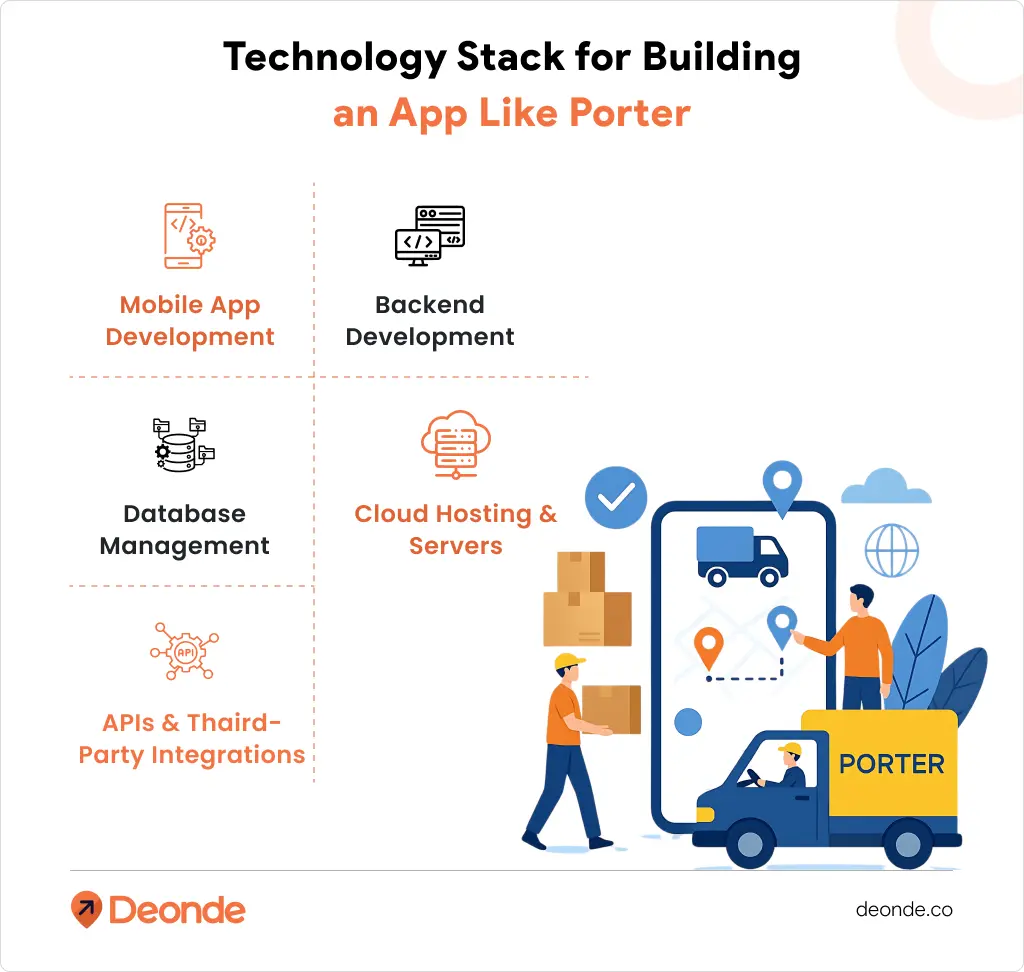
Mobile App Development
Your customer and driver apps need to run on both iOS and Android. You have two main choices:
- Native Apps: Built separately using Swift for iOS and Kotlin for Android. This gives you the best performance and access to advanced features, but takes more time and cost.
- Cross-Platform Apps: Built using frameworks like React Native or Flutter. These allow you to write one codebase for both platforms, saving time and money while still delivering strong performance.
Backend Development
The backend is the brain of your app. It processes bookings, handles payments, tracks drivers, and manages communication.
- Languages & Frameworks: Node.js (fast and scalable), Python with Django (great for flexibility), or Java with Spring Boot (reliable for enterprise-level apps).
- Why it matters: A strong backend ensures smooth communication between users, drivers, and admins without lag or crashes.
Database Management
Your database stores all the important information—user profiles, bookings, driver details, and payment records.
- Relational Databases: PostgreSQL or MySQL for structured and reliable data.
- NoSQL Databases: MongoDB for flexibility and handling large-scale traffic.
Cloud Hosting & Servers
Your app must handle thousands of bookings and location updates at the same time. For this, cloud hosting is essential.
- Popular choices: AWS, Google Cloud, or Microsoft Azure.
- Why it matters: These platforms allow you to scale up during peak hours and scale down when traffic is low, saving costs while maintaining performance.
APIs & Third-Party Integrations
Instead of building everything from scratch, you can plug in existing services.
- Maps & Navigation: Google Maps or Mapbox for route optimization.
- Payments: Stripe, Razorpay, or PayPal for secure transactions.
- Notifications: Twilio or Firebase Cloud Messaging for instant alerts.
- Analytics: Mixpanel or Google Analytics for tracking user behaviour.
Step-by-Step Guide to Build an On-Demand Logistics App Like Porter
Building a logistics app is not an overnight process. It takes structured planning and execution. Here’s the roadmap most startups follow:
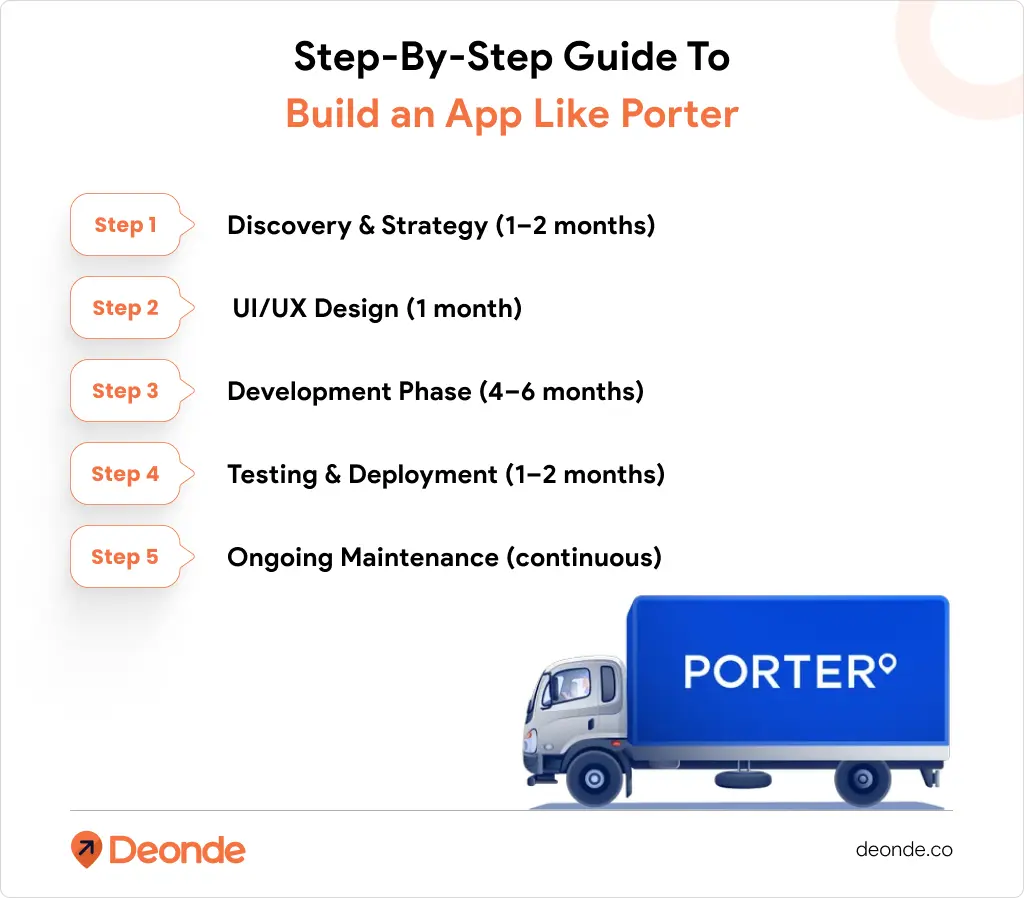
1. Discovery & Strategy (1–2 months)
This is the foundation of your project. During this stage, you’ll:
- Research your competitors and market trends.
- Define your niche (B2B, B2C, or hyperlocal).
- Finalize your feature list.
- Build a clear project plan and budget.
2. UI/UX Design (1 month)
Design is more than just looks—it’s about user experience.
- Create wireframes for each screen (customer, driver, admin).
- Design flows for booking, payments, tracking, and support.
- Test prototypes with sample users to ensure simplicity.
3. Development Phase (4–6 months)
This is where coding happens. Your team builds the apps, backend, and admin panel simultaneously.
- Customer app and driver app were developed in parallel.
- The backend was built to handle real-time requests and data.
- Third-party APIs are integrated for maps, payments, and notifications.
4. Testing & Deployment (1–2 months)
Once the code is ready, you need to test it thoroughly.
- Functional Testing: Does every feature work as intended?
- Performance Testing: Can the app handle high traffic?
- Security Testing: Are payments and user data safe?
After testing, the apps are published on the App Store and Google Play, and the admin panel goes live.
5. Ongoing Maintenance (continuous)
The launch is just the beginning. Regular updates, bug fixes, and feature improvements are necessary.
- Monitor server performance.
- Roll out new features based on user feedback.
- Stay updated with changes in iOS/Android systems.
This path requires a dedicated tech team, significant capital investment (often upwards of $50,000 – $100,000+), and a long time-to-market, during which competitors can gain an advantage.
A Smarter and Cost-Effective Way to Launch: Leveraging a SaaS Platform
For most entrepreneurs and businesses, the goal is to enter the market quickly, validate their business model, and scale efficiently without the massive upfront cost and risk of custom development.
This is where a white-label, ready-made courier delivery software solution becomes the ideal choice. Instead of building from the ground up, you can launch your own branded platform in a fraction of the time and at a fraction of the cost.
The benefits are clear:
- Speed-to-Market: Launch your branded apps in weeks, not years. This allows you to capture market share while competitors are still in the development phase.
- Cost-Effectiveness: Replace a huge, risky upfront capital expenditure with a predictable, manageable monthly subscription fee (operational expenditure).
- Proven Technology: You are building your business on a stable, secure, and scalable platform that has already been tested and proven in the market.
- Focus on Your Core Business: By outsourcing the technology, you can dedicate your time, energy, and capital to what truly matters: marketing, acquiring drivers, and providing excellent customer service that can even surpass Porter’s in your specific niche.
Conclusion: Building the Future of Logistics
The on-demand logistics industry holds incredible promise. Success hinges on a powerful, reliable, and user-friendly technology platform that can meet the demands of customers and empower drivers.
While the prospect of building your own app is tempting, it’s crucial to weigh the immense investment in time, money, and resources against the strategic advantages of launching quickly with a proven, scalable, and ready-to-deploy solution. To truly compete, your focus should be on building your brand and operations, not on reinventing the complex technological wheel.
By understanding the key features and business models, you can make an informed decision on the best path forward to launch your on-demand delivery business and build the future of logistics.

FAQs
Q1. How much does it cost to build an app like Porter?
A custom Porter-like app can cost $50,000–$100,000+, depending on features and team. With Deonde’s White-label Solution, you can launch affordably on subscription. See pricing.
Q2. What features should a logistics app like Porter include?
Key features include easy booking, real-time GPS tracking, multiple payment options, a driver availability toggle, an earnings dashboard, proof of delivery, and an admin panel for operations.
Q3. Which business model is best for an on-demand logistics app?
Popular models are Aggregator (asset-light and scalable), Fleet-Owned (high control, high cost), and Hybrid (balanced approach). Your choice depends on budget and target market.
Q4. Is it better to build a custom logistics app or use a white-label solution?
Custom apps offer full control but are expensive and time-consuming. White-label solutions are faster, cheaper, and ideal for startups testing the market.