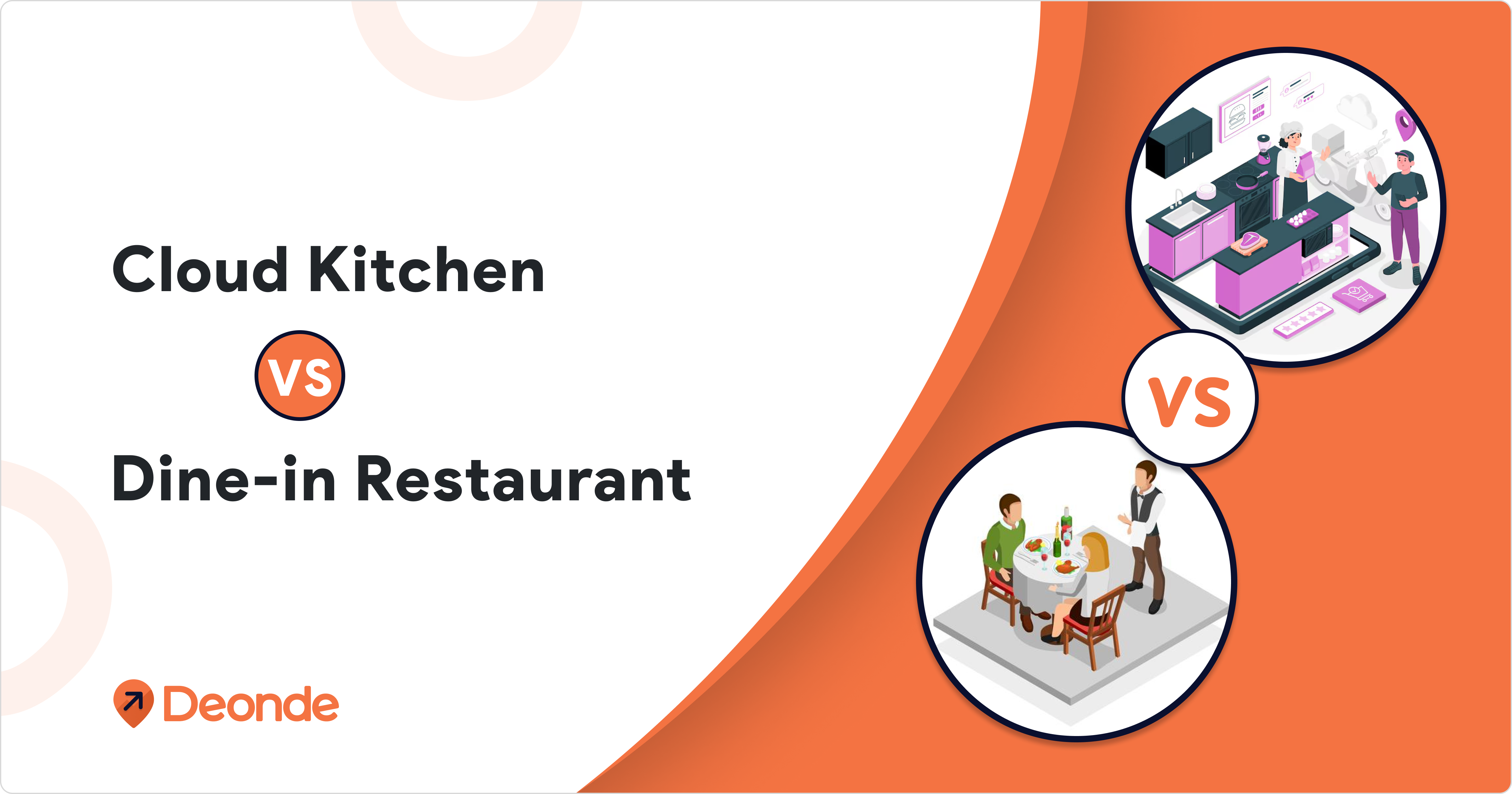
In today’s rapidly evolving culinary landscape, two distinct models dominate: the streamlined ghost kitchen and the traditional dine-in restaurant. But what truly sets them apart? Every invention is born out of necessity.
The success of food delivery has led to the invention of a cloud kitchen or ghost kitchen. Cloud or ghost kitchen is born out of the necessity of easing and simplifying food delivery solutions. Unlike restaurants, it does not need much investment or set-up. We will help you understand the major difference between a Cloud kitchen and a Dine-in restaurant.
Cloud Kitchens (also known as Ghost Kitchens) versus Traditional Dine-In Restaurants. These two models represent fundamentally different business approaches—one based on technology-driven delivery models, and the other grounded in in-person hospitality and physical dining experiences.
This comprehensive guide explores the major differences between ghost kitchens and dine-in restaurants.
What Is a Ghost Kitchen?
A ghost kitchen is a food preparation facility that focuses solely on delivery or takeout orders. Unlike traditional restaurants, ghost kitchens don’t have a dining area or waitstaff. They operate out of commercial kitchens, warehouses, or shared spaces, preparing food for online orders.
Imagine a busy kitchen churning out pizzas, burgers, or sushi, but there’s no storefront or tables. Customers order through apps, and the food is delivered straight to their door. Ghost kitchens are designed for efficiency, cutting costs by skipping the dine-in experience.
They are often set up in low-rent, strategically located commercial spaces, optimizing for speed and cost-efficiency in food production and delivery.
What Is a Dine-in Restaurant?
A dine-in restaurant is the traditional model where customers visit the establishment, order food, and eat on-site. These restaurants focus on providing a complete dining experience, including ambiance, customer service, and sometimes entertainment.
These restaurants prioritize ambiance, service, and food quality to create memorable visits. They’ve been the backbone of the food industry for centuries, offering more than just meals—they provide social and cultural experiences.
Future of the Restaurant Industry: Online Food Ordering Kitchens
The restaurant industry is at a crossroads, with online food ordering kitchens poised to play a pivotal role. According to industry projections, the global cloud kitchen market size was valued at $66.63 billion in 2024. Following a growth rate of 7.8%, the market has reached $71.81 billion in 2025. The momentum doesn’t stop there—projections indicate the market will accelerate further at a CAGR of 11.9% from 2026 to 2030. This surge is driven by the increasing popularity of food delivery, fueled by busy lifestyles and the convenience of apps.
However, dine-in restaurants are not fading away. Many adopt hybrid models, integrating delivery and takeout services to complement their in-person offerings. The future of the industry lies in balancing convenience with experiential dining. Ghost kitchens will likely dominate in densely populated urban areas. At the same time, dine-in restaurants will continue to thrive in suburban or tourist-heavy regions where ambience and social interaction are valued.
Emerging trends shaping the industry include:
- Sustainability: Both models are pressured to adopt eco-friendly practices, such as reducing packaging waste or sourcing local ingredients.
- Personalization: Data analytics allows ghost kitchens to tailor menus to customer preferences, while dine-in restaurants use loyalty programs to enhance guest experiences.
- Automation: From robotic kitchen assistants to AI-driven order systems, technology is streamlining operations across both models.
- Hybrid Concepts: Some dine-in restaurants are launching ghost kitchen brands to diversify revenue, while cloud kitchens are experimenting with pop-up dining events to build brand awareness.
How did the Cloud Kitchen Online Ordering System come into existence?
The concept of cloud kitchens is relatively new, but its origins can be traced to the convergence of technology, urbanization, and changing consumer habits. Here’s a brief history of how cloud kitchens evolved:
The Rise of Food Delivery Platforms (2010s):
- The launch of food delivery apps like Uber Eats (2014), DoorDash (2013), and Zomato (2010) revolutionized the restaurant industry. These platforms made it easier for customers to order food from their favorite restaurants without leaving home.
- Restaurants began to see a surge in delivery orders, prompting some to rethink their business models.
Urbanization and Real Estate Costs:
- As urban populations grew, so did the demand for convenient dining options. However, skyrocketing real estate prices in cities made it difficult for new restaurants to afford prime locations.
- Entrepreneurs saw an opportunity to create delivery-only kitchens in less expensive, non-prime locations, giving birth to the cloud kitchen model.
The Impact of the Gig Economy:
- The gig economy, powered by platforms like Uber and Lyft, provided a ready workforce of delivery drivers. This made it feasible for cloud kitchens to operate without investing in their own delivery infrastructure.
The COVID-19 Catalyst (2020):
- The global pandemic was a turning point for cloud kitchens. With dine-in restaurants forced to close or limit operations, many pivoted to delivery-only models to stay afloat.
- Cloud kitchen startups like Kitchen United and CloudKitchens (founded by former Uber CEO Travis Kalanick) gained traction, offering shared kitchen spaces to restaurants looking to scale their delivery operations.
Technological Advancements:
- Cloud kitchens leveraged technology to optimize operations. Integrated POS systems, automated order management, and data analytics allowed them to streamline processes and reduce costs.
- Virtual restaurant brands, which exist only online and operate out of cloud kitchens, began to proliferate, catering to niche markets and specific cuisines.
- Today, cloud kitchens are a global phenomenon, with players like Rebel Foods (India), Kitopi (Middle East), and CloudKitchens (USA) leading the way. Innovations like robotic kitchens and AI-driven menu optimization continue to push the model forward.
Let us explore the differences between the two food delivery solutions.
1. Location and Space
- Ghost Kitchen: Operates in low-rent areas like industrial zones or shared kitchen spaces, as there’s no need for a customer-facing storefront. The focus is on functionality—enough room for cooking and packaging orders.
- Dine-In Restaurant: Requires a prime, high-traffic location to attract foot traffic. The space must include dining areas, restrooms, waiting lounges, and often outdoor seating, all designed to enhance the customer experience.
Why It Matters: Ghost kitchens save significantly on real estate costs, while dine-in restaurants invest in visibility and atmosphere.
2. Investment Costs
- Ghost Kitchen: Lower upfront costs. You need a commercial kitchen, basic equipment, and minimal decor. Many ghost kitchens operate in shared facilities, further reducing expenses.
- Dine-In Restaurant: High initial investment. Beyond the kitchen, you’re paying for interior design, furniture, lighting, signage, and ongoing maintenance of a customer-ready space.
Why It Matters: Ghost kitchens are more accessible for new entrepreneurs or those testing a concept, while dine-in restaurants require substantial capital.
3. Staffing Needs
- Ghost Kitchen: Employs a lean team, typically just cooks and a small cleaning crew. Some may include a manager or delivery coordinator, but the headcount is minimal.
- Dine-In Restaurant: Requires a diverse staff, including servers, hosts, bartenders, security, cleaning crews, and sometimes gardeners or maintenance workers for larger venues.
Why It Matters: Fewer staff in ghost kitchens mean lower payroll and simpler operations, while dine-in restaurants juggle complex staffing needs.
4. Operating Expenses
- Ghost Kitchen: Lower ongoing costs due to minimal staff, reduced utility bills (no dining area to heat, cool, or light), and no need for customer-facing amenities like tableware or decor.
- Dine-In Restaurant: Higher expenses from larger staff salaries, utilities for the entire venue, and upkeep of dining areas, restrooms, and furnishings.
Why It Matters: Ghost kitchens keep overhead low, allowing for potentially higher profit margins, especially for high-volume delivery.
5. Customer Experience
- Ghost Kitchen: Focused on convenience and speed. The “experience” is digital—ordering is seamless via apps, and the food arrives quickly. Quality and packaging are critical, as there’s no in-person interaction.
- Dine-In Restaurant: Built around the full dining experience—ambiance, service, and social interaction. Customers expect great food plus a memorable atmosphere, from cozy lighting to friendly staff.
Why It Matters: Ghost kitchens cater to busy, delivery-focused customers, while dine-in restaurants appeal to those seeking a night out.
6. Revenue and Profit Potential
- Ghost Kitchen: High profit margins due to low overhead. They can serve multiple “virtual brands” from one kitchen (e.g., offering burgers, tacos, and salads under different names), maximizing revenue from a single setup.
- Dine-In Restaurant: Revenue depends on table turnover, menu pricing, and upselling (drinks, desserts). Profits can be substantial but are often offset by higher operating costs.
Why It Matters: Ghost kitchens offer scalability and flexibility, while dine-in restaurants rely on consistent foot traffic and customer loyalty.
Investor’s Corner: Cloud Kitchen Online Ordering System Vs Dine-In Restaurant
For entrepreneurs and investors, choosing between a cloud kitchen and a dine-in restaurant depends on several financial and strategic factors.
|
Aspect |
Cloud Kitchen |
Dine-In Restaurant |
|
Initial Investment |
Low: Requires minimal setup (commercial kitchen, basic equipment). Can operate in shared or low-rent spaces. |
High: Needs prime location, interior design, furniture, lighting, and customer-facing amenities. |
|
Operating Costs |
Low: Minimal utilities, fewer staff, no dine-in maintenance (e.g., tableware, decor). |
High: Larger staff salaries, utilities for dining areas, and ongoing maintenance of customer spaces. |
|
Staffing Needs |
Lean: Primarily kitchen and cleaning staff. Optional delivery coordinator. |
Extensive: Servers, hosts, bartenders, security, cleaning, maintenance, and more. |
|
Staff Expenditure |
Low: Fewer staff means lower payroll, benefits, and overhead. |
High: Large staff requires salaries, bonuses, living spaces, and other benefits. |
|
Location Requirements |
Flexible: Can operate in low-cost, non-prime areas (e.g., industrial zones). |
Prime: Requires high-traffic, visible locations to attract customers. |
|
Revenue Model |
Delivery-focused: Multiple virtual brands from one kitchen, high order volume. |
Dine-in focused: Revenue from table turnover, upselling (drinks, desserts). |
|
Profit Margin |
High: Lower overhead and scalable operations lead to better margins. |
Moderate: Higher costs can reduce margins, though high revenue is possible in busy venues. |
|
Scalability |
High: Easy to replicate in new markets or add virtual brands with minimal cost. |
Moderate: Expansion requires significant investment in new locations and setups. |
|
Risk Level |
Low: Lower financial commitment and operational complexity. |
High: Larger investment and dependence on foot traffic increase risk. |
|
Market Adaptability |
Strong: Thrives in delivery-heavy markets, ideal for urban areas and trends. |
Moderate: Relies on in-person dining trends, vulnerable to restrictions (e.g., pandemics). |
Conclusion
The choice between a cloud kitchen and a dine-in restaurant boils down to your vision, budget, and market dynamics. Cloud kitchens offer affordability, scalability, and alignment with the delivery boom, making them ideal for entrepreneurs and investors seeking rapid growth. Dine-in restaurants, on the other hand, excel in creating memorable experiences and building brand loyalty, appealing to customers who value ambiance and service.
As the restaurant industry evolves, technology will play a pivotal role in both models. Solutions like Restaurant Management Software empower businesses to streamline operations, enhance customer satisfaction, and stay competitive. Whether you choose a cloud kitchen, a dine-in restaurant, or a hybrid model, embracing innovation and customer-centric strategies will ensure long-term success.
Also Read: