In a world where convenience drives consumer decisions, food delivery apps have become indispensable. Entrepreneurs across industries are eyeing this space, hoping to capitalize on the growing demand for doorstep dining. But one question remains at the forefront of their minds: How long does it take to develop a food delivery app?
The answer isn’t always straightforward. Development timelines vary depending on several factors—some within your control and others that require strategic choices. While some assume it takes over a year to launch a fully functional app, this isn’t necessarily the case.
Here’s a unique perspective to consider: While a fully fledged, custom-built super-app certainly demands significant time, strategic approaches can dramatically cut this timeline. We’re talking about getting your core idea into the market much faster than you might imagine.
While industry standards often cite 4 to 6 months for a fully operational app, this isn’t the only way. In fact, by leveraging agile methodologies and powerful pre-built APIs, launching a scalable, customer-ready app could take as little as 1 week. By leveraging agile methodologies and powerful pre-built APIs, entrepreneurs can drastically reduce the food delivery app development timeline without compromising quality.
At Deonde, we’ve helped startups and enterprises go from idea to live MVP in under six months. This blog outlines the key variables that affect your timeline, shares our agile-first perspective, and helps you estimate the time and cost to develop a food delivery app, from planning to launch.
How Long to Build a Food Delivery App? Step By Step Process
Now let’s go through exactly what happens in a real app development timeline and process.
Phase 1: Discovery & Planning (Weeks 1-2)
This is the place where the majority of new businesses rush, and then pay for it later.
What happens:
Week 1: Requirements Gathering
Your team meets with stakeholders (founders, investors, business partners) and writes down:
Business goals:
- What problem does this app solve?
- Who is the target customer?
- How will you make money?
- What’s your launch city/region?
- Who are your initial restaurant partners?
Example answers:
- Problem: People in Bangalore waste 30 minutes in searching for food delivery options
- Target: Office workers aged 25-45
- Revenue: 8% commission on each order
- Launch city: Koramangala, Indiranagar (first 2 neighborhoods)
- Restaurant partners: Already signed 15 restaurants
Technical requirements:
- List of features to build
- Which platforms (iOS, Android, web, etc.)
- What devices to support
- Performance expectations (how fast should pages load?)
Example:
- Features: Ordering, tracking, payments, support chat
- Platforms: Android first, then iOS, web admin panel
- Devices: Phones from 2020 onwards (not supporting 10-year-old phones)
- Performance: App should load in under 3 seconds
User research:
- Talk to 20-30 potential users
- Ask them how they currently order food
- What frustrates them about current apps?
- What would they pay for?
- What features do they actually care about?
Most startups skip this and build features nobody wants.
Week 2: Wireframing & Design
Your UX/UI designer creates wireframes (basic sketches of how the app looks).
Example wireframe for ordering flow:
Screen 1: Search restaurants
– Search bar
– Filter by cuisine
– Filter by delivery time
– Show restaurant list
Screen 2: Restaurant details
– Restaurant name, rating, delivery time
– Food categories
– Dish list
Screen 3: Dish details
– Photo of dish
– Name, description, price
– Add to cart button
– Option to customize (spicy level, extras, etc.)
Screen 4: Cart
– List items
– Total price
– Edit quantities
– Checkout button
Screen 5: Checkout
– Delivery address
– Payment method
– Special instructions
– Place order button
Screen 6: Order tracking
– Current status
– Live driver location
– ETA
– Chat with support
This takes 1-2 weeks because:
- Multiple rounds of feedback (“Can we add this?”)
- Testing with actual users (showing wireframes to 10-15 people)
- Making sure all features fit logically
Time for this phase: 1-2 weeks Team: 1 product manager + 1 UX/UI designer Cost: $3K–$7K
Why this matters:
If you skip this and start coding, developers will build something that doesn’t match what you actually need. That means rework. That means delays.
Spend 2 weeks planning. Save 4 weeks of development.
Phase 2: Backend Development (Weeks 3-8)
The “backend” is the invisible engine that makes everything work. Users never see it, but everything depends on it.
What needs to be built:
Database Design:
Your database stores all the data:
- User information (phone number, address, payment methods)
- Restaurant information (name, location, menu items, prices)
- Order history (what did customer order, when, from which restaurant)
- Driver information (location, status, completed deliveries)
- Transaction history (payment records)
One developer (who actually knows database design) can spend 3-4 days designing this. A junior developer might spend 2 weeks and still get it wrong.
Good database design means:
- Quick responses (orders appear in <1 second)
- No data corruption (you never lose an order)
- Easy scaling (works for 100 orders/day and 100,000 orders/day)
Bad database design means:
- App gets slow as more orders pile up
- Risk of losing data
- Impossible to fix without rewriting (discovered at launch, too late)
API Development:
APIs are how your mobile app and web dashboard talk to your backend.
Example APIs you need:
/users/register – Create new user account
/users/login – User logs in
/restaurants/search – Find restaurants
/restaurants/{id}/menu – Get menu for specific restaurant
/orders/create – Place a new order
/orders/{id}/details – Get details of an order
/orders/{id}/tracking – Get real-time tracking of an order
/payments/process – Process payment
/support/chat – Send chat message to support
Each API needs:
- Logic to handle the request
- Validation (did the user provide valid data?)
- Error handling (what if something goes wrong?)
- Security (can’t let one user see another user’s orders)
Time: 4-5 weeks for a complete set of APIs
Payment Gateway Integration:
You need to integrate with Stripe, Razorpay, or similar. This involves:
- Account setup
- API key setup
- Payment processing logic
- Refund system
- Security compliance
Time: 1.5-2 weeks
Map & Location Services:
Integrating Google Maps for:
- Showing restaurants on a map
- Real-time delivery tracking
- Distance calculation
- ETA estimation
Time: 1-2 weeks
Push Notifications:
When customer’s order status changes, they should get a notification.
This requires:
- Integration with Firebase or similar service
- Logic to determine when to send notifications
- Notification templates (what to say)
- Testing notifications on different devices
Time: 1 week
Security Implementation:
- Password hashing (never store plain passwords)
- SSL certificates (data is encrypted)
- Authentication tokens (users stay logged in)
- Permission system (restaurant can only see their own data)
Time: 1 week
Testing:
Writing automated tests so that when developers make changes, existing code doesn’t break.
Time: 1-2 weeks
Total backend time: 4-6 weeks Team: 2-3 backend developers, 1 database specialist Cost: $15K–$25K
Phase 3: Frontend Development – Web Admin Panel (Weeks 5-7)
While backend developers work, frontend developers build the web interface for restaurants and admins.
Restaurant Dashboard:
- Login
- View menu
- Edit prices
- Set restaurant hours
- View pending orders
- Mark orders as ready
- View revenue/earnings
- Manage restaurant information
Time: 2-3 weeks
Admin Dashboard:
- Manage users
- Manage restaurants
- Monitor orders
- Handle refunds
- View analytics
- Manage support tickets
Time: 2 weeks
Customer Web Interface:
Some users access through website instead of app.
Features:
- Search and order
- Order history
- Payment methods
- Account settings
Time: 2 weeks
Total web frontend time: 2-3 weeks Team: 2-3 frontend developers Cost: $10K–$15K
Phase 4: Mobile App Development (Weeks 6-9)
Customer App (Android):
Building screens for:
- Registration/login
- Search restaurants
- Browse restaurant menu
- Add items to cart
- Checkout
- Payment
- Order tracking
- Support chat
- Account management
Time: 5-6 weeks
Features to implement:
- Real-time notifications (order status updates)
- Location services (show nearby restaurants)
- Push notifications
- Offline mode (user can browse saved items without internet)
Driver App (if you’re managing delivery):
Screens for:
- Login
- Available deliveries (map view and list view)
- Accept delivery
- Navigate to customer using maps
- Mark as picked up
- Mark as delivered
- Earnings dashboard
Time: 3-4 weeks (can be built in parallel with customer app)
Total mobile app time: 6-8 weeks Team: 2 mobile developers Cost: $20K–$30K
Phase 5: Quality Assurance & Testing (Weeks 10-12)
Quality Assurance is not just “pressing buttons and hoping it works.”
Manual Testing:
QA testers go through every feature:
Ordering flow test:
- Search for restaurant
- Click on restaurant
- Add item to cart
- Increase quantity
- Add another item
- Apply coupon
- Proceed to checkout
- Select delivery address
- Select payment method
- Place order
This simple flow might have 50+ things that could go wrong. Tester needs to try different scenarios:
- What if item goes out of stock while user is ordering?
- What if restaurant closes while user is browsing?
- What if internet cuts out during payment?
- What if user closes app mid-order?
Testing just the ordering flow properly takes 3-4 days.
Now multiply that by 15-20 different flows in your app. That’s 2-3 weeks of manual testing alone.
Automated Testing:
Developers write code that automatically tests other code.
Example: Automated test for login
- Open app
- Enter phone number “9876543210”
- Click send OTP
- Verify OTP was sent (check database)
- Enter OTP
- Verify user is logged in
- Close app
- Open app again
- Verify user is still logged in (session persisted)
But here’s the key insight: These phases run partially in parallel.
While backend developers work (weeks 3-8), frontend developers start (weeks 5-9), and QA starts (week 9).
So actual time = 10-12 weeks, not 20 weeks.
Factors Affecting Development Time
When you ask how long it takes to develop a food delivery app, there’s no single answer. The development timeline is a complex equation influenced by several key variables. Understanding these will help you set realistic expectations and make informed decisions.
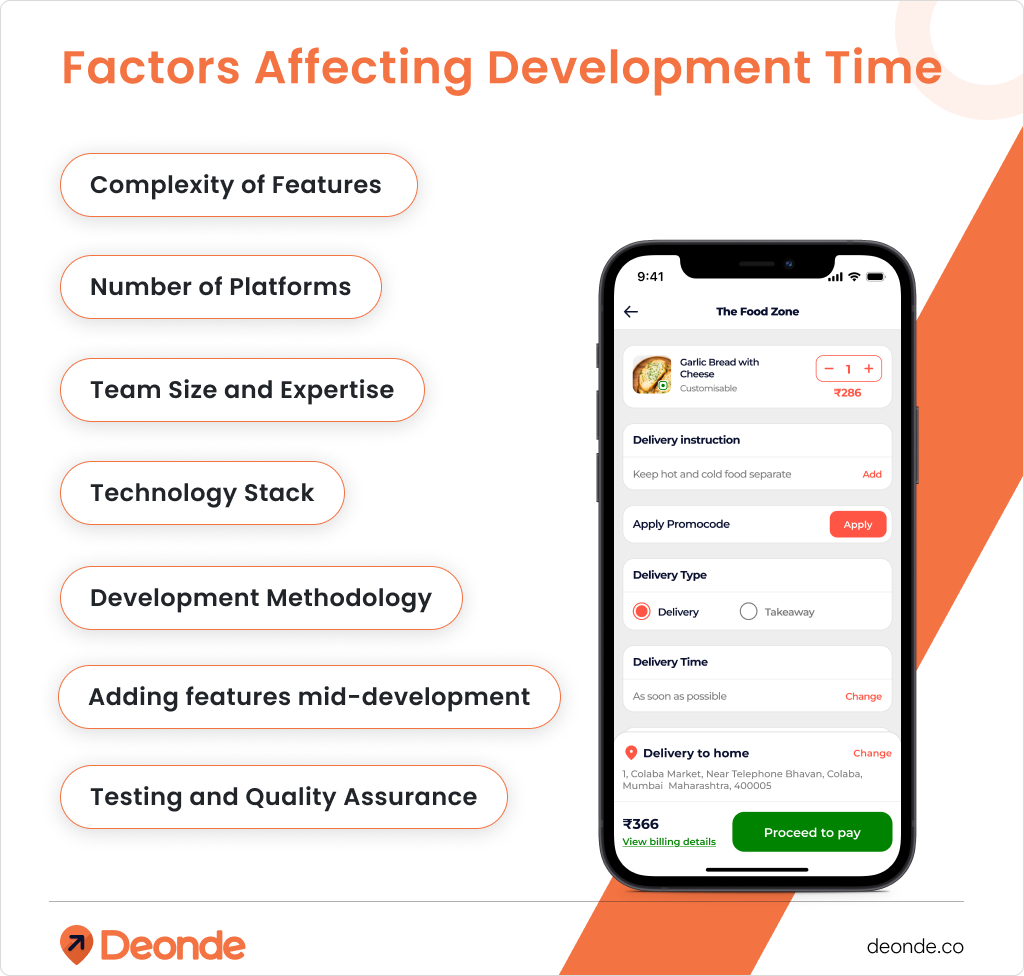
Complexity of Features (MVP vs. Full-Fledged)
This is perhaps the most significant factor. An MVP (Minimum Viable Product) focuses on core functionalities, allowing you to launch quickly, gather user feedback, and iterate. A full-fledged app, on the other hand, includes a wide array of advanced features, integrations, and sophisticated user experiences, naturally requiring more development time.
Number of Platforms (iOS, Android, Web Admin, Rider App)
The customer side app would be iOS and Android, the restaurant/vendor app, the rider app, and the web- based admin panel are all part of a complete food delivery ecosystem. Building for each platform either simultaneously or one after another will determine your total time.
Team Size and Expertise (In-house vs. Agency, local vs. remote)
The issue of the development team is essential: team size, experience, and efficiency. A development agency with a lot of experience or a good organization of an in, house team with the presence of skilled developers can speed up the process greatly in comparison to a smaller, less skilled team.
Technology Stack (Custom vs. Off-the-shelf components, APIs)
Opting for a completely custom build from scratch will always take longer. Utilizing pre-built modules and open-source components and integrating with robust APIs for functionalities like payment gateways, mapping, and notifications can dramatically reduce development time.
Development Methodology (Agile vs. Waterfall)
Agile methodologies, with their iterative and flexible approach, often lead to faster delivery of working software and allow for adjustments along the way. Waterfall, a more linear approach, can sometimes extend timelines if changes are needed late in the cycle.
Scope Creep (Adding features mid-development)
One of the biggest culprits for project delays is “scope creep.” Continuously adding new features or making significant changes once development has begun can significantly inflate the timeline and budget.
Testing and Quality Assurance
Thorough testing and quality assurance are non-negotiable for a robust app. While crucial, this phase also adds to the overall development time. Skimping on QA can lead to a buggy app and a poor user experience in the long run.
The “1-Week” Secret: The Power of Pre-Built Solutions
If a custom build takes 12+ weeks, how is a 1-week launch possible?
Here is the unique perspective: If you look at the 12-week process above, you’ll notice that 80% of the time is spent building standard features: login, menus, cart, payments, and driver tracking. These features are commodities—they are the same for almost every food delivery app.
Why build from scratch when you can assemble?
By using White Label Solutions or Pre-Built APIs, you effectively skip Phase 2 (Backend) and Phase 3 (Web Admin) entirely, and drastically shorten Phase 4 (Mobile). You are taking a proven engine and putting your brand’s chassis on top of it.
- Custom Development: 12–16 Weeks. Best for unique business models requiring total control over proprietary code.
- SaaS / Pre-Built: 1–2 Weeks. Best for entrepreneurs who want to validate their market immediately and start generating revenue.
Conclusion: How Long Does It Take to Develop a Food Delivery App?
So, how long does it really take to build a food delivery app? The honest answer is — it depends on how you choose to build it.
If you’re going for a fully custom platform with advanced features, multiple apps, and deep integrations, the development process can take anywhere from 10 to 16 weeks(or even longer). This approach gives you full control over how you run food delivery business operations, but it also requires more time, budget, and technical planning.
On the other hand, businesses that want to launch faster can take advantage of pre-built solutions, ready APIs, and white-label platforms. With the right strategy, it’s possible to roll out a functional, scalable food delivery app in just 1–2 weeks.
The key takeaway is simple: you’re not just building a single app — you’re creating a complete delivery ecosystem that connects customers, restaurants, drivers, and backend systems in real time. The clearer your vision and technology choices, the smoother and faster your development journey will be.
In a fast-moving digital market, launching early, learning from users, and improving continuously often matters more than waiting months for perfection.
Frequently Asked Questions