What is Swiggy?
Craving your favorite meals? Just Swiggy it!
Swiggy’s food-delivering mobile app lets you get your favorite meals right to your doorstep in just a few taps.
Swiggy is one of India’s largest online food and beverage delivery platforms. Founded in 2014, Swiggy is a Banglore-based corporation operating in more than 500 Indian cities.
Swiggy started as an instant pickup and drop-off service provider. Initially, consumers used Swiggy to deliver items like laundry, lunch, parcels, or documents.
However, Swiggy has become the ultimate destination for food, groceries, and dining-out options.
And that’s not all. Swiggy has grand plans to be India’s most loved hyper-local food delivery platform. Swiggy aims to make its services accessible to reimagine user convenience once and for all.
In their endeavor to maximize user convenience, this year, Swiggy launched a 10-minute ‘Snacc’ delivery app that offers quick deliveries for food ranging from teatime beverages to noodles and Indian tiffin items.
In contrast to Swiggy’s Bolt service, through which the firm offers rapid food delivery from restaurants, Snacc sells fast food, prepared meals, and beverages.
The service has been introduced in Bengaluru so far. Snacc’s offering is similar to Blinkit’s Bistro and Zepto Café, both of which have also introduced standalone delivery apps.
With a significant market share, Swiggy is a food delivery platform that most on-demand app owners look up to.
Swiggy’s 10-minute food delivery service, Bolt, has expanded to over 500 cities and now accounts for 12% of Swiggy’s total order volumes, indicating its success in gaining market share.
Hence, in this blog, we’ll understand how Swiggy operates by exploring its business model, cost structure, revenue streams, and more. So, if you’re interested in building an app just like Swiggy or are just curious about Swiggy’s workflows––then this blog is a must-read!
How does Swiggy Work?
Swiggy operates as a three-way aggregator marketplace platform, connecting users, local food/beverage vendors, and delivery partners. Let’s break down the exact step-by-step workflow for all three sides of the platform:
1. Swiggy Customer Work Flow

The customer app is built for a seamless ordering experience. Here is the 12-step journey of a Swiggy user:
-
Open the App: The user launches the Swiggy application on their mobile device.
-
Enter Location: They set their current delivery address (e.g., Home, Office) so the app can fetch nearby options.
-
Explore Restaurants: The user browses through top picks, recommendations, and various cuisines.
-
Select Restaurant & Add Items: After choosing a restaurant, the user adds their favorite dishes to the cart and customizes quantities.
-
View Cart & Checkout: The user reviews their order, checking the item total, delivery fee, and platform fee before proceeding.
-
Select Payment Method: The user chooses how to pay (UPI, Credit/Debit Card, Net Banking, Wallets, or Cash on Delivery) and completes the transaction.
-
Order Confirmed: The app shows a success screen with an Order ID.
-
Restaurant Accepts Order: The chosen restaurant confirms they have received and accepted the request.
-
Order is Being Prepared: The kitchen starts cooking, and the app updates the user that their meal is being prepped.
-
Order Picked Up: A delivery partner collects the packaged food from the restaurant.
-
Live Tracking: The user can watch the delivery partner’s real-time movement on a GPS map, along with the estimated arrival time.
-
Order Delivered: The food arrives safely at the customer’s doorstep.
2. Swiggy Restaurant (Merchant) Work Flow

For restaurants, Swiggy provides a dedicated merchant dashboard to manage the kitchen rush efficiently:
-
Restaurant Onboarding: The vendor submits their restaurant details, bank info, and completes verification.
-
Menu Listing Live: The restaurant’s menu, complete with combos and bestsellers, goes live on the customer app.
-
Receives Order Notification: The merchant device rings with a new order alert, displaying the items and total bill.
-
Accept / Reject Order: The staff reviews the order and clicks “Accept” to confirm they can fulfill it.
-
Order Confirmation Sent: A signal is sent back to the customer confirming the estimated delivery time (e.g., 30-40 mins).
-
Food Preparation Starts: The chefs begin preparing the actual meal in the kitchen.
-
Update Preparation Status: The merchant manually updates the app tracker (e.g., “Received,” “Preparing,” “Ready”).
-
Delivery Partner Assigned: Swiggy’s backend auto-assigns a nearby delivery executive to the order.
-
Handover to Delivery Partner: The restaurant securely packs the food and hands it over to the arriving partner.
-
Order Completed: The order is logged as finished in the merchant’s order history dashboard.
3. Swiggy Delivery Partner Work Flow
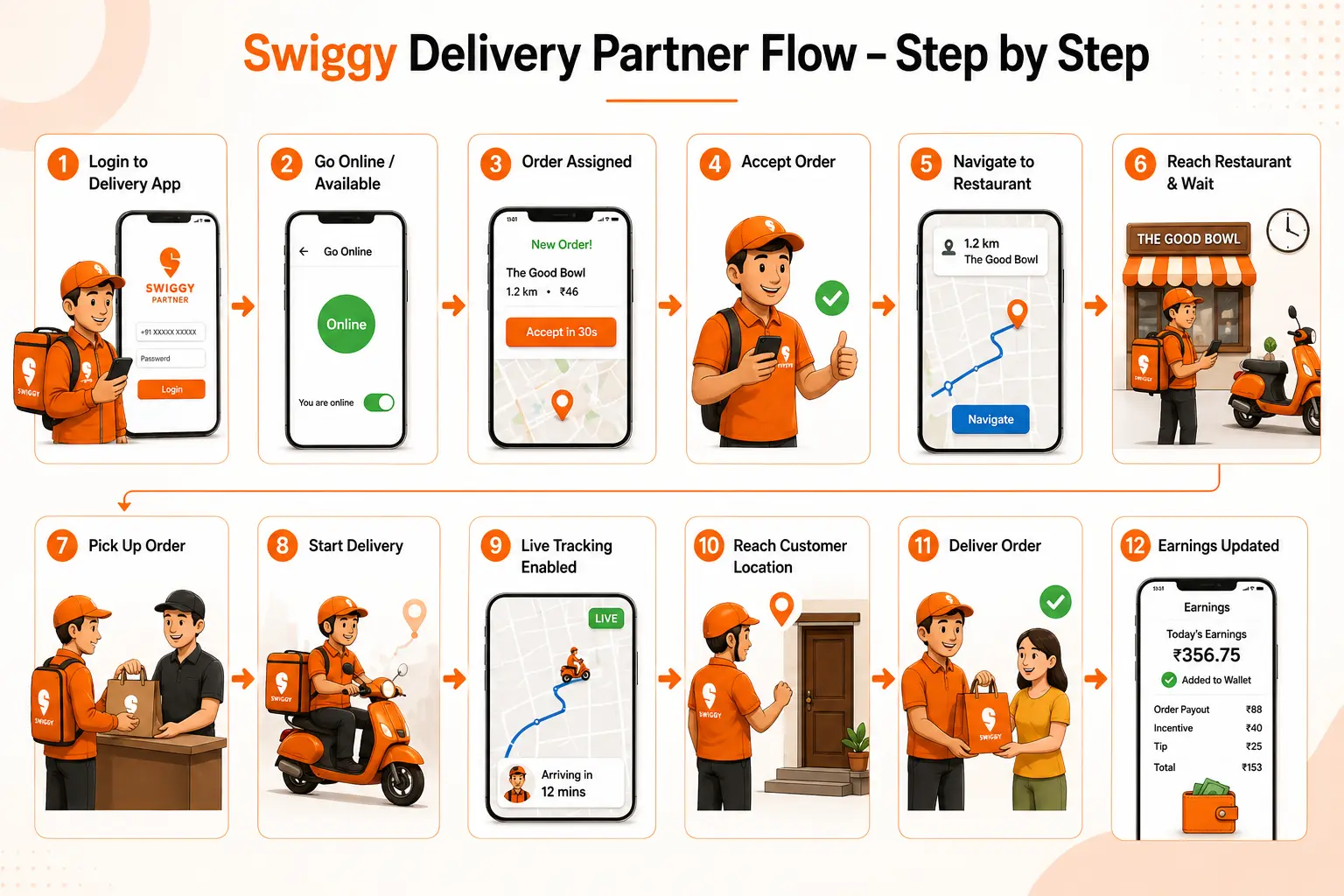
The Swiggy Partner app ensures drivers get the best routes and instant payouts. Here is their 12-step daily workflow:
-
Login to Delivery App: The delivery partner opens their dedicated Swiggy Partner app and logs in.
-
Go Online / Available: They toggle their status to “Online” to start receiving nearby delivery requests.
-
Order Assigned: A new order pops up on the screen, showing the restaurant name, distance, and potential earnings.
-
Accept Order: The partner clicks to accept the delivery task within the given timeframe.
-
Navigate to Restaurant: The app provides a GPS map routing them to the pickup location.
-
Reach Restaurant & Wait: The partner arrives at the outlet and waits for the food to be prepared.
-
Pick Up Order: Once the food is ready, the partner securely collects the Swiggy parcel.
-
Start Delivery: The partner confirms pickup in the app and starts the journey to the customer.
-
Live Tracking Enabled: The customer can now track the partner’s movement live on their map.
-
Reach Customer Location: The partner arrives at the exact drop-off address.
-
Deliver Order: The partner hands the parcel to the customer and marks the delivery as successful.
-
Earnings Updated: The base pay, incentives, and tips for that specific trip are instantly added to the partner’s in-app wallet.
Swiggy Business Model Canvas
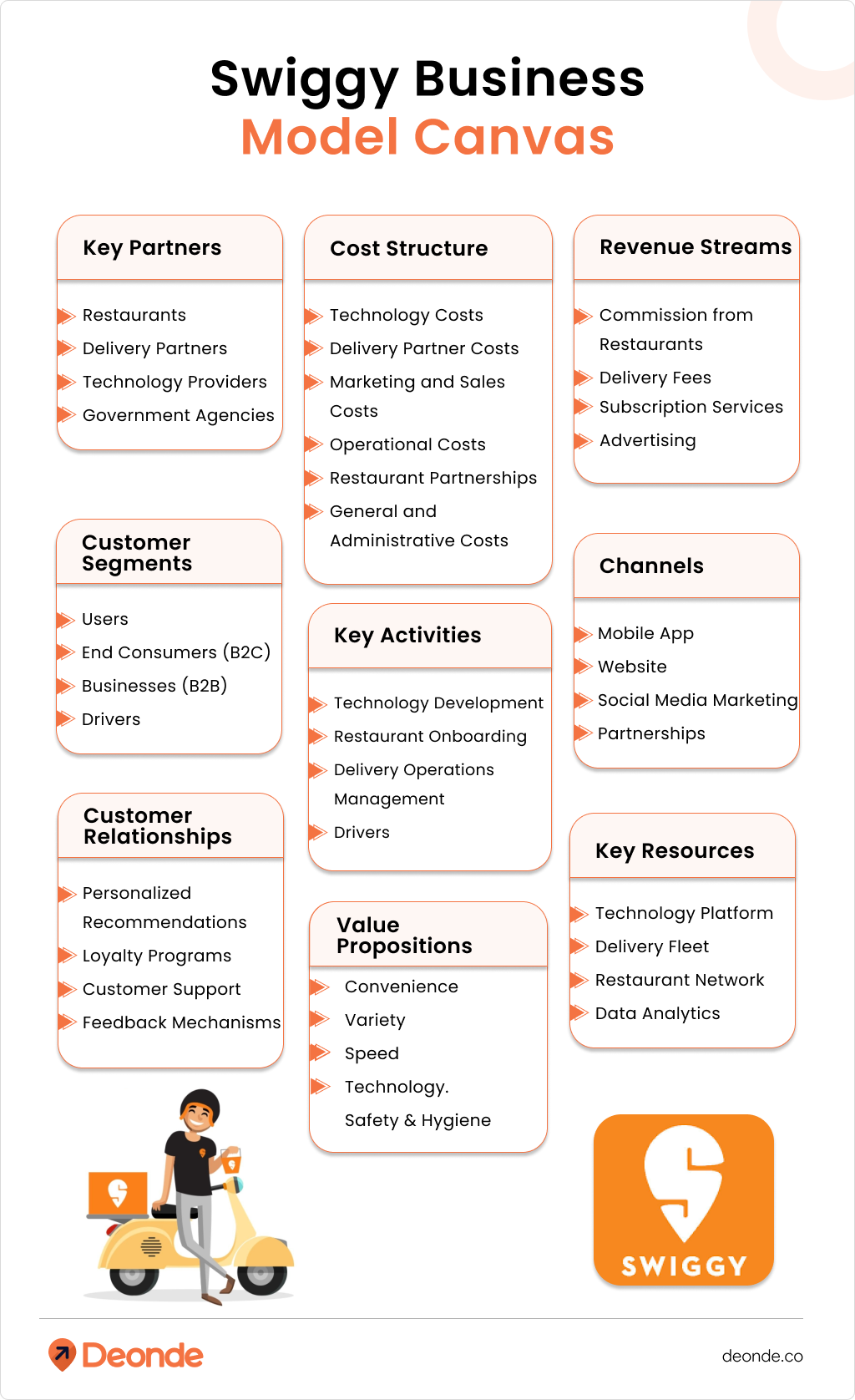
Swiggy business model is focused on the hyper-local, on-demand, food delivery service.
Swiggy aims to deliver food quickly within 30 minutes or less as a market pioneer. For this to happen, Swiggy partners with local restaurant vendors. It even has its delivery fleet to accomplish timely deliveries.
Swiggy’s business model came around to bridge the gap between food lovers and restaurants through cutting-edge technology and streamlined last-mile logistics.
Now, let’s look at how Swiggy business model works:
Consumer Segment:
Swiggy business model is structured in a way that it can easily cater to a diverse range of consumers.
Urbanites
A significant portion of Swiggy’s user base comprises urban residents, particularly working professionals and students, who need convenient food delivery options, as they rarely have the time to dine out.
Tech-Savvy Individuals
Swiggy thrives on its mobile app and website accessibility, attracting users comfortable with online ordering and digital payments.
Food Enthusiasts
Swiggy’s extensive restaurant network and diverse menu options appeal to food lovers all over India, who can explore new cuisines and dining experiences.
Occasional Users
Swiggy is also a convenient option for individuals who utilize food delivery services sporadically, such as during late-night cravings or social gatherings.
Unique Value Propositions:
Swiggy is a food delivery app specializing in delivering food with no minimum order requirement and effective online payment options like PhonePe, Paytm, FreeCharge, Debit and Credit Cards, Mobikwik, Sodexo Meal, Cash-On-Delivery, and LazyPay.
As a company, Swiggy emphasizes the value of supreme convenience and widespread accessibility of its platform.
This is one of the driving factors behind Swiggy’s intuitive UI and UX design. Swiggy incorporates features that are easy to use and can add value to the customer’s shopping experience.
In addition to being widely accessible, Swiggy has the following features that make it stand out of the crowd:
- Access to a vast network of restaurants offering diverse cuisines and menu options caters to varied preferences.
- Eliminating minimum order restrictions provides flexibility and affordability for small orders or single meals.
- A wide array of payment gateways, including digital wallets, credit/debit cards, cash on delivery, and meal vouchers, ensures seamless and secure transactions.
- The intuitive mobile app and website facilitate easy navigation, order placement, and tracking, enhancing the user experience.
If you’re wondering what features you need to add to your Swiggy Alternative app, then jump here.
Swiggy’s user-friendly mobile application is designed to gain customers’ trust and confidence. Additionally, it also provides features like in-app customer support, live order tracking, and talk-to-delivery agents for maximum user convenience.
Here is Swiggy’s value proposition summed up for you:
Customers Relationships
Swiggy is well-known for promoting round-the-clock customer service through its 24/7 customer support channels, including in-app chat, phone support, and email assistance.
The above-mentioned measures ensure the timely resolution of customer queries and complaints.
Swiggy also uses AI recommendations based on past orders and user preferences to enhance the dining experience and drive repeat orders.
Lastly, Swiggy has initiated a loyalty Program to foster long-term customer engagement and reward customers for repeat business.
Swiggy goes all in when it comes to maintaining customer relationships. It actively provides refunds to customers dissatisfied with the quality of food or service.
By taking accountability and addressing concerns head-on, Swiggy has managed to maintain a positive relationship with its customers.
Swiggy’s Key Resources:
Since Swiggy is an aggregator platform, it needs to rely on various stakeholders to vendor its services successfully.
Below, you’ll find a list of resources that make Swiggy what it is today:
1. Technology Resources
Swiggy needs a robust and scalable technology platform to cater to an online consumer segment.
This includes an online mobile ordering app, an ordering webpage, an order management app for vendors, and a delivery suite for drivers.
To learn more about the complete food delivery app suite, click here.
2. Delivery Logistics
Swiggy also needs a vast network of reliable delivery partners, including both full-time and part-time riders, to ensure timely deliveries.
3. Partnerships with Food Vendors
Swiggy needs to build strong relationships with a diverse range of local restaurants. This is essential for expanding its service offerings and attracting new customers.
4. Data Analytics
Swiggy leverages customer data, user’s ordering history, and shopping habits to optimize its marketing and delivery service workflows.
Key Activities
As an aggregator, Swiggy is tasked with the following key actions:
1. Restaurant Onboarding
Swiggy is responsible for identifying, recruiting, and onboarding new restaurants onto the platform. Partnering with new restaurants helps Swiggy expand its menu, which is important for customer acquisition.
Since Swiggy charges a commission on each sale, onboarding more restaurants is like adding to the profits!
Once onboard, Swiggy needs to train restaurant operators to fulfill their orders efficiently and streamlinedly. They also need to proactively support restaurant vendors and help them leverage the Swiggy app to boost market visibility and overall sales.
3. Delivery Driver Management
Swiggy is responsible for training, managing, and compensating delivery drivers. They need to use algorithms to optimize delivery routes and manage delivery schedules.
4. Technology Development
To enhance user experience and operational efficiency, Swiggy continuously hires coders, developers, and designers to improve their mobile app and website.
5. Marketing & Sales:
Swiggy acquires new customers through targeted marketing campaigns that promote new features, offers, and services. Swiggy also uses social media marketing to generate brand awareness.
Cost Structure
If you’re considering setting up a business like Swiggy, then it’s important to take note of the overhead and recurrent costs you may incur. Keep reading to find out what they are:
Swiggy has to cover numerous expenditures during the course of its business operations. The expenditure structure for Swiggy has been listed below:
- Salaries, incentives, and other expenses associated with delivery partners.
- Costs associated with developing, maintaining, and upgrading the mobile app, website, and tech infrastructure.
- Costs associated with advertising, promotions, and customer acquisition campaigns.
- Costs associated with maintaining customer support channels and resolving customer inquiries.
- Costs associated with order processing, inventory management, and other operational expenses.
How Does Swiggy Make Money?
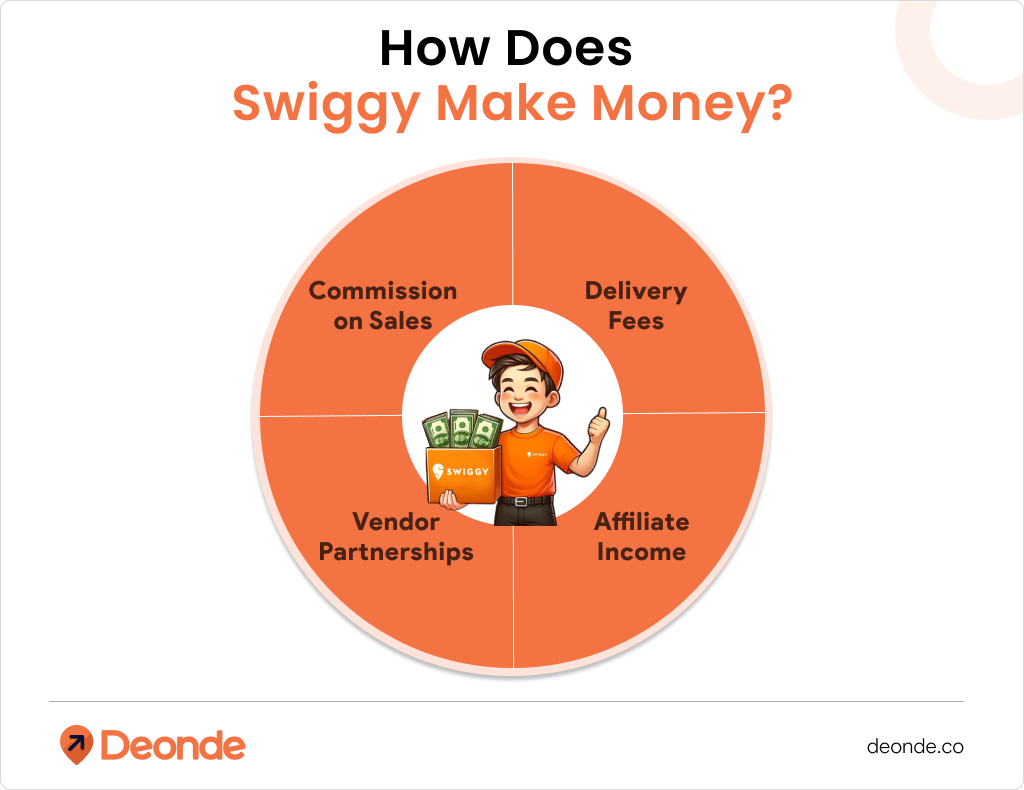
Swiggy’s revenue stream comes from multiple sources, as listed below:
1. Commission on Sales
Swiggy earns a commission on each order placed through its platform.
This commission is typically a percentage of the order value, allowing Swiggy to generate revenue while maintaining competitive consumer pricing.
Swiggy charges a 15-25% commission from restaurants on the total order bill (including Goods and Service Tax).
The commission percentage depends on various factors, such as the number of orders, the location of the restaurant, and the commission charged by other competitors.
2. Delivery Fees
Swiggy charges its users a variable delivery fee.
It’s interesting to note that Swiggy doesn’t follow any minimum order model, unlike most food delivery apps.
This means that it can deliver food for even less than INR 100. However, for orders under INR 100, Swiggy applies substantial delivery charges.
Swiggy also increases its delivery charges during high demand, rains, special occasions, or midnight delivery.
Hence, factors such as order value, delivery distance, and time of day can influence the delivery fee amount.
3. Vendor Partnerships
Advertising Fees: Swiggy offers various advertising options to restaurant vendors, including premium placement in search results, sponsored ads, and in-app banners.
These paid placements help restaurants increase their visibility and reach a wider customer base.
Data Analytics Services: Swiggy can leverage its vast order data to provide valuable insights to restaurants, such as popular menu items, customer preferences, and peak order times.
These data-driven insights can help restaurants optimize their menus, marketing strategies, and inventory management.
4. Affiliate Income
Swiggy generates affiliate income through partnerships with various financial institutions, such as credit card companies like American Express, Citibank, ICICI Bank, and HSBC.
These partnerships typically involve issuing co-branded credit cards that offer exclusive discounts and rewards to Swiggy users. Running joint promotions with credit card companies is great for Swiggy as it helps boost its online sales.
Besides, Swiggy also earns a commission from partner banks on successful credit card referrals through the app.
Bonus: Swiggy lesser-known Revenue Sources:
Swiggy has multiple streams of revenue and here are some of the not-so-popular ones:
swiggy one:
Swiggy One, a customer membership program, was recently launched by Swiggy. Members subscribed to Swiggy Supper enjoy unlimited free deliveries on all orders above INR 99.
In turn, customers pay a one-month membership fee of INR 149 or a three-month membership fee of INR 349.
Swiggy Dineout
Swiggy Dineout by Swiggy allows users to discover and book restaurant tables through features like table reservations, promotional offers, and discounts.
Restaurant vendors pay a commission fee for all the bookings that are made through the platform.
Swiggy Instamart
This instant grocery delivery service provides users with access to a wide range of groceries and daily essentials—-delivered within minutes. Swiggy generates revenue through order commissions, delivery fees, and potential subscription models for Instamart services.
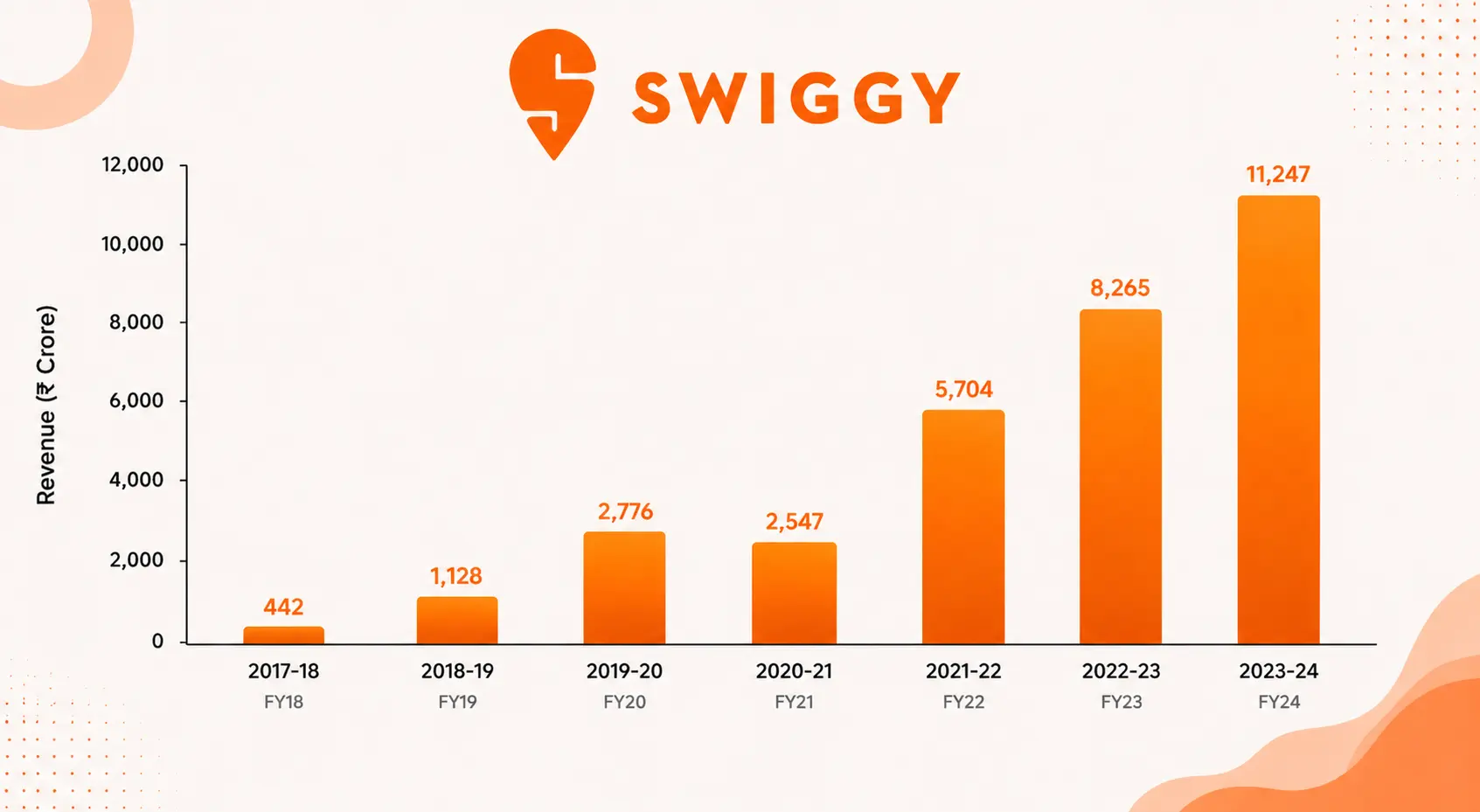
Swiggy Vs. The Competition: 2026 Comparison
Let’s be honest—the food and quick-commerce market is crowded. But when you compare Swiggy side-by-side with its closest rivals, the differences in scale, strategy, and execution become clear. Here’s how the major players stack up in 2026.
|
Feature |
Swiggy |
Zomato (Blinkit) |
Zepto |
|
Market Dominance |
Strong #2 in Food Delivery |
Leader in Food & Quick Commerce |
Fastest growing in Quick Commerce |
|
Quick Commerce Arm |
Instamart |
Blinkit |
Zepto (Standalone) |
|
India Market Share |
42% (Food) | ~22% (Q-Com) |
58% (Food) | ~45% (Q-Com) |
8-20% (Q-Com Only) |
|
Annual Revenue (2025) |
₹15,600 crore ($1.70 Billion USD) |
₹20,243 crore ($2.20 billion USD) |
₹9,668.8 crore ($1.05 Billion USD) |
|
Profitability Status |
Loss-making (₹1,065 Cr Q3 loss) |
Profitable (Consistent growth) |
Near Breakeven |
|
Restaurant Partners |
2.6 Lakh+ |
3 Lakh+ |
N/A (Dark Store Focused) |
|
Subscription Model |
Swiggy One |
Zomato Gold |
Zepto Pass |
|
Primary Strength |
Multi-service “Super App” ecosystem |
High brand loyalty & profitability |
10-minute delivery consistency |
|
Latest Initiative |
AI integration, health-conscious dining, and expanding its quick-commerce ecosystem |
multi-city road safety program, AI-powered accident detection, and “Food Rescue” to reduce wastage |
Zepto Nova and AYUSH Partnership |
|
Valuation |
$9.75 billion |
$22.87 billion USD (over ₹1.95 trillion) |
$7 billion (Pre-IPO) |
Why Is Swiggy Falling?
Swiggy is not profitable yet because of high delivery costs, heavy discounts, losses from Instamart, intense competition, and thin commission margins. While revenue is growing, expenses are growing faster, delaying profitability.
Swiggy is currently facing a “market correction” due to widening losses in its Quick Commerce (Instamart) segment. While its revenue has jumped by 54%, its net loss hit ₹1,065 crore in Q3 FY26. Investors are worried about the heavy “cash burn” compared to its rivals like Blinkit and Zepto, while its main competitor, Zomato, has already turned profitable.
Here Is The Reason That Why Swiggy Is Not Profitable Steel Now?
- IPO Lock-in Expiry: A major catalyst was the end of the lock-in period for pre-IPO investors, allowing them to sell shares, which flooded the market and created massive selling pressure.
- Intense Competition: Fierce rivalry in quick commerce with players like Blinkit, Zepto, Amazon, and Flipkart forces Swiggy to offer heavy discounts, impacting margins.
- Widening Losses: High spending on expanding the Instamart network (more dark stores) and marketing, coupled with competitive discounts, led to wider losses, even with strong revenue growth.
- Profitability Concerns: Despite efforts to reach contribution-level profit, fixed costs and continued investments in quick commerce delay overall sustained profitability, making investors cautious.
Sector-Wide Pressure: A general market slowdown and disappointing results from rivals (like Zomato) have also dampened investor sentiment for the entire food delivery/e-commerce sector.
How Much Does it Cost to Build an App Like Swiggy?
With the rise and evolution of technology, app development has become a part and parcel of the qCommerce business model.
If you want to build a business like Swiggy, you need an app like Swiggy! It’s as simple as that.
However, developing an on-demand food delivery app like Swiggy is easier said than done. Because building an app like Swiggy is resource-intensive and time-consuming.
The actual cost of developing an on-demand food delivery app depends on a lot of factors like the features you want to include, the platform you want to launch your app on, the geographical location of your target market, your tech stack, and more.
So, if you’re starting from scratch, be prepared to spend anywhere between $10,000 and $50,000 to develop a basic version of your app.
You can expect to spend more if you want to include additional features or launch your app in multiple cities.
But what if we told you that you could have all the advanced features of Swiggy, the best tech infrastructure, and a highly engaging app interface under $50 per month?
That’s exactly where Deonde can help you.
Deonde offers white-label, SaaS-based, on-demand food delivery solutions that are completely customizable and can be launched within 7 to 10 days.
Choose your plan, login, customize—and that’s it. You can begin building a business like Swiggy quickly with the help of Deonde’s SaaS-based food ordering and delivery suite.
So, what are you waiting for? You need to explore Deonde’s SaaS-based on-demand app suite and consider using it because:
- It is highly customizable, cloud-based, and has a 99.99% uptime.
- It’s easy to use: You can start in minutes and get access to some of the top food delivery app features.
- Unlike the expensive app development processes, you can get started with Deonde almost immediately (instead of months) at just $50/ per app / per month.
Deonde’s food delivery app is way ahead of its time.
It has exclusive features like route optimization, inventory management, bulk ordering, push notifications, in-app marketing, and more. All of this is available to you at an extremely affordable cost.
So, if you’re serious about starting your food delivery business this week, contact Deonde today!
Conclusion
Swiggy has revolutionized the way people order and consume food.
Its innovative business model, coupled with a focus on customer satisfaction and technological advancements, has positioned Swiggy as a dominant player in the Indian food delivery market.
If you also want to build a business like Swiggy, you must adhere to a similar vendor aggregator model and get started with a food delivery app.
To do that, we urge you to explore Deonde’s cutting-edge SaaS platform and experience the power of a fully featured, customizable solution at an incredibly affordable price.
Start building your own food delivery empire today—only with Deonde!
FAQs
Q: What is Swiggy Business Model called?
A: Swiggy business model is also known as an Aggregator Business Model. Swiggy runs a multi-faceted marketplace platform that depends on customers, restaurant vendors, logistics partners, and more. Since Swiggy deploys services from multiple suppliers on a single platform, which is the hallmark of an aggregator business model, it is categorized like so.
Q: How does Swiggy Make Money?
A: Swiggy generates revenue through multiple streams which includes commission fees from restaurant partners (ranging from 15-25% per order), delivery fees from customers, surge pricing during peak hours, and premium subscription services like Swiggy One.
They also generate profits through promotional fees from restaurants that want to advertise on the Swiggy app for better visibility.
Q: What is the Benefit of Building an App like Swiggy?
A: Developing an online food delivery platform like Swiggy means you can grow rapidly in the market of on-demand convenience services. The platform business model allows room for scalability with relatively low infrastructure or maintenance costs.
Q: Is Swiggy B2B or B2C?
A: Swiggy primarily operates as a B2C or Business-to-Consumer business. This is because Swiggy serves directly to its end consumers who order through the Swiggy app.
However, it’s important to note that Swiggy also has B2B or Business-to-Business elements as it partners with restaurant vendors and logistics patterns to fulfill orders.
Q: What Are The Brands Under Swiggy?
A: As of 2026, Swiggy is much more than just food delivery. It operates a massive ecosystem of specialized brands:
- Swiggy Food: The main app for ordering restaurant meals.
- Swiggy Instamart: 10-minute grocery and “everything” delivery.
- Swiggy Dineout: For restaurant table bookings and discounts.
- Swiggy Genie: A “pickup and drop” service for packages and documents, is shutting down or paused in may 2025.
- Bolt: A specialized 10-minute food delivery service for local favorites.
- Snacc: A standalone app for teatime snacks, drinks, and quick tiffin items.
- Minis: A marketplace for local boutique and D2C brands, is shutting down in August 10, 2025.
- Swiggy One: The all-in-one membership program for free deliveries.