Saudi Arabia has one of the most exciting food delivery markets in the world — and one company has been leading it from the very beginning.
That company is HungerStation, and its story is one of the most interesting business journeys to come out of the Middle East.
Back in 2012, ordering food in Saudi Arabia meant calling a restaurant, hoping someone picked up, and waiting without any idea when your food would arrive.
HungerStation changed all of that — it gave millions of people a simple app, a clear menu, and a real-time tracker that made ordering food feel effortless.
Before HungerStation existed, ordering food meant calling a restaurant, hoping someone picked up, and waiting with zero visibility on when your meal wo
Today the platform operates in 102+ cities, works with 55,000+ restaurant partners, and has fulfilled over 300 million orders since it launched.
In 2022 alone, it generated €609 million in revenue with a 36% growth rate — numbers that caught the attention of global giant Delivery Hero, which acquired it for $297 million in 2023.
But behind those big numbers is a carefully built business model that earns from every single part of the delivery process — not just one source.
Commissions, delivery fees, advertising, subscriptions, payment processing — HungerStation quietly monetizes every touchpoint without the customer even noticing.
This blog breaks down exactly how HungerStation works, where its money comes from, and what makes it so hard for competitors to knock off its throne.
If you are thinking about building your own food delivery platform, this is the business model you need to study first.
Let us start with the basics.
What Is HungerStation?
HungerStation is Saudi Arabia’s largest food delivery platform operations company. It connects millions of customers with over 55,000 restaurant and grocery partners across more than 70 cities in the Kingdom.
The HungerStation app has been downloaded over 40 million times and processed more than 300 million orders to date.
Think of HungerStation as a digital marketplace that brings three groups together: hungry customers looking for food, restaurants wanting to reach more diners, and delivery riders who make the handoff happen.
The platform handles everything from order routing and payment processing to real-time tracking and customer support.
The Three-Sided Marketplace
The HungerStation delivery platform operates on a classic three-sided marketplace model:
- Customers — Browse restaurants, place orders, and track deliveries through the HungerStation app
- Restaurants & Grocery Partners — List their menus, receive orders, and prepare food
- Delivery Riders — Pick up orders and deliver them to customers
This structure is what makes HungerStation different from a traditional restaurant. HungerStation does not own any kitchens, employ any chefs, or prepare any food. It simply connects the three sides and takes a cut for facilitating the transaction.
That is the core HungerStation business model — an asset-light aggregation platform that scales efficiently without the overhead of restaurant operations.
HungerStation Saudi Arabia has refined this three-sided model to fit local market conditions better than any competitor. The platform handles the technology, logistics, and customer experience, while restaurants focus on what they do best — cooking great food.
A Brief History – From Riyadh Startup to Delivery Hero
HungerStation started as a small startup in Riyadh in 2012, founded by a team of Saudi entrepreneurs who saw a glaring gap in the local food delivery market.
At the time, ordering food in Saudi Arabia meant calling restaurants directly, scrolling through PDF menus on restaurant websites, or using fragmented platforms with limited coverage.
The HungerStation app gained traction quickly because it solved a real problem: it aggregated hundreds of restaurants in one place with a seamless ordering experience.
By 2017, the platform covered multiple Saudi cities and was processing hundreds of thousands of orders monthly.
That same year, Germany’s Delivery Hero acquired HungerStation for an undisclosed amount, reportedly in the hundreds of millions of dollars.
The acquisition gave HungerStation access to Delivery Hero’s global technology stack, operational expertise, and capital. Under Delivery Hero’s ownership, HungerStation expanded rapidly, launched Quick Market for grocery delivery, and grew its subscriber base past 10 million members.
Today, HungerStation is not just Saudi Arabia’s largest food delivery platform operations company — it is one of the few profitable food delivery platforms anywhere in the world, outperforming many of its global peers.
What Is the HungerStation Business Model?
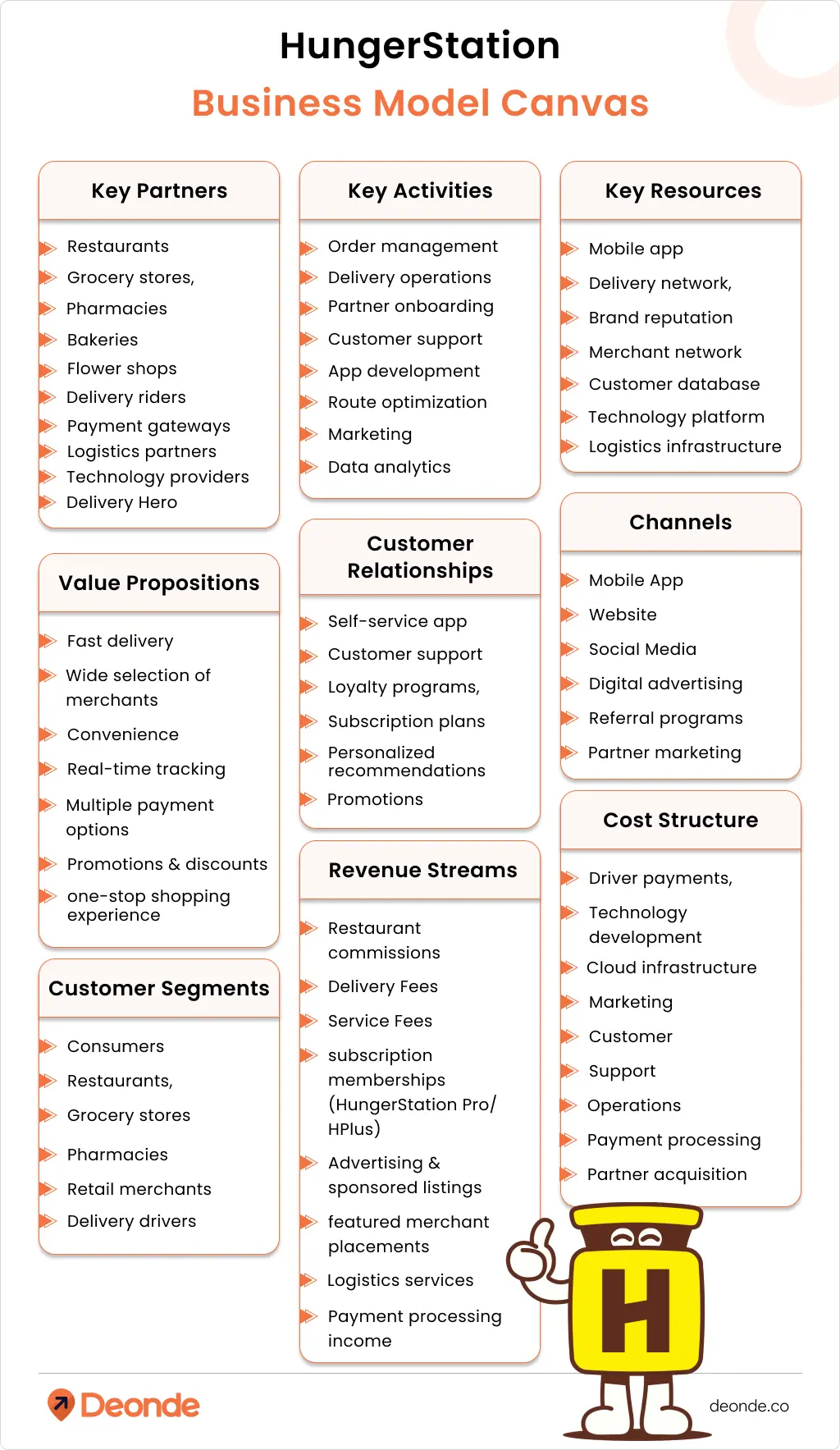
The HungerStation business model is a commission-based, platform-enabled aggregation model. HungerStation generates revenue by taking a percentage of each order value from restaurant partners, plus charging delivery fees, service fees, and subscription fees to customers. It also earns from in-app advertising and promotional placements.
Platform-Based Aggregation Model
At its core, the HungerStation business model is a marketplace aggregator — similar to how Uber connects riders with drivers or how Airbnb connects travelers with hosts.
HungerStation brings supply (restaurants) and demand (customers) together on a single platform and facilitates every transaction.
The platform handles:
- Order management — Routing orders to restaurants, syncing menus, managing real-time availability
- Payment processing — Collecting payments from customers and settling with restaurant partners
- Logistics — Assigning riders, optimizing routes, tracking deliveries in real-time
- Customer service — Handling complaints, refunds, and dispute resolution
For this service, HungerStation charges restaurants a commission on every order. This is the primary engine of the HungerStation revenue model.
Why the Three-Sided Model Works in KSA
The marketplace structure is particularly effective in Saudi Arabia for several structural reasons:
- High smartphone penetration — Over 96% of Saudis own a smartphone, making app-based ordering widely accessible
- Young population — More than 60% of Saudis are under 35, a demographic that heavily uses delivery apps
- Urban concentration — Major cities like Riyadh, Jeddah, and Dammam have dense populations ideal for delivery logistics
- Changing dining culture — Shifting lifestyles and increased female workforce participation have boosted demand for home delivery
- Limited restaurant delivery infrastructure — Most restaurants in KSA lacked their own delivery fleets before aggregators like HungerStation filled the gap
HungerStation Saudi Arabia capitalized on all these factors to become the dominant player. The online food ordering and delivery system in Saudi Arabia has been fundamentally shaped by HungerStation’s approach to the three-sided marketplace.
How HungerStation Works?
Understanding the HungerStation business model requires understanding how an order actually flows through the platform. The entire experience is designed to feel seamless, but behind the scenes, a sophisticated technology stack is coordinating restaurants, riders, and payments in real-time.
Placing an Order — From App to Doorstep
- Browse — A customer opens the HungerStation app, enters their delivery address, and browses nearby restaurants
- Select — They choose items, add them to the cart, and proceed to checkout
- Pay — Payment is made via credit/debit card, Apple Pay, STC Pay, Mada, or cash on delivery
- Submit — The order is sent to the restaurant’s tablet or POS system
- Prepare — The restaurant prepares the food (typically 15–25 minutes)
- Assign — HungerStation assigns a nearby rider to pick up and deliver the order
- Deliver — The rider collects the food and drives to the customer’s address
- Confirm — The customer receives the order and can rate their experience
The entire process averages 30–45 minutes from order placement to delivery. The platform operates as a multi-restaurant food delivery system that aggregates thousands of dining options into a single, unified interface.
The Technology Behind the Platform
HungerStation food delivery platform operations rely on a robust technology stack that includes:
- Customer-facing app — iOS and Android apps with personalized recommendations, saved addresses, and order history
- Restaurant dashboard — A web-based portal where restaurant partners manage menus, view orders, and track performance metrics
- Rider app — A dedicated mobile app for delivery partners with GPS navigation, order details, and payout tracking
- Backend infrastructure — Order routing engine, payment gateway, real-time tracking system, and analytics platform
- AI systems — Machine learning models for demand forecasting, route optimization, and personalized recommendations
For this service, HungerStation charges restaurants a commission on every order. This is the primary engine of the HungerStation revenue model.
Quick Market — How Grocery Delivery Works
In 2022, HungerStation launched Quick Market, a separate vertical for grocery and convenience delivery. Unlike restaurant food delivery, Quick Market operates from HungerStation-owned dark stores — small warehouses in high-demand areas that stock fast-moving consumer goods, ready-to-eat meals, and household essentials.
The Quick Market model works differently from the main platform:
- HungerStation owns the inventory (taking on inventory risk)
- HungerStation employs the pickers and packers
- Delivery is often faster — 15–25 minutes versus 30–45 minutes for restaurant orders
- HungerStation Quick Market grocery delivery revenue comes from product margins rather than restaurant commissions
Quick Market represents a strategic expansion of the HungerStation business model beyond pure aggregation into retail.
It offers higher margins per order and more control over the customer experience, while also increasing order frequency — customers who use Quick Market for groceries tend to open the app multiple times per week.
HungerStation by the Numbers
To appreciate the scale of the HungerStation business model, let us look at the hard numbers.
Scale & Reach
| Metric | Value |
| Total orders processed | 300M+ |
| App downloads | 40M+ |
| Restaurant & grocery partners | 55,000+ |
| Cities covered in KSA | 70+ |
| Active delivery riders | 75,000+ |
| HPlus/HungerStation Pro subscribers | 10M+ |
These figures make HungerStation the clear market leader in Saudi Arabia’s food delivery sector. No other platform in the Kingdom matches its partner network or geographic coverage.
Financial Performance
HungerStation’s financial performance is impressive by any standard:
- Revenue (2024) — Approximately between $677.7 million and $800 million.
- EBIT (2025) — Over $57 million, making HungerStation one of the few profitable food delivery platforms globally
- Revenue growth — Consistent double-digit growth year-over-year, driven by order volume increases and higher average order values
- Parent company — Delivery Hero (listed on Xetra Frankfurt) reports HungerStation as part of its Middle East & North Africa segment
In 2025 HungerStation’s revenue at approximately $709.3 million that figure makes it one of the largest food delivery companies in the Middle East by top-line performance.
Subscription Success
HungerStation’s subscription program, HPlus (rebranded as HungerStation Pro), has been a massive driver of customer loyalty. With over 10 million subscribers, it is one of the most successful subscription programs in the global food delivery industry.
Subscribers receive:
- Free delivery on orders above a minimum value
- Exclusive discounts and special offers
- Priority customer support
- Early access to new restaurant openings and promotions
The subscription creates a powerful retention loop. Subscribers order more frequently because they feel they need to “get their money’s worth” from the monthly fee, which increases order volume and customer lifetime value.
This is a central component of the HungerStation monetization strategy — turning occasional users into high-frequency, loyal customers.
What Makes HungerStation Different
In a competitive market with strong players like Jahez, HungerStation has maintained its leadership position through several key differentiators.
The Homegrown Advantage
HungerStation was founded in Riyadh by Saudi entrepreneurs who understood the local market intimately. Unlike international competitors who entered KSA later, HungerStation built its platform from day one for Saudi users:
- Arabic-first interface — Full Arabic language support with proper right-to-left rendering
- Local payment methods — Integration with Mada, STC Pay, and cash on delivery
- Cultural awareness — Understanding of local dining habits, family ordering behavior, and delivery preferences
- Local partnerships — Deep relationships with Saudi restaurant chains and regional favorites
This homegrown approach helped HungerStation build trust with Saudi users that international competitors struggled to replicate.
Among the top food delivery apps in Saudi Arabia, HungerStation consistently ranks highest for user trust and satisfaction.
AI Innovations
HungerStation has invested heavily in artificial intelligence to improve its platform and differentiate from competitors:
- Shaded Route — An AI-powered feature that suggests alternative pickup locations for riders to reduce delivery times by optimizing routes in real-time
- Subconscious Order — A predictive ordering feature that uses machine learning to suggest orders based on time of day, past behavior, and contextual signals (for example, suggesting coffee on a Monday morning)
- Dynamic pricing — AI adjusts delivery fees based on demand, distance, and rider availability
- Demand forecasting — ML models predict order volumes to optimize rider allocation and reduce wait times
These innovations improve both operational efficiency and customer experience, creating a competitive moat that is hard for smaller competitors to match.
Quick Market & Record-Breaking Delivery
HungerStation’s Quick Market has set delivery speed records in the region, with some orders delivered in under 10 minutes in high-density urban areas.
The dark store model allows HungerStation to control the entire fulfillment process for grocery orders, resulting in faster delivery times and higher customer satisfaction.
Record-breaking delivery times generate social media buzz and reinforce HungerStation’s brand as the fastest and most reliable delivery option in Saudi Arabia.
HungerStation Revenue Model – Every Revenue Stream Broken Down
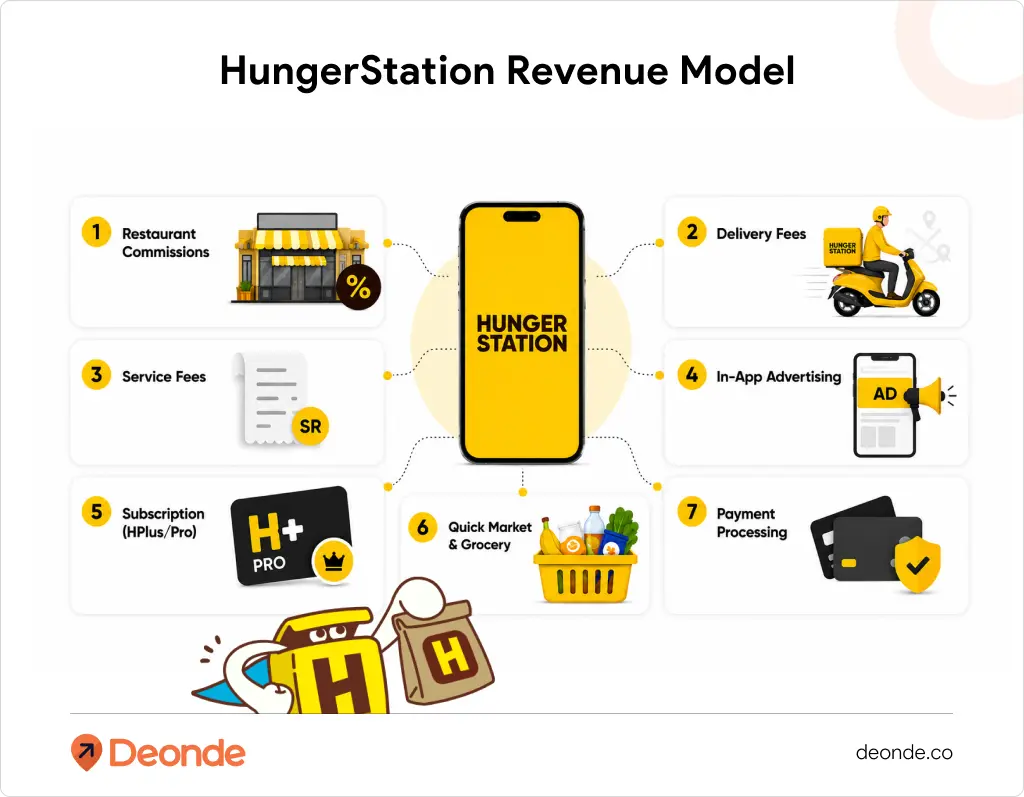
Let us now dive deep into the HungerStation revenue model and examine each HungerStation revenue streams breakdown in detail. The platform has built a diversified income structure with multiple layers.
| Revenue Stream | How It Works | Est. Contribution | Paid By |
| Restaurant Commissions | % of each order (20–30% typical) | Primary (50–60% of rev) | Restaurants |
| Delivery Fees | Distance/demand-based fee | Secondary (15–20%) | Customers |
| Service Fees | Flat SAR 1–3 per order | Small (5–8%) | Customers |
| In-App Advertising | Sponsored listings, banners, featured slots | Growing (10–12%) | Restaurants/brands |
| Subscription (HPlus/Pro) | Monthly/annual fee for free delivery & perks | Recurring (5–8%) | Customers |
| Quick Market & Grocery | Dark-store retail with delivery fee margin | High-growth (10–15%) | Customers |
| Payment Processing | Small cut on card/wallet transactions | Minor (2–3%) | Customers |
Restaurant Commissions – The Primary Engine
The largest component of the HungerStation revenue model is commission fees charged to restaurant partners. HungerStation takes a percentage of the total order value from every order placed through its platform.
HungerStation commission rates Saudi Arabia typically range from 25% to 35% of the order value, depending on several factors:
- Restaurant size and brand — Large chains with high order volumes can negotiate lower commission rates
- Exclusivity — Restaurants that agree not to list on competing platforms may receive better rates
- Delivery responsibility — Restaurants using HungerStation’s delivery fleet pay higher commissions than those using their own riders
- Category and average order value — High-margin categories may have different commission structures
For a typical SAR 50 order at a 30% commission rate, HungerStation earns SAR 15 from the restaurant. Multiply that across millions of monthly orders, and the numbers become substantial.
Delivery Fees – Covering Last-Mile Logistics
Customers pay a delivery fee on most orders unless they have HungerStation Pro or the restaurant offers free delivery as a promotion. Delivery fees in Saudi Arabia typically range from SAR 5 to SAR 15 per order, depending on:
- Distance between the restaurant and the delivery address
- Time of day — Peak hours may have dynamic pricing
- Demand and rider availability
- Weather conditions — Extreme heat may increase fees
While delivery fees are often subsidized or waived for subscribers, they still represent a meaningful revenue stream that helps offset the cost of rider payments.
Service Fees – Small but Steady
HungerStation charges a small service fee on each order, typically SAR 1–3. This covers the technology and platform costs associated with processing the transaction. While small per order, service fees scale with volume and contribute a steady, predictable revenue stream.
In-App Advertising & Sponsored Listings
Restaurants can pay HungerStation for premium placement in the app. Sponsored listings appear at the top of search results and category pages, giving partner restaurants higher visibility.
Advertising options include:
- Sponsored listings — Pay-per-click or pay-per-impression placement in search results
- Banner ads — Premium placement on the home screen and category pages
- Promotional features — Highlighted in “trending” or “recommended” sections
- Push notification ads — Targeted promotional messages sent to user devices
This is a rapidly growing revenue stream for HungerStation, as more restaurants compete for visibility in an increasingly crowded marketplace.
HungerStation Pro – The Subscription Play
HungerStation Pro (formerly HPlus) is a monthly subscription program that offers members free delivery, exclusive discounts, and premium perks. Priced at approximately SAR 29 per month (with annual plans available at a discount), the subscription creates recurring, predictable revenue.
The strategic brilliance of the subscription model is behavioral:
- Subscribers order more frequently to “use” their membership
- They exhibit higher loyalty and lower churn rates
- They generate more commission revenue through increased order volume
- The subscription fee itself is nearly pure profit after covering the cost of waived delivery fees
With over 10 million subscribers, even at a conservative average of SAR 20 per month per subscriber, HungerStation Pro generates hundreds of millions in annual subscription revenue.
Quick Market & Multi-Category Delivery
HungerStation Quick Market grocery delivery revenue follows a different model than restaurant delivery. With Quick Market, HungerStation acts as a retailer rather than an aggregator:
- Product margin — HungerStation buys goods at wholesale prices and sells at retail prices, capturing the margin
- Higher retention — Customers who use Quick Market for groceries visit the app more frequently
- Cross-selling — Grocery orders often include higher-margin prepared foods and snacks
Quick Market positions HungerStation to compete with traditional grocery delivery and convenience store services, significantly expanding its total addressable market.
Payment Processing and Other Minor Streams
HungerStation also earns small amounts from:
- Payment processing fees — A small percentage of card transaction values
- Late payment fees — Charges for delayed settlements to some restaurant partners
- Cancellation fees — Charges for orders canceled after preparation has started
- Data insights — Anonymized order data and analytics sold to restaurant partners and FMCG brands
Individually, these streams are small. Collectively, they add up across millions of monthly transactions.
HungerStation Cost Structure – Where the Money Goes
Understanding the HungerStation business model also requires understanding where the money goes. Every revenue stream has a corresponding cost.
Rider Payments – The Biggest Cost
Delivery riders are the largest line item on HungerStation’s expense sheet. Each order requires a rider to travel from their current location to the restaurant, then to the customer’s address. Rider payments include:
- Per-delivery fee — A fixed amount paid to the rider for each completed delivery
- Distance compensation — Additional payment based on total kilometers traveled
- Peak time bonuses — Extra incentives for deliveries during high-demand periods
- Tips — Customer tips go directly to riders (not to HungerStation)
| Daily Orders | Monthly Gross | Commission | Fuel Cost | Net Rider Profit |
| 5 | SAR 1,800 | SAR 300 | SAR 150 | SAR 1,350 |
| 15 | SAR 6,750 | SAR 900 | SAR 450 | SAR 5,400 |
| 30 | SAR 13,500 | SAR 1,800 | SAR 900 | SAR 10,800 |
Rider costs typically account for 40–50% of HungerStation’s total operational expenses.
Technology & Platform Costs
Maintaining a large-scale food delivery platform requires significant ongoing investment in:
- Software development — Salaries for engineers, product managers, and designers
- Cloud infrastructure — Server costs, database hosting, and content delivery networks
- Third-party services — Payment gateways, mapping APIs, and notification services
- Data storage and analytics — Customer data, order history, and business intelligence systems
Marketing & Customer Acquisition
HungerStation spends heavily on marketing to attract new customers and retain existing ones:
- Digital advertising — Social media ads, search engine marketing, influencer partnerships
- Promotions and discounts — First-order discounts, referral bonuses, seasonal campaigns
- Brand marketing — TV commercials, billboards, and sponsorship deals
- Loyalty programs — HungerStation Pro perks and reward points
The competitive market in Saudi Arabia means customer acquisition costs are significant and rising.
Operational & Regulatory Costs
Running a food delivery business in Saudi Arabia also involves:
- Office and warehouse rent — HQ offices and Quick Market dark stores
- Regulatory compliance — Food safety certifications, labor law compliance, data privacy
- Customer support — Call centers and chat support teams
- Insurance — Rider insurance, liability coverage, and cargo insurance
Unit Economics – What Happens to Every SAR
To understand the HungerStation business model at a granular level, let us break down the unit economics of a typical SAR 100 restaurant order.
| Item | Amount (SAR) | Paid By |
| Order value | 100 | Customer |
| Restaurant commission (30%) | 30 | Restaurant |
| Delivery fee | 8 | Customer |
| Service fee | 2 | Customer |
| Total platform revenue | 40 | |
| Rider payment | 15 | Platform |
| Payment processing fee | 2 | Platform |
| Gross margin | 23 (57.5%) |
After subtracting technology costs, marketing, general administration, and other overhead, the estimated net margin per order is approximately 10–15% of platform revenue.
These unit economics are strong compared to global food delivery averages. HungerStation benefits from relatively high order values in Saudi Arabia and efficient delivery routes due to urban density. This efficiency is a key reason why HungerStation profitability 2025 market conditions remain favorable despite intense competition.
HungerStation vs Jahez – A Comparison
The HungerStation vs Jahez comparison Saudi Arabia is one of the most discussed topics in the local food delivery industry. Here is how the two platforms stack up across key metrics.
| Aspect | HungerStation | Jahez |
| Founded | 2012 (Riyadh) | 2016 (Riyadh) |
| Parent company | Delivery Hero (Germany) | Jahez International (listed on Tadawul) |
| Restaurant partners | 55,000+ | 50,000+ |
| Active cities | 102+ | 100+ |
| Revenue (2025) | EUR 662 million or SAR 2.66 billion | ~SAR 2.3B |
| Subscription program | HungerStation Pro (10M+ subs) | Jahez Plus (3M+ subs) |
| Grocery delivery | Quick Market | Jahez Mart |
| Core strength | Scale and technology resources | Local brand loyalty and public market credibility |
While HungerStation leads in absolute revenue and order volume, Jahez has carved out a strong position by positioning itself as the “local Saudi champion” and leveraging its Tadawul listing for visibility and transparency.
For a deeper look at how the model compares across the region, the Talabat business model in the UAE follows a similar platform-aggregation approach but with different market dynamics and regulatory conditions.
The 2025–2026 Market Context – SAR 24 Bn and the Subsidy War
The Saudi online food delivery market is projected to reach SAR 24 billion by 2026, growing at approximately 18% CAGR. This growth is driven by:
- Population growth — Saudi Arabia’s population is young and expanding
- Urbanization — More people living in cities with delivery infrastructure
- Lifestyle changes — Increased demand for convenience and time-saving services
- Tourism acceleration — Vision 2030 initiatives bringing more visitors to the Kingdom
- Digital payments adoption — Cashless transactions making ordering faster and easier
However, the market is also characterized by intense competition. Both HungerStation and Jahez are spending aggressively on customer acquisition, which compresses margins. The “subsidy war” means platforms are:
- Offering deep discounts on first orders
- Reducing delivery fees (subsidizing logistics costs)
- Investing heavily in loyalty and subscription programs
- Expanding into new categories like grocery, pharmacy, and convenience
HungerStation profitability 2025 market conditions are defined by this tension between growth spending and margin optimization. HungerStation has the advantage of Delivery Hero’s global scale and technology resources, but it must constantly innovate to maintain its market share lead.
Risks and Challenges Facing HungerStation
Even the dominant player faces real risks. Here are the key challenges to the HungerStation business model:
- Intense competition from Jahez — Jahez is growing faster in certain metrics and benefits from being a publicly listed Saudi company with strong local brand loyalty
- Regulatory pressure — Saudi labor laws, gig economy regulations, and food safety requirements are evolving, which could increase operating costs
- Rider classification risk — Global debates about whether delivery riders should be classified as employees rather than independent contractors could significantly increase costs if regulations change
- Restaurant commission pushback — Large restaurant groups are increasingly pushing back against high commission rates, threatening the core of the HungerStation revenue model
- Direct ordering competition — Some large restaurant chains are investing in their own direct ordering platforms to avoid paying commissions to third-party aggregators
- Margin compression — The subsidy war with Jahez could compress margins significantly in the short term
Some restaurants are exploring commission-free restaurant ordering as an alternative model, where customers order directly from the restaurant and the platform simply facilitates the transaction without taking a percentage.
Conclusion
The HungerStation business model is a textbook example of how platform-based aggregation can dominate a regional market.
By connecting three sides — customers, restaurants, and riders — HungerStation created a self-reinforcing ecosystem that now processes hundreds of millions of orders annually and generates billions in economic value for its partners.
The HungerStation revenue model is diversified across commissions, delivery fees, subscriptions, advertising, and grocery retail, providing multiple growth levers and reducing reliance on any single income source.
With strong unit economics, over 10 million subscribers, and a commanding market share in Saudi Arabia, HungerStation is well-positioned for continued expansion.
However, the HungerStation monetization strategy faces headwinds from rising competition, regulatory changes, and restaurant pushback on commission rates.
The platform’s ability to continue innovating — through AI features, new verticals like Quick Market, and subscription enhancements — will determine its long-term market position.
If you are an entrepreneur or restaurant owner studying food delivery models, HungerStation offers valuable lessons in platform economics, local market adaptation, and revenue diversification. Understanding how market leaders operate is the first step to building your own successful food delivery business.
Looking for an online ordering system for restaurants to launch your own branded ordering channel? Deonde provides white-label food delivery SaaS solutions that help restaurants and entrepreneurs launch their own marketplace.
Explore our SaaS-based online food ordering platform to see how you can compete in the evolving food delivery landscape without paying high commission fees.
If you are researching how to start an online food delivery business, we have resources and case studies to help you navigate every stage — from planning and development to launch and scaling.

FAQs About the HungerStation Business Model
Q: What business model does HungerStation use?
A: HungerStation uses a commission-based platform aggregation model, connecting customers, restaurants, and riders while earning revenue through commissions, delivery fees, and subscriptions.
Q: How does HungerStation make money without owning restaurants?
A: HungerStation generates revenue by charging restaurants a commission (25–35%) on each order, plus delivery fees, service fees, subscription fees, and advertising from partners.
Q: What are the commission rates for restaurants on HungerStation in Saudi Arabia?
A: HungerStation commission rates Saudi Arabia typically range from 25% to 35% of the order value, depending on restaurant size, exclusivity agreements, and delivery arrangements.
Q: How many customers does HungerStation have in Saudi Arabia?
A: HungerStation has over 10 million HungerStation Pro subscribers and has been downloaded over 40 million times across Saudi Arabia.
Q: Is HungerStation profitable?
A: Yes, HungerStation is one of the few profitable food delivery platforms globally, reporting over EUR 50 million in EBIT in 2024.
Q: Who owns HungerStation?
A: HungerStation is owned by Delivery Hero, a German-based global food delivery conglomerate that acquired the company in 2017.
Q: How does HungerStation compare to Jahez?
A: In the HungerStation vs Jahez comparison Saudi Arabia, HungerStation leads in revenue, order volume, and restaurant partners, while Jahez competes strongly on local brand loyalty and public market credibility.
Q: What is HungerStation Quick Market?
A: Quick Market is HungerStation’s dark-store grocery delivery service offering 7,000+ products with delivery in under 1 hour across 95% of KSA.