If you’re a restaurant owner in the USA evaluating platforms for the first time — or switching away from one that’s quietly bleeding your margins — knowing what features to actually demand from a restaurant website builder could save you more than $40,000 a year.
That’s not a made-up number. When you factor in third-party commission fees, clunky ordering flows that kill conversions, and platforms with renewal prices that double after year one, the cost of choosing the wrong website builder adds up fast.
According to a survey my team did in 2025, 77% of people in the US check a restaurant’s website before deciding where to eat. 68% say a bad website has directly stopped them from going to a restaurant.
Your website is no longer “nice to have.” It is your most active salesperson, working 24 hours a day without a tip.
But before you type in a credit card number for any platform, you owe it to your business to run through this checklist.
We’ve broken down the 7 must-have features every restaurant website builder needs to offer in 2026 — and what to watch for when a platform only pretends to offer them.
What Is A Restaurant Website Builder?
A restaurant website builder is a specialized software platform that enables food and beverage operators to create, manage, and scale a direct-to-consumer online ordering website.
It provides built-in tools for digital menu management, secure payment processing, and delivery logistics without requiring the restaurant to write any code.
You probably want to avoid paying high fees to third-party delivery apps if you are looking for a restaurant website builder.
We consult with multi-chain managers and independent operators every day who face this exact dilemma.
They know that only using aggregators will cut into their profits. The best way to get back control of your money is to build your own online presence. After all, off-premises orders (takeout and delivery) now bring in a lot of money, and direct website orders help restaurants keep more of their profits while also collecting customer data.
But not all platforms are made to work in the food and drink business. A generic drag-and-drop tool might look nice, but it won’t work when you get a lot of orders on a Friday night.
Top Features to Look for Before Choosing a Restaurant Website Builder
Picking the right restaurant website builder can have a direct effect on your online orders, how well your customers are treated, and how much money you make overall. Before you make a choice, you need to know what the most important features are that will help your website grow, work better, and be successful in the long run.
Feature 1. A Design That Works On Mobile Devices First And Loads Very Quickly
63% of Google searches in the USA occur on mobile devices.
If your restaurant website is not fully optimized for mobile — meaning it loads in under three seconds, navigation is thumb-friendly, and the “Order Now” button is immediately visible without scrolling — you are losing a significant portion of your potential customers before they read a single menu item.
Mobile responsiveness is not just about resizing a desktop layout to fit a phone screen.
It means that the whole user journey, from getting to your homepage to placing an order for food or making a reservation, works smoothly on a 375px-wide screen with a 4G connection.
When we evaluate any restaurant website builder, we run what we call the three-second test: load the demo site on a phone, do not scroll, and count how long it takes to see a “View Menu” or “Order Now” call-to-action above the fold.
If it takes longer than three seconds, or if the CTA is buried below a giant hero image and three animated carousels, the builder has not been designed with mobile-first customers in mind.
Feature 2. Built-in or Seamless Commission-Free Online Ordering
Your restaurant website builder’s money-making engine is a high-converting online ordering system. This feature lets customers look at your menu, change their orders, and pay safely right on your domain.
The platform we built specifically removes per-order transaction fees entirely. If you pay 20% to 30% per order to an aggregator, your profit margin on a $30 order drops to zero.
On average, Third-party apps charge 15-30% per order. Restaurants using their own direct ordering system save up to 35% per order and often see 10% overall sales growth.
A native, zero-commission ordering system ensures that every dollar spent by the customer goes directly to your bank account. It transforms your website from an expense into a revenue-generating asset.
We recommend looking for a platform where commission-free direct ordering is built into the core product, not an upgrade tier. Our online ordering for restaurants works this way — restaurants keep their full margin on every order, from day one.
Feature 3: A Menu Management System That Lets You Interact With It In Real Time
Your menu is the page that gets the most traffic. But one of the most common mistakes restaurant owners make is to upload a PDF menu and think they’ve done everything they need to do.
PDFs are invisible to Google, impossible to read on mobile screens, and require design software to update when a price changes or a seasonal item sells out.
A proper restaurant website builder must include a built-in menu management software tool that lets you update items, prices, descriptions, photos, and dietary flags in real time — from any device, without any technical knowledge.
The menu should render as an HTML page that search engines can crawl and index, not a static file that Google cannot read.
In 2026, the best menu systems also support modifiers (e.g., “add extra cheese,” “choose your base”), item-level dietary labels (vegan, nut-free, gluten-free), multiple menu versions (lunch, dinner, weekend brunch), and time-based visibility so your Sunday specials don’t show up on a Tuesday morning.
Our team says that professional food photography and interactive menu descriptions can boost orders on certain dishes by as much as 30%. Sixty-five percent of customers say that pictures and videos of food have a big impact on where they eat.
The builder you choose should make it easy to pair that photography with menu items in a layout that works perfectly on mobile.
Feature 4. Native or Easy Reservation/Booking System Integration
Filling tables quickly is very important for dine-in success. Your website builder should make it as easy as possible for people to book.
Key reservation features:
- One- or two-click booking process
- Integration with popular systems like OpenTable, Resy, Tock, or built-in calendar tools
- Waitlist management and automated confirmations
- Mobile-optimized booking flow
- Optional AI-powered availability suggestions or chat support
A smooth reservation system can significantly reduce no-shows and increase table turnover by making it effortless for guests to commit.
Feature 5. Strong SEO & AI-Discovery Optimization (AEO-Ready)
Traditional SEO still matters, but in 2026 you’re also competing in AI answer engines (like ChatGPT, Google AI Overviews, and voice assistants). Your site needs to be easily understood by both humans and machines.
What a modern builder should do:
- Built-in local SEO tools (structured data/schema markup for menus, location, hours)
- Simple Google Business Profile sync
- Fast indexing and mobile performance
- FAQ sections, clear descriptive text, and review widgets
- Conversational content that answers natural questions (“Is [restaurant] open now?” or “Best vegan options near me”)
AI tools, which are becoming more important for finding restaurants, are much more likely to recommend sites with properly structured data.
Feature 6: Multi-Channel Ordering Without Multi-Platform Chaos
This is the feature gap we see most often overlooked in buyer comparisons — and it is where restaurants lose the most operational efficiency.
In 2026, your customers will not all order from the same channel. Some scan a QR code at the table. Some order via your website on a laptop. Some find you on Instagram and tap a link in your bio. Some use WhatsApp.
A restaurant website builder that handles only one of these channels forces you to manage four or five separate systems, each with its own menu version, payment setup, and order dashboard.
The best platforms support multi-channel ordering from a single backend — meaning QR code ordering, website ordering, social media ordering, and direct app ordering all flow into one unified order management view.
We offer this through a single platform that connects QR code menus, WhatsApp ordering, Instagram ordering, and direct website ordering — all managed from one dashboard.
When looking at a builder, ask, “If I get an order from my website and an order from a QR code table at the same time, do they both show up in the same place, or do I need to check two different apps?”
The answer will tell you everything about how the platform was actually designed to be used.
Feature 7: Restaurant Analytics That Are Actually Actionable
Most restaurant website builders provide traffic data. Very few provide the kind of analytics that actually help you run a better food business.
There is a meaningful difference between a dashboard that tells you “you had 1,200 visitors this month” and one that tells you which menu items are generating the highest revenue per order, what time of day your conversion rate drops, how many customers placed a repeat order within 30 days, and which delivery zones have the highest average order value. The first is vanity data. The second is a business intelligence tool.
According to a Toast Restaurant Trends report (2026), 69% of customers use a restaurant’s website to decide whether to dine in, while 43% use it to make a takeout or delivery decision.
A platform with robust analytics helps you understand exactly which pages, CTAs, and menu items are converting those visitors — and which are not.
We’ve built our restaurant analytics dashboard around the metrics that actually affect revenue: order frequency, average basket size, customer retention rate, and delivery performance by zone.
Before committing to any builder, request a demo of their analytics view and ask: “Can I see which menu items drove the most revenue last week?” If the answer requires exporting a spreadsheet and doing the math yourself, the platform is not built for operators.
Real Case Study: Biryaanism Restaurant – Serampore
Biryaanism switched to a native online ordering system integrated directly on their website (avoiding third-party commissions).
Results achieved:
- Online ordering increased total sales by 10%
- They now save 35% per order compared to third-party fees
- Customers love the direct experience, and the restaurant keeps full control of its data and branding
This is a classic win for independent restaurants: lower costs + higher margins + better customer relationships.
Web Ordering system: https://order.biryaanism.com/
Many similar stories appear with platforms like deonde, ressto and others — restaurants often see 20-30% revenue lifts from strong direct ordering once implemented properly.
How Do We Pick The Best Website Builder For Restaurants?
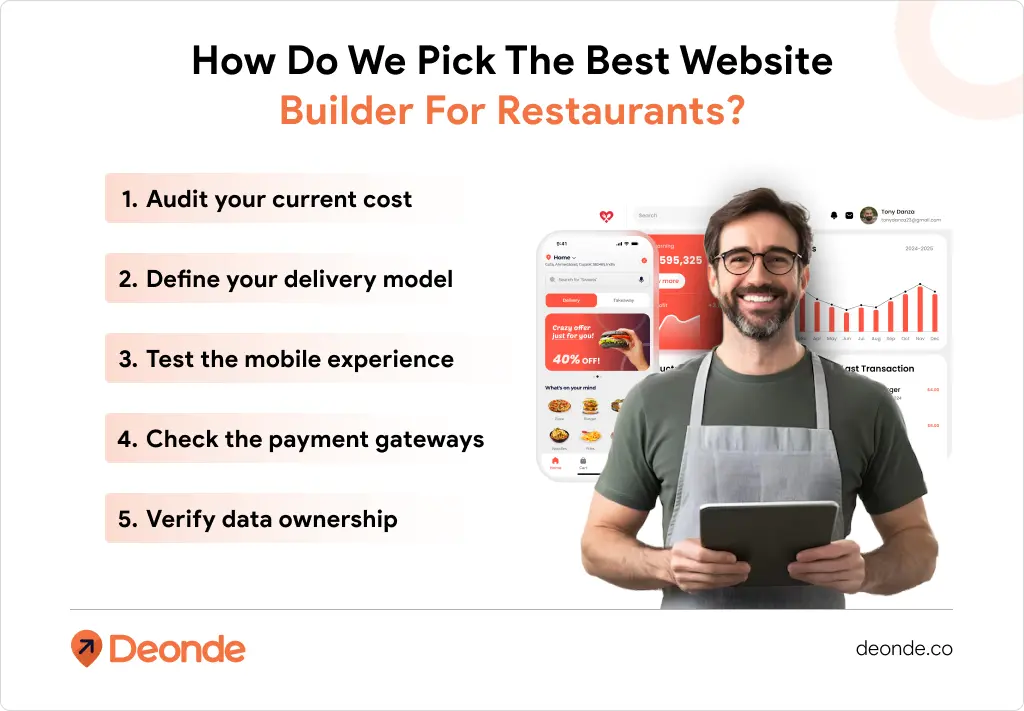
Choosing the right platform needs a strategic approach. We have written down the exact steps you need to take to evaluate.
- Audit your current costs: Calculate exactly how much you paid in aggregator commissions last month to establish your software budget.
- Define your delivery model: Determine if you need integrated last-mile driver tracking or if you only offer in-store pickup.
- Test the mobile experience: Load the demo site on your phone to ensure the checkout process is frictionless and fast.
- Check the payment gateways: Ensure the platform integrates with your local preferred payment processors (e.g., Stripe, Razorpay).
- Verify data ownership: Ask the software provider directly if you can export your customer CRM list at any time without restriction.
Following this framework ensures you invest in a tool that actually increases profit margins with your own delivery platform.

Conclusion
Choosing the right restaurant website builder is no longer just a technical decision — it is a strategic business move. A well-designed restaurant website acts as a central hub where customers can explore menus, place direct orders, book tables, and interact with your brand.
Restaurants that invest in a strong website platform have a big edge over their competitors as online ordering grows and customers rely more on digital discovery.
They depend less on third parties, keep higher profit margins, and build stronger relationships with customers by directly interacting with them. In fact, restaurants with easy online reservation systems report up to 30% more bookings.
Before committing to any platform, restaurant owners should carefully evaluate mobile performance, ordering capabilities, analytics tools, and SEO readiness.
The right builder will not only support daily operations but also help restaurants scale their digital presence and revenue in the years ahead.