Restaurants waste thousands each month paying commissions to third-party delivery platforms. Meanwhile, your customers’ phones sit right in their pockets—a direct line to drive repeat orders without paying a single commission fee.
Restaurant SMS marketing software changes the game. We’re seeing restaurant owners use text alerts to boost repeat order rates by 40% and build a marketing channel they actually own. SMS continues to deliver 98% open rates, with most messages read within three minutes. Email? It hovers at 20-30% and is often ignored.
This isn’t about blasting generic “20% off” texts. The restaurants winning today treat SMS strategically: automated welcome sequences, personalized win-back campaigns, and targeted flash sales.
Here is how you can build an SMS program that drives direct orders and turns one-time buyers into loyal regulars.
What is restaurant sms marketing software?
Restaurant SMS marketing software allows operators to send automated, targeted text alerts directly to customers’ phones. We see conversion rates hit 14% when texts link straight to a commission-free direct ordering page. It is the fastest way to drive repeat restaurant orders and bypass third-party aggregator fees.
Third-party delivery platforms charge massive commissions. We consult with multi-chain operators in the USA who lose thousands of dollars daily to these fees. Pulling your customers off these aggregators is critical for survival.
Consequently, shifting transactions to your native app requires a direct communication line. Text alerts provide that line. They cut through the noise and land directly in the customer’s hand right before mealtime.
How Text Alerts Actually Work
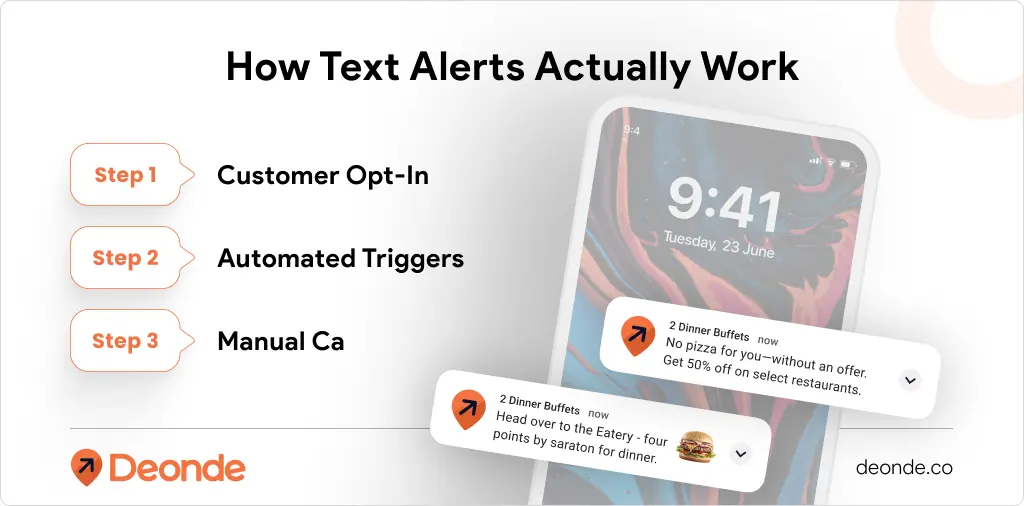
At Deonde, we integrated SMS into our platform because we watched too many owners pay 15-30% to aggregators while their own data sat unused. Here is the standard flow:
- Step 1: Customer Opt-In. When someone orders through your website, they check a box saying, “Get exclusive deals via text.” You capture their number with explicit legal permission.
- Step 2: Automated Triggers. The software watches for actions. New customer? It sends a 10% welcome discount. Haven’t ordered in 21 days? It sends a “we miss you” offer. Order placed? It sends a delivery ETA.
- Step 3: Manual Campaigns. You send texts for strategic wins. If Tuesday lunch is slow, you blast a flash sale at 11 AM.
According to Notifyre, 79% of consumers are more likely to buy when subscribed to an SMS list. Relevance is key; targeted messages drive revenue.
Why Does Text Marketing for Restaurants Beat Email?
Text marketing for restaurants guarantees visibility because text alerts trigger push notifications right on the lock screen. According to our team, SMS open rates average 98%, while email sits at just 20%.
Therefore, you capture immediate attention when hunger strikes. Customers ignore promotional emails for hours. In contrast, they read a text message within three minutes of receipt.
This immediacy makes SMS the perfect tool for time-sensitive food promotions. We find that combining text alerts with a commission-free restaurant ordering system generates immediate revenue spikes.
|
Feature |
SMS Marketing |
Email Marketing |
|
Average Open Rate |
98% |
20% |
|
Response Time |
Under 3 minutes |
2 to 24 hours |
|
Best Use Case |
Flash sales & urgent alerts |
Monthly newsletters |
|
Deliverability |
Direct to lock screen |
Often hits spam folders |
Is Restaurant Text Message Marketing TCPA Compliant?
We enforce strict TCPA compliant protocols to protect operators from heavy fines when sending text alerts. You cannot legally text a customer just because they placed an order once.
Therefore, explicit opt-in consent is required before initiating any restaurant text message marketing. We implement these mandatory compliance steps across all platforms.
- Require explicit checkboxes: Add a clear, unchecked opt-in box on the digital checkout page.
- Provide simple opt-outs: Every single text message must include “Reply STOP to cancel.”
- Honor delivery windows: Send texts only during daytime business hours to respect local laws and user privacy.
The Real ROI: Commission-Free Revenue
Most owners measure marketing by “likes” or “opens.” We care about repeat order rates and commission savings.
Every order placed through your own website via an SMS campaign is an order that didn’t go through DoorDash or Uber Eats. No 30% fee. No locked data. One Deonde client switched from social ads to SMS, resulting in a 38% increase in direct orders and $4,200 saved in monthly commissions.
How to Calculate Your SMS ROI
Formula: > (Revenue from SMS orders – SMS platform cost – Discount costs) / Total SMS investment
If you spend $150 on your platform, give away $672 in discounts, and generate $4,480 in revenue, your ROI is a massive 445%.
Ready-to-Use SMS Templates
Ready to start texting? Use these proven templates to drive immediate action.
- The Welcome Offer: “Welcome to the [Restaurant Name] VIP list! To say thanks, here is a free appetizer on your next direct order. Tap here to claim: [Link]. Reply STOP to opt out.”
- The Slow Day Flash Sale: “Tuesday lunch plans? Get 20% off all tacos today until 2:00 PM at [Restaurant Name]! Skip the line and order ahead right here: [Link]. Reply STOP to cancel.”
- The ‘We Miss You’ Win-Back: “Hey [First Name], it’s been a minute! We miss seeing you at [Restaurant Name]. Come grab your favorite meal with $5 off, valid this week only: [Link]. Reply STOP to opt out.”
- The Rainy Day Push: “Don’t want to cook in the rain tonight? Stay dry and let [Restaurant Name] handle dinner. Free delivery on all direct orders over $20 tonight: [Link]. Reply STOP to opt out.”
Top Software Recommendations
Choosing the right platform is critical. Here are three archetypes of software to consider based on your restaurant’s needs:
- Deonde: Best for full-suite integration. It ties your online ordering, CRM, and SMS directly together so you can trigger texts based on exact order history.
- SlickText: Best for large-scale operations and multi-location franchises that need robust mass-texting capabilities and detailed analytics.
- BiteBuddy: Best for AI-driven automation, perfect for operators who want a hands-off approach to customer segmentation.
Best Practices: What Works (and What Doesn’t)
What Works:
- Personalization: Use first names and past orders. “Hey Sarah, your usual Thursday veggie bowl is one tap away.”
- Perfect Timing: Send lunch promos at 10:30 AM and dinner deals at 4:30 PM.
- Exclusivity: “VIP-only deals” outperform generic blasts.
- Urgency: “Order by 3 PM today” forces a decision.
- Two-Way Messaging: Allow customers to reply with questions or special requests.
What Doesn’t Work:
- Over-Sending: Stick to 2-4 highly relevant texts per month.
- Generic Blasts: “Happy Monday!” has no offer and no urgency. It’s just noise.
- Broken Links: Always test your order links on a mobile phone before sending.
- No Clear Opt-Out: You must include “Reply STOP to opt out.” It’s good business and the law.
- Ignoring Compliance: Sending texts without an opt-in violates the TCPA and carries heavy fines.
Advanced Tactics: Segmentation & Triggers
Stop blasting your whole list. Smart restaurants segment their audience:
- By Frequency: VIPs get early access to menus; lapsed customers get aggressive win-back deals.
- By Spend: High spenders get premium family meal promos; low spenders get free delivery thresholds.
- By Preference: Vegetarians get plant-based updates; dessert buyers get bakery specials.
Behavioral Triggers that Print Money:
- Customer orders the same dish 3x: “Notice you love the Margherita! Here’s 15% off to try our Truffle pie.”
- Customer goes silent for 30 days: “Everything okay? Here’s 20% off your next order.”
Why Integration Matters
Generic SMS guides ignore operations. Your SMS needs to talk to your online ordering system.
At Deonde, all customer data (phone, address, favorites) lives in one CRM. This enables:
- Order-Triggered Texts: Automatic confirmations and ETA updates (reduces “Where’s my food?” calls by 40%).
- Menu Sync: Launch a new sandwich at 2 PM, and promote it via text at 5 PM with a photo pulled straight from your system.
- Accurate ROI: Automatically track exactly how many people redeemed your text promo.
Measuring Success: KPIs That Matter
Track metrics that tie directly to your rent:
- Revenue Per Message: Target $3-$10+ per promotional text sent.
- Repeat Order Rate Lift: SMS subscribers should reorder 30-50% more often than non-subscribers.
- Commission Savings: Track the direct revenue that bypassed third-party apps.
- Opt-In Rate: Aim for 40-60% of new customers joining your list.
FAQ
Q1. How do restaurants use SMS marketing?
Ans: We use it to send time-sensitive promotions, order status updates, and win-back offers. Texts always include direct links to the restaurant’s native ordering system.
Q2. How do you get customers to opt-in to text alerts?
Ans: We incentivize opt-ins by offering a small discount on their first direct order. A clear checkbox on the checkout page captures consent smoothly and legally.
Q3. Are text alerts better than push notifications?
Ans: Both work well together. Text alerts reach customers even if they uninstall your native app. However, push notifications for repeat orders cost nothing to send.
Q4. What is the best time to send text alerts?
Ans: We find that sending texts 45 minutes before standard meal times works best. For instance, texting at 11:15 AM captures the lunch rush, while 5:30 PM captures dinner.
Q5. How much does SMS marketing software cost?
Ans: Pricing depends on your monthly message volume. Most platforms charge a flat monthly fee plus a small fraction of a cent per individual text message sent.