In India’s hyper-competitive digital landscape, Swiggy has evolved from a food delivery startup into a logistics and convenience “super-app.” While its rivals focused on restaurant discovery, Swiggy’s marketing strategy was built on a different, more powerful foundation: operational excellence.
Swiggy’s rise is a masterclass for every entrepreneur and startup founder on how to win a market. While competitors focused on being directories, Swiggy’s founders—Sriharsha Majety, Nandan Reddy, and Rahul Jaimini—understood a fundamental truth: in India, the problem wasn’t discovery, it was delivery
But what exactly is Swiggy’s marketing strategy, and how did it leverage a delivery-first mindset—powered by a complex food apps algorithm—to build a billion-dollar ecosystem?”
Swiggy’s success isn’t just about clever ads; it’s a masterclass in building a brand that commands a stable 43% of India’s food delivery market, promising speed and reliability. This foundation of trust allowed them to expand far beyond food into groceries (Instamart), dining out (Dineout), and more.
This blog explores the core pillars of Swiggy’s marketing, from its iconic billboard campaigns to the powerful “flywheel” of its Swiggy One loyalty program.
The Swiggy Story: From “Bundl” to a Food-Tech Behemoth
Launched in 2014 by Sriharsha Majety, Nandan Reddy, and Rahul Jaimini, Swiggy (initially named Bundl) entered a crowded market. Bundl was initially a courier + logistics idea before pivoting to food. Zomato was already the established leader in restaurant discovery. But Swiggy’s founders saw a different gap: the delivery itself.
Their masterstroke was simple but revolutionary: build their own delivery fleet.
Instead of relying on restaurants to deliver, Swiggy controlled the entire experience. This meant:
- Guaranteed delivery times.
- Reliable service (no “sorry, our delivery boy is busy”).
- The ability to offer “no minimum order,” a game-changer that attracted students and single professionals.
This operational strength became the foundation of their marketing promise: lightning-fast, reliable delivery.
Swiggy’s Core Marketing Playbook: How They Built the Brand
Before it became an ecosystem, Swiggy built its brand name with a creative, multi-channel approach.
1. Hyperlocal OOH (Billboard) Dominance
Swiggy is a master of Out-of-Home (OOH) advertising. Their billboard campaigns are famous for being witty, minimalist, and perfectly in tune with the local culture.
- Witty, Relatable Copy: They use short, clever phrases that capture everyday moments, like “Unexpected guests? Swiggy it!” or “Cooked at 8, ate at 10? Swiggy it!”
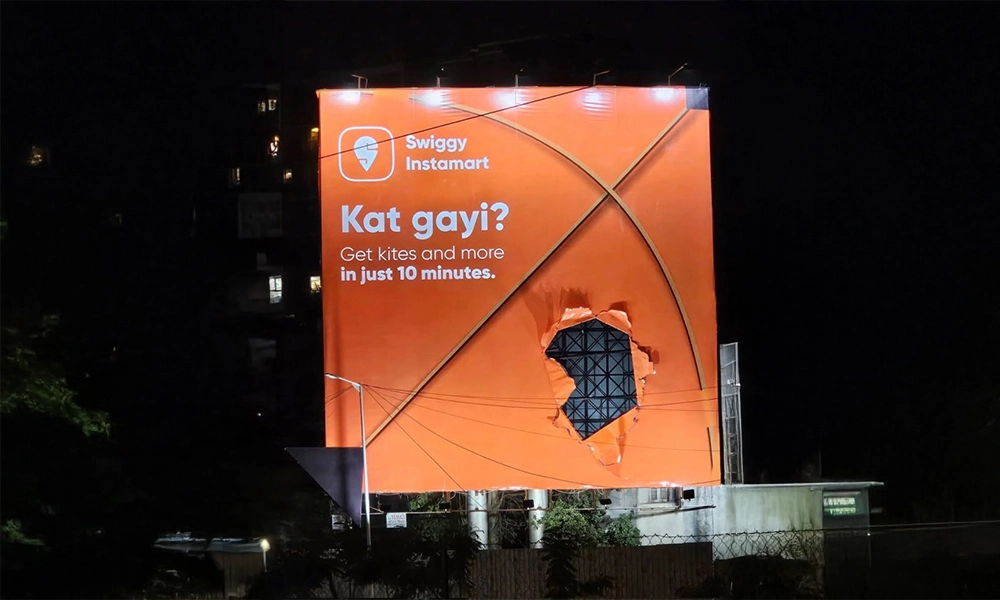
- Hyperlocal & Contextual: Their Instamart billboards are a prime example. During the Makar Sankranti kite festival, a billboard with a kite-shaped hole read, “Kat gayi? Get kites and more in 10 minutes.” This real-world, contextual marketing generates massive social media buzz.
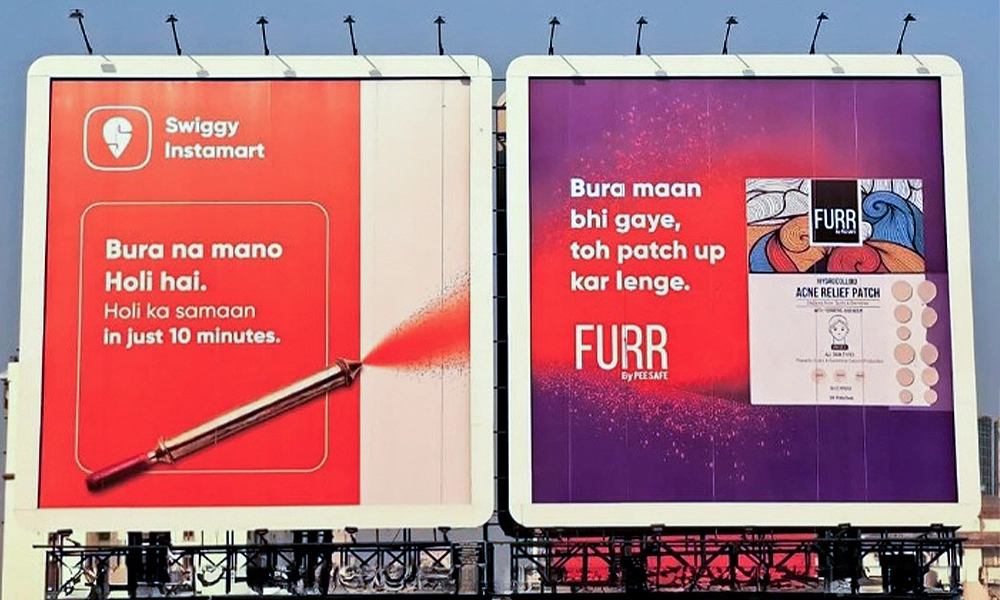
- Moment Marketing: During Holi, their billboards “Bura na mano, Holi hai. Holi ka samaan in just 10 minutes,” invited other brands to join in, creating a viral ad-war.
2. Social Media & Moment Marketing (The “Relatable Friend”)
Swiggy’s social media voice is that of a “relatable friend” who understands pop culture, memes, and the daily struggles of life. This voice is adapted for each platform:
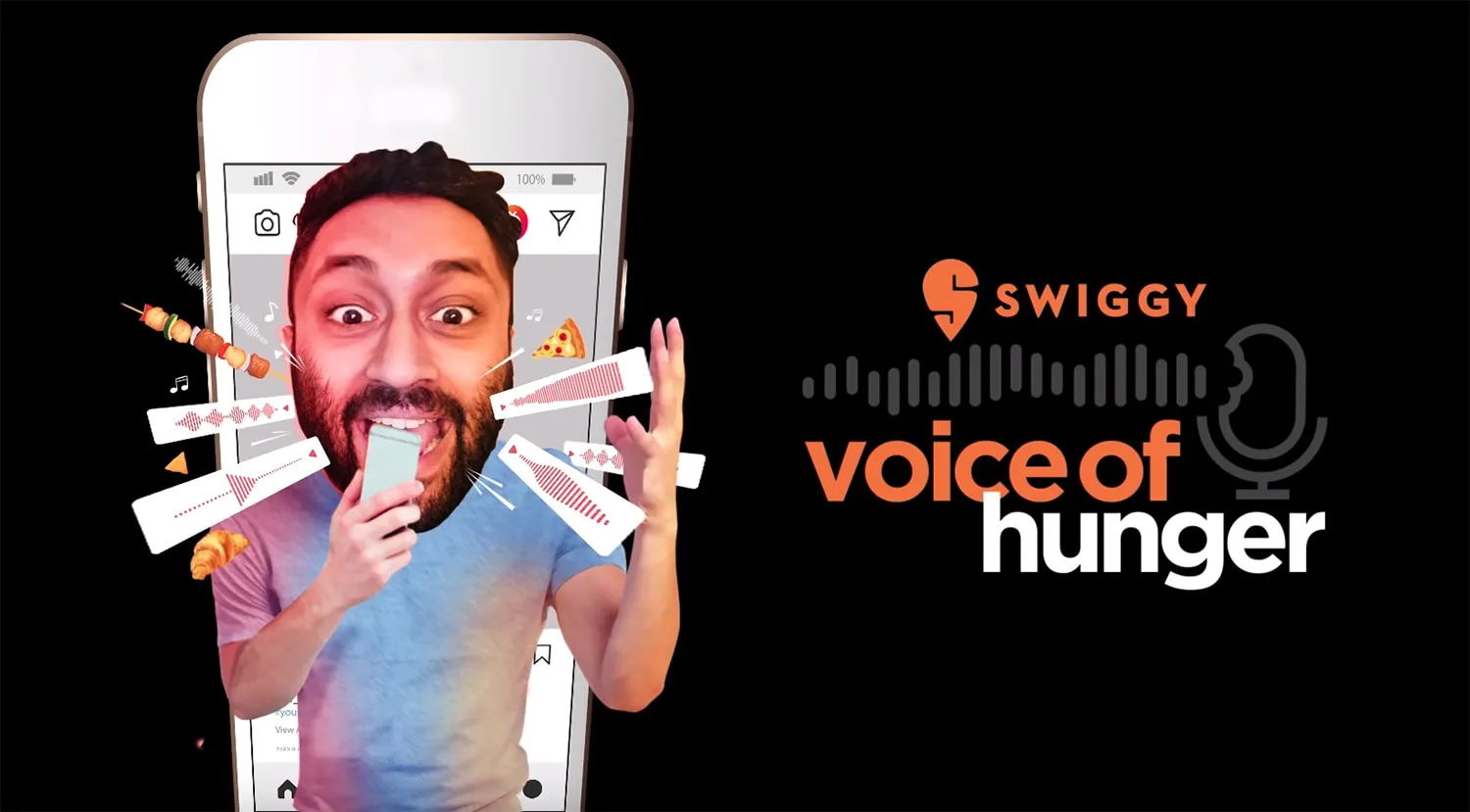
- Campaign Example: “Voice of Hunger” This legendary Instagram campaign challenged users to DM Swiggy voice notes that looked like food waveforms (a burger, nachos, etc.). It was a genius use of a platform-native feature, generating hundreds of thousands of user-generated entries and cementing their brand as creative and fun.
- Real-time Event Hijacking: During the IPL, Swiggy runs campaigns like “66% off every time a six is hit.” This directly links the excitement of a live national event to the action of ordering on the app, driving massive, time-sensitive order volumes.
The pitch at Uppal isn’t the only thing getting smoked tonight.
This year @Swiggy we’ve launched the Swiggy Sixes campaign where everytime a six is hit, users get 66% off
I’m a big SRH fan & given the form our bois are in, i think are in for a very expensive evening pic.twitter.com/rVoi1Loy6n
— Phani Kishan A (@phanikishan) March 27, 2025
3. Why is Swiggy’s Meme Marketing So Effective?
This is a core pillar of Swiggy’s social media dominance. Swiggy understands that on platforms like Instagram and X (Twitter), users don’t want to be “sold to”; they want to be entertained.
- Meme-Jacking: Swiggy’s team is incredibly fast. When a new meme format goes viral (from a movie, a show, or a current event), they “hijack” it within hours, connecting it back to food, ordering, or the simple struggles of life.
- Relatable Original Content: They create original memes that perfectly capture moments like the joy of seeing your delivery partner arrive, the pain of a Monday meeting, or the struggle of sharing food.
- Brand Affinity: The goal is not direct sales, but brand love. By being a source of daily humor, Swiggy builds a loyal community. When it’s time to order, that positive emotional connection makes Swiggy the default, “friendly” choice.
View this post on Instagram
4. Push Notifications: The Direct-to-Screen Nudge
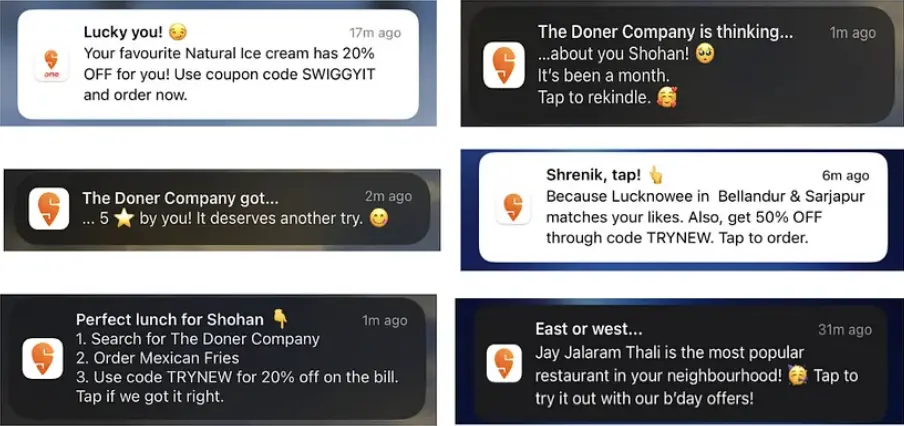
This is one of Swiggy’s most powerful conversion tools. Push notifications are a direct, immediate, and personal line to the user, designed to trigger instant action.
- Time-Sensitive Offers: “Lightning deal! Get 50% off on your lunch, valid for 30 minutes.” This creates urgency.
- Personalized & Contextual: “It’s raining! How about some hot pakoras?” or “IPL match starting! Order your snacks now.” These are triggered by real-world events.
- Re-Targeting: “Forgot something? Your cart is waiting!” This recovers potentially lost sales.
- Personalized Nudges: By learning user habits, they can send a 4 PM notification for “Your usual cold coffee,” moving from marketing to a personal-assistant-like service.
5. Email Marketing: The Personalized Retention Engine
While social media builds the brand, email marketing is Swiggy’s workhorse for customer retention.
- Hyper-Personalized Offers: Swiggy’s emails are highly personalized. Users receive emails like, “Your favorite Biryani is at 40% OFF” or “We’ve got new desserts from [Restaurant you love].”
- “We Miss You” Campaigns: If a user hasn’t ordered in a while, the system automatically triggers a “We miss you!” email, often paired with an exclusive discount to reactivate them.
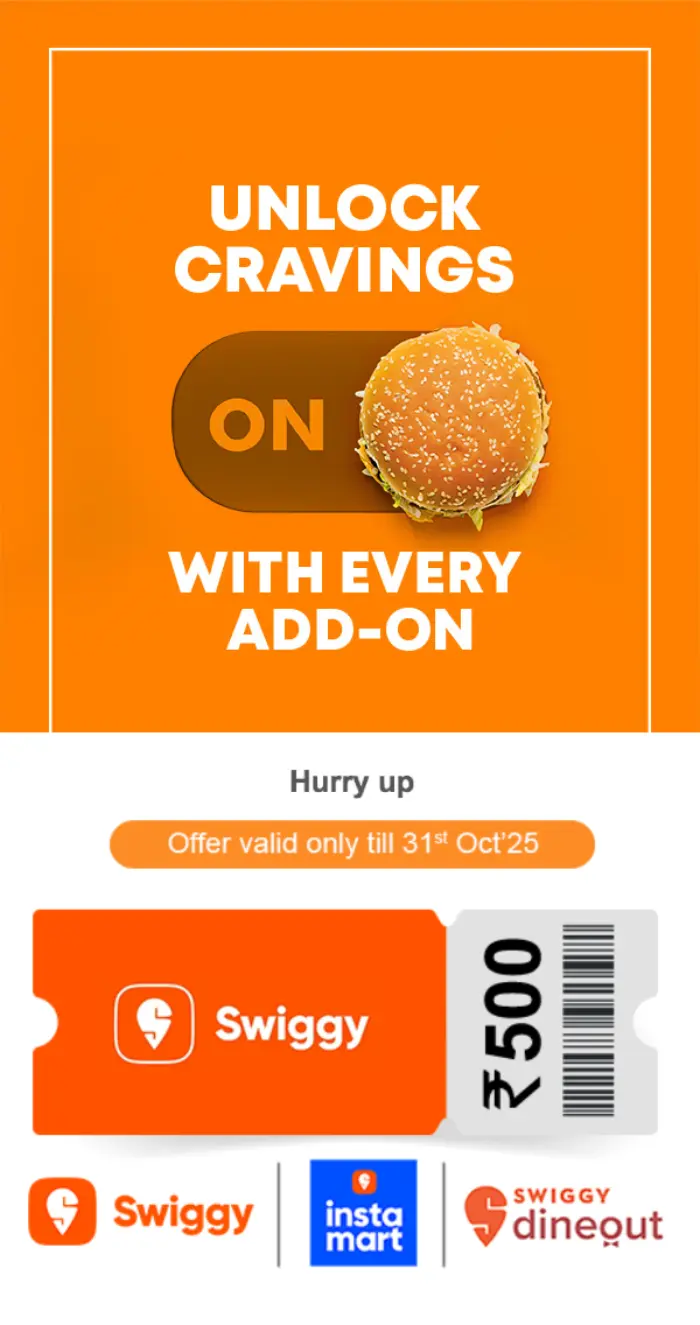
- Cross-Selling the Ecosystem: Email is a primary channel for promoting Swiggy One (“Save on your next 10 orders!”), Instamart (“Forgot to buy milk?”), or Dineout (“Get 25% off when you eat out”).
6. The In-App Engine: Marketing Through AI & Personalization
Swiggy’s most powerful marketing channel is the app itself. It functions as a one-to-one marketing engine driven by AI and data.
- Predictive Recommendations: The app homepage shows “restaurants you might like” based on past orders, search history, and time of day. This is marketing as a “helpful suggestion.”
- Trigger-Based Marketing: If you frequently order coffee at 4 PM, the app learns this and may feature a “4 PM Snacks” carousel, targeting you at the exact moment of your need.
- Driving Higher AOV (Average Order Value): The “Frequently Bought Together” or “Customers also ordered” sections are pure data-driven marketing, personalizing upsells to increase the cart value.
7. Influencer & Celebrity Endorsements
Celebrity Endorsements (Top-Down): They partner with major celebrities for big-budget TV campaigns (like during the IPL) to build mass-market trust.
Influencer Marketing (Bottom-Up): They collaborate with influencers of all sizes, from hundreds of local food bloggers to major YouTube personalities. This includes longer-form YouTube collaborations and unique branded playlists like the “Swiggy Weekend Watchlist” and “Swiggy Specials,” which promote local restaurants and new app features.
8. SEO & Content
Swiggy’s SEO strategy is laser-focused on high-intent keywords. They dominate search results for “order food online in [City]” and “restaurants near me.” The acquisition of Dineout also gave them a massive library of discovery-based content (e.g., “best cafes in [Area]”).
Beyond this, Swiggy’s own blog is a powerful content marketing engine. It captures long-tail keywords by focusing on food culture, not just transactions. This includes:
- Topical & Festival-Based Content: (e.g., posts about “What to eat during Navratri” or “Popular Diwali sweets”).
- Hyperlocal & Dish-Specific Content: (e.g., “Best biryani in [City]” or “Popular local dishes in [Area]”).
This strategy captures users at all stages of the funnel, from informational (what to eat) to transactional (where to order it from), strengthening their overall search engine footprint.
Swiggy’s Marketing Mix (4Ps): The Core Ingredients
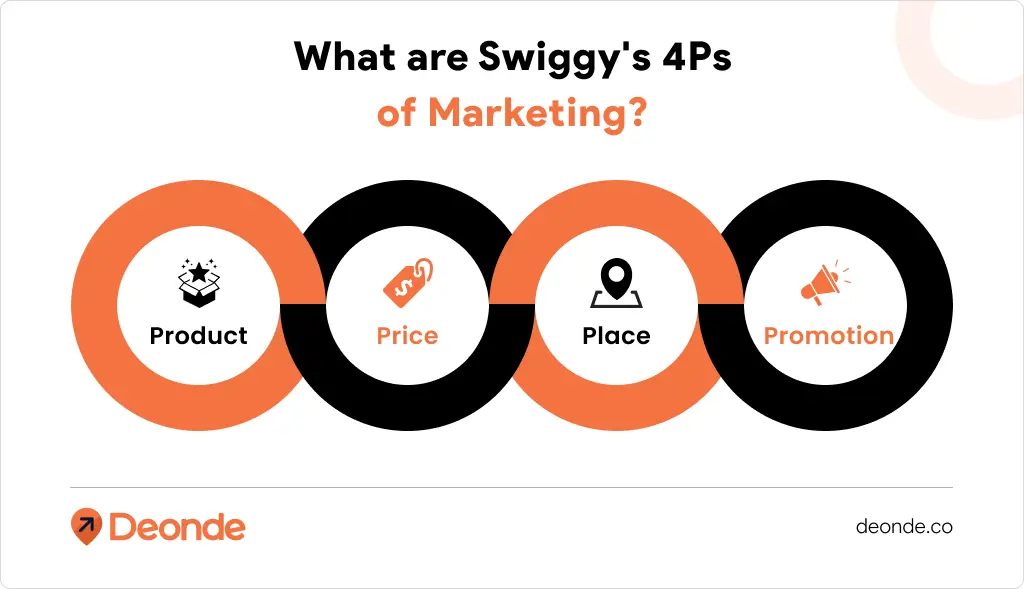
Swiggy’s success isn’t just one campaign; it’s a perfectly balanced mix of the 4Ps, optimized for the digital age.
1. Product
Swiggy’s “product” is not food; it’s convenience as a service.
- Core Service: The multi-restaurant food delivery system app, known for its seamless UI/UX, live-tracking, and wide restaurant selection.”
- Swiggy Instamart: A brilliant diversification into the quick-commerce (q-commerce) market, promising grocery delivery in 15-30 minutes.
- Swiggy Dineout: Acquired by Swiggy, this service is integrated into the app, allowing users to discover restaurants, book tables, and pay their dining-out bills, often with significant discounts. This captures the user’s “out-of-home” dining habits, not just delivery.
- Swiggy One: A subscription model offering free deliveries, discounts, and other perks across all its services, building immense customer loyalty.
2. Price
Swiggy employs a dynamic and intelligent pricing strategy:
- Discounts & Offers: Constant flow of app-only discounts, bank/wallet partnerships, and restaurant-funded promotions.
- Surge Pricing: Like Uber, Swiggy implements surge fees (delivery charges) during peak hours, bad weather, or high demand, managing fleet availability.
- Subscription Value: The “Swiggy One” price creates a psychological-sunk cost, encouraging users to order more to “get their money’s worth.”
3. Place
The “place” is 100% digital and hyperlocal.
- The App: Swiggy’s primary storefront is the mobile app, available on iOS and Android.
- Website: A fully functional web app for desktop users.
- Hyperlocal Network: The strategy is built on saturating specific zones. They onboard restaurants and build a dense delivery fleet city by city, block by block, ensuring the 30-minute promise can be kept.
4. Promotion
This is where Swiggy truly shines. Its promotional strategy is multi-channel, relentless, and incredibly “native” to the platforms it uses.
- Digital: Hyper-targeted social media, SEO, and content marketing.
- Offline (ATL): High-impact TVCs (television commercials), especially during the IPL (Indian Premier League), print, and billboards.
- BTL: Direct partnerships with restaurants and events.
The “Ecosystem” Strategy: Marketing Beyond Food
This is Swiggy’s most powerful marketing strategy. They understood that the app itself, and its millions of users, was their greatest marketing asset.
By building a multi-service ecosystem, they also significantly reduce customer churn; when a user relies on one app for food, groceries, and dining out, the “cost” of switching to a competitor becomes much higher.
Swiggy Instamart (Quick Commerce)
Instamart, the 10-minute grocery service, is a marketing engine.
- It creates new “use cases”: A user who only ordered food 3-4 times a week now opens the app 10-15 times to buy milk, snacks, or coffee. This dramatically increases brand touchpoints.
- It’s marketed as a “problem-solver”: Ads focus on relatable “panic” moments: running out of diapers, missing one ingredient for a recipe, or late-night snack cravings.
- Cross-Promotion: Swiggy’s most potent tactic is advertising Instamart to its massive, existing food-delivery user base with in-app banners and “first-order free” discounts. They converted their food audience into a grocery audience at a fraction of the cost a new startup would pay.
Swiggy Dineout (Expanding the Ecosystem)
While Instamart captures the “at-home” grocery market, the Dineout acquisition was a brilliant strategic move to capture the user’s “out-of-home” spending. This move directly challenges competitors on their home turf (restaurant discovery) and integrates another key food-related activity into the Swiggy app.
It ensures that whether a user wants to order in, cook, or eat out, their first reflex is to open the Swiggy app. This dramatically increases Swiggy’s daily utility and makes it much harder for a user to switch to a competitor.
The Loyalty Loop: How Swiggy One Locks In Customers
How do you keep users loyal in a market with endless discounts? You make loyalty an ecosystem.
Swiggy One is the glue that holds the entire strategy together. It’s a paid subscription program that acts as a powerful “loyalty-loop.”
- It’s Not Just a Discount: For a single fee, a user gets free delivery on food, and free delivery on Instamart, and exclusive discounts on Dineout.
- It Creates a “Sunk Cost”: Once a user has paid for Swiggy One, they are psychologically driven to maximize its value. Why order from a competitor and pay a delivery fee when your Swiggy order is “free”?
- It Locks In High-Value Users: It identifies and captures high-frequency customers, making it prohibitively expensive for them to switch, thereby starving competitors of the most valuable user segment.
The B2B Play: Marketing to Restaurants and FMCG Brands
A brilliant, and often overlooked, part of Swiggy’s strategy is its B2B marketing.
- Marketing to Restaurants: Swiggy offers partners a “self-serve” platform to manage menus, run their own promotions, and get access to valuable data insights on what’s selling in their area. They also offer services like professional food photoshoots, positioning themselves as a “growth partner,” not just a delivery app.
- Instamart as a Retail Media Network: This is a genius move. Swiggy allows FMCG brands (like Coca-Cola, Lays, or Nestlé) to buy ad space inside the Instamart app. Brands can pay for “Sponsored Listings” or “Homepage Banners,” just like on Amazon. Swiggy gets a new, high-margin revenue stream, and brands get access to customers at the exact moment of purchase.
Why Swiggy’s Marketing Strategy Stands Out?
Swiggy’s marketing strategy is a masterclass in building an ecosystem of convenience.
While Zomato built a brand around “foodie” culture and discovery, Swiggy built a logistics-first brand focused on speed and reliability. This operational positioning allowed them to win customer trust and gave them the credibility to expand into Instamart.
Their genius lies in making their diversified services (Instamart, Dineout, DeskEats) their best marketing channels, all held together by the powerful glue of the Swiggy One loyalty program.
Conclusion: The Unstoppable Swiggy Flywheel
Swiggy’s marketing strategy is not a simple, linear plan. It’s a powerful, self-reinforcing flywheel:
It started with a Logistics-First Model that built deep user Trust in its reliability.
It used Creative Marketing (billboards, social) to attract millions of Users to its food delivery service.
It then leveraged that user base to Diversify Services (Instamart, Dineout) at a low acquisition cost.
It locks those users into the ecosystem with the Swiggy One loyalty program, which increases order frequency.
More users and more orders generate more Data, which attracts more Restaurant and Brand Partners (B2B), who pay for ads.
This B2B revenue funds more innovation and better service, which strengthens the logistics model… and the flywheel spins faster.