Every day, we speak with local restaurant owners who are struggling with a common problem: small restaurants want more direct online orders, but third-party platforms are taking massive chunks of their revenue.
A small restaurant generally cannot afford to build and run a custom, standalone delivery app from scratch, but yes they can afford pre-built white-label SaaS ordering platforms.
When a typical $40 order yields only $2 in actual profit because of 15% to 30% delivery app fees Many owners realize this and want out, but they hesitate.
They think building a ready-made app is simply too expensive and complicated. But the real question is not just about the upfront restaurant delivery app cost but whether it can afford to keep paying high delivery app fees and third-party commissions forever.
For a small restaurant, the idea of launching an app can sound risky. Many owners assume a small restaurant app is only for big brands, but that is not true anymore.
A modern restaurant mobile app can help a business take more control over orders, customer data, and repeat sales. With a white-label food ordering app, a restaurant does not need to build everything from zero.
Is It Really Necessary for a Small Restaurant to Build Its Own Delivery App?
Yes, Nowadays, in the highly competitive restaurant market, having your own ordering and delivery app has become absolutely essential for small restaurants.
The main reasons are as follows:
- Save on commissions: Platforms like doordash, Lieferando or Uber Eats charge a high commission of 15% to 30% on every order. With your own app, this commission is saved, and the restaurant keeps the full profit.
- Direct customer relationship: Third-party apps don’t share customer data (mobile numbers, emails). With your own app, you have access to this data, allowing you to send offers and discounts directly.
- Build brand identity: Having your own app creates a unique brand image. Customers order directly from you without comparing with other restaurants.
- Repeat customers: Loyal customers who enjoy your food will keep ordering through your app, ensuring consistent sales growth.
In short, third-party apps are good for finding new customers, but to maximize profit and retain existing ones, having your own delivery app is absolutely necessary.
Related: Why Do You Need an Online Ordering System in 2026?
What an Own Delivery App Actually Gives You
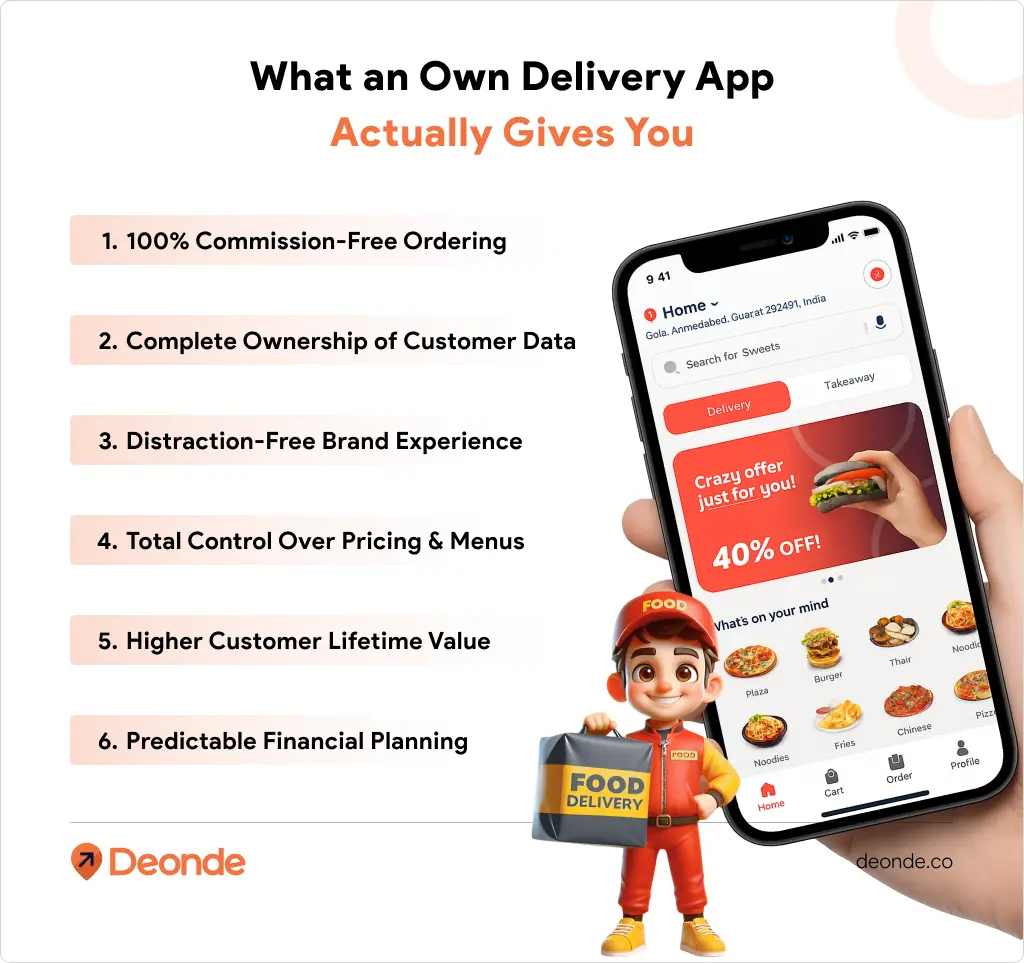
When we look at restaurants that successfully transition away from heavy aggregator reliance, the difference isn’t just financial, it fundamentally transforms how they operate.
Having your own dedicated app gives your business complete control over your revenue, branding, and customer relationships.
Here is a clear breakdown of what owning your delivery app actually gives you:
- 100% Commission-Free Ordering: You keep every single rupee or dollar earned from direct online orders instead of losing up to 30% to high delivery app fees.
- Complete Ownership of Customer Data: You gain access to customer names, phone numbers, email addresses, and order histories giving you the power to run targeted SMS, WhatsApp, or email marketing campaigns whenever you want.
- Distraction-Free Brand Experience: You provide a dedicated mobile ordering app for restaurants where your menu takes center stage, completely free from competitor ads, recommended listings, or price wars.
- Total Control Over Pricing & Menus: You can launch flash sales, run custom combo offers, or adjust prices instantly without waiting for third-party approval or dealing with delayed menu updates.
- Higher Customer Lifetime Value: By offering exclusive loyalty points, rewards, and a seamless ordering process, you encourage repeat orders directly from your most loyal customers.
- Predictable Financial Planning: Shifting to pre-built white-label SaaS ordering platforms replaces unpredictable, escalating per-order commissions with a transparent, fixed operational cost.
Related: How Can a Commission-Free Restaurant Ordering System Boost Your Profits in 2026?
How Much Does It Really Cost?
The phrase restaurant delivery app cost usually scares small business owners. But the cost depends on the model you choose.
A custom-built app can be expensive, while a ready-made restaurant app Builder or SaaS solution can be much more practical for a small business. That is why many restaurants now look for an affordable restaurant ordering app instead of building from scratch.
If your goal is to reduce third-party commissions and start getting more direct orders, a white-label solution can be a smarter first step.
Read More: How Much Does It Cost To Develop A Restaurant App
Pros and Cons of Building Your Own Restaurant Delivery App
When transitioning to your own platform, here is a quick look at what we advise our restaurant partners to expect:
Pros (The Advantages)
- Enjoy commission-free ordering and completely eliminate high third-party delivery app fees.
- Keep your restaurant delivery app cost low, making your own restaurant app affordable.
- Collect names and contact info directly to run your own targeted marketing campaigns.
- Your Mobile Ordering App for Restaurants only shows your menu, never your rivals.
- Update prices, add items, and launch flash sales instantly without waiting for approvals.
- Rely on flat-fee pre-built white-label SaaS ordering platforms instead of losing a percentage of every sale.
Cons (The Responsibilities)
- Demands active marketing on your end to drive direct online orders.
- Requires managing your own delivery logistics or local driver partners.
- Takes time and incentives to move regulars away from third-party apps.
- Means your staff must handle customer service and delivery complaints directly.
- You have to offer discounts and incentives to train regulars to switch to your new app.
- Your front-of-house team will need to learn your new online ordering system for restaurants.
How Deonde Helps Small Restaurants Go Direct
We built our solution to help local businesses break free from high fees and own their growth. Here is how we help:
- Offers a fully customized white-label food ordering app under your own brand name.
- Provides a complete online ordering system for restaurants to handle orders and delivery effortlessly.
- Acts as a quick restaurant app Builder so you can launch your app in just a few days without coding.
- Dramatically reduces your overall restaurant delivery app cost with a flat monthly plan.
- Delivers a dedicated Mobile Ordering App for Restaurants designed to drive direct online orders.
- Uses powerful pre-built white-label SaaS ordering platforms to make having a small restaurant app affordable.
- Includes built-in customer data and marketing tools built specifically for lead generation and sales growth.
- Keeps your ordering process completely commission-free so 100% of the revenue stays with you.
See also: What Is Deonde? Complete Guide
Do Food Delivery App Really Help Restaurants?
So, do aggregator food delivery apps really help restaurants? The honest answer is: it depends on how you use them. For a standard independent restaurant, relying heavily on aggregators can result in high volume but zero extra profit.
As Barnett suggests, third-party apps are best used purely as a marketing expense or a lead-generation tool.
Once they bring you a new customer, your goal should be to migrate them over to your own app. Drop flyers, “dine-in only” coupons, or direct-order promotions into the takeout bags.
DoorDash’s commission charges and similar fees from other platforms are built for customer acquisition, not customer retention, and treating them as a permanent, primary channel is where restaurants quietly lose the most money over the course of a year.
The smartest strategy isn’t to quit third-party apps overnight. Instead, we recommend a hybrid approach to smoothly reduce third-party commissions over time:
- Use for Discovery: Keep a listing on one or two major apps purely to find new customers.
- Promote Your Own Platform: Print QR codes on receipts, takeout bags, and table tents pointing directly to your own restaurant mobile app.
- Incentivize the Shift: Offer a small first-order discount to move repeat customers over to your direct online orders, where you keep the full profit and the relationship.
Restaurants that fail to make this shift end up building a loyal customer base on rented land, where someone else owns the data and can change the rules at any time. Those that do make the switch find that their most profitable repeat revenue stays exactly where it belongs—on a platform they actually own.
Related: Why 70% of Food App Customers Never Reorder
Conclusion
So, can a small restaurant really afford its own delivery app? Yes — if it chooses the right model. A custom build may be expensive, but white-label SaaS ordering platforms make it much more realistic for small restaurants to start with a branded app.
If you want more control, better margins, and fewer marketplace fees, a smart app strategy can pay off.
Ready to see what that looks like for your business? Deonde’s online ordering system for restaurants can have your own branded website live in about three days, with zero commission on every order, ever.
book a quick demo to see exactly what your restaurant could save.