
If you run or maybe planning to start a new food, grocery, milk, restaurant, cloud kitchen or any delivery business and want to launch your own online ordering system, you have probably come across Deonde. But do you know exactly what Deonde is, and how does it fit for your operations?
Most delivery businesses pay third-party platforms 15–30% commission on every order. Deonde gives you a way out. It is a SaaS-based platform that lets you build your own branded ordering and delivery system — across food, grocery, pharmacy, courier, and more — without paying per-order fees.
Deonde ordering & delivery management software is a white label, subscription-based platform. It gives businesses a full ordering system, a driver app, a customer app, and an admin dashboard. You own the brand. You own the customer. You pay a fixed monthly fee.
What Exactly Is Deonde?
Deonde is a SaaS platform built for businesses that want to run their own ordering and delivery operation. It is not a marketplace like Uber Eats, DoorDash, or Deliveroo—and therefore not a competitor to them. It does not list your business next to competitors. It builds you a private, branded ordering system that you control.
The platform covers the entire ordering & delivery workflow. A customer places an order on your app or website. The order reaches your admin dashboard. A driver picks it up and delivers it. You track everything in real time.
Deonde serves businesses across three broad categories: food and beverage, retail and essentials, and logistics. Each category has its own set of tools and workflows built into the platform.
The company operates globally. Businesses in India, UAE, South Africa, USA, UK, Kenya, Singapore, Canada, and more than a dozen other countries use the platform. The core product is the same across all markets — what changes is the local payment gateway integration, delivery zone configuration, and regulatory compliance requirements.
What Does Deonde Stand For?
Deonde stands for Delivery on Demand. The name reflects the platform’s core purpose: giving businesses the tools to fulfill customer orders on demand, without relying on third-party marketplaces.
The company was founded by Ashish Sudra, who brings over 16 years of experience in IT and on-demand software. Deonde serves food and retail businesses globally. Its focus is giving independent operators the same ordering technology that large platforms have — at a fraction of cost.
You do not pay per order. You do not share your customer data. You build your own platform and keep everything you earn.
Who Uses Deonde?
Deonde works for a wide range of business types. It is not limited to restaurants.
Food and Beverage businesses use Deonde to manage online ordering and delivery. This includes restaurants, pizza outlets, tiffin services, bakeries, liquor stores, meat ordering brands, and home-cooked food businesses.
Retail and Essentials businesses use Deonde to run grocery delivery, milk delivery, pharmacy delivery, flower ordering, and cannabis delivery operations.
Logistics businesses use Deonde to manage courier delivery, fuel ordering, and multi-category delivery operations.
The platform also works for specific business models. Cloud kitchens, quick commerce brands, hyperlocal businesses, startups, and enterprise chains all use Deonde. You can explore the multi-restaurant delivery system if you run multiple outlets, or the online ordering system for restaurants if you operate a single brand.
Real businesses across these categories have used Deonde to launch and scale.
Chowman, a restaurant chain, used the platform to move orders from third-party apps to its own branded system. Munch Zimbabwe used it to run a multi-delivery operation across a new market. HungryJi and GTEats used it to launch online ordering businesses from scratch. These cases show that Deonde works across different countries, different business sizes, and different delivery verticals.
What Problems Does Deonde Solve?
Three problems push most businesses toward Deonde.
High third-party commissions: Platforms like Uber Eats, DoorDash, and Deliveroo charge 15–30% per order. A restaurant processing $20,000 in monthly orders loses $3,000–$6,000 in commissions alone. Deonde replaces that with a flat monthly subscription. The savings grow as order volume increases.
No customer ownership: On third-party platforms, customers belong to the platform — not to you. You cannot contact them directly. You cannot run your own loyalty program. You cannot see their order history or preferences. Deonde gives you full access to your own customer data from day one.
Fragmented delivery operations: Many businesses manage orders on one app, drivers on another, and payments on a third. Reporting is scattered. No single view shows the full picture. Deonde brings everything into one system — ordering, driver dispatch, delivery tracking, payments, and analytics.
What Does the Deonde Platform Include?
The Deonde platform has four core components that handle both ordering and delivery end to end.
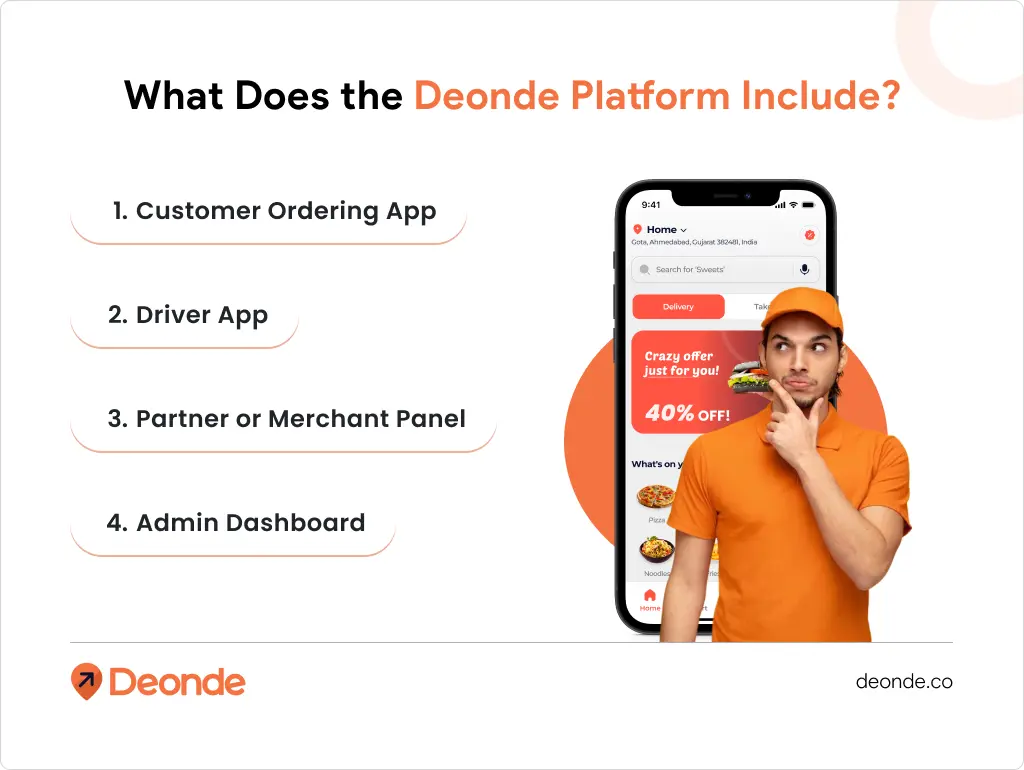
Customer Ordering App
Your customers use a branded app to browse your menu, place orders, track deliveries, and make payments. The app carries your logo, your colors, and your brand name. No Deonde branding appears on customer-facing side.
Customers can order through multiple channels. These include a mobile app, a website, WhatsApp, Instagram, Facebook, Google, and QR codes. The SaaS-based grocery ordering solution and courier ordering solution both use this same multi-channel ordering setup.
This matters because different customers prefer different channels. A 40-year-old ordering groceries may prefer WhatsApp. A 25-year-old ordering food may prefer the mobile app. Having all channels active means you capture more orders without running multiple systems.
Driver App
Drivers receive order alerts on their phones. They accept orders, navigate to pickup and drop-off points, and update delivery status in real time. The admin dashboard tracks every driver’s location live.
The driver management system within Deonde also handles driver settlement — so you can calculate earnings, manage payouts, and monitor performance from one screen. You can assign drivers manually or let the system auto-assign based on proximity and availability.
Partner or Merchant Panel
If you run a multi-vendor platform, each merchant gets their own panel. They manage their own menu, track their own orders, and view their own reports. You manage all merchants from the admin dashboard above them.
This structure suits marketplace-style businesses. A grocery platform with 20 stores. A food delivery network with 50 restaurants. Each merchant operates independently inside the shared system.
Admin Dashboard
The admin dashboard is the control center. You set delivery zones, manage drivers, run promotions, view customer data, handle payment settlements, and read analytics reports — all from one interface. For a detailed walkthrough of how these features connect, see how Deonde works.
Key Features Built Into Deonde
Deonde covers the full delivery operation — not just the ordering part.
- Delivery zone management: lets you define where you deliver, set different fees per zone, and block out areas outside your radius. You can draw custom zones on a map and apply different minimum order values to each one.
- Marketing automation: includes coupons, promo codes, loyalty programs, push notifications, and customer chat. You can run a promotion for a specific zone, a specific day, or a specific customer segment. The restaurant marketing software tools inside Deonde are built for this exact use case.
- Analytics and reporting: show you order volumes, revenue trends, top-performing menu items, driver efficiency, and customer retention data. You do not need a separate analytics tool. All reports live inside the admin dashboard.
- Subscription management: works for businesses that sell recurring orders — daily milk delivery, weekly tiffin subscriptions, or monthly meal plans. Customers sign up once and orders are auto-generated on their schedule.
- Multi-Language and Multi-Payment Support: The platform works across languages and accepts multiple payment gateways. This is essential for businesses operating across different regions.
- Third-party integrations: connect Deonde to payment gateways, POS systems, and logistics providers. You are not locked into a single payment option or delivery partner.
- Contactless delivery: options and proof-of-delivery tools are built in. Drivers can collect photo or signature confirmation on delivery. This is standard for pharmacy and courier operations.
What Industries Does Deonde Serve?
Deonde is built for multi-industry use. The same core platform powers different delivery types through industry-specific configurations.
|
Industry |
What Deonde Enables |
|
Restaurants and Cloud Kitchens |
Online ordering, table reservations, QR menus, ordering tracking |
|
Grocery |
Real-time inventory display, scheduled delivery slots, multi-category ordering |
|
Pharmacy |
Prescription uploads, contactless delivery, compliance-friendly workflows |
|
Milk and Tiffin |
Subscription ordering, daily route management, recurring billing |
|
Courier and Logistics |
Multi-stop dispatching, proof of delivery, driver settlement |
|
Liquor and Cannabis |
Age-verification workflows, geofenced delivery zones, compliance controls |
|
Flower Store |
Time-sensitive slot booking, fragile-goods handling, special occasion tagging |
|
Fuel Delivery |
GPS-based dispatch, bulk order management, scheduled delivery windows |
This range makes Deonde a platform for ordering and delivery businesses of all types — not just food.
Deonde uses a SaaS subscription model. You pay a fixed monthly fee based on your plan. There are no per-order commissions and no revenue sharing.
This matters most when your order volume grows. On a third-party platform, more orders means more commission paid. On Deonde, more orders means more revenue kept. Your subscription cost stays flat regardless of how many orders you process.
Deonde offers different plans for startups and enterprise businesses. A startup launching its first delivery operation pays a different rate than an enterprise chain managing hundreds of locations. You can review the full breakdown on the Deonde pricing page.
How Is Deonde Different From a Marketplace?
A marketplace like Uber Eats, DoorDash, or Deliveroo aggregates many businesses on one platform. Customers browse all of them together. You compete for attention. The platform charges commission on every sale.
Deonde is the opposite. It builds a private platform for your business only. Customers who use your app see only your brand. You control the pricing, the promotions, and the experience.
The difference is ownership. In a marketplace, the platform owns the customer relationship. On Deonde, you do.
This also changes how your marketing budget works. When you run a promotion on a third-party app, you attract customers who may never return directly to you. When you run a promotion on your Deonde-powered app, you attract customers into your own ecosystem. Every repeat order after that costs you nothing extra.
Getting Started With Deonde
Deonde offers live demos for each vertical. You can test the restaurant ordering system, grocery delivery system, tiffin/meal kit system, milk system, and more — before committing to a plan.
The onboarding process covers account setup, menu or catalog upload, delivery zone configuration, and driver app installation. Most businesses complete the setup within a few days.
If you already know what you need, pricing page shows plan options for startups and enterprise accounts.
The Bottom Line
Deonde ordering and delivery management software is a platform for businesses that want to run delivery on their own terms. It covers ordering, driver management, marketing, analytics, and payments — across food, retail, and logistics verticals.
The core advantage is straightforward. You build your own branded system. You own your customer data. You pay a flat subscription instead of per-order commissions.
If you run a restaurant, grocery store, pharmacy, courier business, or any other delivery operation, Deonde gives you the infrastructure to operate independently.
For a step-by-step walkthrough, read our guide on how Deonde works.
Frequently Asked Questions
What does Deonde do for restaurants?
Deonde gives restaurants a branded online ordering system with their own app, website, and ordering and delivery management tools. Restaurants take orders directly from customers — without paying commission to third-party marketplaces.
Who is Deonde best suited for?
Deonde works for restaurants, grocery stores, pharmacies, milk delivery businesses, tiffin services, bakeries, couriers, and logistics operators. It suits startups launching a delivery business and established brands moving away from third-party platforms.
How is Deonde different from third-party delivery apps?
Third-party apps list your business alongside competitors and charge 15–30% commission per order. Deonde gives you a private, branded platform. You pay a flat monthly subscription and keep your full order revenue.
How much does Deonde cost per month?
Deonde offers subscription plans for different business sizes. The cost depends on the plan you choose — startup or enterprise. Full pricing details are available on the pricing page.