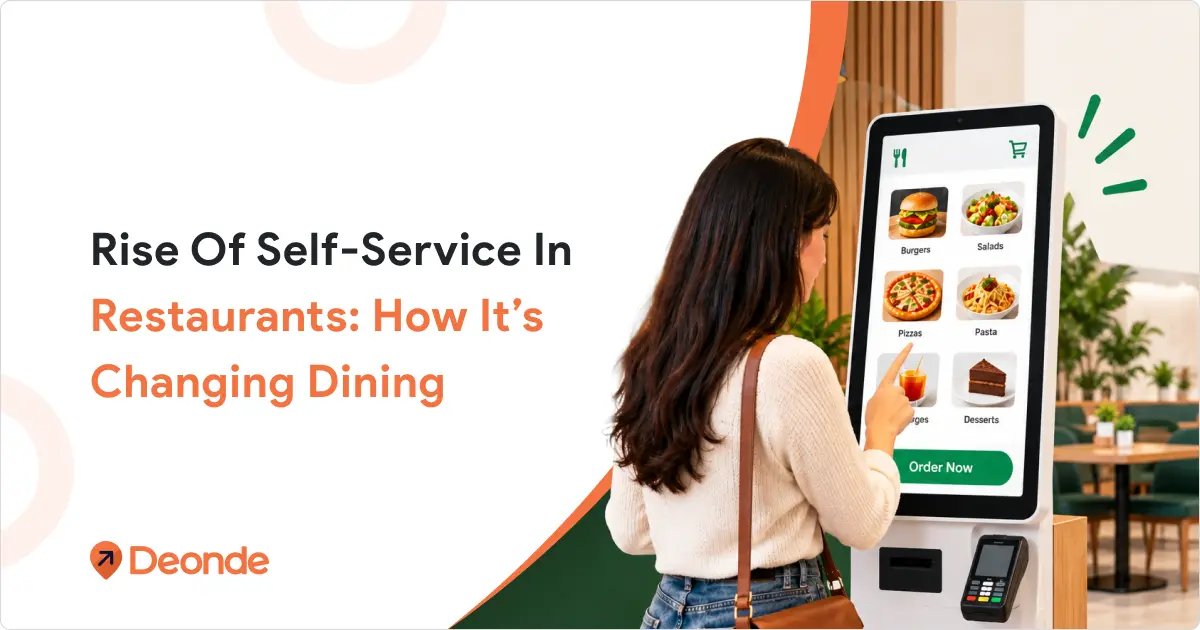
Self-service in restaurants means letting guests order, customize, and often pay for their own meals without needing a staff member to walk them through every step.
Restaurants are adopting it to speed up service, ease labor pressure, and meet rising demand for guests to control their own ordering process.
Restaurant turnover has averaged close to 80% a year in recent periods, up from about 72% before the pandemic, a major reason operators are turning to automation.
70% of restaurant operators report job openings that are difficult to fill, and 45% say they don’t have enough staff to meet demand, according to our research.
Restaurants that deploy self-order kiosks commonly report average order values rising 15–30%, driven largely by automated upsell prompts.
What Does Self-Service Mean in Restaurants?
Self-service in restaurants covers any technology that lets a guest place an order, customize an item, pay, or collect food without a staff member handling the transaction.
It generally falls into four categories: ordering kiosks, QR code table ordering, mobile or app-based ordering, and self-checkout or self-pickup stations.
Types of Self-Service Restaurant Technology
Self-service isn’t one piece of technology, it’s a category that covers several tools, often used together.
- Self-order kiosks: Freestanding or countertop screens where guests browse the menu, customize items, and pay. Common in quick-service and fast-casual restaurants.
- QR code menus: A scannable code that opens a digital menu on the guest’s own phone, replacing or supplementing printed menus.
- Mobile ordering: Apps or mobile-optimized sites that let guests order ahead for pickup or delivery, or order from their table.
- Table-side ordering: Tablets mounted at the table or handed to guests, often used in casual dining and bars.
- Payment kiosks: Devices dedicated to checkout and payment, sometimes paired with traditional order-taking.
- Pickup lockers or shelves: Heated cubbies or open shelving where mobile and delivery orders wait, so guests can grab food without a handoff.
Why Self-Service Is Growing in the Restaurant Industry
Self-service didn’t become common because it’s trendy — it became common because it solves problems restaurants were already struggling with.
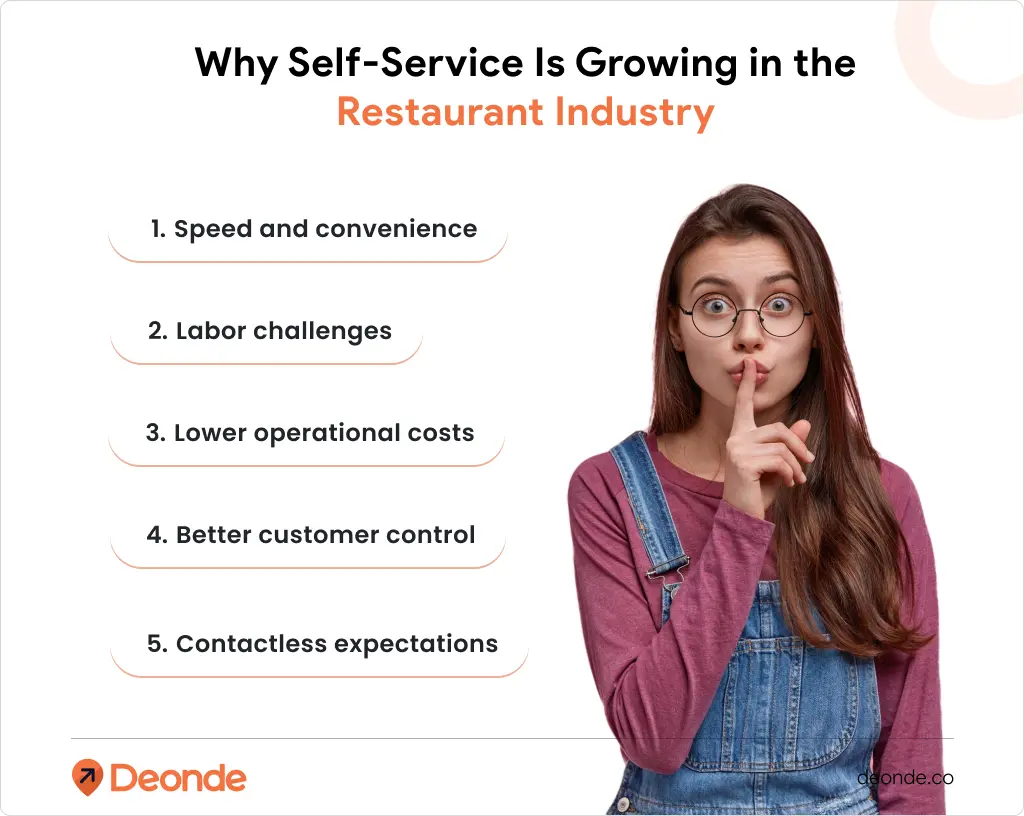
- Speed and convenience: Guests can order the moment they’re ready instead of waiting for a server, which shortens lines and speeds up table turns.
- Labor challenges: The restaurant industry remains an estimated 200,000-plus workers short of pre-pandemic staffing levels, according to our research, and annual staff turnover stays close to 80%. Self-service reduces how many order-taking staff a location needs to run smoothly.
- Lower operational costs: Fewer staff hours spent on order-taking means labor budgets can shift toward food quality, kitchen speed, or hospitality instead.
- Better customer control: Guests can browse at their own pace, customize orders without feeling rushed, and skip the awkwardness of a server waiting on a decision.
- Contactless expectations: What started as a pandemic-era safety measure has become a lasting preference; many guests now simply expect the option to order without face-to-face interaction, even if they don’t use it every time.
Taken together, these pressures explain why kiosk installations worldwide climbed by roughly 43% between 2021 and 2023 alone, with market researchers projecting continued double-digit growth for the rest of the decade.
Key Benefits of Self-Service Technology for Restaurants
Restaurant self-service pays off in four measurable ways: faster throughput during peak hours, lower labor cost per order, fewer order errors, and richer data on what guests actually order.
- Faster throughput — guests order and pay in parallel instead of waiting in a single line, shortening peak-hour queues.
- Lower labor cost per transaction — one employee can support several kiosks or QR tables instead of taking every order individually.
- Fewer order errors — a guest entering their own order removes the mishearing and hand-off mistakes common in busy service.
- Higher average order value — kiosk and app upsell prompts convert more consistently than a rushed verbal pitch.
- Better data — every self-service order is logged automatically, feeding into a restaurant analytics and reporting tool that shows which items and channels actually drive revenue.
Benefits of Self-Service for Customers
Guests get real advantages too, which is a big part of why adoption keeps climbing:
- Shorter wait times: No need to wait in a line behind other orders being taken verbally.
- More convenience: Order whenever it’s convenient, without needing a server’s attention.
- More control over the order: Customize freely, without feeling rushed or judged.
- Easier menu browsing: Visual menus with photos and descriptions make decisions easier than a verbal rundown.
- Better payment experience: Split checks, tip, and pay on a personal schedule instead of flagging someone down.
What Are the Challenges of Self-Service in Restaurants?
Self-service isn’t free of trade-offs: it requires upfront investment and integration work, and not every guest wants to use it. Full-service and fine-dining restaurants especially need to treat self-service as an addition to hospitality, not a replacement for it.
Integration is the real cost, not the hardware
A kiosk or QR system that doesn’t talk to your point-of-sale creates duplicate order entry and kitchen delays. Clean restaurant POS integration is what determines whether self-service actually saves labor or just adds a second system to manage.
Guest preference is genuinely split
One national guest survey by the point-of-sale provider Toast found that a majority of diners still said they preferred a physical menu over a QR-only one, with that preference climbing sharply among guests over 55. Self-service works best as one channel among several, not a forced replacement for staffed service.
Accessibility and hospitality still matter
Guests without a smartphone, guests with disabilities, and guests who simply want a server’s recommendation all need a staffed option available. The strongest rollouts keep a human in the loop for anything beyond routine ordering.
How to Implement Self-Service in Your Restaurant
Rolling out self-service works best as a phased process: map your current order flow, choose the right channel for your format, integrate it with your kitchen systems, retrain staff for a hybrid model, then pilot before scaling.
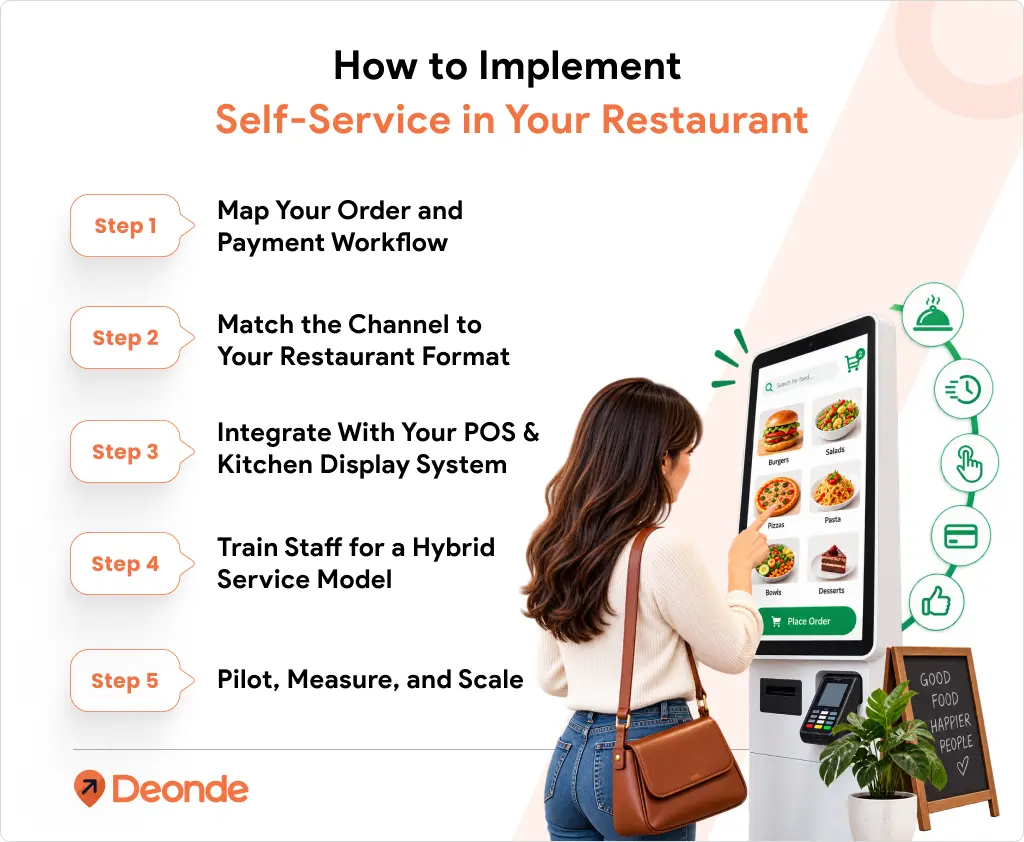
Step 1: Map Your Order and Payment Workflow
Walk through exactly how an order currently moves from guest to kitchen to payment. Every point where a staff member is a bottleneck — not a value-add — is a candidate for self-service.
Step 2: Match the Channel to Your Restaurant Format
Quick-service and fast-casual restaurants usually see the fastest return from kiosks. Casual dining does better starting with QR table ordering. Multi-location and delivery-heavy brands get the most value from a dedicated ordering app.
Step 3: Integrate With Your POS and Kitchen Display System
This is where most self-service projects stall. Orders from a kiosk, a QR menu, and an app all need to land in the same kitchen display system without manual re-entry, or the kitchen becomes the new bottleneck.
Building this stack from scratch kiosk software, QR ordering, a payment gateway, and POS/kitchen sync is typically a multi-month engineering project.
A ready-to-use online food ordering system like Deonde packages these pieces together, so a restaurant can launch self-service ordering in days instead of building and maintaining each system separately.
Step 4: Train Staff for a Hybrid Service Model
Self-service shifts staff roles from order-taking to order-support: helping guests who get stuck, running food, and handling exceptions. Staff need to know the system well enough to troubleshoot it in front of a guest without slowing the line down.
Step 5: Pilot, Measure, and Scale
Run the new channel at one location or one daypart first. Track order accuracy, average order value, and labor hours saved before expanding it across every location.
Self-Service vs Traditional Service
Neither model is strictly better; they solve different problems. Here’s how they compare on the factors that matter most to operators:
| Factor | Self-Service | Traditional Service |
| Speed | Orders placed instantly, no wait for staff | Limited by how many guests one server can reach |
| Cost | Lower per-order labor cost; upfront tech investment | Higher per-order labor cost; no tech investment needed |
| Customer experience | Self-paced and private; good for guests who want control | Personal and guided; better for hospitality-driven concepts |
| Accuracy | Orders reach the kitchen exactly as entered | Depends on a server correctly hearing and relaying the order |
| Operational flexibility | Scales during rushes without adding staff | Better for judgment calls, special requests, in-person upselling |
Many restaurants land somewhere in the middle — using self-service for ordering and payment while keeping staff focused on hospitality and food.
Best Practices for Restaurant Self-Service
A few habits separate self-service rollouts that work from ones that frustrate guests:
- Keep menus clear. Group items logically, and don’t bury popular items behind extra taps or scrolls.
- Make checkout fast. Every extra screen or step is a chance for a guest to give up.
- Add helpful upsells. Suggest relevant add-ons, not random ones — a drink with a sandwich, not a dessert with a salad.
- Ensure mobile compatibility. QR menus and ordering pages need to load fast and look right on any phone.
- Test everything before launch. Run through every menu path, payment method, and edge case before guests do it for you.
The Future of RestThe Future of Restaurant Self-Service: What’s Coming Next
Self-service in restaurants is still in its early stages. Several emerging trends will reshape the landscape over the next 2–5 years.
Fully Automated Restaurants
Steak ‘n Shake’s plan to eliminate front-of-house staff entirely is the most aggressive example. White Castle’s “Castle of Tomorrow” concept stores feature robotic fryers and AI-driven drive-thru systems. These are still prototypes — but they point to where the industry is heading.
AI-Powered Personalization
Kiosks that remember your preferences, suggest items based on your past orders, and adapt menus to the time of day will become standard. McDonald’s is already deploying this at scale.
Voice Ordering as a Standard Modality
By 2028, voice AI at drive-thru and in-store ordering stations will likely be as common as touchscreens are today. The technology is already live at Wendy’s and McDonald’s pilot locations.
Integration with Loyalty Programs
Self-service systems will feed directly into loyalty programs — automatically crediting points, suggesting rewards-eligible items, and personalizing offers based on ordering history.
Predictive Ordering and Inventory
AI will predict what customers will order before they walk in — based on weather, time, day of week, local events, and historical data. Restaurants will prep accordingly, reducing waste and improving speed.
Conclusion
Self-service in restaurants isn’t a passing trend, it’s a response to real pressure: a labor market that hasn’t fully recovered, rising costs, and customers who increasingly expect to control their own experience.
Done well, it speeds up service, reduces errors, lifts average order value, and frees staff to focus on hospitality instead of order-taking.
It isn’t a universal fix, though. QR menus and kiosks work best as options, not replacements, and some concepts will always depend on personal service as part of what makes them work.
The restaurants getting the most out of self-service are the ones using it to remove friction not to remove the human touch that keeps guests coming back.
FAQ
1. Is self-service replacing servers in restaurants?
Ans: No. Self-service replaces the order-taking step, not hospitality. Most successful rollouts shift staff toward food running, guest support, and handling exceptions rather than eliminating roles entirely.
2. What’s the cheapest way to start with self-service?
Ans: QR code table ordering is typically the lowest-cost entry point since it doesn’t require kiosk hardware — guests use their own phones to view the menu and order.
3. Do restaurant guests actually like self-service?
Ans: It’s mixed. Adoption and satisfaction are high in quick-service settings, but surveys show a meaningful share of guests — especially in full-service dining and among older diners — still prefer a staffed option.
4. Does self-service work for fine dining?
Ans: Rarely for ordering itself, but it works well behind the scenes for reservations and payment, where guests want speed without losing tableside service.