Building an app like Milk & More costs anywhere from around $39/month with a white-label platform to $5,000 to $100,000+ for a fully custom build, and takes 1 – 2 weeks with a ready-made solution versus 12 – 18 months from scratch.
At minimum, you need three connected pieces: a customer app, a delivery-partner app, and an admin dashboard, plus subscription billing, a hard order cutoff, and live tracking.
There’s something very British about waking up to the clink of glass bottles on the doorstep.
Milk & More is the closest thing the UK has to a national on-demand dairy brand the old-fashioned milkman, rebuilt as a subscription app.
What’s changed is that behind that clink now sits a proper piece of software: route planning, standing orders, live inventory, an app that reminds you at half eight that you’ve forgotten to add eggs.
Milk & More has turned a Victorian-era delivery model into a business reportedly worth over £120 million a year, and it’s the reference point most founders reach for when they say “I want to build something like that.”
This guide is for anyone actually trying to do it: dairies, independent grocers, and entrepreneurs who want the Milk & More playbook without the multi-year build.
Milk & More at a glance
| Metric | Detail |
|---|---|
| Owner | Freshways Group (since 1 Jan 2024); previously Müller UK & Ireland |
| Registered as | MoreCo Group Limited, Camberley, Surrey |
| Annual revenue | £121.97m, latest reported year. Milk & More saw revenues fall 13.8% year on year to £121.97m in light of volume contraction and portfolio reshaping |
| Regional depots | 31, across England & Wales. Milk & More is one of the market leaders for home grocery deliveries, with about 1,100 employees and 31 depots |
| Staff | ~1,000–1,100 |
| Weekly customers | 300,000+ regulars; base approaching 500,000 including occasional shoppers |
| Bottles delivered | 50.7m+ refillable glass bottles in 2025 |
| Delivery window | Up to 3x/week, free, by 7am |
| Order cutoff | 9pm the night before delivery |
| Product range | 8 categories: Milk, Breakfast, Dairy, Dairy-Free, Juice & Drinks, Bread & Bakery, Fruit & Veg, Pantry & Home |
| Coverage | England & Wales only — not Scotland or Northern Ireland |
| App | iOS + Android; ~220K+ combined installs estimated. Trusted by 221K+ people, with a 4.5/5 user rating |
How to Build Your Milk Delivery App: Step by Step Guide
Most of the work is configuration and planning, not coding. Here’s the sequence that works, whether you build from scratch or launch a ready-made platform.
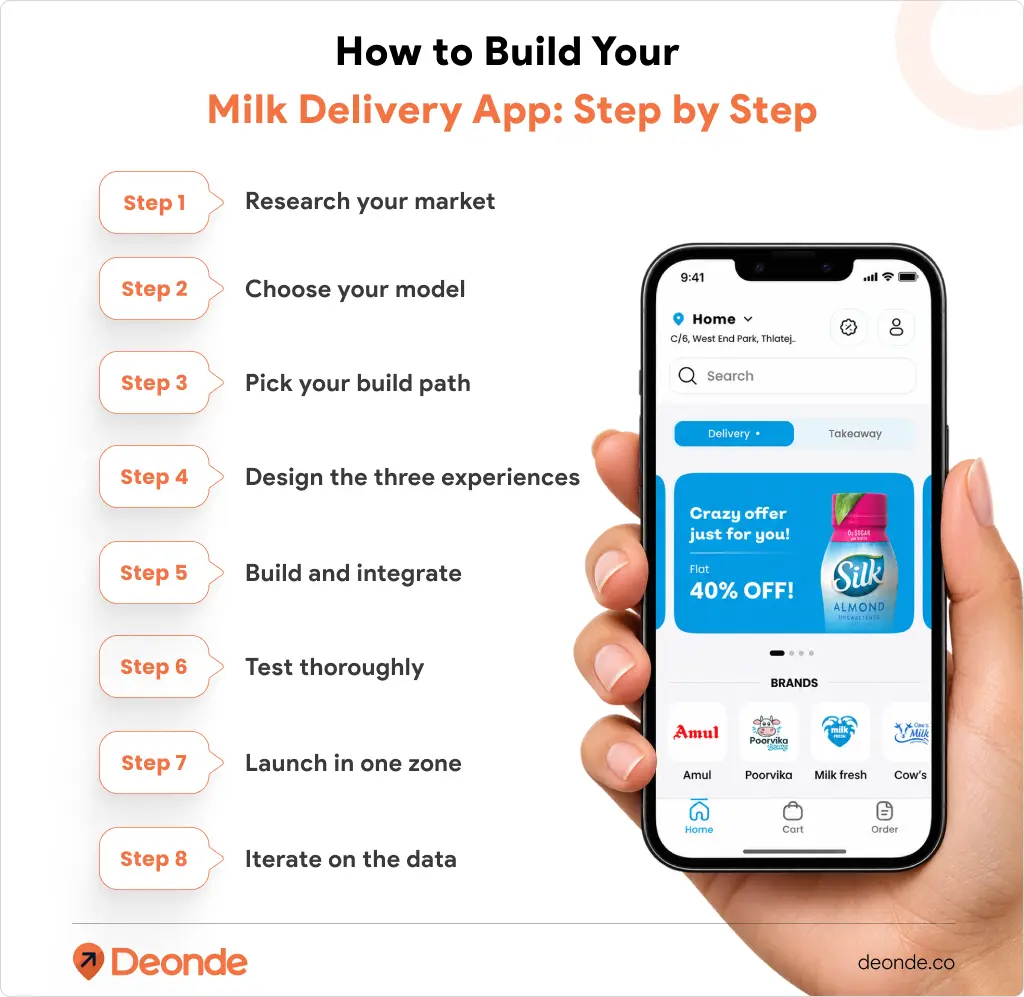
Research your market: Study local competitors, delivery density, and whether customers will pay a premium for glass bottles, organic options, or speed.
Choose your model: Pure subscription, pure on-demand, or a hybrid like Milk & More’s.
Pick your build path: Custom build vs. white-label, based on budget, timeline, and technical resources.
Design the three experiences: Customer app, driver app, and admin dashboard — each with a distinct job.
Build and integrate: Payments, maps/routing, push notifications, and a subscription billing engine.
Test thoroughly: Payment edge cases, route failures, cutoff-time logic, and load testing before any real delivery happens.
Launch in one zone: Prove the model with a single depot or postcode area before expanding.
Iterate on the data: Churn rate, average order value, and delivery cost per order should drive every feature decision after launch.
How Much Does It Cost to Build a Milk Delivery App?
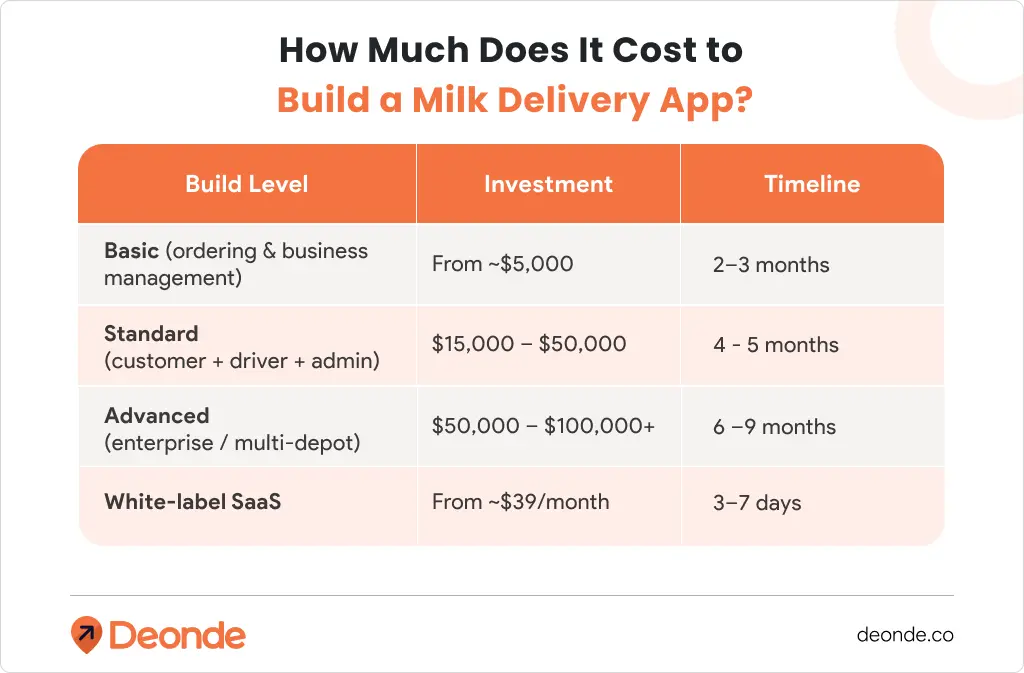
Custom development runs from $5,000 to $100,000+ depending on scope, starting with a basic ordering and milk business management app around $5,000, a few months for a standard build, or 12–18 months for an advanced custom platform with extensive features.
A white-label SaaS platform starts near $39/month and goes live in 3–7 days.
Cost at a Glance
| Build Level | Investment | Timeline |
| Basic (ordering & business management) | From ~$5,000 | 2 – 3 months |
| Standard (customer + driver + admin) | $15,000 – $50,000 | 4 – 5 months |
| Advanced (enterprise / multi-depot) | $50,000 – $100,000+ | 6 –9 months |
| White-label SaaS | From ~$39/month | 3–7 days |
The Hidden Costs Nobody Quotes
Most quotes miss what keeps the app alive:
- Server hosting — scales with your user base.
- Payment gateway fees — 2–3% per transaction, which adds up fast on daily orders.
- Maps API — charged per request for driver navigation.
- SMS & notifications — OTPs, reminders, delivery updates.
- Maintenance — budget 15–20% of the build cost per year for fixes and OS updates.
- App store fees — Apple $99/year, Google $25 one-time.
- Compliance — GDPR and food-safety basics aren’t optional in the country.
Expert Advice: Add a 25–30% operating buffer beyond the build cost for Year 1. Few people do, and it’s the #1 reason milk app launches stall at month six.
Custom Build vs White-Label SaaS — Honest Comparison
Thinking about costs would be incomplete without addressing the practical alternative to a custom build.
| What You Need | Custom-Built | White-Label (Ready-Made) |
| Time to first order | 3 -18 months | 3 – 7 days |
| Upfront cost | $15,000 – $100,000+ | From ~$39/month |
| Engineering team | Backend, iOS, Android, QA | Not required |
| Customer/driver/admin apps | Built from scratch | Pre-built, store-ready |
| Subscription + wallet + routing | Months of extra work | Built in |
| Payment gateways | One-off integrations | 30+ pre-integrated |
| Maintenance | You pay forever | Included in subscription |
Custom makes sense when software is your product. For a dairy business where the product is the milk, most founders save 12 months and most of their budget with a ready-made platform — and use the saved time to win households.
Important Note: App development costs vary significantly depending on the country and region where your development team is based, primarily driven by regional hourly rate differences.
Why Milk & More’s Business Model Works
Three decisions explain most of its staying power:
No lock-in, but subscription-shaped behavior
Customers can order with zero minimum spend and no contract, but the 9 PM cutoff and recurring delivery slots quietly train people into subscription-like habits, with high retention without the friction of a hard commitment.
Glass bottles as a genuine differentiator
In a market where supermarkets compete purely on price, reusable glass bottles give Milk & More a sustainability story competitors can’t easily copy; it’s a product decision that doubles as a marketing asset.
Website and app, doing different jobs
The website handles browsing a 200+ item catalog and building larger weekly baskets easier on a bigger screen.
The app is the daily-use tool: adding a forgotten pint, pausing before a holiday, or editing an order before the cutoff. If you’re only planning an app, you’re solving half the problem; the browsing/onboarding experience matters just as much as the day-to-day one.
What Makes Milk & More’s Delivery Model Different?
Milk & More pairs a traditional milk round with online ordering: customers place recurring or one-off orders with no subscription lock-in and no minimum spend. Orders placed by roughly 9- 10 pm arrive before 8 am the next day, often in reusable glass bottles.
It isn’t a locked-in subscription. Customers set a standing order they can pause, skip, or edit anytime through their account.
The real innovation is logistics, not the product. Milk is low-margin and high-frequency — the business only works with tight delivery routes and predictable morning drop-offs.
Reusable glass bottles add a reverse-logistics layer most delivery apps skip entirely: empties get collected and reused, which needs its own tracking inside the driver app. (For a subscription-first comparison, see how Country Delight structured its recurring milk delivery app.)
Who Else Is Doing This? The UK Competitive Set
Milk & More isn’t alone, and the two most-cited rivals took different routes to get here.
| Feature / Metric | Milk & More | The Modern Milkman | McQueens Dairies |
|---|---|---|---|
| Founded/rebuilt | Modernised under Müller from 2016; Freshways-owned since 2024 | 2018, Colne, Lancashire. Founded in 2018, expanding to 16 hubs across England | 1995. Started its first milk round in 1995 |
| Model | Hybrid: website + app, traditional rounds modernised | App-first, plastic-free brand story built for a younger demographic | Traditional rounds plus a growing online layer |
| Depots/hubs | 31 | 16+ Recently expanded, with a multimillion-pound growth phase adding new depots and 100 additional workers | Expanded across the UK |
| App downloads (est.) | ~220K+ combined | ~750K+ combined (Trusted by 757K+ users) | No consumer app at comparable scale |
| Differentiator | Scale, brand recognition, broadest grocery range | Youth-skewing eco brand, in-app plastic-saved tracker | Long-established regional trust |
The takeaway for a founder: Milk & More wins on scale and range, Modern Milkman wins on app-first storytelling to a younger audience, and McQueens wins on regional trust built over three decades. There’s room for a fourth model that combines app-first UX with genuine local-supplier sourcing.
- Recurring standing orders, not locked subscriptions
- Zero minimum spend or sign-up fee
- Fixed evening order cutoff, next-day delivery
- Reusable packaging with reverse-logistics tracking
- Multi-category catalog: milk, dairy, bakery, produce, household basics
The Must-Have Features If You’re Building an App Like This
A platform like Milk & More is really three connected products.
Customer app
- Postcode coverage checker before registration
- One-off orders and standing/regular orders, editable independently
- A visible order-cutoff timer (the single most-copied UX detail from Milk & More)
- Pause/skip/holiday mode
- Wide category browsing with substitution preferences (e.g., “if out of stock, substitute with…”)
- Recurring card billing plus one-off payment
- Push notifications for cutoff reminders and delivery confirmation
- A sustainability counter (bottles reused, plastic avoided) tied to the customer’s own account
Driver (“milkman”) app
- Round/route optimisation by depot
- Proof of delivery and exception handling (missed doorstep, substitution logged)
- Offline-capable functionality for early-morning, patchy-signal rounds
- EV range/charge tracking if running electric vehicles
Admin Dashboard
- Centralized order and subscription management
- Inventory and supplier management
- Driver and route assignment, live fleet view
- Analytics: churn, average order value, best-selling SKUs
- Coupon, discount, and referral-tracking tools
- Multi-depot / multi-zone management
For a deeper walkthrough of each panel, our step-by-step milk delivery app development guide and how a milk delivery app works, from order to doorstep, cover the full order lifecycle in detail.
How Milk Delivery Apps Make Money
- Recurring subscriptions — the most predictable revenue stream, and the one Milk & More’s cutoff-time design quietly encourages.
- Per-order delivery or platform fees — for non-subscribers
- Catalog expansion — milk as the entry point, groceries as the margin (Milk & More’s 200+ SKUs are the clearest example)
- Premium/express delivery upsells
- Supplier commission or sponsored placement on multi-vendor platforms
- B2B licensing — if your platform itself becomes the product, as with white-label vendors
Why Build Your Milk Delivery App With Deonde
If you’d rather launch in weeks than months, Deonde’s SaaS-based milk delivery software gives dairy and grocery businesses a ready-made version of everything covered above:
- Branded customer, driver, and admin apps — no code required
- Subscription management with automatic route updates when deliveries are paused or skipped
- Zero commission on orders — connect your own payment gateway and keep 100% of revenue
- 30+ payment gateway integrations, including Stripe, PayPal, and Razorpay
Plans start at $39/month, with a 15-day free trial and no credit card required. You can book a free demo to see the customer, driver, and admin apps in action before committing to anything.
Your Next Move
Pick your pilot zone this week: one postcode cluster, not a whole city. Routing, reverse logistics, and cutoff times all get easier to design once you know exactly who you’re delivering to.
Disclaimer: Milk & More is a trademark of its respective owner. Deonde is an independent software provider and is not affiliated with, endorsed by, or connected to Milk & More. This article is for educational, informational, and technical reference purposes only.