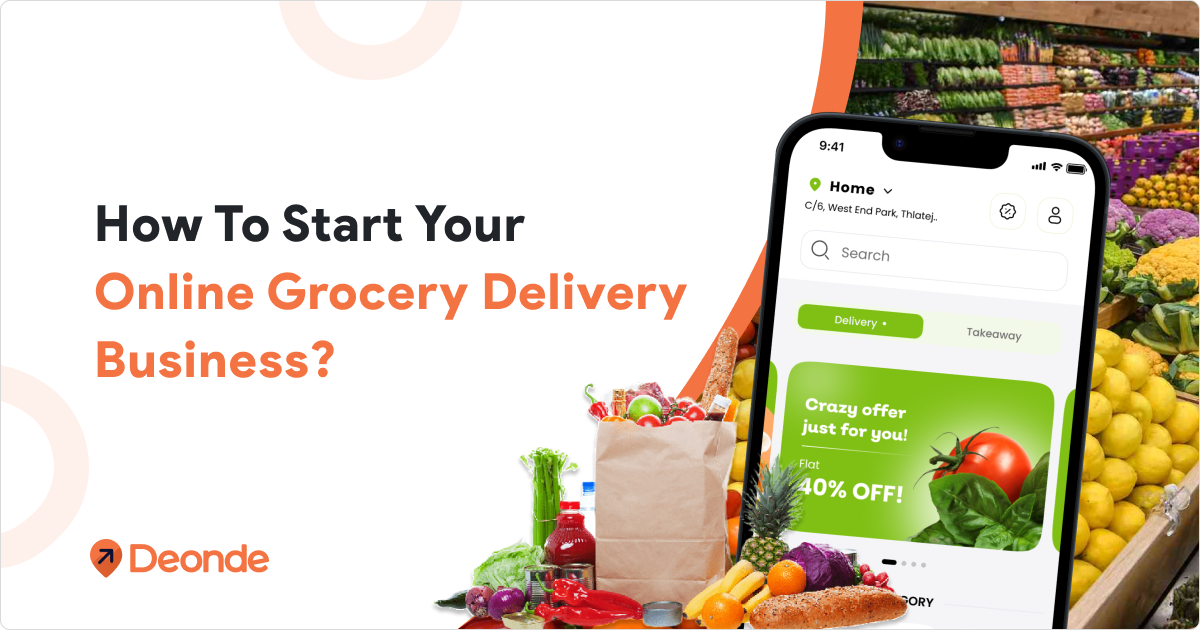
Online grocery delivery apps have transformed shopping, delivering essentials like milk and vegetables in as little as 10-30 minutes. This guide reveals how these platforms operate and provides a roadmap to build your own competitive app.
Perfect for entrepreneurs, developers, and business leaders, we’ll explore key features like smart inventory and fast delivery networks. You’ll learn the technology and strategies needed to create a grocery app that stands out.
Quick commerce powers these apps, using hyperlocal dark stores for rapid order fulfillment. Their intuitive interfaces and real-time tracking create seamless, convenient shopping experiences.
From cloud-based systems to GPS-driven logistics, the tech infrastructure ensures scalability and efficiency. We’ll detail the tools and frameworks to replicate this success.
With careful market research and strategic launches, you can build a platform that thrives in your community. Start small, scale smart, and prioritize customer satisfaction.
Understanding the Online Grocery Delivery Business Model
The rise of quick commerce in grocery delivery
Online grocery delivery apps have transformed the market by offering ultra-fast deliveries, often within 10-30 minutes, creating the quick commerce category. These platforms rely on strategically located micro-warehouses, or dark stores, placed within a 2-5 km radius of customers to enable rapid order fulfillment that traditional retailers struggle to match.
Target audience and customer demographics
These apps primarily target urban consumers, particularly millennials and Gen Z aged 25-40, who prioritize convenience over cost. Tech-savvy users in metro cities with above-average incomes prefer paying premium prices for time-saving services, opting for apps over physical store visits.
Revenue streams and monetization strategies
Successful online grocery delivery apps generate revenue through multiple channels, including:
- Product markups
- Delivery fees
- Subscription models
- Vendor commissions for promotional placements
Higher pricing compared to traditional stores, along with partner fees for premium visibility, forms the core of their monetization approach.
Competitive advantages over traditional grocery shopping
Online grocery apps excel with hyper-local inventory management and predictive analytics, ensuring over 90% availability of essential items. Unlike brick-and-mortar stores with fixed hours, these platforms often operate 24/7, offering:
- Real-time inventory updates
- Personalized product recommendations
- Seamless payment systems
This creates a frictionless shopping experience that keeps customers returning.
How Does an Online Grocery Delivery App Work? (Step-Wise)
If you are wondering how a grocery delivery app works, here’s the typical step-by-step process:
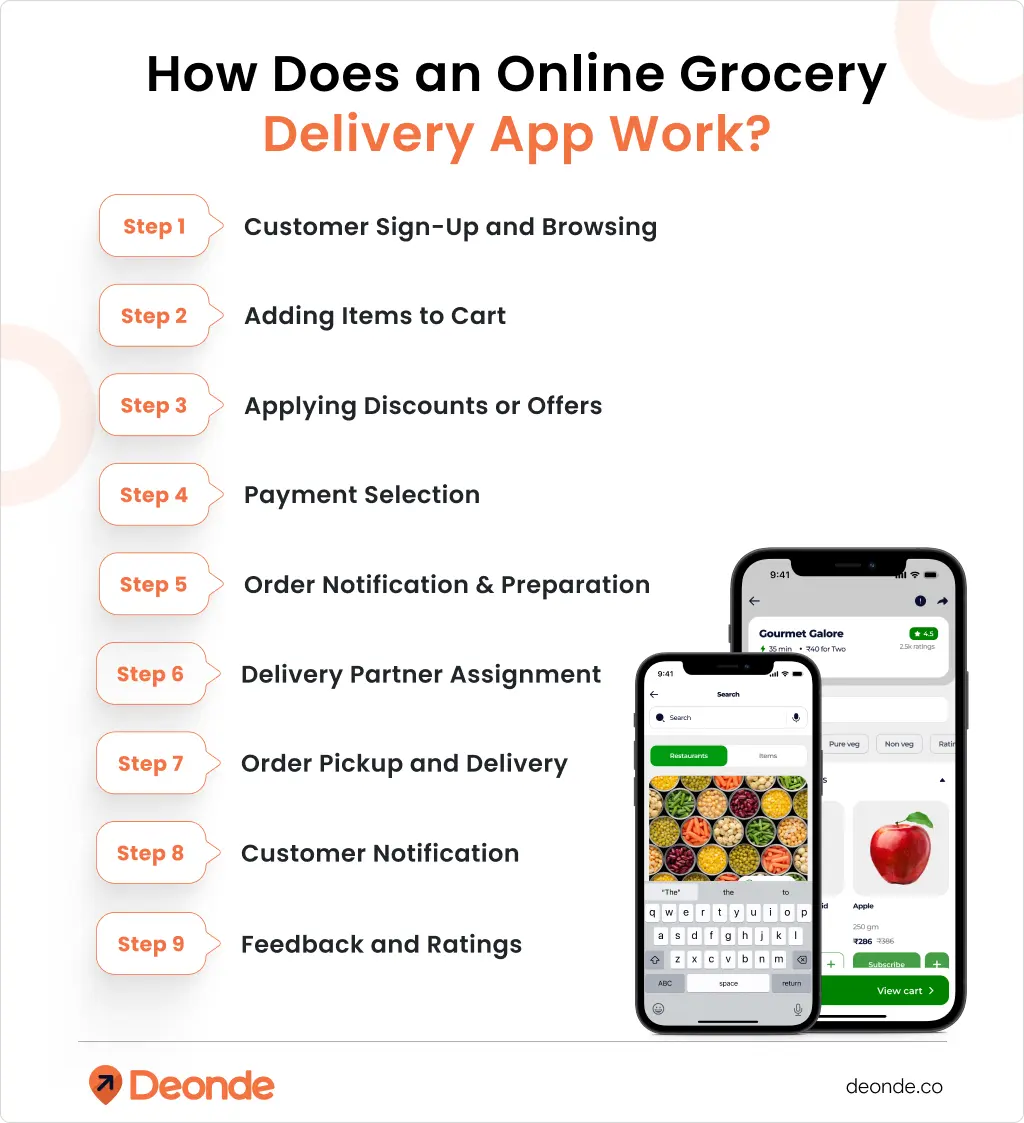
Step 1: Customer Sign-Up and Browsing: Users sign up on the app and browse a wide range of grocery items from nearby dark stores or partnered vendors.
Step 2: Adding Items to Cart: Customers select products, customize quantities, and add them to their cart for ordering.
Step 3: Applying Discounts or Offers: Available coupons, loyalty points, or promotions are applied before checkout to reduce costs.
Step 4: Payment Selection: Users choose from payment options like UPI, credit/debit cards, or cash-on-delivery for a seamless transaction.
Step 5: Order Notification & Preparation: The app notifies the nearest dark store or vendor, who accepts the order and begins preparation. Customers can view real-time updates on preparation through the app’s dashboard.
Step 6: Delivery Partner Assignment: The vendor contacts a nearby delivery partner to pick up the order from the dark store.
Step 7: Order Pickup and Delivery: The delivery partner collects the prepared order and delivers it to the customer’s location.
Step 8: Customer Notification: The app notifies the customer when the order is on its way, providing real-time tracking updates.
Step 9: Feedback and Ratings: After delivery, customers rate the product quality, service, and delivery experience via the app.
Features & Technology of Grocery Delivery Apps

Rapid delivery and fulfillment mechanisms
The hallmark of top grocery delivery apps is their ability to deliver within tight timeframes. By positioning dark stores in high-density urban areas, these apps create hyperlocal networks for instant order fulfillment. Smart algorithms pre-stock high-demand items and optimize delivery routes, while GPS tracking allows customers to monitor orders from the warehouse to the doorstep.
Intuitive mobile app interface and navigation
A user-friendly app is critical for success. Leading apps feature clean interfaces where users can find products within seconds. Key elements include:
- Visual search with product recognition
- Smart filters for quick item selection
- Personalized homepages with frequently bought items
Streamlined navigation ensures minimal clicks from browsing to checkout, with features like saved orders and instant availability updates enhancing the user experience.
Real-time inventory management and availability
Advanced inventory systems update stock levels instantly across all warehouses, preventing orders for unavailable items. Real-time tracking displays accurate product availability and delivery estimates, while predictive algorithms trigger restocking alerts and suggest substitutions to maintain customer satisfaction during stock shortages.
Flexible payment options and seamless checkout
Top apps integrate multiple payment methods, including:
- UPI and digital wallets
- Credit/debit cards
- Cash-on-delivery
Checkout processes are optimized with saved payment details and one-click ordering for repeat purchases. Secure gateways and subscription options enhance convenience and trust.
Technology Infrastructure Behind the Scenes
- Scalable cloud-based architecture to handle peak demand.
- GPS tracking & route optimization with machine learning for traffic and rider proximity.
- Automated inventory & replenishment through demand forecasting.
- Real-time order processing & dispatch for efficiency and load balancing.
- Data analytics for personalization to refine pricing, promotions, and customer experiences.
Logistics and Supply Chain Operations
- Dark store networks and location strategy: 2-5 km coverage for rapid delivery.
- Warehouse management: Zone picking, temperature-controlled storage, automated expiry tracking.
- Delivery partner network: Gig riders, GPS-based route assignments, fleet optimization.
- Quality control and freshness protocols: Cold chain management, FIFO rotation, and customer feedback loops.
Steps to Build Your Own Grocery Delivery App
Market research and competitor analysis
Analyze your local grocery market to identify customer pain points and gaps in service. Study competitors to understand their:
- Pricing models
- Delivery zones
- Product offerings
Defining your value proposition and target market
Target underserved segments, such as:
- Busy professionals
- Elderly customers
- Niche dietary needs
Your value proposition could focus on 24/7 delivery, competitive pricing, or curated selections. Validate your concept with potential users before development.
Choosing the technology stack and development approach
- Native apps for performance or cross-platform (React Native/Flutter) for speed.
- Backend with Node.js or Python.
- SQL for transactions, NoSQL for product catalogs.
- Cloud platforms like AWS or Google Cloud for scalability.
Technical development requirements
- Frontend development: Customer app (browsing, payments, tracking) + Delivery app (routes, orders).
- Backend infrastructure: Scalable databases for speed and accuracy.
- Third-party integrations: Payment gateways, Google Maps, SMS/push notifications.
- Security & data protection: SSL, JWT, PCI DSS compliance, 2FA, GDPR compliance.
Or Avoid These Steps to Launch Faster with Deonde.
Get a ready-to-use grocery storefront (web + iOS + Android) plus a rider app on a monthly subscription no heavy upfront cost.
Launch Strategy and Growth Tactics
- Pilot testing: Launch in 2-3 urban neighbourhoods with tech-savvy early adopters.
- Partnerships with suppliers: Build strong ties with local stores and distributors.
- Customer acquisition & retention:
- Introductory offers
- Referral programs
- Consistent delivery times and quality products
- Introductory offers
- Scaling & expansion: Optimize warehouse placement, expand to nearby zones, and consider partnerships or acquisitions.
Conclusion
Successful online grocery delivery apps combine rapid delivery, robust technology, and efficient supply chains to make shopping effortless. They excel with intuitive interfaces, real-time tracking, and reliable logistics that keep customers returning.
Building your own app requires understanding your local market, selecting the right tech stack, and planning logistics carefully. Start small, focus on a specific region, and scale methodically while prioritizing customer satisfaction. With strategic execution, you can create a grocery delivery platform that thrives in your community.