
Building a food delivery app like Mr D means creating a multi-vendor marketplace that connects customers, restaurants, and delivery drivers on a single platform.
The process involves choosing the right development approach, planning essential features, integrating local payment gateways, and understanding the South African market landscape.
Mr D has over 11,000 restaurant partners and delivers to more than 2,600 areas across South Africa with an average delivery time of 60 minutes. It is the benchmark for on demand delivery in Africa.
South Africa’s food delivery market has grown fast. Mr D alone serves over 700 000 monthly active users across the country. With Uber Eats and Bolt Food also competing for market share, the opportunity for new entrants is clear.
But building an app like Mr D sounds like a project reserved for big budgets and giant tech teams. Most entrepreneurs assume they need hundreds of thousands of dollars and a year of development.
The truth is different. You do not need to build from scratch to launch a competitive Mr D alternative. This guide breaks down exactly how to do it with real costs, essential features, and a faster route to market.
What Is Mr D? (The Success Story Behind South Africa’s Favorite App)
Mr D is a food delivery marketplace that connects users with local restaurants and stores. Customers browse menus, place orders, and get food delivered to their door. The app handles payments, tracking, and driver allocation behind the scenes.
Mr D started as Mr Delivery in 1992, a paper based phone ordering service with printed menus stuck to fridge doors. In 2014, Takealot acquired the business and transformed it into a digital first platform.
Mr D operates on a commission based aggregator model. It charges restaurants 15% to 30% per order in exchange for customer access, delivery logistics, and marketing visibility. This fee structure is standard across global food delivery platforms.
Why does Mr D work so well? Three reasons.
- Convenience: customers get everything from KFC to groceries in one tap.
- Speed: the 60 minute promise sets clear expectations.
- Brand recognition: Mr D is a trusted household name in South Africa.
For anyone looking to build an app like Mr D, the lesson is clear. You need a platform that works for your specific market, not a copy of a global app.
Key Features for a Mr D–Style Food Delivery App in South Africa
When you build an app like Mr D, certain features are non-negotiable. Here is what you need across each part of the platform.
For Customers:
The customer app is where every order starts. It must be fast, intuitive, and friction free.
- Easy registration using phone number or email
- Smart search with filters for cuisine and price
- A simple checkout flow
- Real time order tracking with gps
- Multiple payment options including cash on delivery
- Ratings and reviews for restaurants
- Loyalty points and subscription plans
For Restaurant Partners:
Restaurant partners need a simple dashboard to manage orders without switching screens.
- Order dashboard showing all incoming orders
- Menu management tools
- Order notifications with accept or decline options
- Preparation time updates sent to customers
- Payout tracking
- Daily and monthly earnings tracking
For Delivery Drivers:
Drivers are the backbone of your delivery network. Their app must be reliable and easy to use.
- Receive delivery requests with distance and earnings shown upfront
- Turn by turn navigation to restaurant and customer locations
- Order status updates (picked up, on route, delivered)
- Earnings history
- Availability toggle to go online or offline anytime
For The Admin:
The admin panel is your command centre. It gives you full control over every part of the platform.
- User management
- Restaurant onboarding
- Commission settings
- Promo code system for marketing campaigns
- Complete analytics on sales, orders, and customer behaviour
- Payment gateway management
- Driver performance tracking with SLA monitoring
Technical Requirements: Tech Stack for Mr D Clone
Building a food delivery app that performs well across Africa means choosing the right components from the start. Here is the recommended tech stack.
| Component | Recommended Options |
| Mobile App | React Native or Flutter (cross-platform) |
| Backend | Node.js, Python Django, or Laravel |
| Database | MongoDB or PostgreSQL |
| Cloud Storage | AWS S3 or Google Cloud |
| Maps / Tracking | Google Maps API |
| Payment Gateways | 30+ options (credit card, EFT, cash) |
| Hosting | AWS, Google Cloud, or DigitalOcean |
| Push Notifications | Firebase Cloud Messaging |
This tech stack is built for the South African market. React Native and Flutter let you launch on both iOS and Android with a single codebase, cutting development time nearly in half. Node.js and PostgreSQL handle high order volumes during peak meal times without slowing down.
The stack supports payment methods that African customers actually use: credit cards, instant EFT, and cash on delivery. You can connect 30+ payment gateways out of the box.
It is also optimized for areas with slower or unstable internet connections. The apps cache menus and work offline where possible, so customers in lower connectivity zones can still browse and place orders.
How Much Does It Cost to Build an App Like Mr D?
The cost depends on your approach. Building from scratch takes more time and money. A white label solution gets you to live faster for a fraction of the price. Here is what each path looks like.
Custom Development Cost Breakdown
| Stage | Custom Development Cost | Time |
| Planning + Design | R30,000 – R50,000 | 2-3 weeks |
| Frontend Development | R100,000 – R150,000 | 2-3 months |
| Backend Development | R120,000 – R200,000 | 2-3 months |
| Testing + QA | R20,000 – R40,000 | 2-3 weeks |
| Deployment | R10,000 – R20,000 | 1 week |
| TOTAL | R300,000 – R460,000 | 5-7 months |
Ongoing Monthly Costs
Custom development does not end at launch. You still pay for hosting and maintenance every month.
- Server hosting: R3,000 – R8,000 per month
- Maintenance and updates: R8,000 – R15,000 per month
- Payment gateway fees: 2% to 3% per transaction
Custom vs White Label Comparison
| Factor | Custom Development | White Label (Deonde) |
| Cost | R300,000+ | R632 per month (~$39) |
| Time | 5-7 months | 1 week |
| Commission | 0% | 0% |
| Maintenance | R8,000+ per month | Included |
Custom development gives you full control but costs R300,000 or more and takes up to 7 months.
A white label platform like Deonde costs roughly R632 per month, goes live in weeks, and charges zero commission on orders. Maintenance is included, so you do not need a technical team.
90% of restaurants and startups choose white labels for a faster launch.
Step by Step Process: How to Build Your Mr D Clone
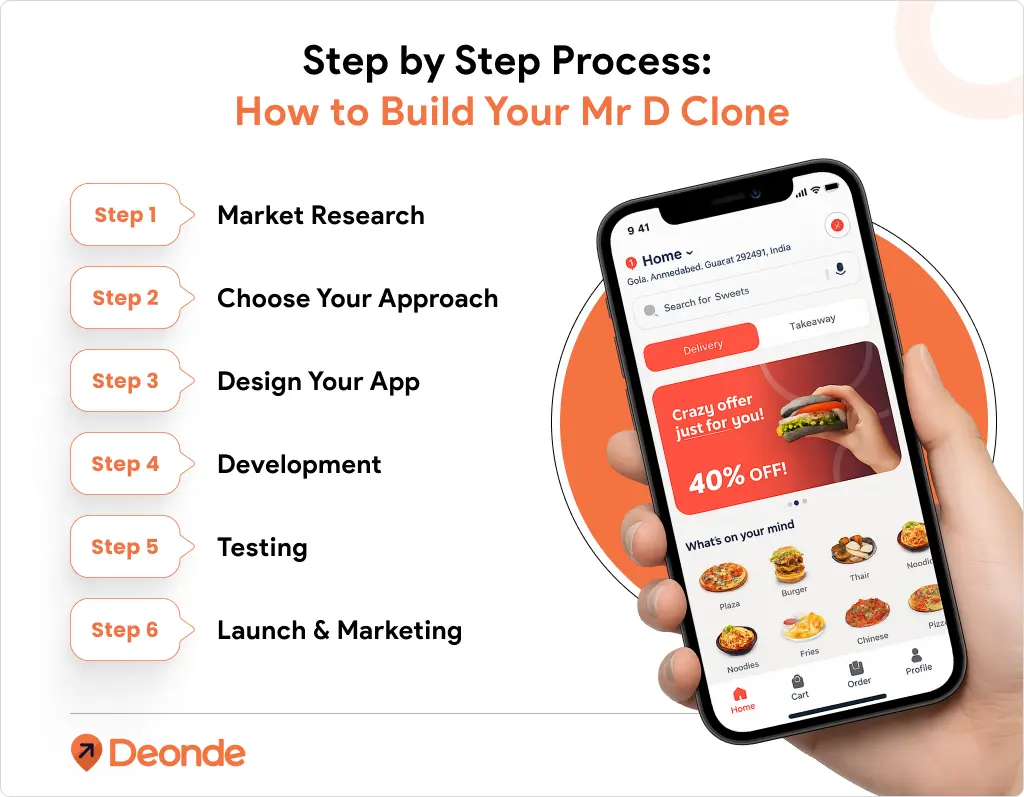
Step 1: Market Research (1 to 2 weeks)
Analyze competitors like Mr D, Uber Eats, and local delivery apps operating in your target cities. Identify your niche: food only, groceries, or a multi vendor marketplace. Define which suburbs you will serve first. Talk to 10 to 20 restaurant owners about their real pain points and what they need from a delivery platform.
Step 2: Choose Your Approach (Critical Decision)
You have two paths.
- Option A is custom development, which costs R300,000 or more and takes around 6 months.
- Option B is a white label solution starting at roughly R632 per month with a 2 to 4 week launch timeline.
Most startups go with a white label platform to test the market first before investing in a full custom build.
Step 3: Design Your App (2 to 3 weeks)
Start with simple wireframes that map the user journey. Design the UI around your branding, logo, and colours. Keep it mobile first because most customers in Africa order from their phones. Test the prototype with 5 to 10 potential customers and refine based on their feedback.
Step 4: Development (1 week for White Label)
Set up all four apps: customer app, restaurant app, driver app, and admin panel. Integrate payment gateways including credit card, instant EFT, and cash on delivery. Add real time tracking with Google Maps. With a white label platform like Deonde, this is already built. You just customize the branding and go live.
Step 5: Testing (2 to 3 weeks)
Test on multiple Android devices including Samsung and Huawei. Verify every payment method works correctly. Run a load test with 100 or more orders at the same time to check performance. Fix all bugs before you launch.
Step 6: Launch and Marketing
Publish your apps on Google Play Store and Apple App Store. Onboard your first 20 to 50 restaurant partners. Run launch promotions like free delivery or discounts. Use social media and local marketing to spread the word. Collect customer feedback from day one and iterate fast.
Why Choose White Label Instead of Building From Scratch?
Building a food delivery app from zero sounds appealing until you face the reality of timelines, budgets, and technical headaches. Here is why most founders pick a white label route.
Cost is the biggest factor. Custom development runs R300,000 or more before you take a single order. A white label platform costs roughly R632 per month with no upfront payment. That leaves you with capital to spend on restaurants, marketing, and growth instead of engineering.
Time to market matters. Custom takes 5 to 7 months. White label goes live in 2 to 4 weeks. In a fast moving market like South Africa, that head start can be the difference between owning a city and playing catch up.
You do not need a technical team. White label platforms handle hosting, updates, server maintenance, and security. You focus on signing restaurants and acquiring customers, not debugging code at midnight.
Zero commission on orders. Both custom and white labels give you 100% of your order revenue. But white label achieves this without the months of backend development needed to build a commission free system from scratch.
Updates are included. Payment gateways change. Operating system updates break apps. New features become expected. With white label, the platform provider handles all of this as part of your subscription. You never pay extra for a new feature or a security patch.
The platform is already tested. White label solutions power hundreds of live businesses processing millions of orders. The bugs are already fixed. The edge cases are already handled. You inherit a production ready system on day one.
You can always go custom later. Start with white label to validate your market and build revenue. Once you have traction, you can invest in custom features without the pressure of building everything from nothing.
Common Mistakes to Avoid When Building a Food Delivery App
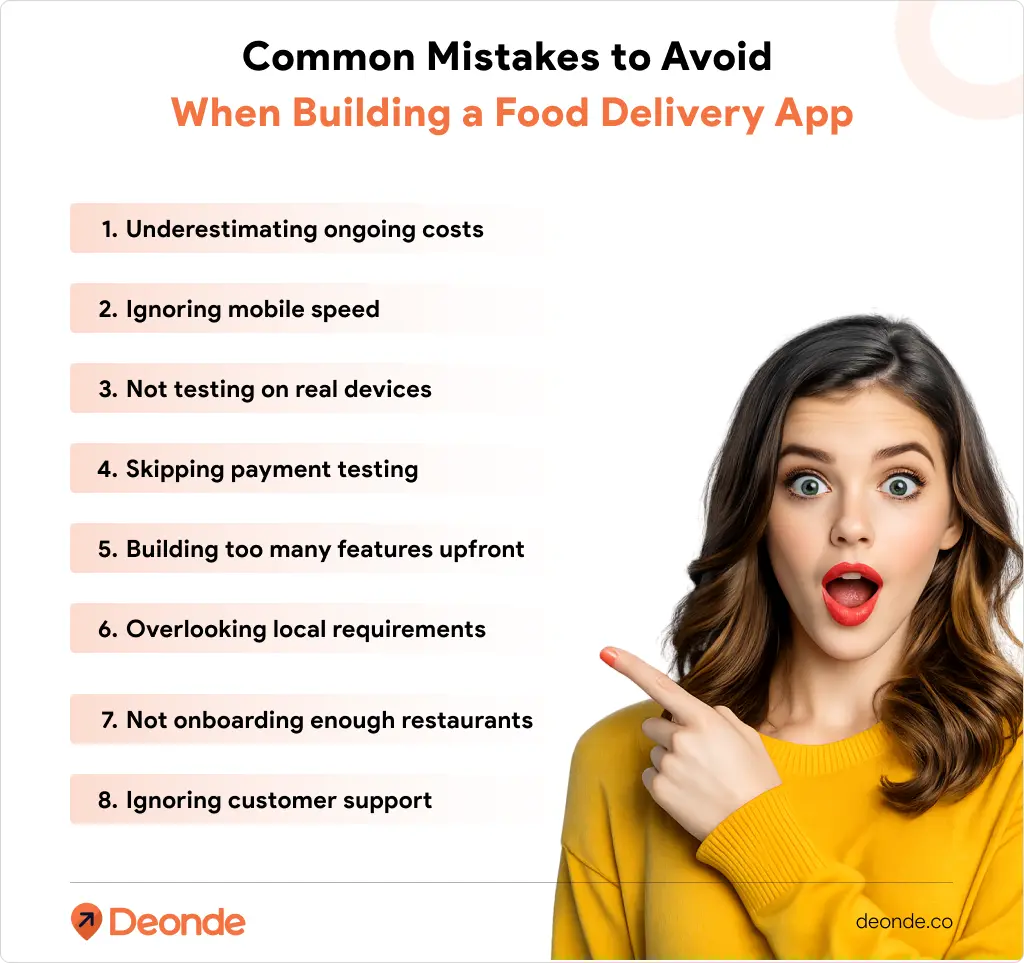
Underestimating ongoing costs
Many founders calculate only the build cost and forget the monthly burn. Servers, maintenance, payment gateway fees, and customer support staff add R15,000 to R25,000 per month. If your revenue does not cover that from month one, you bleed cash fast.
Ignoring mobile speed
A slow app kills orders. South African users browse on data plans and switch off if a page takes more than 3 seconds to load. Test your app on 3G networks, not just office WiFi. Compress images, minimise API calls, and cache menu data locally.
Not testing on real devices
Android fragmentation is real in Africa. A Samsung Galaxy A03 performs nothing like a Huawei P40 or a Tecno Spark. Test your app on at least 10 different phone models available in your target market before launch.
Skipping payment testing
Failed payments are the fastest way to lose a customer. Test every payment method you offer: credit card, instant EFT, cash on delivery, and any local mobile money option. Run test orders end to end across all gateways. One failed transaction at checkout can cost you that customer forever.
Building too many features upfront
You do not need AI recommendations, a loyalty programme, and subscription plans on day one. Launch with the core flow: browse, order, pay, track, deliver. Add features based on what real customers ask for, not what you guess they want.
Overlooking local requirements
Cash on delivery is not optional in South Africa. A significant portion of Mr D’s orders still use cash. If you launch cards only, you exclude a big chunk of your market. Support cash, EFT, and cards from day one.
Not onboarding enough restaurants
A food delivery app with 5 restaurants looks empty. Customers open it, see no variety, and uninstall. Recruit at least 20 to 30 restaurants before your launch date. Focus on popular local brands and diverse cuisines so every customer finds something they want.
Ignoring customer support
Orders go wrong. Drivers get lost. Payments fail. If nobody answers the phone or replies to emails, restaurants stop trusting your platform and customers leave reviews that sink your rating. Have a support person available during operating hours from day one.
Conclusion
Building a food delivery app that competes with Mr D seems like a massive undertaking. Most founders get stuck on cost, complexity, and the fear of building something that will not work.
The truth is simpler. You do not need R400,000 and a year of development to launch a competitive platform. The technology already exists. Restaurants are already looking for better commission terms. Customers are already ordering food online every night. The only missing piece is someone who acts.
You might worry about technical skills. You do not need them. White label platforms handle the servers, the apps, the payments, and the updates. Your job is to sign restaurants, run marketing, and deliver a great customer experience.
Launch in weeks instead of months. Spend R632 per month instead of R300,000 upfront. Keep 100% of every order. And build a business that serves your community while the big players take their 30% cut.
Deonde gives you everything you need to launch your own Mr D alternative with zero commission and zero technical work. The market is ready. The platform is ready. Start today while the opportunity is still open.

Frequently Asked Questions
Q: How much does it cost to build an app like Mr D?
A: Custom development costs R300,000-R460,000 and takes 5-7 months. White-label solutions like Deonde start at $25/month (R632) and launch in 2-4 weeks.
Q: Can I build a food delivery app without coding?
A: Yes. White-label platforms like Deonde give you a ready-made app with custom branding — no coding needed.
Q: How long does it take to build an Mr D clone app?
A: Custom development: 5-7 months. White-label (Deonde): 2-4 weeks.
Q: What features do I need in a food delivery app?
A: Customer app (search, menu, cart, payment, tracking), restaurant app (order management), driver app (delivery tracking), and admin panel (analytics, management).
Q: Do I need to pay commission on food delivery orders?
A: Not if you use commission-free platforms like Deonde. You own 100% of your revenue and pay only a fixed monthly fee.
Q: Can I customize the app with my own branding?
A: Yes, Deonde is fully white-label — your domain, logo, colors, and brand everywhere.
Q: What payment methods should I support in South Africa?
A: Credit card, debit card, EFT, and cash on delivery are essential.