Independent restaurants feel this hardest because margins already hover around 3% to 6%. You are paying 15% to 35% per order just to talk to customers who already know your food. There is a better route.
Modern diners value convenience, speed, and control. They want to browse menus, place orders, and make payments without waiting on calls or third-party apps. A Food Website delivers all three by allowing customers to order directly from your restaurant without friction or unnecessary steps.
When built correctly, an online ordering website improves customer satisfaction while streamlining restaurant operations. It also strengthens trust by offering a consistent and branded experience from menu browsing to checkout.
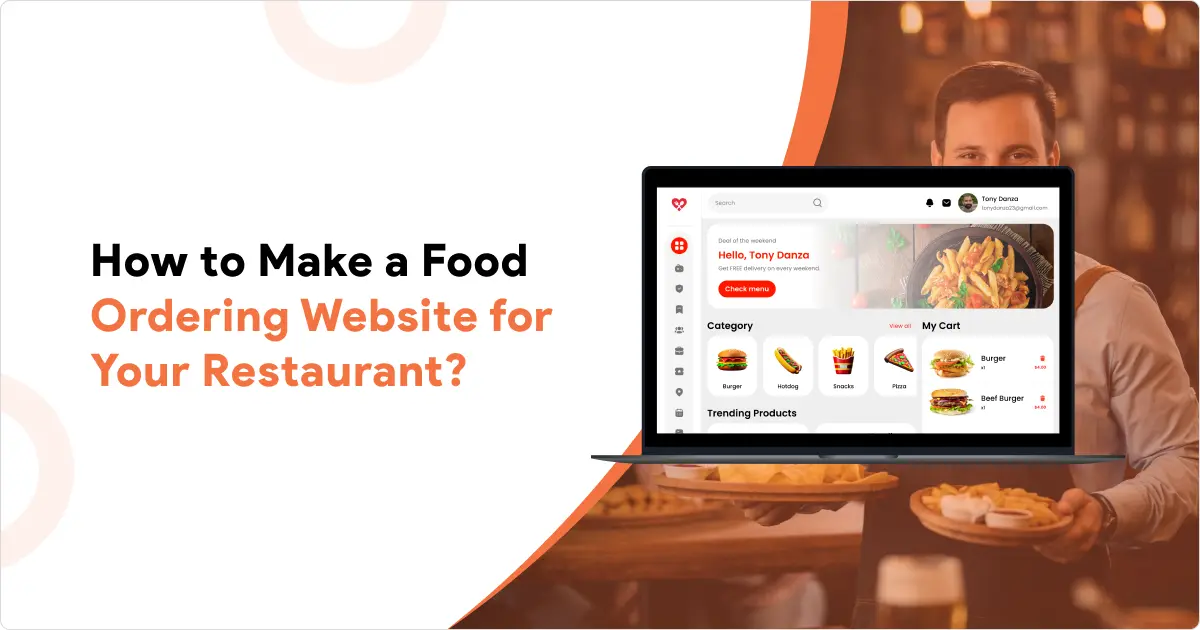
An online ordering system for restaurants that you control gives you back your margins, your data, and your brand. A dedicated food ordering website for restaurant operations is the single best investment you can make this year. Here is exactly how to build one.
With a food order website, restaurants can manage delivery orders, takeaway orders, self-pick-up orders, and dine-in orders through a unified system. This reduces manual errors, improves order flow, and simplifies daily operations.
Owning your online ordering channel improves visibility, credibility, and profitability. It also ensures your restaurant remains competitive in a search-driven marketplace
In this step-by-step guide, you will learn how to create a Food Ordering Website that addresses the modern customer expectations and business goals.
The 30% Problem — What Delivery Apps Are Really Costing You
Every time a customer orders through a third-party app, the payout math hurts. A $20 ticket breaks down like this:
| Line Item | Amount |
|---|---|
| Menu total | $20.00 |
| Commission (25%) | -$5.00 |
| Processing fee (3%) | -$0.60 |
| Marketing fee (varies) | $0-$2.00 |
| You receive | $12.40-$14.40 |
You keep 62% to 72% of your own sale. On a $12 lunch special, you walk away with roughly $7.50. Multiply that across 300 monthly delivery orders and you are losing thousands in fees that should stay in your pocket.
Independent restaurants bear the worst of it because they lack the volume to negotiate lower rates. Research on third-party commission costs shows independents pay 2-3 percentage points more than chains on average.
A commission free restaurant ordering system flips this dynamic completely — instead of per-order percentages, you pay a flat monthly fee and keep every dollar from every order.
The real insult? You pay these fees to take orders from customers who already eat at your restaurant. These are your regulars. You are paying a middleman to hand you a call you could have taken yourself.
What a Commission-Free Restaurant Ordering System Actually Does
A commission free restaurant ordering system lets customers place orders directly through your own website. No middleman takes a cut. The customer visits your site, browses your menu, places an order for pickup or delivery, and pays online — all inside your brand experience.
Instead of paying 25% per order, you pay a flat monthly fee. That fee covers the software, payment processing at standard card rates, and basic support. Every dollar above that fee stays in your pocket.
Unlike the major apps, commission-free online ordering through your own site means the customer belongs to you, not to a platform. Data on how a restaurant ordering system boosts sales confirms that direct ordering increases average check sizes by 20-30% because there are no commission limits on what you can offer.
A real direct online ordering for independent restaurants setup means you own the customer relationship, the email address, and the order history. The app never touches your customer.
Decide the Right Type of Food Ordering Website
Not every restaurant requires the same type of online ordering setup. The right choice depends on how customers place orders and how your team prepares and delivers food.
Below are the most common types of restaurant ordering websites:
Pickup-Only Ordering Website
A pickup-only website allows customers to place orders online and collect them directly from the restaurant.
Best suited for:
- Cafés and bakeries
- Quick-service restaurants
- Takeaway-focused food businesses
Key benefits:
- No delivery logistics
- Faster order turnaround
- Lower operational costs
Delivery and Self-Pickup Ordering Website
This model provides customers the option to choose between home delivery and to self-pickup at the time of checkout.
Best suited for:
- Full-service restaurants
- Local delivery-based businesses
- Restaurants reducing dependency on third-party apps
Key benefits:
- Wider customer reach
- Increased order volume
- Centralized order management
Multi-Location Restaurant Website (Franchise)
A multi-location website supports restaurants operating in multiple areas or cities under one brand.
Best suited for:
- Restaurant chains and franchises
- Growing food brands
Key benefits:
- Location-based menus and pricing
- Central brand control
- Outlet-level order management
Cloud Kitchen / Virtual Brand Website
A cloud kitchen website is designed exclusively for online orders without dine-in facilities.
Best suited for:
- Delivery-first food businesses
- Virtual restaurant brands
Key benefits:
- Lower overhead costs
- Faster scalability
- Optimized for high online order volume
The Hybrid Strategy — Keep Apps for Discovery, Your Site for Profit
You do not need to delete your DoorDash account today. That would hurt your revenue. The smart play is a hybrid strategy.
Use third-party apps for one thing only: discovery. New customers who search “pizza near me” and find you on DoorDash are potential regulars. The problem is keeping them on apps forever.
Here is the strategy: Every order that comes through an app gets a menu insert or sticker on the bag that says “Order direct next time and save 10% — yourwebsite.com.” You turn a discovery channel into an acquisition funnel.
Your restaurant online ordering website becomes the retention engine. You capture emails. You build a loyalty program. You send a text when a customer has not ordered in three weeks. Apps cannot do any of this — they actively prevent it.
The math works like this: If 30% of your app orders move to your own site in six months — a realistic pace for restaurants that migrate from DoorDash using a structured plan — you save thousands in commissions while keeping the same total order volume. You do not escape doordash and ubereats commissions with own website by abandoning apps overnight. You do it by systematically moving customers one by one.
How to Make a Food Ordering Website for Your Restaurant
Now, how to make a food ordering website for your restaurant comes down to two paths.
Option 1: Use a dedicated online ordering system for restaurants platform that provides a white-label website with ordering built in. This is the fastest route — typically 3 to 7 days to launch.
You get a restaurant website with online ordering, payment processing, and a dashboard to manage orders. To build a restaurant ordering website this way, choose a provider that understands independent restaurant margins.
Option 2: Create a website for a restaurant using general tools like Ressto, WordPress or Wix and add a separate ordering plugin. This takes 2 to 6 weeks, requires more technical setup, and often includes per-transaction fees that cut into your savings.
Most independent owners choose Option 1 because the math is cleaner. Here is what to look for in a provider, keeping restaurant website builder features like menu management and QR code ordering in mind:
- Flat monthly pricing — No percentage fees. You want a commission free restaurant ordering system, not a smaller commission.
- White-label branding — Your food ordering system should show your logo, your colors, your domain.
- POS integration — Orders should flow directly to your existing screen or printer.
- Mobile-friendly checkout — Over 60% of online food ordering happens on phones.
| Feature | Dedicated Platform | Website Builder + Plugin |
|---|---|---|
| Setup time | 3-7 days | 2-6 weeks |
| Monthly cost | $50-$150 flat | $20-$40 + transaction fees |
| Per-transaction fees | None | 2%-5% |
| Customer data ownership | Yes | Varies |
If you want to how to set up online ordering for a small restaurant quickly, platforms like Deonde — read about what is Deonde — eliminate the technical complexity entirely. Your takeout website becomes a full revenue channel with no hidden costs.
Website builders for restaurants like Deonde, Ressto, Wix and Squarespace work, but they require additional ordering plugins and lack restaurant-specific features.
If your goal is to eventually start your online food delivery business under your own brand, a dedicated platform reduces launch time from weeks to days.
And if you want to stop paying just eat commission build your own website, this dedicated route is your fastest path to breakeven.
The 30-Day Plan to Move Customers to Your Own Website
Building the site is step one. Moving customers is step two. Here is a week-by-week plan:
Week 1 — Launch and test. Go live with your restaurant website and place five test orders yourself. Check the flow from menu browse to payment confirmation. Fix any friction.
Week 2 — In-restaurant promotion. Add table tents, counter signs, and receipt stickers with your website URL. Train your staff to say “You can order ahead on our site next time” after every phone call.
Week 3 — Email and SMS. If you have customer emails from past orders, send a “We built our own online food ordering site” announcement. Offer 10% off the first direct order.
Week 4 — Bag inserts. Every delivery order through apps gets a flyer: “Next time, order from our restaurant online ordering website and save.” Include a clear URL and a discount code.
Week 5-6 — Loyalty launch. Introduce a digital punch card through your site — “Order 10, get 1 free” — that only works on direct orders.
Week 7-8 — Retarget app customers. Run a small Facebook or Google ad targeting people who visited your app listings, directing them to your site.
Week 9-10 — Review and optimize. Look at your direct online ordering for independent restaurants analytics. Which menu items sell best? Where do customers drop off? Adjust.
Week 11-12 — Scale. Increase ad spend. Document your setup so your team understands how to create a restaurant online ordering website and can manage orders independently.
If you follow this plan, you can shift 20-30% of your app volume to your own site within 90 days.
UK Restaurant Owners — What’s Different
If you are based in the UK, the same core principle applies — but the landscape has specific differences.
Click and collect dominates UK takeaway culture. Building a takeaway website with integrated click-and-collect ordering reduces your reliance on Just Eat, which charges similar commission rates to DoorDash and Uber Eats.
Two UK-specific factors to note:
- Natasha’s Law — You must display full ingredient and allergen information on your online food ordering pages. Your site needs to handle this properly.
- Just Eat switch — Many UK independents are actively looking to stop paying just eat commission build your own website due to rising fees and limited control over customer data.
Current online food delivery trends show UK consumers are open to ordering directly from restaurants when given a clear incentive — typically a discount or loyalty benefit that apps cannot match.
How Much Does a Food Ordering Website Actually Cost?
Here is the honest breakdown of what you will spend:
| Cost Item | Dedicated Platform | DIY Build |
|---|---|---|
| Setup fee | $0-$200 | $100-$500 |
| Monthly software | $50-$150 | $0-$30 |
| Domain + hosting | $15-$30/year | $15-$200/year |
| Payment processing | 2.5%-3.0% | 2.5%-3.0% + plugin fee |
| Annual total (year 1) | $650-$2,200 | $500-$1,500 + trans fees |
The real number that matters is savings. If you do $8,000/month in delivery orders at 25% commission, you are paying $24,000 a year to apps. A food ordering website for restaurant owners that costs $1,200 a year saves you $22,800.
Your restaurant online ordering website pays for itself in the first month of redirected orders. That is the single strongest argument for making the switch today.
Your online ordering system for restaurants should be evaluated on total cost of ownership, not just the monthly fee. Factor in the commission savings, the customer data value, and the freedom to run your own promotions.
Final Thoughts: Take Control of Your Orders Today
The math is simple. Delivery apps take 25% of every order. A food ordering website for restaurant owners costs a flat monthly fee. The difference between those two numbers is your profit — and your independence.
You do not need to fire DoorDash tomorrow. But you do need to start building your direct online ordering for independent restaurants channel today. Pick a platform, launch your site, and start moving customers one order at a time. Your margins will thank you.
Building a website for a restaurant is no longer optional for restaurants that want to be competitive. It gives you control over your brand, customer experience, and revenue while reducing dependency on third-party platforms.
By getting the right structure of your website right, configuring SEO correctly, creating some great content, making it easy to order and deliver, rewarding your faithful customers, and actively promoting your website, you have a good base for long-term growth.
A well-built food ordering website for a restaurant is not just a digital tool. It becomes a direct connection between your kitchen and your customers—one that supports consistency, trust, and repeat business.

FAQ Section
Q: How much money can I save by switching to my own ordering website?
A: A restaurant doing $8,000/month in delivery orders at 25% commission saves roughly $22,000 per year after platform costs. The exact number depends on your volume and current commission rate.
Q: Do I need technical skills to learn how to create a restaurant online ordering website?
A: No. Modern platforms are template-based with drag-and-drop menus. Most independent owners launch within a week with zero coding.
Q: Will I lose customers from DoorDash if I promote my own site?
A: No. You keep your app listings for discovery while gradually moving repeat customers to your restaurant website. The hybrid strategy protects your revenue during the transition.
Q: What features should my food ordering system include?
A: At minimum: online menu display, payment processing, SMS or email confirmations, and POS integration. Optional but valuable: loyalty programs, QR code ordering, and delivery zone management.
Q: Can I accept both pickup and delivery orders on my own site?
A: Yes. Most platforms support both. You manage pickup orders in-house and either self-deliver or route delivery orders through a third-party courier service on a pay-per-delivery basis.