The food delivery boom taught us one thing: customers want everything delivered. But running separate platforms for food, groceries, and medicine creates operational chaos.
You manage multiple apps, split your driver fleet across categories, and lose the cross-selling opportunities that make delivery businesses profitable.
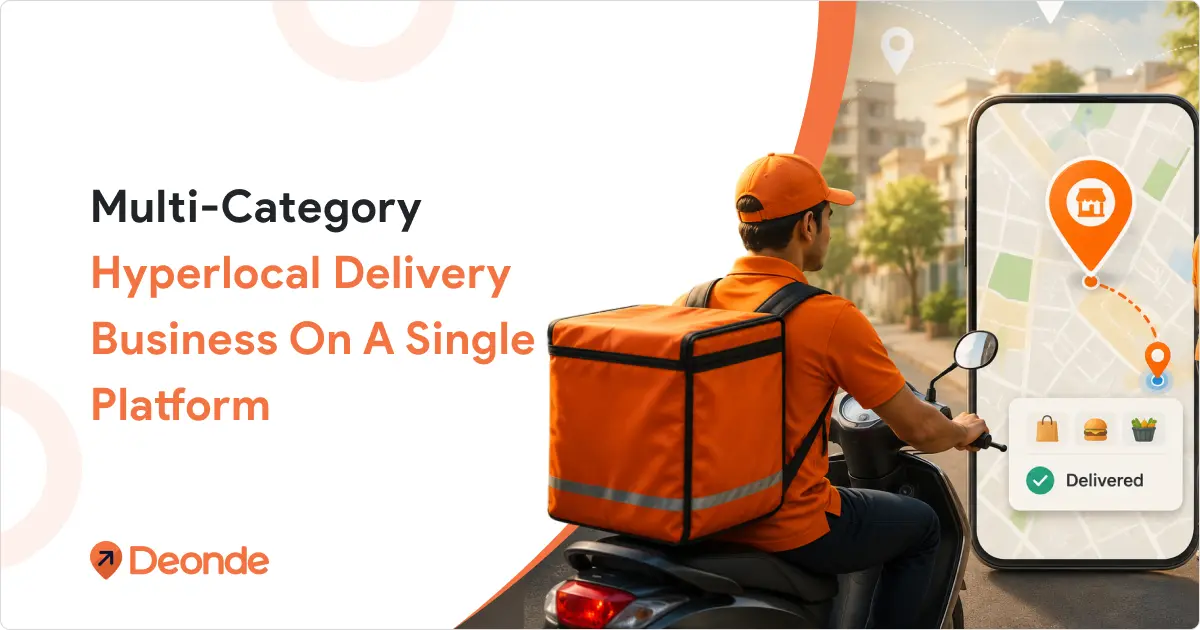
A multi-category hyperlocal delivery platform solves this. One system. One customer app. One driver fleet. Food, grocery, and pharmacy — all under one roof.
This guide covers what multi-category hyperlocal delivery means, why it works, the business models that power it, and exactly what you need to build one.
What Is a Multi-Category Hyperlocal Delivery Platform?
A multi-category hyperlocal delivery platform is a single system that handles ordering and delivery across different product types — restaurant meals, grocery staples, pharmacy prescriptions, and more — within a defined local area. Instead of operating separate apps for food and groceries, you run everything from one dashboard.
The key difference from single-category delivery is operational density. A food-only platform utilizes its drivers only during meal times.
A multi-category platform spreads demand across the day — morning grocery orders, lunch meals, afternoon pharmacy runs, dinner deliveries.
Your drivers stay busy longer, and your revenue per driver goes up.
This model builds on the hyperlocal delivery model where fulfillment happens within a tight geographic radius.
But instead of limiting yourself to one category, you capture every local delivery need your customers have.
Why Combine Food, Grocery & Pharmacy Under One Platform?
Running a single-category delivery business works. But running multiple categories under one platform works better. Here is why.
Higher Customer Lifetime Value
Customers who use a platform for both groceries and food ordering spend more and stick around longer.
Data from multi-category operators shows that cross-category users have significantly higher lifetime value than single-category users.
When a customer can order dinner, breakfast supplies, and a prescription refill from the same app, they have fewer reasons to download a competitor.
Better Driver and Fleet Utilization
A food-only delivery fleet sits idle between lunch and dinner rushes. A multi-category fleet stays busy.
Morning grocery orders, midday pharmacy deliveries, afternoon snacks, dinner — the demand curve flattens when you serve multiple categories.
Your drivers earn more, your delivery costs per order drop, and your fleet efficiency improves.
Expanded Revenue Streams
Every category you add opens a new revenue line. Commission from restaurants, markup on grocery items, delivery fees for pharmacy orders.
You are no longer a single-threaded business dependent on one category’s margins.
This super app approach — offering multiple services from one platform — is exactly how platforms like Swiggy and Grab have scaled beyond food into groceries, payments, and more.
Business Models for Multi-Category Delivery
Not all multi-category platforms operate the same way. Your choice of business model determines your margins, your upfront investment, and your operational complexity.
Aggregator Model
You connect existing local businesses — restaurants, grocery stores, pharmacies — to customers through your platform. You do not own inventory. You do not stock products. You take a commission on each order.
Pros: Low upfront cost, fast to launch, scalable across cities Cons: Lower margins per order (15-30%), less control over quality and availability
This aggregator business model is the same approach used by DoorDash, Uber Eats, and HungerStation. It works best when you want to launch quickly and build a marketplace of local merchants.
Inventory-Led / Dark Store Model
You own the inventory. You stock products in micro-fulfillment centers (dark stores) located close to customers. When an order comes in, your pickers pack it from your own stock and your drivers deliver it.
Pros: Higher margins (25-35%), full quality control, faster delivery times Cons: Requires working capital for inventory, higher upfront investment, inventory risk
The dark store model powers quick commerce platforms like Blinkit, Zepto, and Gopuff. It works best when you have capital to invest and want to control the full customer experience.
Hybrid Model
You operate dark stores for high-demand, high-margin categories (groceries, essentials) while aggregating restaurants and specialty stores for categories where variety matters more than speed.
Pros: Best of both models, balanced risk, can start as aggregator and add dark stores later Cons: More complex operations, requires managing both inventory and vendor relationships
| Model | Upfront Cost | Margins | Launch Time | Best For |
| Aggregator | Low | 15-30% | 2-4 weeks | Fast market entry |
| Dark Store | High | 25-35% | 2-3 months | High-margin focus |
| Hybrid | Medium | 20-30% | 4-8 weeks | Balanced approach |
Must-Have Features in a Multi-Category Delivery Platform
Building or buying a multi-category platform means choosing the right feature set. Here is what your platform needs.
Unified Customer App with Cross-Category Cart
Customers should be able to add sushi from one restaurant, milk from a grocery store, and medicine from a pharmacy — all in a single checkout.
A white label multi delivery app gives you this unified experience under your own brand, on both iOS and Android.
Multi-Vendor Management and Split Payments
When an order contains items from three different vendors, each vendor needs their own payout.
Your platform must handle split payments — taking payment from the customer once and distributing it to each vendor, minus your commission. A multi vendor delivery platform manages this automatically through its admin panel.
Real-Time Tracking and Route Optimization
Customers expect to see where their driver is at every step. Your platform needs live GPS tracking with accurate ETAs.
Route optimization becomes more critical when drivers handle multi-stop, multi-category deliveries. The driver app should auto-assign the nearest available driver and suggest the most efficient route.
Geofenced Delivery Zones
Different categories need different delivery radii. Hot food needs a tight 2-3 km zone. Groceries can stretch to 5-7 km. Your platform must let you draw custom delivery zones per category and set different delivery fees, minimum orders, and ETAs for each zone.
Centralized Admin Dashboard
Every category, every vendor, every driver, every order — managed from one place.
The admin dashboard should show real-time order volume across categories, vendor performance metrics, driver utilization rates, and revenue breakdowns by category. Without this unified view, running multiple categories becomes guesswork.
Technology Stack Overview
A multi-category delivery platform requires four core applications working together:
Customer App (iOS & Android): Browse categories, search products, place orders, track deliveries, manage addresses and payment methods.
Vendor Portal: Each restaurant, grocery store, or pharmacy manages their own catalog, pricing, opening hours, and incoming orders independently.
Driver App: Receive order alerts, navigate optimized routes, update delivery status, collect proof of delivery, track earnings.
Admin Dashboard: Manage vendors, drivers, delivery zones, promotions, commission rates, payments, and analytics across all categories.
Payment Gateway: Handle split payments, vendor payouts, customer refunds, and multiple payment methods (cards, wallets, COD) through a single integration.
Challenges to Expect When Running Multi-Category Delivery
Multi-category delivery is powerful, but it comes with real challenges. Knowing them upfront helps you plan better.

Logistics and Routing Complexity
A driver delivering three restaurant meals is straightforward. A driver delivering a meal, two grocery bags, and a pharmacy order to different addresses is not.
Your routing engine must handle multi-stop deliveries across categories, each with different handling requirements (hot food first, cold groceries second, medicine last).
Vendor Onboarding and Retention
Signing up restaurants is hard enough. Adding grocery stores and pharmacies triples the effort. Each category has different onboarding requirements — restaurants need menu setup, pharmacies need prescription handling protocols, grocery stores need inventory sync.
Your onboarding process must be standardized enough to scale yet flexible enough for each category’s needs.
Maintaining Quality Across Categories
A bad experience in one category affects how customers feel about your entire platform. A late pharmacy delivery makes customers question your reliability for food too.
You need category-specific SLAs — different delivery time promises, temperature control requirements, and packaging standards for each vertical.
Unit Economics and Pricing Strategy
Each category has different economics. Restaurants accept 20-30% commission. Grocery margins are thinner at 10-15%. Pharmacy delivery commands premium fees.
Your pricing model must account for these differences while keeping the total checkout experience simple for customers.
How to Choose the Right Approach for Your Market
The right model depends on three factors: your market, your capital, and your goals.
Assess Your Local Market Conditions: If your city already has established restaurants and grocery stores with no direct ordering system, the aggregator model lets you launch fast. If local stores have poor quality or limited selection, the dark store model gives you control.
Match Your Model to Your Resources: Limited capital? Start as an aggregator and transition to hybrid as you grow. Have investment funding? The dark store model delivers higher long-term margins. Your pricing strategy should reflect your model — commission-based for aggregator, markup-based for dark stores.
Regardless of your approach: the core principle stays the same: a multi-category hyperlocal delivery platform outperforms a single-category one on customer retention, driver efficiency, and revenue per user. The operational complexity is real, but the payoff is worth it.
Start Building Your Multi-Category Delivery Platform
Running food, grocery, and pharmacy delivery from one platform is no longer just an ambition — it is the standard that customers expect. A multi-category hyperlocal delivery platform gives you the operational efficiency to compete with single-category giants while offering the convenience that keeps customers coming back.
The technology is available. The demand is proven. The only question is whether you will build a single-category platform and compete in one race — or build a multi-category platform and own the entire local market.
Frequently Asked Questions
Q. What is a multi-category hyperlocal delivery platform?
A: It is a single platform that handles ordering and delivery across multiple product types — food, groceries, pharmacy, and more — within a defined local area. Instead of running separate apps for each category, you manage everything from one dashboard with one driver fleet.
Q. Can one platform handle food, grocery, and pharmacy delivery?
A: Yes. Modern delivery platforms support all categories through a single system. Each category has its own catalog management, pricing rules, and delivery settings, but they share the same customer app, driver fleet, and admin dashboard.
Q. How do multi-category delivery platforms make money?
A: Revenue comes from multiple streams: commission on restaurant orders, retail markup on grocery items, delivery fees on pharmacy orders, subscription plans for frequent users, and advertising or promotional placement fees from vendors.
Q. What features should a multi-category delivery platform have?
A: A unified customer app with cross-category checkout, multi-vendor management with split payments, real-time driver tracking, geofenced delivery zones per category, route optimization for multi-stop deliveries, and a centralized admin dashboard with category-level analytics.