
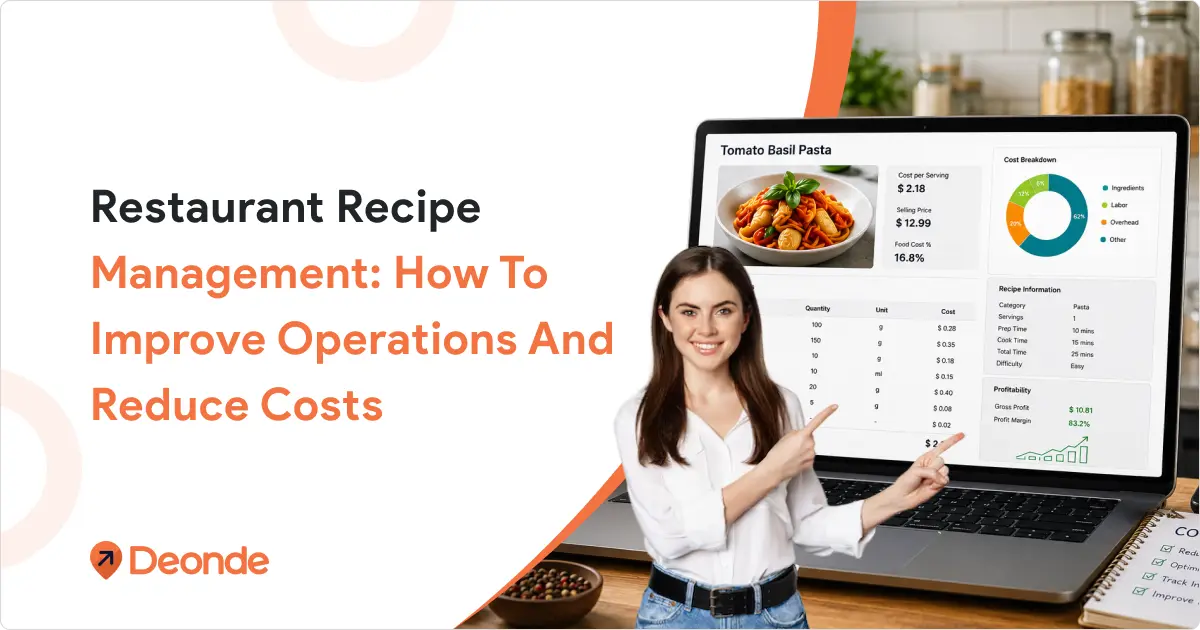
Walk into any restaurant kitchen during a busy Friday night, and you’ll see something that keeps operators up at night: three different cooks preparing the same dish three different ways.
Maybe it’s a pinch of salt here, an extra ounce of protein there — each deviation feels small at the moment. But multiply those tiny differences across hundreds of covers a night, week after week, and you’re looking at margin erosion that quietly destroys profitability.
That’s where restaurant recipe management comes in — the discipline of standardizing every component of every dish so each plate leaving the pass is identical in ingredients, portion size, and cost.
At its core, this practice gives you predictable margins, consistent quality, and far less food waste. And when your digital channels — an online ordering system for restaurants — and your kitchen are aligned on recipe specs, you stop leaking money through inconsistency.
Done right, recipe costing software reveals exactly where every dollar of ingredient spend goes. Food cost reduction in a restaurant starts with knowing what each dish actually costs — not what you think it costs, but what the data says.
Let’s break down exactly how to build a recipe management system that works for real kitchens, not just spreadsheets.
Why Recipe Management Is Really a Margin Problem
Most recipe guides focus on consistency. Consistent dishes, happy customers. That’s table stakes. The real reason to get serious about recipe management is that your food cost percentage doesn’t exist in a vacuum — it changes depending on where that dish gets sold.
The Channel Profit Trap
A pasta dish with a 30% food cost looks fine on paper. But run that same dish through a third-party delivery order at 25% commission plus packaging and marketing fees, and the margin story changes completely:
| Channel | Menu Price | What You Keep | Food Cost (30%) | Net Contribution |
| Dine-in | $35.00 | $35.00 | $10.50 | $24.50 |
| First-party online | $35.00 | $34.00 | $10.50 | $23.50 |
| Third-party delivery | $35.00 | $26.25 | $10.50 | $15.75 |
That’s an $8.75 gap between dine-in and third-party delivery — on the exact same dish, made with the exact same recipe.
Now overlay the typical costing mistakes. According to a 2024 study 61% of restaurant recipes are mis-costed — meaning the actual food cost doesn’t match what the recipe card says.
A half-dollar error on cheese portions might cost $9,000 a year on dine-in. On delivery, with commissions eating into margin, that same error is proportionally more damaging.
The takeaway: You can’t know which dishes actually make you money until you cost them per channel.
Step 1 — Build Recipes That Reflect Real Costs
Most operators think their recipes are accurate. They’re usually not. Here’s where the gaps hide.
Write Down Every Ingredient — Including the “Free” Stuff
The oil, the garnish, the side sauce — these get left off recipe cards because they seem insignificant. A tablespoon of olive oil costs about $0.12. Use it on 200 dishes a day and that’s $8,760 a year unaccounted for.
We’ve seen operators discover they were spending $15,000+ annually on garnishes they thought were “basically free.” Small items compound fast.
Cost by Edible Yield, Not Invoice Weight
You buy a 10-pound box of bell peppers. After trimming and seeding, you get about 7.5 pounds. If your recipe is 10 pounds, you’re understating food cost by 25%.
True cost formula: (Ingredient price) ÷ (Yield percentage)
| Ingredient | Typical Yield % |
| Leafy greens | 70–75% |
| Whole proteins | 65–80% |
| Fresh herbs | 60–75% |
| Whole vegetables | 75–85% |
| Pre-trimmed proteins | 90–95% |
Attach Channel-Specific Costs
This is the step that transforms recipe management from a kitchen tool into a financial control system. A recipe shouldn’t have one cost — it should have a cost stack for each channel:
- Dine-in: Ingredients + plateware + dish labor
- Takeout: Ingredients + packaging + bagging + sauce cups
- First-party online: Ingredients + packaging + payment processing (~3%)
- Third-party delivery: Ingredients + premium packaging + commission (15–30%) + marketing fee + refund reserve
Build these columns into your recipe database. Most food service platforms now support this level of granularity — you just need to set it up. The clarity it gives your pricing decisions is worth the effort.
Step 2 — Lock Portion Control at Every Station
You can build the perfect recipe. If the line isn’t following it, the numbers don’t mean anything.
The $55,000 Mushroom Problem
Pitfire Pizza discovered their kitchen was using about 30% more mushrooms per pizza than their recipe called for.
The culprit? Pre-sliced mushrooms in a bin — staff grabbed handfuls instead of measuring. That one ingredient variance was costing them roughly $55,000 annually, according to a case study from Supy.
The fix wasn’t a lecture. It was switching to pre-portioned packs.
Systems That Make Correct Portions Easy
- Pre-portioned proteins — Buy chicken breast at 6 oz each, not whole birds to trim.
- Color-coded ladles — Red for 2 oz sauce, blue for 4 oz soup, yellow for 1 oz dressing.
- Build cards with photos — Laminated card showing exactly how the finished dish looks.
- Scales on the line — Weigh high-cost ingredients every time. Not in storage. On the line.
- Pre-pan by shift — Prep cooks portion ingredients into individual containers. Line cooks just grab and go.
The goal: make the correct portion the easiest option.
Step 3 — Connect Recipes to Live Ingredient Prices
If your recipe costs are based on prices from three months ago, your numbers are fiction.
The “Cost Once, Never Update” Trap
Commodity prices for beef, poultry, produce, and cooking oil swing 15–30% in a single quarter. A burger you think costs $4.50 might cost $5.80 now. But most operators set recipe costs at menu launch and never touch them.
The main driver is simply not updating prices.
Set a Recosting Rhythm
- Weekly: Top 20–30 sellers — recost these. They drive 70–80% of revenue.
- Monthly: Seasonal items and volatile ingredients (avocados, seafood, tomatoes).
- Quarterly: Full menu recost.
- Trigger: Any supplier price change over 10% — recost affected items immediately.
When your recipe costs are current, your pricing decisions become confident instead of guessed.
Step 4 — Engineer Channel-Specific Menus
Not every dish on your dine-in menu belongs on your delivery menu. Recipe data helps you decide which stays and which goes.
Three Tests for Delivery Fitness
- Travel quality: Does this dish survive 15-20 minutes in a container? Fries go soggy. Salad wilts. Sauces separate. If it doesn’t travel well, it doesn’t belong on delivery.
- Margin test: What’s the effective food cost after commission? If a dish runs 25% on dine-in but 42% on UberEats, it’s a delivery loss leader.
- Speed test: Can the line build and pack this in under 8 minutes during a rush? If not, it slows down the entire operation.
Pricing Per Channel
Customers understand that delivery prices are higher. According to a 2025 survey, 74% of delivery users expect menu prices to be higher on third-party apps. Use that understanding:
- Dine-in: Baseline pricing
- First-party online: +3–5% (covers packaging + processing)
- Third-party delivery: +12–18% (covers commission + fees)
Step 5 — Protect Margins by Owning Your Channel
All the recipe management in the world doesn’t help if you’re giving 25–30% of every delivery order to a platform. This is where margin protection meets channel strategy.
The Same Dish, Three Channels
| Channel | Net Revenue | Food Cost | Other Costs | Net Profit | Margin |
| Dine-in | $35.00 | $10.50 | $0 | $24.50 | 70% |
| First-party online | $34.00 | $10.50 | $2.50 | $21.00 | 62% |
| Third-party delivery | $26.25 | $10.50 | $10.25 | $5.50 | 21% |
Dine-in profit: $24.50. Third-party delivery profit: $5.50. Same recipe. Same portions. The difference is the channel.
What First-Party Ordering Changes
A customer ordering through your own website or app avoids the 15–30% third-party commission entirely. You pay payment processing (~3%) and a platform fee — typically $1–3 per order instead of $7–10.
For a restaurant doing 200 delivery orders a week:
- Third-party: ~$1,750/week in commissions
- First-party: ~$350/week in fees
- Weekly savings: ~$1,400
- Annual savings: ~$72,800
In a 2025 National Restaurant Association survey, operators using branded online ordering reported saving $5–8 per order compared to third-party platforms. Over a year, that changes the financial trajectory of a business.
Real Numbers — Two Operators Who Made the Shift
Operator A — $1.2M casual Italian
- Before: Paper recipes, never recosted, portions eyeballed. Effective delivery food cost: 46%.
- Change: Standardized 28 menu items, added channel-specific cost columns, pre-portioned proteins.
- After: Delivery food cost dropped to 33%. Annual savings: $38,000 on ingredients + $22,000 through portion control.
Operator B — $850K fast-casual bowls
- Before: No recipe standards for sauces and toppings. 60% of orders through third-party.
- Change: Digital build cards with weights, moved top 15 sellers to first-party ordering, raised third-party prices by 15%.
- After: 12% of orders shifted to first-party within 3 months. Margin improved from 58% to 66%.
Practical 30-Day Action Plan
Week 1 — Audit: Pick top 15 selling items. Weigh every ingredient. Compare to recipe cards. Fix discrepancies.
Week 2 — Cost update: Recost those 15 items with current supplier prices. Add the small stuff. Calculate yield-adjusted costs.
Week 3 — Channel costing: Add third-party delivery cost column. Include commission, packaging, marketing fees. Identify low-margin delivery items.
Week 4 — Menu + tools: Order portion tools. Adjust delivery menu — remove items that fail the three tests. Adjust channel pricing.
Common Mistakes in Restaurant Recipe Management (And How to Avoid Them)
Even experienced operators make these errors. Here’s what to watch for.
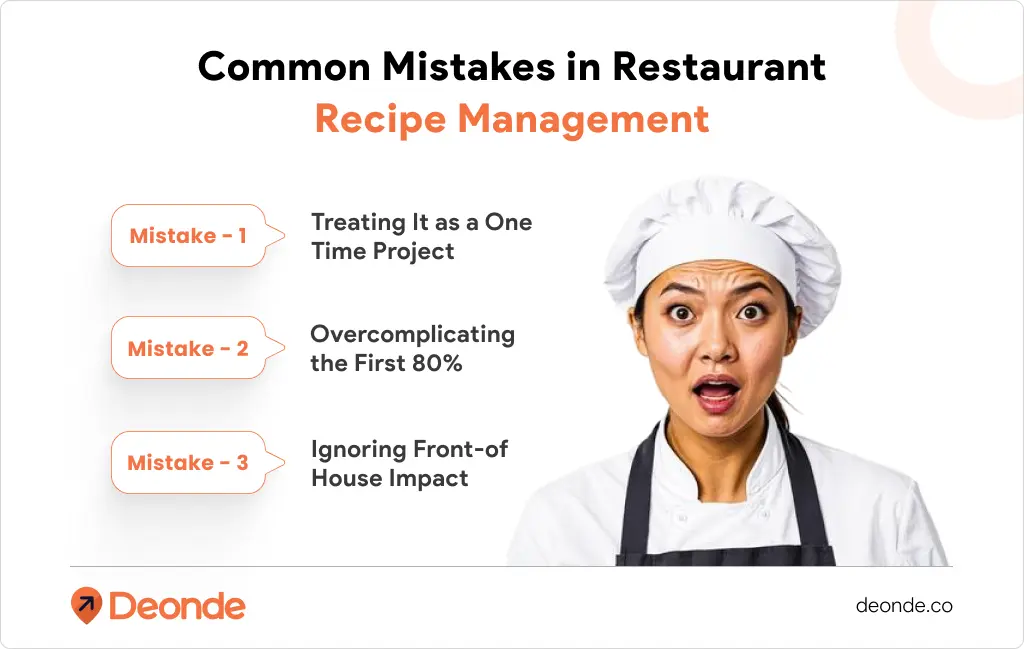
Mistake #1 — Treating It as a One-Time Project
The most common failure mode. A manager spends two weeks building recipe cards, costs every dish, feels great — and six months later the recipes are gathering dust in a binder while the kitchen has drifted back to old habits.
Recipe management is a system, not a project. It needs a weekly cadence: price checks, portion audits, spec refreshers. If nobody owns this process, it will die, and your margins will drift back to wherever they were before.
Mistake #2 — Overcomplicating the First 80%
Some operators try to cost every single ingredient across every single dish before they launch. They get stuck in analysis paralysis and never actually implement anything.
Start with the 20% of dishes that drive 80% of your revenue. Get those right. Then expand. Perfect is the enemy of done in recipe management.
Mistake #3 — Ignoring Front-of-House Impact
Your servers can be your best allies or your biggest leak. If a server doesn’t know what’s in a dish or can’t describe the portion size to a guest, they can’t set expectations. And when expectations aren’t set, guests complain about portion sizes — which leads to comps, remakes, and margin loss.
Train your front-of-house team on the recipe specs too. A server who can accurately describe the 8-ounce ribeye with confidence adds value. A server who says “it’s a decent size” creates ambiguity.
FAQ
Q: What is restaurant recipe management?
A: It’s documenting every ingredient in every dish, calculating true cost (including waste and yield loss), and keeping costs updated as prices change. Done well, it also accounts for channel-specific costs like packaging and platform commissions.
Q: How do recipes cost differently for delivery vs. dine-in?
A: Dine-in revenue is the full menu price. Delivery revenue gets reduced by platform commissions (15–30%), packaging, and marketing fees. Same ingredients, same labor — but what you collect per dish is much less.
Q: How often should I update recipe costs?
A: Top 20–30 sellers weekly. Everything else quarterly. If a major ingredient spikes, recost immediately.
Q: What’s the fastest way to start recipe management?
A: Pick your top 10 sellers. Weigh every ingredient. Cost with current invoices. That’s 80% of the value in 20% of the work. Build from there.
Q: How much can proper recipe management save?
A: Based on operating data across hundreds of restaurants, tightening recipe standards typically saves 3–5% of total revenue. For a $1M restaurant, that’s $30,000–50,000 per year.