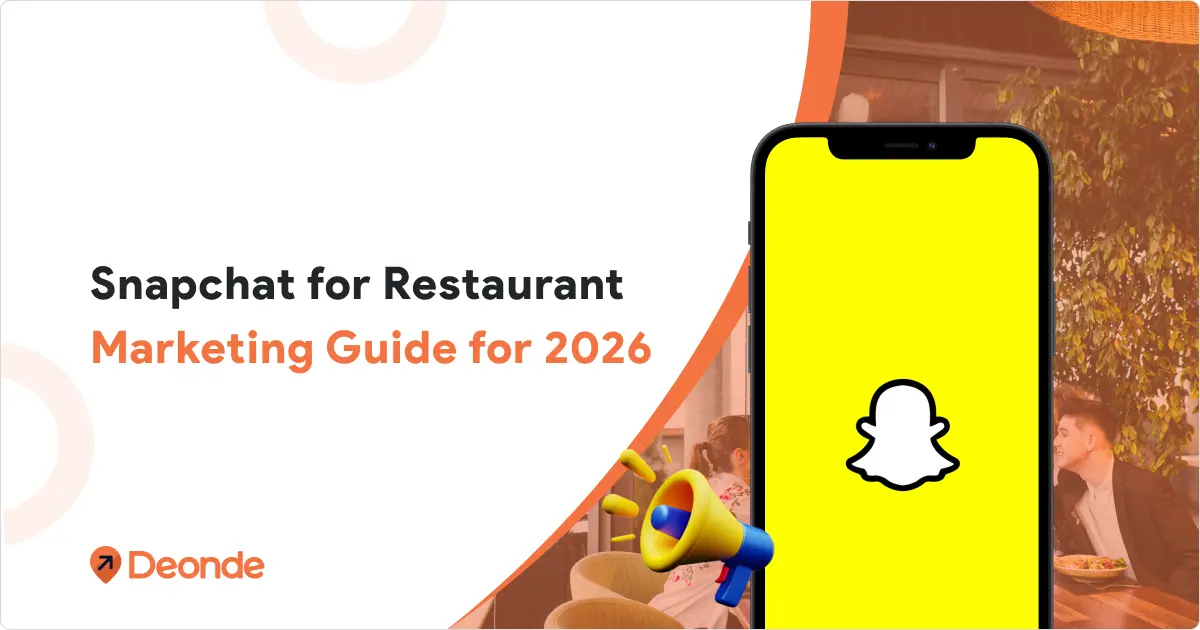
you think Snapchat is just a photo-sharing app for teenagers, the platform’s numbers will change your mind fast. According to Statista, Snapchat reached 477 million daily active users in Q3 2025 — and 90% of all 13–24-year-olds globally use it.
For restaurants chasing the Gen Z and younger millennial demographic, there is no social platform with this kind of reach and this level of daily engagement.
The real opportunity for restaurant owners, though, is not just that young people are on Snapchat. It is how they use it.
According to Sprout Social, Snapchatters open the app nearly 40 times per day — and 63% of them have made a purchase directly influenced by content they saw on Snapchat. That makes it a genuine conversion tool, not just a brand awareness channel.
This guide covers everything you need to know about using Snapchat for restaurant marketing in 2026 — from setting up your business account, to running Promoted Places on Snap Map, to building AR Lenses that make your restaurant the most talked-about spot in your area.
What is Snapchat for restaurant marketing?
Snapchat for restaurant marketing means using the platform’s unique visual tools — Stories, Spotlight, Snap Map, Geofilters, AR Lenses, and paid Snap Ads — to attract new diners, drive repeat visits, and promote your menu, events, and offers to a highly engaged Gen Z and millennial audience.
Why Does Snapchat Work So Well for Restaurant Marketing?
Snapchat’s audience profile matches restaurant marketing goals almost perfectly. The platform reaches 75% of all 13–34-year-olds globally, and according to Sprout Social, Snapchatters outspend users on other platforms by significant margins — 88% of them say they love to shop, and 82% consider it a primary hobby. These are hungry, spontaneous consumers with disposable income and the habit of acting on what they see.
Restaurants benefit specifically because Snapchat thrives on food content. The platform is built around visual, in-the-moment sharing — exactly the kind of content a kitchen, a dining room, or a chef at work produces naturally. You don’t need a production budget.
A 10-second clip of a burger coming off the grill or a barista pulling an espresso shot is exactly what performs well here.
There’s also the competitive gap to consider. Most restaurants are pouring effort into Instagram and TikTok, leaving Snapchat significantly underutilised.
That means your content faces far less competition for attention, and your ad spend goes further.
How to Create a Snapchat Business Account for Your Restaurant
Setting up a business account takes under 10 minutes. Here is the current 2026 process:
- Download the Snapchat app on iOS or Android, or visit snapchat.com on desktop.
- Tap “Sign Up” and enter your restaurant’s name as the display name. This is what your followers will see.
- Choose your username carefully. Use your restaurant name — for example, @thenoodlehouse or @marinagrillnyc. If your exact name is taken, add your city or a short location identifier.
- Enter your date of birth, email, and phone number. Snapchat will send a verification code.
- Switch to a Business Profile. Go to your profile settings → tap “My Business” → select “Create Business Account.” This unlocks Ads Manager access, Snapchat Insights (analytics), and the ability to add business details like your hours, website, and menu link.
- Add your business information. Fill in your restaurant’s address, website URL, and a short bio. This information appears when users tap your profile from the Snap Map.
- Download your Snapcode. This is your unique QR-style code that customers can scan to follow you instantly. Print it, use it, and put it everywhere.
Once your account is live, the first goal is getting your existing customers to follow you. The easiest way to do this is through your Snapcode — which we cover in the next section.
How to Grow Your Snapchat Following as a Restaurant
Your Snapchat following will not build itself. The restaurants that grow fastest on Snapchat are the ones that take their profile offline and plant it everywhere a customer might look.
- On your premises: Print your Snapcode on table tent cards, menu inserts, receipts, and entrance signage. Customers who are already sitting in your restaurant are your most willing followers — give them a reason and a way to follow you in seconds.
- On your delivery packaging: Stick your Snapcode on delivery bags, food containers, and takeaway boxes. Every order that leaves your kitchen is a chance to turn a one-time buyer into a Snapchat follower.
- On your other social channels: Add your Snapchat username and Snapcode to your Instagram bio, Facebook page, and WhatsApp business profile. Cross-platform visibility compounds quickly.
- On your website and online ordering page: Add a Snapchat follow button or your Snapcode image to your site’s footer and your online ordering system. Customers who order from you directly are likely to engage if you make it effortless.
- With your staff: Ask your team to tell dine-in customers about your Snapchat — a genuine “we post behind-the-scenes stuff there” recommendation from a server converts better than any sign.
Snapchat Restaurant Marketing Strategies That Actually Drive Orders
1. Share Raw, Behind-the-Scenes Content
Snapchat’s algorithm and culture both reward authentic content over polished production. The restaurants winning on Snapchat in 2026 are sharing clips of their chefs at work, their prep kitchen in the morning, and their staff having fun during service — not glossy food photography styled for a magazine shoot.
This works because Snapchat’s audience skews heavily Gen Z, and this demographic actively distrusts content that looks too curated.
A 7-second video of your chef flambéing a pan, shot on a phone with no editing, will consistently outperform a heavily produced food reel. We’ve found that content posted within an hour of something happening — a new menu item going live, a kitchen experiment, a packed Friday night service — performs far better than pre-scheduled polished posts.
2. Use Exclusive Snapchat Discounts and Promo Codes
One of the highest-converting tactics on Snapchat is offering exclusive discount codes or coupons only visible through your Snapchat story. The scarcity and 24-hour expiry naturally creates urgency — followers who want the deal need to check your story today.
You can hide the promo code partway into your story so that only engaged followers who watch all the way through receive it. This also gamifies your content and rewards loyalty.
According to Branding Los Angeles, this tactic increases both follower retention and repeat visits, because customers know your Snapchat story is worth watching.
If you run promotions through your own ordering platform, you can use our coupon and promo code management tools to set these codes up so they are ready to go live when your Snap does.
3. Run Contests and Engagement Challenges
Snapchat is built for participation. Running a simple contest — “Snap your meal from our restaurant and send it to us, and we’ll pick a winner for a free dinner” — costs nothing and can generate significant organic reach. The submissions become content themselves, and winners become brand advocates.
More effective in 2026 are challenges tied to your Spotlight content (covered below) where you ask customers to recreate a dish at home, guess a mystery ingredient, or participate in a branded food challenge.
Every participation creates a direct connection between your brand and that customer’s personal Snapchat network.
4. Announce New Menu Items in Real Time
Snapchat’s disappearing-content format makes it the perfect place to build anticipation for new dishes, seasonal specials, or limited-run items.
Post a short teaser — the ingredient delivery arriving, the chef testing a plating, or a blurred shot of the finished dish — days before the item launches. By the time it goes live, followers are primed.
This is far more effective on Snapchat than on Instagram or Facebook because the ephemeral nature of the content signals exclusivity.
Followers know that if they miss the snap, they miss the news. That urgency drives daily app opens and keeps your brand at the front of their minds during those 40 daily Snapchat sessions.
5. Leverage Influencer Takeovers
Contact a local food blogger, a Snap Star (Snapchat’s verified creator program), or a micro-influencer with a following that matches your target diner profile.
Arrange a “takeover” where they run your Snapchat account for a day — showing up at your restaurant, trying your menu, and sharing the experience to both your audience and their own.
These takeovers perform well because Snapchat’s audience values personal recommendations over brand content.
When a creator their network trusts is posting from inside your kitchen, the credibility transfer is significant. We recommend giving the influencer creative freedom — pre-scripted takeovers feel fake, and Snapchat users notice immediately.
6. Post to “Our Story” and Community Content
Beyond your own profile, Snapchat lets you add content to “Our Story” — a publicly visible collection tied to a location or event.
When customers snap your restaurant and add it to the local story, their content appears to every Snapchat user who explores that area on the Snap Map.
Encourage this actively. Put a small card on the table: “Having a great time? Add to Our Story!” — the organic reach generated by customer-posted location content is free, authentic, and extremely targeted.
How to Use Snap Map to Drive Foot Traffic to Your Restaurant
Snap Map is one of the most underrated tools for restaurant discovery in 2026. According to data from Thunderbit, Snap Map is used by over 300 million people every month and was opened over 40 billion times in just the first quarter of 2025.
That is an enormous volume of people actively exploring what is around them — including restaurants.
When your restaurant appears on the Snap Map, nearby Snapchat users can see your location, tap your profile, view your business hours, and navigate to you — all without leaving the app. Your restaurant effectively functions as a listing on a social-native local search engine.
Promoted Places: The Snap Map Advertising Tool for Restaurants
Promoted Places is Snapchat’s paid feature that highlights your restaurant at the top of the Snap Map for nearby users.
According to Snap Inc.’s own data, marking a business as a “Promoted Place” drives a typical visitation lift of 17.6% among frequent Snapchat users. McDonald’s and Taco Bell were among the first restaurant brands to test this feature at scale, and it is now available to independent restaurants through the Ads Manager.
To use Promoted Places, set up a business profile with your correct address, claim your location in Ads Manager, and create a campaign under the “Promote Local Place” objective. You can set a daily budget as low as $5 and define a radius around your restaurant for targeting.
The feature integrates with third-party data partners so your restaurant’s real-time details — including hours and specials — appear accurately on the map.
How Do AR Lenses Work for Restaurant Marketing?
AR Lenses are Snapchat’s augmented reality filters that users can apply to their own photos and videos.
According to Thunderbit, Snapchat users play with AR Lenses over 8 billion times per day, with more than 75% of daily active users engaging with AR in some form. For restaurants, this represents a massive organic amplification opportunity.
A branded AR Lens is essentially a visual marketing tool that travels through your customers’ social networks every time someone uses it.
You can create a custom Lens in Snapchat’s Lens Studio — for example, a lens that places your restaurant’s logo and a “I just ate here” badge on a user’s selfie, or one that transforms a customer’s photo into a stylised version of your menu design.
Food and beverage brands have already demonstrated the power of this format at scale. According to Snap Inc.’s success stories, GB Glace’s AR Lens campaign generated over 100,000 shares, 170,000+ earned impressions, and a 17% incremental reach compared to video-only campaigns.
Dairy Queen used AR Lenses and Snap Stars to drive engagement beyond summer. Even food delivery platforms like Wolt ran A/B tests comparing Snap Ads against AR to identify which format drove better results for their restaurant partners.
You don’t need a major brand budget to create a Lens. Lens Studio is free, and basic branded lenses can be created without a developer if you follow Snapchat’s templates.
Winter Menu Ideas for Restaurants that will increase customers in 2026
Snapchat Ads for Restaurants: What Are Your Options?
Snapchat offers several ad formats that work well for restaurants, each suited to different marketing goals.
Snap Ads are full-screen, vertical video ads that appear between Stories. They auto-play with sound on (64% of Snap users engage with audio, according to Statista), which means your sizzling pan or satisfied customer “mmm” actually gets heard. Snap Ads can run from a daily budget of $5, making them accessible for independent restaurants.
Sponsored Snaps are a newer format (launched in 2024) that delivers a full-screen video Snap directly into a user’s inbox. Users opt in to open it, and they can reply directly — creating a conversation channel between your restaurant and potential diners. McDonald’s used this format to offer MyMcDonald’s Rewards members a Snapchat+ subscription as part of a partnership campaign.
Story Ads appear within the Discover section as a branded tile that users tap to open a collection of Snaps. These work well for restaurants launching a new menu, promoting a seasonal event, or telling a brand story across multiple pieces of content.
Collection Ads display a row of shoppable products under a video — useful if you sell packaged goods, gift cards, or merchandise alongside your restaurant.
How to Advertise on Snapchat (Step-by-Step for Restaurants)
- Visit ads.snapchat.com and sign into your business account.
- Click “Create Ad” and choose your campaign objective — for restaurants, this is usually “Awareness,” “Traffic,” or “Promote Local Place.”
- Define your audience — set a geographic radius around your restaurant, age range (typically 18–35 for dining), and interests (food, local discovery).
- Set your daily or lifetime budget. You can start at $5/day and scale based on results.
- Upload your ad creative. Vertical video (9:16) at 1080x1920px performs best. Keep it under 10 seconds for Snap Ads.
- Add a call-to-action — “Order Now,” “See Menu,” or “Get Directions” are the best-performing CTAs for restaurants.
- Submit for review. Snapchat typically approves ads within 24 hours.
Track your results in Snapchat Insights — you can monitor impressions, swipe-ups, saves, and (with Snap Pixel installed) conversions from your online ordering page.
How to Create and Use Snapchat Geofilters for Your Restaurant
A Snapchat Geofilter is a branded overlay that appears when users in a specific geographic area swipe through Snapchat’s filter carousel. When a customer uses your geofilter and shares it, your restaurant’s branding appears in the story of every person who sees that snap.
How to create a Snapchat Geofilter for your restaurant:
- Go to snapchat.com/create/ on desktop.
- Choose “On-Demand Geofilter” and select your template or upload a custom design.
- Keep the design simple: your restaurant name or logo, and optionally a short tagline. Avoid text-heavy designs — the simpler the better for organic sharing.
- Set the geographic boundary. For a single restaurant, select a tight radius covering your location and the immediate street area.
- Set the time period — geofilters can run continuously or be scheduled for specific events (a launch weekend, a New Year’s Eve service, a seasonal promotion).
- Submit for approval. Approved geofilters typically go live within 1 business day.
Geofilters cost between $5–$20 for a 24-hour event radius around a single location, making them one of the most cost-effective pieces of branded content you can run.
According to data cited in local marketing research, geofilters increase foot traffic by approximately 20% when deployed during active marketing campaigns.
Using Spotlight to Reach New Diners in 2026
Spotlight is Snapchat’s short-form video feed — its answer to TikTok’s For You page. According to Thunderbit, Spotlight now has over 500 million monthly viewers, with time spent watching Spotlight content increasing by 175% year-over-year.
This is a distribution channel that most restaurants are not yet using, which means early movers gain disproportionate reach.
Unlike Stories — which only reach your existing followers — Spotlight content is distributed algorithmically to people who have never heard of your restaurant. A single strong Spotlight video showing your chef’s best dish, a dining room with real atmosphere, or a creative food transformation can land in front of hundreds of thousands of users organically.
The rules for Spotlight content are the same as TikTok: short, visually engaging, vertically framed, and shot with real energy.
What makes Snapchat’s Spotlight uniquely powerful for restaurants is the platform’s tone — content here is raw and personal by default.
You do not need a social media team or a production setup to compete. A 15-second video of your kitchen during a busy Friday service, posted immediately after it happens, can drive more attention than a week of planned posts.
A Note on Connecting Snapchat Marketing to Real Orders
Snapchat is excellent at driving awareness and intent. But the conversion gap — between a potential diner seeing your snap and actually placing an order — depends on what happens when they click through.
If your Snap Ads link to a commission-heavy third-party marketplace, you lose margin on every order they generate. We’d recommend linking your Snapchat content and ads directly to your own commission-free online ordering system so that every customer your Snapchat marketing brings in generates full-margin revenue for your restaurant.
Your restaurant’s branded ordering app or website ordering page are the right landing destination for your Snap Ads — they create a seamless experience that matches your brand identity and keeps the customer relationship entirely yours.
Final Thoughts
Snapchat in 2026 is not the niche app it was when most restaurant marketing guides were written. With 477 million daily active users, Snap Map opened 40 billion times in a single quarter, and AR Lenses driving 8 billion daily interactions, it has become a serious channel for restaurants that want to reach younger diners without competing in the same overcrowded Instagram and TikTok feeds.
The advantage right now is that most restaurants are still not using it well. The ones that post authentic content consistently, use Promoted Places to surface on the Snap Map, and run low-cost Snap Ads to new local audiences are building a loyal, order-ready audience that their competitors haven’t discovered yet.
Start with your Snapcode in your restaurant. Post one Story this week. Claim your location on the Snap Map. From there, every step forward compounds.
If you’re building your own restaurant delivery app or online ordering system, we’d love to show you how our platform makes it easy to convert the customers your Snapchat marketing brings in — without paying commission to anyone. Book a demo with us and we’ll walk you through it.
FAQ — Snapchat for Restaurant Marketing
Q1: Is Snapchat good for restaurant marketing?
Ans: Yes — particularly for restaurants targeting diners aged 18–34. Snapchat reaches 90% of 13–24-year-olds globally, and its users are 34% more likely to purchase a product after seeing it advertised on the platform than on other social networks. For restaurants in this demographic sweet spot, it is one of the most cost-effective social channels available.
Q2: How much does Snapchat advertising cost for restaurants?
Ans: Snapchat ads start at $5 per day, making them accessible to independent restaurants. Geofilters cost between $5–$20 for a 24-hour event area. Promoted Places on the Snap Map are priced on a CPM basis within Ads Manager, with campaigns runnable on modest daily budgets. There is also a $75 ad credit available if you spend $50 as a new advertiser.
Q3: How do I use Snapchat to promote my restaurant?
Ans: Start with a business account and your Snapcode placed everywhere customers can see it. Post Stories consistently — behind-the-scenes content, menu reveals, and exclusive promo codes. Set up your restaurant on the Snap Map. As your following grows, add Geofilters for events, run Snap Ads to reach new diners nearby, and explore Promoted Places for measurable foot traffic lift.
Q4: How do I create a Snapchat Geofilter for my restaurant?
Ans: Visit snapchat.com/create/, select “On-Demand Geofilter,” design your overlay (or upload one), set the geographic boundary around your restaurant, and choose your time period. Approval typically takes less than 24 hours. Costs start at around $5 for a small area over 24 hours.
Q5: What Snapchat features are best for restaurants in 2026?
Ans: The five highest-impact features for restaurants right now are: Promoted Places (Snap Map visibility with a proven 17.6% visitation lift), AR Lenses (8 billion daily plays — organic reach at scale), Spotlight (algorithmic short video distribution to 500M monthly viewers), Snap Ads (full-screen video from $5/day), and Geofilters (branded overlays that travel through your customers’ networks for free).
Q6: Can Snapchat drive online orders for my restaurant?
Ans: Yes, directly. Snap Ads and Stories both support swipe-up links and call-to-action buttons. Link these to your own commission-free ordering page rather than a third-party platform to keep full margin on every order. Snapchat’s Snap Pixel can also track conversions from your ads to your ordering site so you can measure exact return on ad spend.