
The food delivery market Saudi Arabia 2026 hit SAR 26.5 billion in gross booking value — with 65,000+ restaurant locations and 110,000+ monthly active riders.
But that year also tested the industry’s balance. Discounts surged, smaller players exited, and a Chinese giant reshuffled the competitive rankings within months.
This article breaks down the state of play — the market’s size, who is winning, what trends matter, and how entrepreneurs can enter or grow in the Kingdom.
Saudi Arabia Online Food Delivery Market Size Forecast 2026
Multiple research firms have studied the Saudi food delivery market independently. Their findings all point in the same direction:
- The Consumer Spending (The Scale): As of 2025, the market already sees a massive SAR 24 billion in Gross Booking Value.
- The Pure Food Segment (The Core): Focusing strictly on food ordering, the segment is aggressively growing at an 18.42% CAGR, projected to reach USD 8.22 billion by 2030.
- The Full Ecosystem (The Future): When zooming out to the broader delivery app ecosystem (including groceries and on-demand), the market size expands to an estimated USD 9.59 billion in 2026, scaling up to USD 19.45 billion by 2031.
The bottom line: Saudi Arabia’s food delivery market is a multi-billion dollar opportunity that is still growing at double-digit rates. It is not close to saturation, and independent research firms agree on that conclusion even when their exact numbers differ.
Saudi Arabia Food Delivery Market 2026 Trends
The Saudi food delivery market is going through big changes in 2026. Here are the key trends shaping the industry right now:
- Discount intensity hit 36% of gross booking value in 2025, up from 20% — absorbing SAR 3.2 billion in platform profits. Platforms are now shifting away from free delivery toward subscription-based loyalty programs.
- Cloud kitchens are growing fast. The cloud kitchen market reached USD 1.33 billion in 2025 and is growing at 12.12% CAGR. Brands like Rebel Foods have entered Riyadh with plans for 60 delivery-only restaurant brands.
- AI is now operational, not experimental. SDAIA declared 2026 the Year of Artificial Intelligence. Platforms are using AI for route optimization, demand forecasting, and personalized recommendations.
- Secondary cities are underserved. Aggregator penetration drops below 10% outside Riyadh, Jeddah, and Dammam. Cities like Hail, Tabuk, and Al Kharj represent open market gaps.
- Corporate meal delivery is emerging as a new segment, growing at 15.41% CAGR with almost no dedicated platform competing for it yet.
- Regulations tightened in 2025. The Balady home delivery permit, GAC competition guidelines, and new motorcycle standards have raised the bar for operators — filtering out informal players.
Key Trends Shaping Saudi Arabia’s Food Delivery Industry in 2026
Several structural shifts are redefining how the market works.
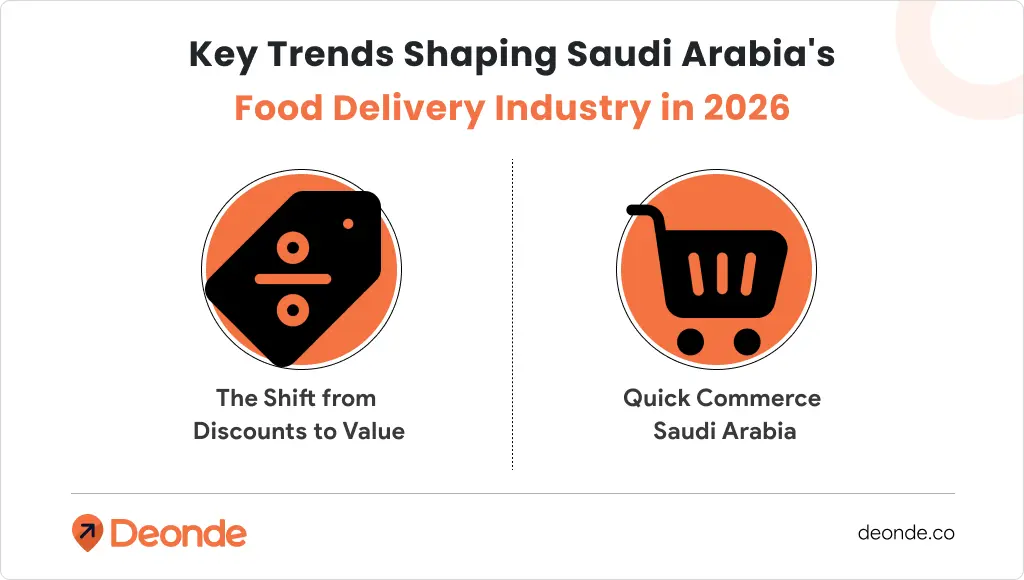
The Shift from Discounts to Value
Redseer’s May 2026 report revealed that discount intensity rose from 20% to 36% of gross booking value, absorbing SAR 3.2 billion in profitability impact.
Free delivery became a default expectation, and the cost is now unsustainable. The next phase favors platforms that preserve consumer value while rebuilding healthy restaurant and rider economics.
Quick Commerce Saudi Arabia
Quick commerce means delivering groceries and everyday items in under 30 minutes using dark stores — not restaurants. In Saudi Arabia, this model has grown faster than almost anywhere else in the world.
Why Saudi Arabia is ideal for quick commerce:
- Dense urban population in Riyadh, Jeddah, and Dammam creates the order frequency dark stores need to be profitable.
- SAMA’s payment infrastructure makes checkout fast — reducing drop-off between intent and completed order.
- High consumer willingness to pay for speed — Saudi consumers have shown they value convenience, which supports delivery fee economics.
Key milestones in Saudi quick commerce:
- 2020–2022: HungerStation launches Quick Market dark-store pilot in Riyadh, adding grocery alongside food delivery.
- 2023–2024: Quick Market scales to 95% Kingdom coverage. Consumer expectations shift from same-day to under 30 minutes.
- July 2025: Ninja reaches unicorn status at a USD 1.5 billion valuation, delivering in 15–20 minutes through its own dark store network.
- 2026: Keeta averages ~30-minute delivery across 23 cities using AI-powered dispatching. Free delivery becomes a default consumer expectation.
Where the real opportunity is:
The generalist dark-store model is already competitive. The open opportunity is in verticalization:
- Health-focused and keto/vegan grocery SKUs
- Halal-certified specialty products
- B2B restocking for small businesses and offices
- Tier-2 city coverage where Quick Market penetration is still low
NEOM’s USD 10 billion logistics joint venture with DSV is also building next-generation last-mile infrastructure that will extend quick-commerce economics into new urban zones — making now the right time to plan for that expansion.
Food Delivery Apps Saudi Arabia Growth
Saudi Arabia’s food delivery app market is one of the fastest growing in the Middle East. Here is what is driving that growth:
- 97.5% smartphone penetration and 98% internet access means almost every Saudi consumer can order food online right now.
- Mada card transactions hit USD 53 billion in 2024, showing that digital payments are now mainstream — reducing a major barrier to app-based ordering.
- Keeta loyalty data from 2025 shows subscribed users saved an average of SAR 400 per year — proving that loyalty programs are driving repeat orders, not just one-time downloads.
- Women’s workforce participation crossed 30% under Vision 2030, creating more dual-income households that rely on delivery apps for daily meals.
- HungerStation’s Quick Market expanded the app use case from food into groceries and household items, increasing how often users open the app each week.
- The online food ordering segment alone is projected to grow at 18.42% CAGR, reaching USD 8.22 billion by 2030 according to ResearchAndMarkets.
Who Are the Top Players?
The competitive landscape has shifted dramatically in the last 18 months.
HungerStation vs Jahez vs Keeta
| Platform | Market Position | Key Stats |
| HungerStation | Leader (~50% share in major cities) | Quick Market covers 95% of the Kingdom; 10M+ grocery orders since 2020 |
| Jahez | ~30-33% share | First Saudi food startup on Nomu; market cap ~$750M; ~15% commission model |
| Keeta | 10-11% share in under 1 year | 150M+ orders in 2025; 50,000+ restaurant partners; 38,000+ riders across 23 cities |
HungerStation dominates with its Quick Market dark-store network. Jahez competes on local loyalty and its logistics arm Logi. Keeta disrupted the market using aggressive free-delivery backed by Meituan’s global infrastructure.
For a detailed breakdown of each platform, our guide to the top food delivery apps Saudi Arabia covers features and market share.
Saudi Arabia Food Delivery Apps HungerStation, Jahez, Keeta, Market Trends 2025–2026
HungerStation, Jahez, and Keeta are the three platforms defining how food delivery works in Saudi Arabia right now. Each one is taking a different approach — and the gap between them and everyone else is getting wider every month.
HungerStation: Defending the top spot through infrastructure
- HungerStation holds roughly 50% market share in major cities — a lead built over years of network investment, not just marketing spend.
- Its biggest move in 2025–2026 has been expanding Quick Market dark stores to cover 95% of the Kingdom, making it the only platform that can reliably serve both food and grocery at national scale.
- The platform processed 10 million+ grocery orders since 2020, showing that its expansion beyond restaurant food is working.
- HungerStation’s response to Keeta’s free-delivery push was to absorb pressure through larger basket sizes and higher order frequency — a structural advantage smaller platforms do not have.
- Its rider fleet remains the largest in the country, giving it a last-mile execution advantage that is expensive and slow to replicate.
Jahez: Building a business beyond delivery commissions
- Jahez holds 30–33% market share and became the first Saudi food startup to list on the Nomu exchange, with a market cap of approximately USD 750 million.
- Its most important strategic move is the Logi logistics platform — a B2B service that now serves merchants outside food delivery entirely, reducing Jahez’s dependence on restaurant commissions.
- Jahez charges approximately 15% commission to restaurant partners, significantly lower than the industry standard of 25–30%. This has helped it retain restaurant loyalty during the price war triggered by Keeta’s entry.
- The Co Limited shared kitchen initiative gives delivery-only restaurant brands access to commercial kitchen space — positioning Jahez as infrastructure for the broader food economy, not just a delivery middleman.
- Being publicly listed gives Jahez capital access that most regional competitors cannot match, especially important during a prolonged margin-compression period.
Keeta: The disruptor rewriting the rules
- Keeta launched in Saudi Arabia in September 2024 and captured 10–11% market share in under 12 months — one of the fastest platform ramp-ups in the region’s history.
- It is backed by Meituan, the Chinese food delivery giant with over USD 150 billion in experience scaling competitive delivery markets — giving Keeta operational playbooks and capital reserves that local competitors cannot easily match.
- Keeta recorded 150 million+ orders in 2025, onboarded 50,000+ restaurant partners, and deployed 38,000+ riders across 23 cities.
- Its average order value reached SAR 53 in 2025, driven by AI-powered personalized recommendations — showing that Keeta built engagement quality, not just order volume.
- Keeta’s AI dispatching system averages approximately 30-minute deliveries across all 23 cities it operates in.
- The free-delivery model Keeta introduced forced all incumbents to respond — directly contributing to discount intensity rising from 20% to 36% of gross booking value across the industry in 2025.
What these three trends mean for the market in 2026:
- The subsidy war is unsustainable. SAR 3.2 billion in platform margins were absorbed by discount pressure in 2025. All three platforms are now moving toward subscription loyalty models to rebuild profitability without losing users.
- Market consolidation is accelerating. Shagardi shut down in October 2025 after 7 million orders across 35 cities — a direct casualty of competing against three well-funded platforms simultaneously. The gap between the top three and the rest is widening.
- Technology is becoming the differentiator. Route optimization, demand forecasting, and personalized recommendations are no longer premium features — they are baseline requirements. Platforms that cannot match Keeta’s AI dispatching efficiency will struggle to compete on delivery speed or cost.
The Shakeout
Market concentration is accelerating — Saudi’s delivery market is twice as competitive as benchmark countries (Redseer).
Shagardi shut down in October 2025 after 7 million orders across 35 cities, a direct casualty of the price war. Talabat, Mrsool, ToYou, The Chefz, and Nana Direct hold niche positions, but the gap between the top three and the rest is widening.
How Is AI Transforming Food Delivery in Saudi Arabia?
Artificial intelligence is no longer experimental in Saudi food delivery — it is operational
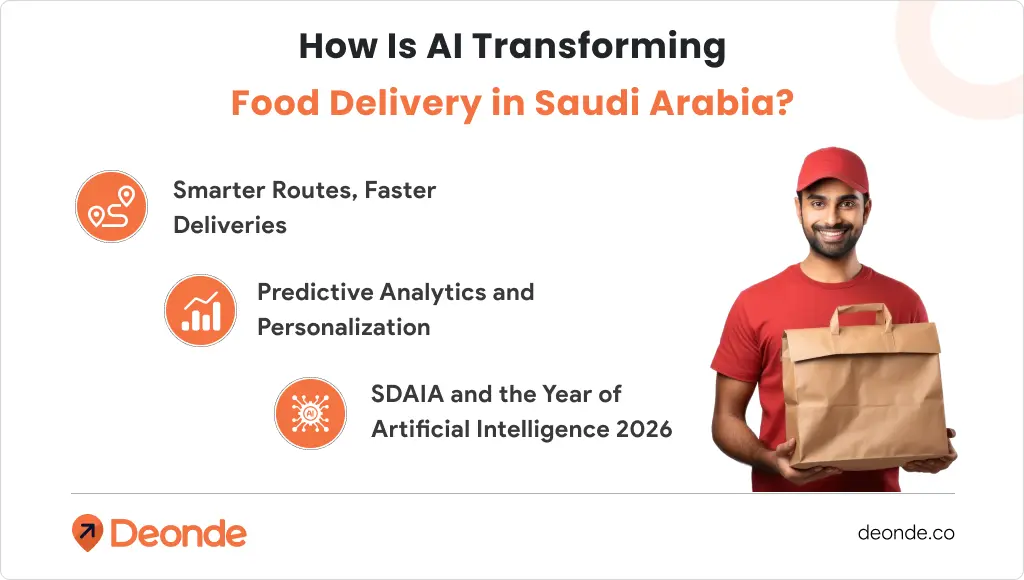
Smarter Routes, Faster Deliveries
Keeta’s intelligent dispatching optimizes rider routing in real time, averaging ~30-minute deliveries. Jahez’s Logi platform uses predictive logistics to improve rider efficiency. AI-driven fleet management is moving from differentiator to table stakes.
Predictive Analytics and Personalization
Platforms use machine learning to forecast demand by neighborhood, time, and cuisine. Personalized recommendations boost basket sizes — Keeta’s average order value reached SAR 53 in 2025, driven largely by algorithmic suggestions.
SDAIA and the Year of Artificial Intelligence 2026
In March 2026, the Saudi Data and Artificial Intelligence Authority (SDAIA) declared 2026 the Year of Artificial Intelligence, issuing comprehensive guidelines for AI adoption across all sectors.
The national push directly supports food tech innovation — from AI-powered demand forecasting that reduces food waste to automated customer service handling order queries.
For entrepreneurs, government-backed AI adoption lowers the technology barrier. Tools once available only to well-funded platforms are now accessible through SaaS providers and open APIs, making it possible for smaller delivery businesses to compete on logistics efficiency.
How Does Vision 2030 Impact the Food Delivery Sector?
Vision 2030 is the structural backbone of Saudi Arabia’s delivery boom.
E-commerce now accounts for 10% of retail sales, expected to reach 25% by 2035. SAMA’s digital payments framework reduces checkout friction. ZATCA’s e-invoicing platform standardizes tax compliance.
NEOM’s $10 billion joint venture with DSV is building next-generation last-mile delivery infrastructure. The Regional Headquarters program (0% corporate tax for 30 years) has attracted global players like Keeta.
For business owners evaluating entry, a white-label food delivery platform eliminates the need to build technology from scratch while keeping 100% of revenue and customer data.
Regulations for Food Delivery Platforms
The regulatory environment matured significantly in 2025-2026.
The Ministry of Municipalities and Housing launched a home delivery permit service via Balady (July 2025), requiring health certification for delivery personnel, vehicle standards meeting technical requirements, and business branding displayed on all delivery vehicles.
Field inspections and penalties apply for non-compliance.
The General Authority for Competition issued market guidelines in March 2025, signaling regulatory maturation rather than restriction. Non-Saudi riders must work through licensed light transport companies only.
Face verification is now mandatory to secure rider accounts and reduce fraud.
Motorcycle delivery regulations have also tightened, with stricter technical requirements for bikes and scooters.
These rules raise the bar for entry but create a more professional ecosystem that benefits serious operators.
Final Word
The food delivery market Saudi Arabia 2026 is large, growing, and competitive — but not closed. The subsidy war is burning out, regulations are creating a cleaner playing field, and technology costs are falling.
If you want to start your food delivery business in Saudi Arabia, the infrastructure and demand are both ready. The question is whether you will build on your own terms or someone else’s.
Frequently Asked Questions
Which food delivery app is most used in Saudi Arabia?
HungerStation holds the largest share (50% in major cities), followed by Jahez (30-33%) and Keeta (10-11%).
What is the growth rate of food delivery in Saudi Arabia?
The market is growing at a CAGR of 15.18% (2026-2031), with online food ordering expanding at 18.42% CAGR.
What are cloud kitchens and their growth in Saudi Arabia?
Delivery-only restaurant facilities. The market reached USD 1,329 million in 2025, projected at 12.12% CAGR to USD 3,726 million by 2034.
How is AI used in Saudi food delivery?
Real-time route optimization, demand forecasting, personalized recommendations, and fleet management — accelerated by SDAIA’s Year of AI 2026.