A restaurant reservation system is software that lets customers book a table in advance through a website or app, while giving restaurant staff real-time control over seating, waitlists, and guest management. It replaces phone calls and paper logbooks with one organized dashboard.
You will also see it called a restaurant booking system, table booking software, or reservation management software. They all describe the same job.
This number has been increasing rapidly over the past few years. People love to visit restaurants. They would love it if they got something that would help them book a table according to their requirements in their favorite restaurants.
While many guides still focus on basic features like online table booking and automated reminders, the most successful restaurants in 2026 are leveraging reservation systems as strategic assets that:
– Increase revenue per available seat hour
– Reduce customer acquisition costs through direct booking ownership
– Enable hyper-personalization at scale
– Provide predictive insights for staffing and inventory management
– Create seamless omnichannel dining experiences
This guide goes beyond feature checklists to show you how to select, implement, and maximize a reservation system that delivers measurable ROI in 2026 and beyond.
How Does A Restaurant Reservation System Work?
At its core, the system answers one question for every request: can we seat this party at this time without breaking service? Behind a single booking, this is what happens
1. The guest finds you: They use the booking button on your website, your Google listing or social profiles, a marketplace app, or a phone call answered by staff or, increasingly, an AI voice assistant. Staff log walk-ins and phone bookings in the same system.
2. The availability engine checks capacity: It compares the party size with your table map and applies your rules: opening hours, how long each party size usually stays (turn time), pacing limits (covers seated per 15 or 30 minutes), blackout dates and tables held back for walk-ins.
3. The booking is confirmed and the guest is recorded: The system stores the name, contact details, party size and notes such as an occasion or an allergy the guest chose to mention. If you require it, it takes a deposit or a card hold.
4. Confirmations and reminders go out: by email or SMS, with a simple link to change or cancel.
5. On the day, the host stand runs from the floor plan: Arrivals are marked, tables are assigned, and walk-ins and the waitlist fill the gaps that cancellations leave.
6. After service, the data stays useful: No-shows, covers by hour and repeat visits feed your reports and guest profiles.
Why Do You Need a Restaurant Reservation System?
If you are a restaurant owner, you can understand the importance of an online booking system. More than 80% of restaurants have included Restaurant Reservation System. More than 90% of those restaurants reported growth in their business after including the system.
Shifting to an online business has been profitable for almost all restaurants. They have seen a great hike in the diner’s number. The restaurants are witnessing a regular increase in the number of reservations.
Customers love the online restaurant reservation system because they get a convenient dining experience by having a booking through this system. They can book a table from anywhere without worrying about the hustle they need to face.
In short, this system is profitable for both the consumer and the owner of the restaurant. Let us discuss the features which make the online restaurant reservation system a worthy deal for restaurant owners.
Features Of Online Restaurant Reservation System
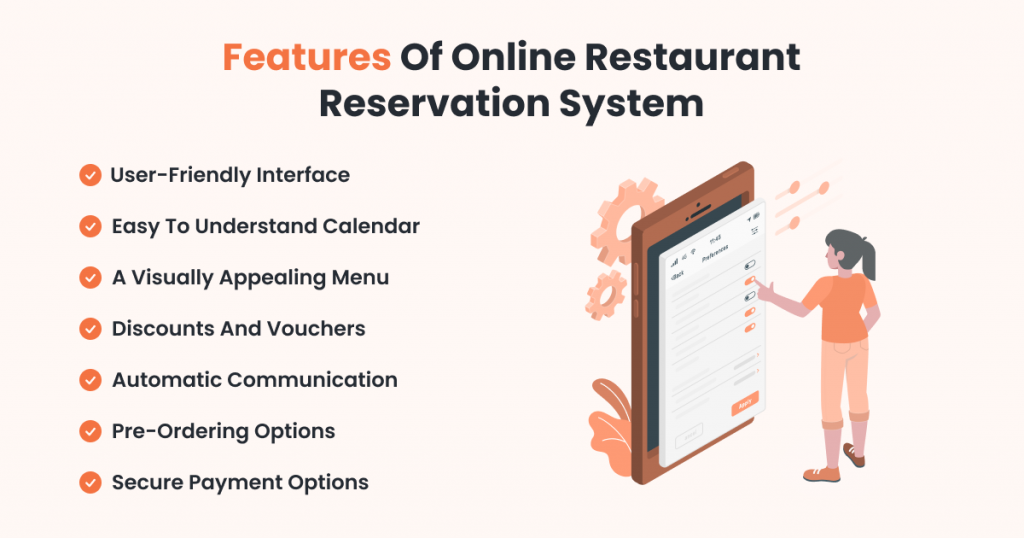
Table booking systems for restaurants have proved to be a boon for restaurant owners. Here are the Most Innovative and Useful 5 Features which will make your online reservation app standalone in the queue
User-Friendly Interface
First thing you need to remember is the UI of the app or the website for the table booking system for restaurants. It should be easy to deal to use the app. Do not try to make it enigmatic. Keep it as straightforward as possible.
The app should be easy to access so that the customers can book a table for themselves in no time. All the details of the restaurant must be easy to navigate. Don’t try to make things difficult, just be as simple as possible and transparent.
Easy To Understand Calendar
As we mentioned above, you need to keep everything clearer and simpler to understand. A simple calendar is a necessary tool for any online restaurant booking system.
A perfectly managed calendar is crucial in dealing with online reservations for the tables of restaurants. If not organized it can cause chaos and will be a big failure for your system.
Consumers should be able to view the reservation calendars explicitly. If not, consumers will face double bookings, wrong table bookings, and many more problems. We are sure you do not want your consumers to face these problems at all.
Photos and a Menu guests can browse
Grubhub claims that adding pictures to your restaurant’s menu will increase sales by 30%. The consumer is most likely to navigate through your whole website if he/she sees the photos of the dining room and the dishes you are providing.
Read Also: How Your Restaurant Menu Inspires Your Restaurant Revenue?
If your app, website, or online restaurant reservation system has a visually appealing menu, your sales will skyrocket in no time.
Research also shows that more than 85% of customers try new restaurants after seeing the images of the food they are providing.
Try to have a professional photo session for the advertisement of the signature dishes to attract diners to your place!
Discounts And Vouchers
Trust us, customers love discounts on their favourite foods or things they want to buy. You can provide them with attractive discounts if they are booking a table through the website’s app.
He will help you grab their attention. It also gives you a mouthful of publicity profit by itself.
Quick Tips- You can give your customers an enticing deal or a major discount within a period of comparatively low sales. It will help you to boost your sales.
Automatic Communication
This is a feature that will play a great role once the booking is done. Your online table booking system should have the feature to provide a push notification in the form of an email or SMS to the registered user. This will help the consumer to reach the place in time.
You can also send discount vouchers and deals to regular customers to increase their engagement with your restaurants.
Concisely, you need to send them regular reminders on your part. It will increase the incoming the customers.
Pre-Ordering Options
If you want to have an effective restaurant reservation system, you need to need this feature in your app or website. This feature helps the customer get hot and deliciously served food without waiting.
If he/she is in a hurry, they can choose this option. It saves the time of both the customer and the staff working in the restaurant.
See Also: Importance Of Having A Pre-Ordering (Order In Advance) System In A Restaurant
Secure Payment Options
According to our research more than 80% of the diners prefer to pay the whole payment by phone or wirelessly, and more than 90% of the restaurant owners think that the online payments option is one of the most important technologies they should have!
If a diner feels safe and secure while paying the bills, it enhances their trust in your restaurant. It will help you grow your business and succeed.
Beyond the basics. These features earn their keep as you grow:
- Drag-and-drop floor plan and table management, including joined tables
- Waitlist and walk-in management, with a text when the table is ready
- Guest profiles with visit history, notes and tags
- Integrations with your POS, website and online ordering, Google, and email and SMS tools
- Reports on covers by hour, no-shows, channel mix and revenue per cover
- Multi-location management with role-based permissions
Benefits Of An Online Restaurant Reservation System
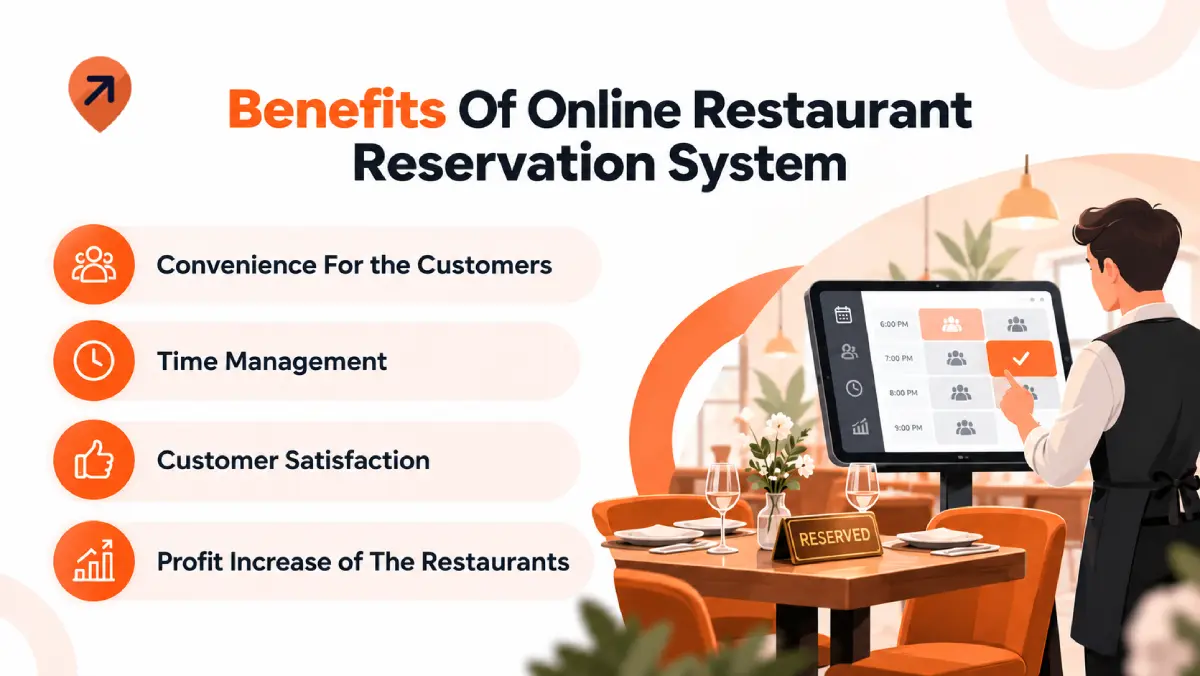
In the previous section, all the features your online table reservation system must have been outlined. In this section, we will discuss the benefits of this system.
Convenience For the Customers
This benefit of the online restaurant reservation system is the most significant one for the diners. They can easily get access to the restaurant without even visiting the restaurant. They can book a table for themselves or their family and friends whenever they want, from the comfort of their homes.
This feature helps the customers with easy service. You can pre-order food, pre-book a table, schedule dining for a special occasion, and learn more about the services all at once. This eventually increases the overall sales of the restaurants.
Time Management
This benefit is the second most significant of all. During the occupied days, restaurants staff gets so busy that they do not have considerable time for the customers. This can draw a wrong impression on the diners.
This online reservation system helps the staff to get a loose hand on some points. They don’t have to give too much time to the diners for arrangements of sitting. In the past, a staff member used to book the tables for the customers on a first come first serve basis.
Some restaurants still use this method, but it is not that effective and can cause lots of time wastage. With this handy system of online table booking, the diners can book anytime that is convenient to them.
Customer Satisfaction
If you own a restaurant or any other business, you can understand that customer satisfaction is a must-have requirement. This system makes the customer satisfied if he/she is getting timely reservations, special offers and discounts, advance pre-orders, etc. All these experiences make the customer satisfied, which is our first goal in any business.
Profit Increase of The Restaurants
An online table booking system gives the restaurant owners a great hike in their overall profits. Due to the online restaurant reservation system’s success, customers are satisfied with the services they receive.
According to research, 75% of the customers and restaurant owners want an online restaurant table booking system for their business. It won’t be an exaggeration if we say that this system is the future of the restaurant business.
How To Manage Restaurant Reservations (And Cut No-Shows)
Software only helps if its rules are sound. These practices apply whether you take bookings online, by phone, or both.
How big is the no-show problem? It depends on who is counting. Resos’ 2026 index, covering 3.77 million reservations at 2,417 restaurants, puts the average recorded no-show rate at 2.33%.
Bloom Intelligence’s data on more than 641,000 reservations shows 3.7% no-shows plus another 15% cancellations, so nearly one booking in five never seated a guest.
Both are vendor datasets that record only what restaurants log, so treat them as benchmarks and measure your own.
1. Set pacing before you open bookings: Cap how many covers can be seated in each 15- or 30-minute window so the kitchen isn’t hit by one big wave.
2. Set turn times by party size, then revisit them: For example, 75 minutes for two and 105 for six. Those numbers are placeholders; replace them with real seating data after a month. Too short and you overrun; too long and you turn away guests you could have seated.
3. Hold back tables for walk-ins: on your busiest days and release them closer to service.
4. Write a clear cancellation policy and show it before the guest confirms: Set a grace period for late arrivals (15 minutes is common) and a cancellation deadline, for example, free changes up to 24 hours before. If you charge a fee, say so up front.
5. Use deposits or card holds where the risk justifies the friction: large parties, peak nights, tasting menus. OpenTable says restaurants using deposits through its system saw 60% fewer no-shows, which is a vendor claim worth testing on your own numbers.
Large parties no-show least in Bloom’s data (1.8% for parties of seven or more), yet one empty big table costs the most, so weigh the friction of a deposit against your exposure.
6. Keep a live waitlist so cancelled tables are refilled. It matters more than it sounds, because cancellations are far more common than no-shows.
7. Review monthly: Check no-shows and cancellations by day, channel and party size. In Bloom’s data, online bookings no-showed more than phone bookings (3.9% vs 3.0%) and cancelled far more often (16.3% vs 9.3%), and Sunday and Monday were the worst days (4.2%). Your pattern may differ, so look at your own numbers before overbooking or adding fees.
8. Taking bookings by phone or in person? Use one master calendar and never a second paper book, read back the date, time and party size, take a mobile number, and state your cancellation policy before you end the call. Enter walk-ins in the same system so availability stays accurate.
What to Consider before Choosing a Restaurant Reservation System?
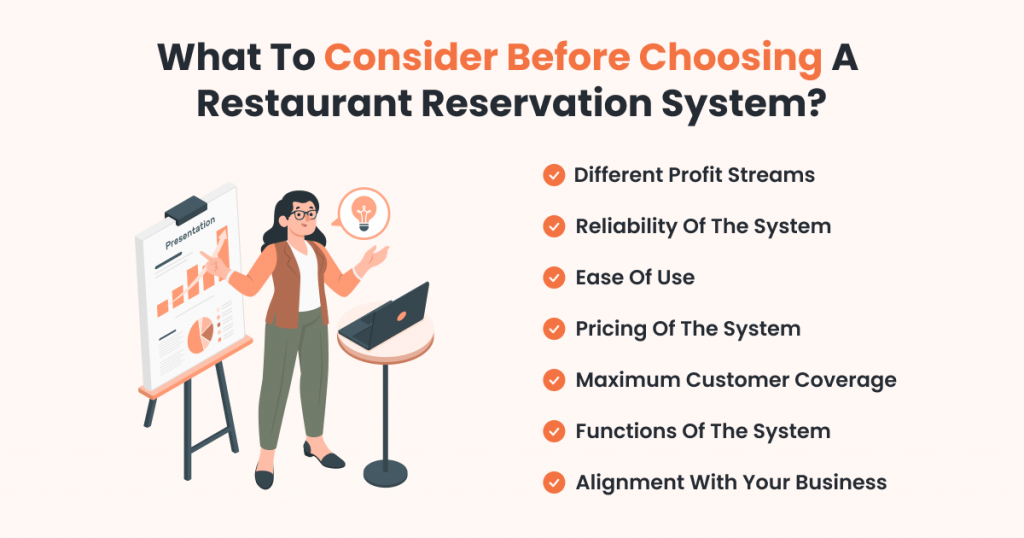
Online Reservation Systems abound, but you should choose the most dependable one. We will discuss some important aspects to consider before choosing an online Reservation System.
Different Profit Streams
This system is getting famous day by day. Restaurant owners are switching over this system of online table booking systems rapidly. In such a case you need to choose some features which make you stand alone in the crowd.
Concisely speaking, you need to develop or think of some ideas which can increase your profits and make your online reservation system unique.
Reliability Of the System
Consider this aspect the most significant one. You need to have a reliable system. If your system suddenly crashes or hangs frequently during a load of bookings, t can make a really bad impression on your customers.
You cannot afford this impression at all in such a business. Hence, you need an online reservation system that can work smoothly during busy times.
Ease Of Use
If your app is not simple and easy enough to understand, the customer will never take a bet on it. You need software that provides ease of use to the customers and even the system operators. You cannot afford to lose customers because of the complicated interface he/she is facing while booking a table.
Pricing of the System
There are two types of pricing plans; you can pay for monthly use or you can pay on a commission basis. Choosing a platform with a monthly payment plan is usually a smart idea, as if you choose a commission-based plan, you might end up paying more than a monthly plan.
A commission price is based on the reservation system. The platform gets some commission per booking you have through the online table booking reservation system.
Maximum Customer Coverage
There is a system called waitlist management in the online reservation system. It helps you to have maximum coverage of the consumers and arrange their bookings accordingly.
Restaurant reservation systems need to be built on algorithms that can handle up to 10,000 seats easily. You also need to maintain full transparency with the customers about the reservations.
Functions of the System
A good online table booking system ensures to provides you with lots of functions such as memberships, discount vouchers or codes, push notifications, reminders and many more. Choose a system that can provide you with all the crucial features. Make sure that the system doesn’t hang or crash while using all the algorithms.
You need to make sure that the customers the enjoying all the features of a fast-working system.
Alignment with your Business
You need to keep this point in your mind all the time if you are a restaurant business owner. Your system of online table booking system should align with your business plan perfectly.
You will see two online reservation systems: consumer-facing websites and operator-facing management platforms.
The first one works as a market for the restaurants. Restaurants can list their seating arrangements and consumers can access them directly through the platform’s search feature.
The second one allows the restaurant to handle their websites and get reservations from there. The restaurant owners can also advertise this website if they want.
Which Reservation System Fits Your Restaurant?
- Small restaurant, café, bar or pub. Look for a flat monthly fee, a simple floor plan, SMS reminders and a booking link you can put on Google and Instagram. Add a marketplace listing only if you need discovery.
- Fine dining, tasting menus and ticketed events. Prepayment or ticketing, set seatings, deposits, guest notes and strong waitlist tools matter most.
- Chains and multi-location groups. Prioritise a shared guest database, per-location settings, role-based access, group-level reporting, API or POS integrations and consistent policies across sites.
- Hotel restaurants. Look for property management system (PMS) integration, priority for in-house guests and outlet-level reporting.
- Restaurants that also sell takeaway or delivery. Keep booking and ordering on the same branded channel where you can, so guests deal with one brand rather than several. Deonde’s commission-free ordering website covers the ordering side, and our guide to the online restaurant ordering system explains what to look for.
Shortlist two or three systems and trial them for a couple of weeks with your own staff before you commit.
AI in Restaurant Reservation Systems: What Has Changed in 2026
We have watched restaurant reservation systems evolve from simple digital calendars into highly intelligent, conversational hosts. In 2026, voice AI assistants handle phone calls around the clock.
They speak naturally with guests to book tables, manage cancellations, and answer routine questions without needing human help.
This means we no longer lose revenue to missed calls during a chaotic dinner rush. Instead of guessing, modern systems use smart data to predict exactly how long a party will stay.
They adjust the dining room floor plan on the fly, allowing us to seat more walk-ins and maximize our daily guests.
The booking experience is now incredibly personalized from the moment a guest reaches out. The AI effortlessly remembers a diner’s favorite table, food allergies, and past orders, making every return visit feel special.
We are also seeing a major shift toward personal AI agents, where a customer’s own digital assistant can search for open tables and secure a booking for them.
Because these smart platforms sync directly with our point-of-sale and staff schedules, we run much smoother operations, keep our tables full, and reduce the heavy lifting for our front-of-house team.
Wrapping it up
If you own the best online reservation platform, it will help you get satisfied and happy customers. All the points discussed above will help you to get the best Restaurant Reservation System. Read all the points mentioned carefully if you want to grow your business rapidly and in the right direction.
If you want to develop a Restaurant Reservation System for your restaurant business, we are here to help you with this task. Our company has been developing online reservation platforms for a long time. Our charges are affordable, and you will get full support from our technical team of experts.
Restaurant Reservation System FAQs
What Is A Restaurant Reservation System?
It is software that lets guests book a table online while giving staff one live view of tables, waitlists and guest details. Good systems add reminders, deposits, reports and integrations with your website, Google listing and POS.
Is A Restaurant Booking System The Same As A Reservation System?
Yes. ‘Booking’ is the more common word in the UK, Europe and Australia and ‘reservation’ in the US, and both describe software for taking and managing table bookings. Some booking tools also handle events or private rooms.
Do Small Restaurants, Cafés And Pubs Need One?
If you take more than a handful of phone bookings per service, lose tables to no-shows, or want guests to book outside opening hours, yes. If you are almost entirely walk-in, a booking link on Google plus a simple waitlist may be enough.
How Can Restaurants Reduce No-Shows?
Send confirmations and reminders with an easy way to cancel, set a clear cancellation window, take deposits or card holds for large parties and peak slots, and keep a waitlist to refill cancelled tables. In Resos data, bookings with no-show protection had a 0.80% no-show rate against 2.47% without.
Can Guests Book Directly From Google?
Yes. Add your booking link to your Google Business Profile, or use a reservation provider that integrates with Reserve with Google so a ‘Reserve a table’ button appears on your listing. Keep the profile category set to restaurant and check the live listing after changes.