
4 walls marketing means selling more to the people already inside your restaurant — the customers who are already primed to buy. Focusing on in‑house tactics raises average checks, boosts repeat visits, and costs far less than chasing new customers.
Most restaurant owners pour money into Instagram ads, Google listings, and food delivery platforms. That is smart. But the real untapped opportunity is often already inside the building.
What Is 4 Walls Marketing and Why Does It Matter?
The concept was popularized by restaurant consultant Peter Christie, former President of the Massachusetts Restaurant Association, and later expanded by Tom Feltenstein into the well-known “4 Walls, 4 Blocks, 4 Miles” framework.
The core idea is straightforward. Once a customerwalks through your door, you have full control over their experience. Every touchpoint from that moment — the greeting, the menu, the lighting, the server’s recommendation, the receipt message — is a marketing opportunity.
Getting an existing customer to visit again is far cheaper than finding a brand new one. Studies across the hospitality industry consistently show that repeat customers spend 67% more than first-time visitors. 4 walls marketing is the system that makes repeat visits happen.
8 Practical 4 Walls Marketing Strategies for Restaurants
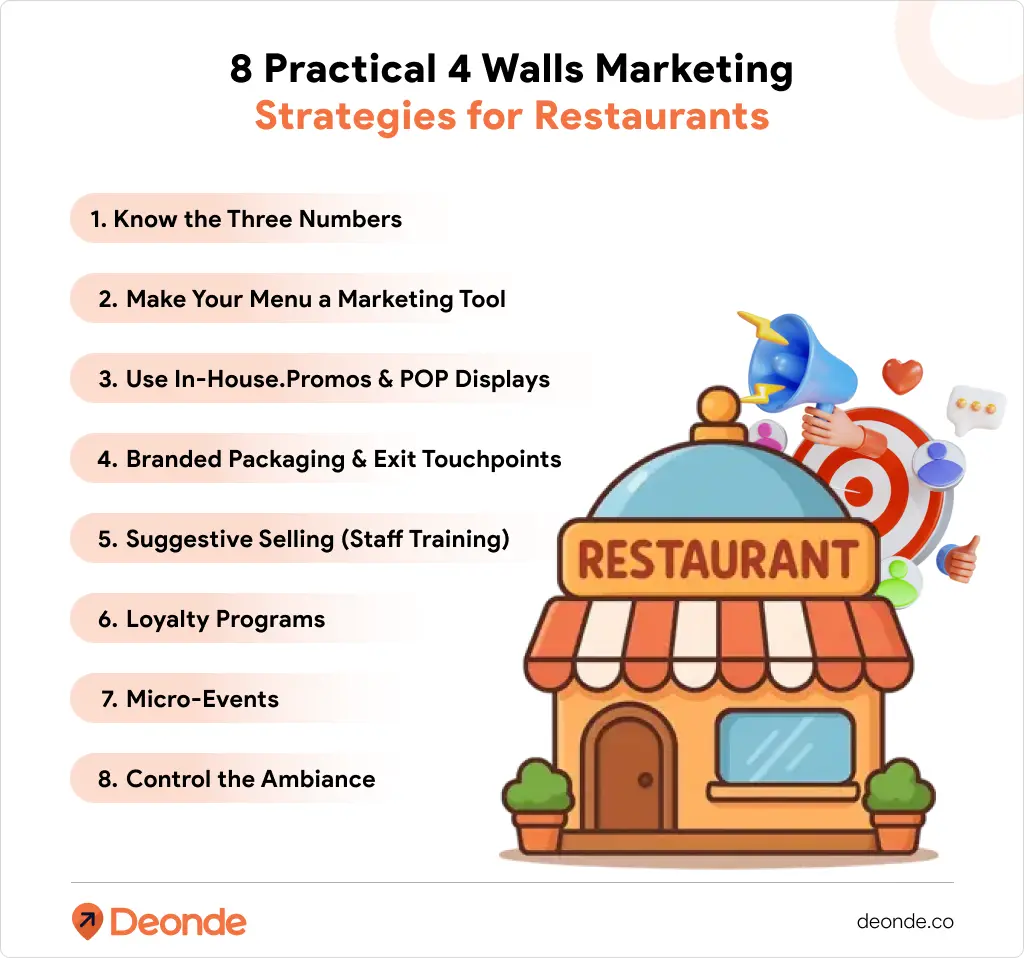
1. Know the Three Numbers That Actually Tell You Where to Focus
Before you change anything inside your restaurant, you need to know which lever to pull first. There are three numbers that matter most for four walls marketing.
- Repeat rate: What percentage of customers come back within 60 days?
- Visit frequency: How many times per month does your average regular visit?
- Average check: How much does a typical customer spend per visit?
Each number points to a different fix. If your repeat rate is low, a quick win is placing a loyalty QR code on every table so guests can sign up before they leave.
If your average check is low, the priority is training staff on suggestive selling for desserts and add-ons. If visit frequency is low, micro-events and exclusive loyalty perks are your best tool.
Knowing your numbers stops you from guessing and lets you run one focused improvement at a time.
2. Make Your Menu a Marketing Tool, Not Just a List
Your menu is the single most read document in your restaurant. Every customer reads it. Most restaurants treat it as a neutral list of items. Smart operators treat it as a sales page.
Here is what works:
– Place your highest margin items in the top right corner — the “sweet spot” where eyes land first
– Use a chef’s section that bundles a main, drink, and dessert at a slight premium
– Highlight two or three signature dishes with a short, specific description rather than a generic one
– Remove currency signs where local customs allow — research consistently shows it reduces price sensitivity
Menu inserts are also an underused tool. A single sheet highlighting a seasonal special or a limited time offer placed inside the main menu draws attention without reprinting everything. The cost is almost zero. The impact on sales can be significant.
3. Use In-House Promotions and Point of Purchase Displays Strategically
Promotions inside the restaurant work best when they feel natural rather than pushy. The goal is to inform, not to pressure.
The three most effective in-house promotion formats are:
– Table tents placed at each table promoting a seasonal offer, a loyalty sign-up, or a new menu item
– Boards at the entry or near the bar using chalk so they are easy to update daily with specials or events
– QR code menus where offers appear at the top of the digital menu automatically, so every customer sees them before ordering
With a platform like Deonde’s online ordering system, you can configure your QR menu so that active promotions appear at the top of the ordering flow. customers browsing the menu at the table will see the offer before they even get to the main categories.
One rule: do not overload the table with too many displays. Two points of focus work far better than six competing for attention.
4. Control the Ambiance Because It Directly Affects Spend
Ambiance is not decoration. It is a direct driver of how long customers stay and how much they order.
Temperature, lighting, and music volume are the three variables that most operators get wrong. Guests who are uncomfortable leave faster and order less. Customers who feel comfortable linger, order dessert, and add another round of drinks.
Set a daily ambiance checklist for your managers to run through before each shift:
– Lighting at the right level for the time of day (brighter for lunch, warmer for dinner)
– Music volume low enough that customers can talk without raising their voices
– Temperature between 68 and 72 degrees Fahrenheit, adjusted by how full the room is
– Dining room clean, well-maintained, and smelling fresh
This sounds obvious.
But visiting dozens of restaurants in a month, you realize it is consistently overlooked. The restaurants that get this right build a reputation that no amount of paid advertising can manufacture.
5. Train Every Staff Member on Suggestive Selling
Your front of house team is not just there to take orders. They are your highest-converting in-house marketing channel, and most restaurants underuse them completely.
The most effective approach is a short weekly structure rather than a one-time training session:
- Give each role three specific suggested lines: one for the host, one for servers, one for cashiers at the counter
- Run a 10-minute staff huddle at the start of each week to practice the lines out loud
- Set a small weekly incentive for the highest attach rate by server or by shift, tracked through your POS
Example scripts that work: “Would you like to try our signature chocolate mousse tonight? It sells out most evenings.” “Our spiced lemonade pairs really well with that — shall I add one?” “We have a fresh dessert special today that most guests are going for after their meal.”
The key is to make the suggestion feel like a genuine recommendation, not a sales push. Staff who believe in what they are recommending convert far better than those reading lines without conviction.
6. Build a Loyalty Program That Operates Inside the Four Walls
Most loyalty programs are promoted digitally through apps and email campaigns. The best moment to actually sign guests up is when they are already inside your restaurant, satisfied, and in a good mood.
Do not wait for them to find the app later. Make signing up a natural part of the table experience.
- Place a QR loyalty signup code on the table tent, the check presenter, and the receipt
- Offer a compelling, immediate reward: “Sign up before you leave and get a free dessert on your next visit”
- Collect name plus phone or email, and if possible tag a preference (vegetarian, spicy, non-veg) so future offers feel personal rather than generic
- Use a two-tap signup flow — the fewer steps, the more completions you get
The most effective loyalty structures reward guests after 3 to 4 visits, not 10 or 15. Reaching the reward quickly keeps engagement high.
Once you have customer contact information, the loop closes. You can re-engage them through restaurant loyalty management system with automated reminders, personalized offers, and push notifications based on their ordering history.
7. Create Micro-Events That Give Guests a Reason to Return
A great meal creates satisfaction. A memorable experience creates a story worth sharing and a specific date to come back for.
Micro-events work across all restaurant formats without a large budget:
- A weekly trivia or game night at a café builds a reliable, recurring crowd
- Tasting flights for a new seasonal menu give casual dining guests an exclusive preview of what is coming
- A live acoustic hour on a typically slow Tuesday changes the entire energy of the room
- A loyalty-member-only preview for a new dish makes regulars feel recognized and valued in a way no discount ever can
Promote these in-house with table flyers and a poster near the entry — not just on social media. Reserve a couple of seats specifically for loyalty members. This builds the sense of exclusivity that drives word of mouth faster than any paid promotion.
The goal is to give guests a concrete reason to return on a specific date rather than a vague intention to “come back sometime.”
8. Use Branded Packaging and Exit Touchpoints to Extend the Experience
The conversation with your customer does not end when they pay the bill. Everything they walk out with continues to market for you.
Branded takeout boxes and bags are visible in offices, at home, and on social media. A small investment in clean, well-branded packaging pays ongoing dividends.
A few things worth adding at the exit point:
– A small card inside the takeout bag with a discount for the next online order
– A flyer informing dine-in customers that they can now order delivery directly from your website (avoiding third-party commission fees)
– A receipt message at the bottom with a short, specific line like “Next visit: show this receipt for a free coffee with any meal”
This approach works because you are reaching guests at the moment they are most satisfied. The experience is fresh. The intent to return is at its peak.
Quick Launch Checklist: Start Next Week
Use this before your next service to get your four walls marketing running immediately:
- Print table tents and a dessert or drinks insert with a QR loyalty signup code ready at each table
- Write three suggestive sell lines per role (host, server, cashier) and run a 10-minute staff huddle
- Set one micro-event for the week — a tasting night, trivia, or loyalty member preview — and reserve seats for loyalty members
- Create a simple QR landing page with one clear reward and a two-tap subscribe flow
- Record your baseline numbers now: average check, repeat rate, and new loyalty signups per week
These five actions cost very little and produce measurable data within the first week of implementation.
The Takeaway
Every restaurant spends money to get customers through the door. The ones that grow consistently also have a system for what happens after that.
Know your three key numbers. Engineer your menu intentionally. Place targeted displays at the right seats.
Make QR codes earn their space at the table. Train your staff with real scripts and weekly incentives. Build loyalty from inside the room. Create events that give customers a concrete reason to return. And measure every change so you know exactly what to keep.
If you want to connect your in-restaurant experience to a direct online ordering platform that eliminates third-party commissions, take a look at how Deonde works for restaurants. It gives you the tools to market inside your four walls and grow beyond them at the same time.
FAQ: 4 Walls Marketing for Restaurants
What is 4 walls marketing for restaurants?
It refers to all in-location marketing efforts a restaurant uses to improve customer experience, increase sales, and build loyalty among customers who are already inside the restaurant.
How is 4 walls marketing different from digital marketing?
Digital marketing focuses on attracting new customers from outside. 4 walls marketing focuses on maximizing the value of every customer who is already inside your restaurant.
What are the most effective 4 walls marketing tactics?
Staff training for upselling, strategic menu engineering, in-house promotions using table tents and QR menus, ambiance control, and on-site loyalty sign-ups consistently deliver the highest return.
How do I measure if 4 walls marketing is working?
Track your average check size, table turn time, and repeat visit rate month over month. An increase in any of these after implementing in-house marketing changes is a clear signal it is working.
Can 4 walls marketing work for quick service restaurants?
Yes. While the tactics differ slightly, the core principles apply. Speed, accuracy, and small upsell prompts at the counter (like a combo upgrade) are high-impact 4 walls marketing moves for QSR operators.
What is the “4 Walls, 4 Blocks, 4 Miles” strategy?
It is a layered restaurant marketing framework where you first maximize your in-restaurant experience (4 walls), then build relationships in the immediate neighborhood (4 blocks), and then extend your reach across the wider local area (4 miles).
How do QR codes support in-house restaurant marketing?
Beyond displaying the menu, a well-set-up QR code can enroll customers into loyalty, collect contact data for SMS campaigns, accept next-visit pre-orders, and run post-meal surveys — all from one scan at the table.