Most food business owners evaluate software the wrong way. They look at the monthly subscription price, compare it to what they’re paying aggregators, and assume the math works in their favor. Sometimes it does. But often, they’re missing three to four cost layers that flip the calculation entirely — and they discover that six months too late.
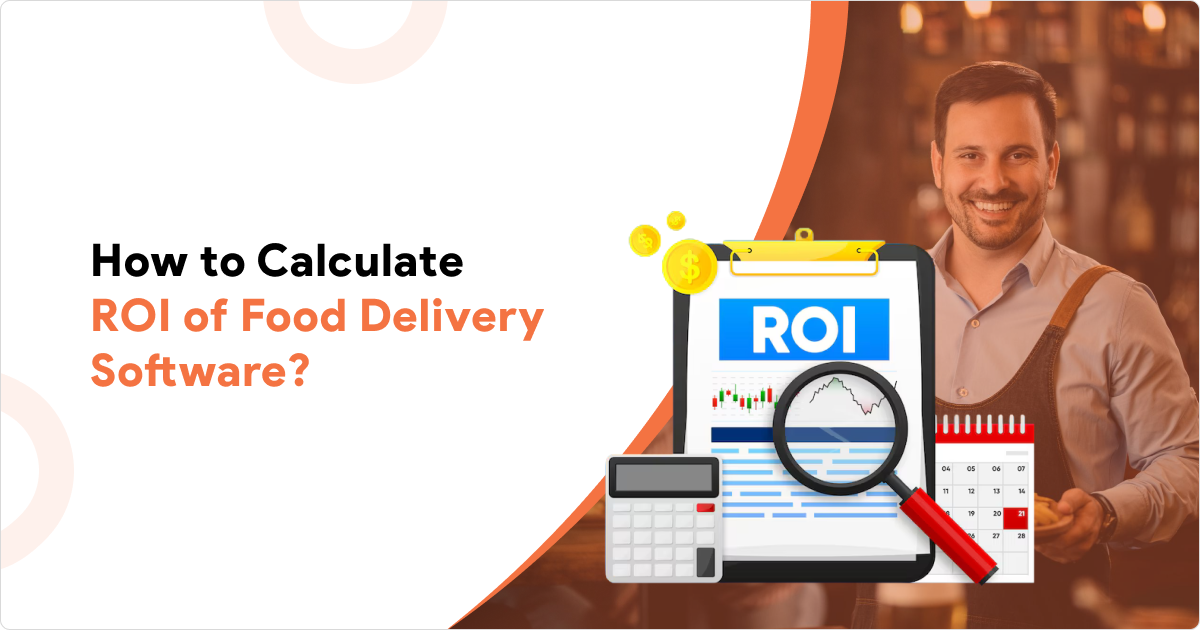
Before you sign any food delivery software contract, you need to run a proper ROI calculation. Not a rough estimate — a structured, five-step analysis that accounts for hard savings, soft returns, and the payback timeline your cash flow can actually absorb. We’ve helped thousands of food businesses across 48+ countries make this decision. Here’s the exact framework we recommend every operator use before committing to any platform.
What is the ROI of food delivery software? The ROI of food delivery software is the net financial return a food business gains from investing in a delivery platform — calculated by measuring all cost savings, revenue gains, and operational improvements against the software’s total annual cost, expressed as a percentage. A positive ROI confirms the investment generates more value than it costs.
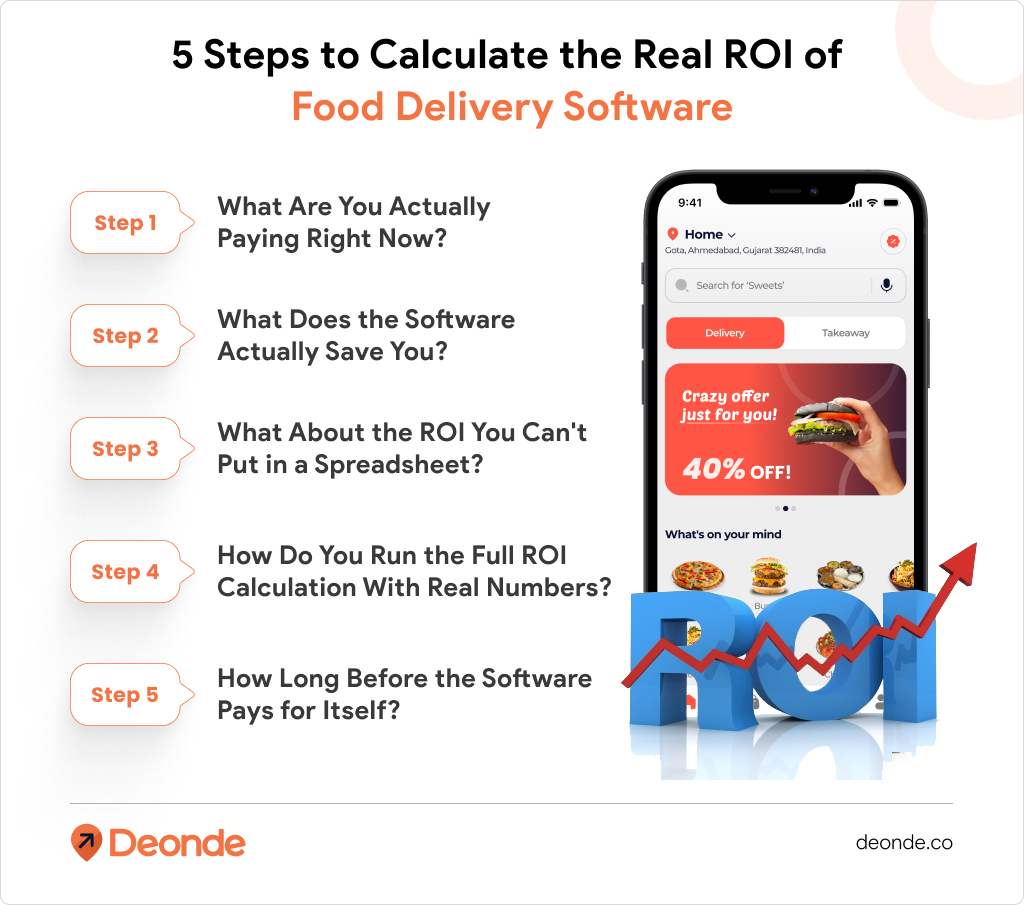
5 Steps to Calculate the Real ROI of Food Delivery Software
Step 1: What Are You Actually Paying Right Now?
Before you measure any ROI, you need an accurate baseline — and most operators don’t have one. Third-party delivery platforms don’t make their true cost easy to see in one place.
Here is what you need to add together:
- Commission fees — the visible cost. DoorDash, Uber Eats, Zomato, Talabat, and similar platforms charge between 15% and 30% per order in base commission. On $5,000 worth of monthly delivery orders, that’s $750–$1,500 leaving your business before you’ve counted anything else.
- Payment processing fees — layer two. Third-party platforms typically charge 2.9%–3.5% in payment processing on top of commission. This fee doesn’t appear in your headline commission rate, but it hits every transaction.
- Marketing and boost fees — layer three. Want visibility on the platform? Sponsored listing fees, campaign costs, and “boost” charges can add another 5%–10% of monthly revenue. Most restaurants spend in this range just to maintain competitive placement within the app’s search results.
- Lost customer data value — layer four. According to research across direct ordering platforms, owning your customer data increases lifetime value by up to 67% through direct marketing and loyalty programs. When a customer orders through a third-party app, their contact info, preferences, and order history belong to the platform — not to you.
Your true current cost formula:
True Monthly Cost = (Commission % × Monthly Revenue) + Payment Processing Fees + Boost Spend + Estimated Customer LTV Loss
Run this against your last three months of delivery data. Most operators we work with discover their real cost is 35%–45% of delivery revenue — not the 15%–30% they originally assumed. That gap is where the real ROI story begins.
Step 2: What Does the Software Actually Save You?
Once you know your true current cost, identifying the hard savings from food delivery software becomes straightforward. These are the numbers you can take directly to a spreadsheet.
Commission elimination. If you process $5,000/month in delivery orders through an aggregator at 25% commission, you’re paying $1,250/month in fees alone. Switch to a commission-free delivery platform and you keep that margin immediately — every single month.
Driver cost savings. Good delivery management software handles auto-dispatch, route optimization, and driver payouts automatically. According to industry data, route optimization alone reduces delivery costs by 20%–35% through fuel savings and fewer missed assignments. (Source: Straits Research, 2025)
Order accuracy savings. Manual order management generates errors. Each error results in refunds, remakes, and customer churn. Automated order management systems reduce error rates significantly — and every prevented refund goes directly back to your bottom line.
Labor efficiency gains. When orders flow automatically from customer to kitchen to driver — without staff manually punching in orders from multiple apps — your labor hours per order drop. For a restaurant handling 50+ orders daily, this typically saves 1–2 staff hours per shift.
Hard Savings Formula:
Annual Hard Savings = (Commission saved per month × 12) + (Driver cost reduction × 12) + (Error reduction savings × 12) + (Labor hour savings × hourly rate × 365)
For most operators processing more than 200 orders per month, this number clears the software’s annual cost well within the first quarter of going live.
Step 3: What About the ROI You Can’t Put in a Spreadsheet?
Hard savings only tell part of the story. Three soft ROI factors matter enormously for long-term profitability — and most operators completely ignore them when evaluating software.
Customer data ownership. When you own your ordering channel, you own the customer relationship. You can run retargeting campaigns, send personalized push notifications, and build loyalty programs that bring customers back directly. Research on direct ordering platforms shows customer reorder rates on direct channels (35%–55%) are roughly double those on third-party apps (15%–25%).
Brand equity recovery. On a third-party app, customers associate their experience with the platform — not your restaurant. Studies show that 43% of customers cannot recall the restaurant name after ordering through a delivery app. Your own platform puts your brand front and center on every order, every notification, and every receipt.
First-party analytics. With your own analytics dashboard, you can see which menu items drive the most reorders, which delivery zones are most profitable, and which promotions generate real revenue versus just discounts. This intelligence compounds over time — and every week on your own platform, your decisions get sharper.
These three factors don’t appear in a monthly savings calculation. However, they determine whether your business is building equity or simply processing transactions for someone else’s platform.
Step 4: How Do You Run the Full ROI Calculation With Real Numbers?
Here is the complete ROI formula for food delivery software:
ROI (%) = [(Annual Savings + Annual Revenue Gains) – Annual Software Cost] ÷ Annual Software Cost × 100
Let’s run a worked example using realistic figures for a restaurant processing $5,000/month in delivery orders.
Current situation — third-party platform:
- Monthly commission (25%): $1,250
- Monthly payment processing fees (3%): $150
- Monthly boost/marketing spend: $250
- Total monthly cost: $1,650
- Annual cost: $19,800
After switching to your own platform:
- Software subscription: $49/month ($588/year)
- Payment processing (2%): $100/month
- Driver management costs: $200/month
- Total monthly cost: $349
- Annual cost: $4,188
Annual hard savings: $15,612
Add conservative soft revenue gains (5% improvement in repeat order rate × monthly volume): Additional annual revenue: $3,600
Total annual return: $19,212 Annual software investment: $588
ROI = [($19,212) – $588] ÷ $588 × 100 = 3,167%
Even if you apply a 70% conservative discount to the soft revenue gains and cut the commission savings estimate by 20%, the ROI still exceeds 1,500%. The math is not close. This is why we consistently see operators call this the highest-ROI technology decision they’ve made for their food business. To understand more about how switching to your own platform increases margins, read our breakdown on how to increase profit margins with your own delivery platform.
Step 5: How Long Before the Software Pays for Itself?
ROI percentage tells you the return. Payback period tells you when you’ll feel it — and that matters for cash flow planning.
Payback Period Formula:
Payback Period (months) = Annual Software Cost ÷ (Monthly Savings + Monthly Revenue Gains)
Using our example:
- Annual software cost: $588
- Monthly savings + revenue gains: $1,600
Payback Period = $588 ÷ $1,600 = 0.37 months — under two weeks
For most food businesses processing more than 150 orders per month, payback happens within the first 30–60 days. For smaller operations under 50 orders/month, expect 2–4 months.
According to SaaS industry benchmarks, a payback period under 12 months is considered excellent for any software investment. (Source: SaaS Capital, 2025) Commission-free food delivery software routinely achieves payback in 1–3 months — a standard almost no other business technology can match.
Before signing any contract, ask the vendor to walk you through this calculation using your actual order volume. If they can’t — or won’t — that tells you something important about how confident they are in their own product’s value.
What Red Flags Should You Watch Before Signing?
Running the ROI calculation is only half the work. The other half is reading the contract carefully. Here are four things that commonly erode the ROI you calculated on paper.
Per-order fees hidden in “processing.” Some platforms advertise zero commission but charge a per-order transaction fee that functions exactly like commission at scale. Always calculate total cost at your actual monthly order volume — not the sample scenario on the pricing page.
Long lock-in periods with no exit clause. If the software underperforms, can you leave? Annual contracts with no early exit clause eliminate your ability to course-correct. We recommend starting with a monthly plan and upgrading once you’ve verified ROI in your first 60 days.
Setup fees that weren’t in the headline price. Implementation costs, onboarding fees, and branded app publishing charges can add significantly to your upfront investment. Factor these into your payback period calculation — they extend the timeline meaningfully for lower-volume businesses.
Analytics locked behind a premium tier. If you can’t measure delivery performance, driver efficiency, and customer reorder rates in your base plan, you cannot manage ROI. Always confirm that reporting and analytics are included — not sold separately. Look at what our commission-free ordering system includes by default to understand what a complete, transparent package should look like.
How We Help You Run the Numbers Before You Commit
We built our pricing model with ROI transparency in mind. Our plans start from $49/month — with no per-order commissions, no hidden boost fees, and no customer data lockout.
Every subscription includes a full analytics dashboard, driver management, delivery zone configuration, online payments, and a branded customer app — so every metric described in this framework is measurable from your first week live.
Before you go live, our team works through this exact five-step ROI calculation with you using your real order volume, delivery frequency, and current third-party spend. We want you to know the numbers before you sign — not six months after.
Explore our pricing or book a live demo to run the calculation on your business. We’ll do the math together.
Frequently Asked Questions
How do I calculate the ROI of food delivery software?
Use this formula: ROI (%) = [(Annual Savings + Annual Revenue Gains) – Annual Software Cost] ÷ Annual Software Cost × 100. Start by calculating your true current cost — commission, payment fees, boost spend, and lost customer data value. Then quantify your hard savings from switching to your own platform. Always run the calculation on your actual order volume, not industry averages.
What is a good payback period for food delivery software?
A payback period under 12 months is considered excellent for any business software investment. For commission-free food delivery platforms, most operators processing 150+ orders/month see payback within 30–60 days. The key variable is your current commission spend — the higher it is, the faster the software pays for itself.
What hidden costs of third-party delivery should I include in my ROI calculation?
Beyond the headline commission rate (15%–30%), include payment processing fees (2.9%–3.5%), sponsored listing and boost fees (5%–10% of revenue), and the estimated lifetime value of lost customer relationships. Most operators discover their true third-party cost is 35%–45% of delivery revenue — not the 15%–25% they originally assumed.
Is food delivery software worth it for a small restaurant?
Yes, if you process more than 50 delivery orders per month. Below that volume, the absolute commission savings may not cover the software cost within the first 1–2 months. However, the brand equity, customer data, and analytics benefits remain valuable even at lower volumes — particularly if you’re building long-term repeat business rather than relying on one-time platform orders.
Which metrics should I track after switching to my own food delivery platform?
Track five metrics monthly: commission saved, average order value, customer reorder rate, delivery error rate, and driver cost per order. Compare these against your pre-switch baseline. By month three, you’ll have a clear, data-backed picture of whether the software is performing as projected — and where you can optimize further.
How does owning customer data affect my ROI?
Customer data ownership is one of the most undervalued ROI drivers in food delivery. Research shows direct channel reorder rates (35%–55%) are roughly double those on third-party apps. Every customer who reorders directly through your branded platform instead of a third-party app adds 100% margin on that order — no commission, no fees, and a stronger relationship with your brand.