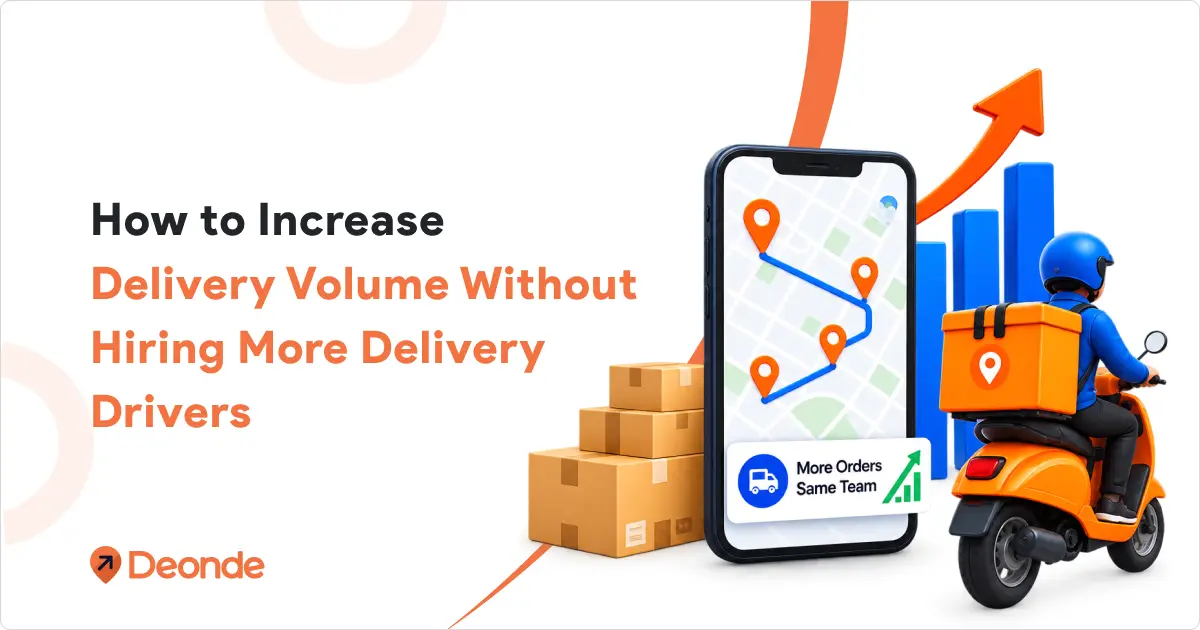
To increase delivery volume without hiring more drivers, raise the number of orders each driver completes per hour.
Do that by auto-dispatching orders, batching nearby drops, tightening delivery zones at peak, moving demand into scheduled slots, cutting pickup waits, and eliminating failed deliveries. Use partner fleets only for overflow.
Hiring looks like the obvious solution, but it comes with hidden costs. You’re not just paying a per-delivery rate. You’re adding recruitment time, training, uniforms, bikes or fuel subsidies, insurance, and management overhead.
More drivers also mean more complexity. More schedules to manage. More variables in your dispatch. More room for error. If your current operations are leaky, adding people just scales the leaks.
Before you post a job, ask a simpler question: how many deliveries is each driver actually completing per shift today, and what’s stopping them from doing more?
This post shows exactly how to do that. No fluff, no theory. Just practical levers you can pull to increase delivery volume without hiring more delivery drivers.
Where Your Delivery Volume Is Actually Being Lost
Most fleets that feel short on drivers aren’t short on drivers. They’re losing paid hours to gaps between orders, long waits at pickup counters, failed drop attempts, and orders sent in opposite directions. Find the leak before you sign another contract.
Compare Planned Time Against Actual Time
Compare how long each route was supposed to take against how long it actually took. The gap is your capacity sitting idle.
Once you see a repeating gap, break it down by route, by hour, by zone. Recurring patterns point to a fixable process problem, not a staffing problem.
The Five Capacity Leaks
Most operations lose driver hours the same five ways:
- Low-density zones – miles driven for too few stops
- Dwell time – drivers parked and waiting at a pickup counter
- Failed deliveries – a trip that delivered nothing and has to be repeated
- Recurring overtime – certain shifts always run long
- Long-tail orders – a few far orders dragging down an otherwise good route
A failed delivery is the worst of the five. It takes your route twice and completes nothing.
Break Cost Per Stop Down By Route
One rising average usually means one bad route. Sort cost per stop by route, zone, and order type, and the problem shows up fast.
Our food delivery route optimization guide covers the math on why fewer miles per stop turns directly into more orders per shift.
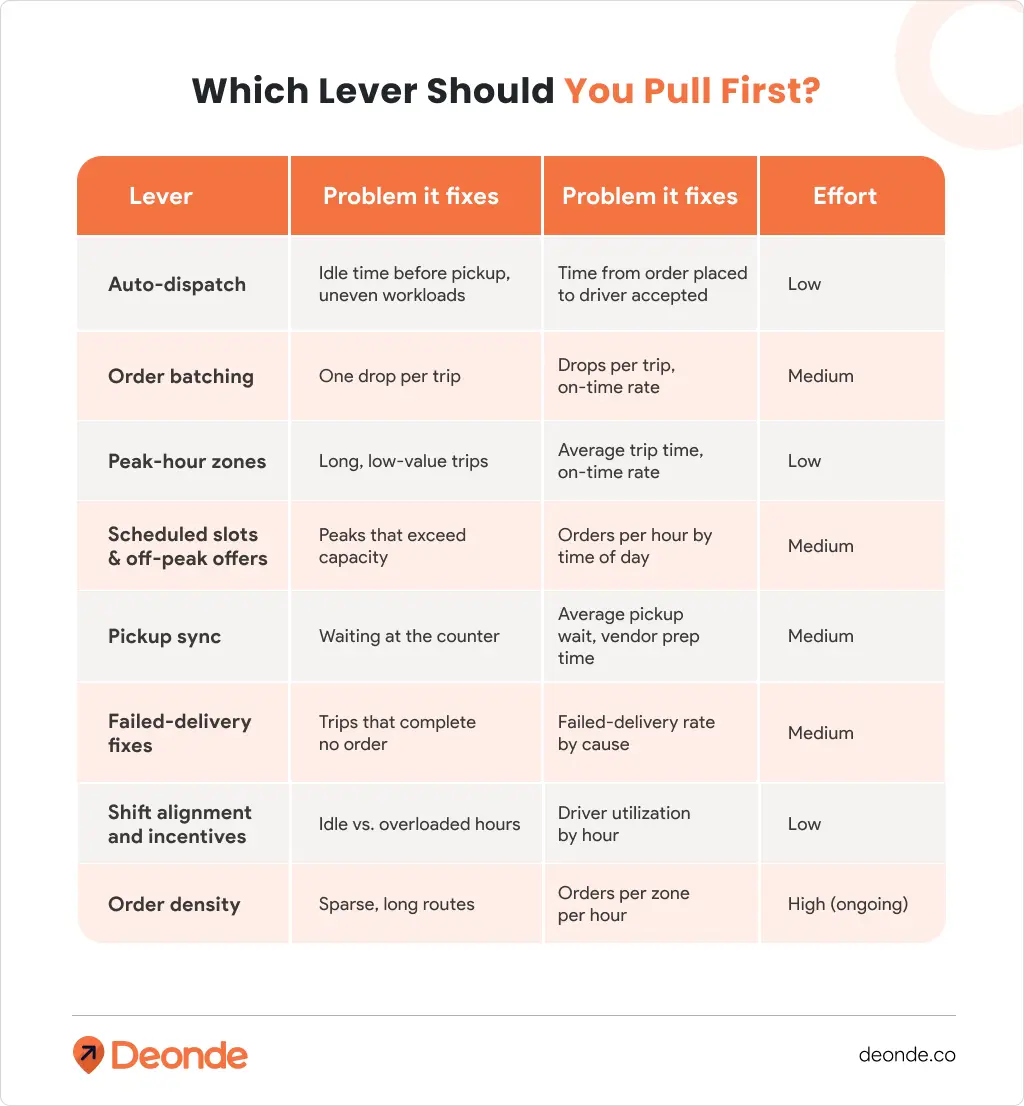
Which Lever Should You Pull First?
| Lever | Problem it fixes | Metric to watch | Effort |
| Auto-dispatch | Idle time before pickup, uneven workloads | Time from order placed to driver accepted | Low |
| Order batching | One drop per trip | Drops per trip, on-time rate | Medium |
| Peak-hour zones | Long, low-value trips | Average trip time, on-time rate | Low |
| Scheduled slots and off-peak offers | Peaks that exceed capacity | Orders per hour by time of day | Medium |
| Pickup sync | Waiting at the counter | Average pickup wait, vendor prep time | Medium |
| Failed-delivery fixes | Trips that complete no order | Failed-delivery rate by cause | Medium |
| Shift alignment and incentives | Idle vs. overloaded hours | Driver utilization by hour | Low |
| Order density | Sparse, long routes | Orders per zone per hour | High (ongoing) |
Step-by-Step: How to Increase Delivery Volume With Your Current Fleet
Five practical changes raise capacity without new hires: automate dispatch, batch nearby orders, sequence routes, redraw zones and time slots, and add flexible drivers only for peaks. Each one lifts orders per driver-hour by cutting idle minutes or wasted kilometers every shift.

Step 1: Replace Manual Dispatch With Auto-Dispatch
Manual assignment is the slowest link at peak. Someone reads the order, checks who is free, messages a driver, and waits for a reply.
Auto-dispatch closes that gap by sending each new order to the nearest available driver as soon as it is confirmed. Keep manual override for large or VIP orders.
Timing matters too. Send the driver when the kitchen is a few minutes from ready, not when the order is placed, so nobody waits at the counter.
Building dispatch logic in-house is slow and costly. Deonde’s food delivery management software with auto-dispatch is a ready-made alternative: it assigns each order within your dispatch radius and reassigns it if a driver doesn’t accept in time.
Step 2: Batch Nearby Orders Into One Run
Batching sends one driver to two or more close drop-offs on a single trip. It cuts kilometers per order and frees the driver for the next pickup.
In the Meituan study, the grouping model batched 13–24% of orders depending on the hour, versus 7–17% under the platform’s usual practice, without holding orders longer.
Hot food sets the limit. An Intouch Insight secret-shopper study of third-party orders found food arrived at the right temperature on 77% of batched orders versus 95% of direct ones.
Cap batches at two orders for hot food. Dry grocery and pharmacy items tolerate larger batches than hot meals.
Deonde’s delivery driver app with multi-order batching shows the driver one sequenced run of pickups and drop-offs, so dispatchers don’t plot it by hand.
Step 3: Sequence Routes Before Drivers Leave
A route that backtracks wastes the same minutes as a traffic jam. Sequencing stops before the driver leaves removes much of that waste.
For multi-stop runs, pick up in ready-time order and deliver the most time-sensitive order first.
Give drivers turn-by-turn navigation so they follow the plan instead of improvising. Compare planned and actual drop-off times for a week to spot habitual detours.
Step 4: Redraw Delivery Zones and Time Slots
Smaller, denser delivery zones keep drivers close to the next order. Set the dispatch radius by area and cap how many orders each time slot accepts.
The same research found long-distance orders rarely find a partner to share a trip, so far zones justify a higher minimum order or delivery fee.
Set slot caps from your own numbers: drivers on shift × orders per driver-hour × slot length in hours. Six drivers at 3 orders an hour allow 9 orders per 30-minute slot.
Let customers schedule orders ahead, so you can plan those runs before the rush hits. Small discounts for off-peak slots help flatten the lunch and dinner spikes.
Step 5: Add Flexible Capacity Only for Peaks
If peaks still overwhelm the fleet, add part-time or on-demand drivers for those windows instead of permanent hires. Payroll stays flat during quiet hours. Schedule extra drivers only for the two windows where your queue grows longest.
FarEye’s survey found 57% of operators run a hybrid fleet, and hybrid networks posted 93% on-time performance.
Deonde’s driver app lets drivers toggle availability and supports incentive programs, which makes staffing only the peaks easier.
Worked Example: What Four Saved Minutes Do for a Six-Driver Fleet
Cutting the average order cycle from 24 minutes to 20 raises output from 2.5 to 3 orders per driver-hour. A six-driver fleet then completes 54 orders in a three-hour dinner peak instead of 45, a 20% gain with the same headcount.
Here is the math I walk new operators through. Orders per driver-hour = 60 ÷ average minutes per order cycle, measured from assignment until the driver is free again.
At 24 minutes, a driver completes 2.5 orders an hour. At 20 minutes, that rises to 3. Over 30 days, six drivers add roughly 270 extra orders with no new hires.
These are round, illustrative numbers, so swap in your own. In my experience, the first minutes come out of assignment delays and backtracking, not from asking drivers to ride faster.
How Should Cloud Kitchens, Grocery, Pharmacy, and Marketplaces Apply This?
Each model batches on a different signal. Cloud kitchens group by prep time, grocery and pharmacy stores by zone and delivery window, and marketplaces by vendor clusters. Start with whichever signal your order density supports, then tighten the rule as volume grows.
Cloud Kitchens
Several brands share one kitchen, so pickups cluster at one door. Send two orders together when their food finishes within minutes of each other and the drop-offs share a direction.
For ghost kitchens, Deonde’s cloud kitchen delivery software runs on a platform that brings ordering, driver dispatch, delivery tracking, payments, and analytics into one system.
Grocery and Pharmacy
Baskets are bigger and delivery windows wider, so batch by zone and slot. One driver can serve a neighborhood in a single loop when drop-offs share a window.
Keep a fast lane for urgent medicine orders and batch routine refills. Deonde offers grocery delivery software and pharmacy delivery software for both models.
Multi-Vendor Marketplaces
Marketplaces can batch across vendors. Pair orders from restaurants in the same cluster when prep times line up, and send one driver to both pickups.
A multi-vendor food delivery marketplace platform like Deonde’s manages vendors, drivers, orders, and revenue from one platform.
The Six Numbers to Track Weekly
Six numbers tell you whether your capacity is real. Track them every Monday, same meeting, same person. Weekly rhythm matters more than perfect accuracy. If you only have time for three to begin, take on-time rate, first-attempt success, and cancellations — those three cost nothing to pull and point straight at where volume is leaking.
| Metric | Healthy range | When it’s low |
| Deliveries per driver hour | 2.5+ | Fix batching and dispatch first |
| On-time delivery rate | 95%+ | Shrink zones or add capacity |
| First-attempt success | 97%+ | Send arrival heads-up, fix addresses |
| How well the fleet is used | 80%+ | Look at shift staggering |
| Cost per delivery | Trending down | Audit zones, fees, and dead miles |
| Cancellations | Under 2% | Check stock sync and prep times |
Track cost per delivery against the figure you need to increase profit margins with your own delivery platform.
Which Delivery Metrics Prove Your Capacity Is Growing?
Track five numbers weekly: orders per driver-hour, average delivery time, on-time rate, cost per delivery, and failed-delivery rate. Capacity is genuinely growing when orders per driver-hour rise while on-time rate holds. If lateness climbs, you are only trading speed for volume.
Review these numbers by zone and by hour, because a single daily average hides the lunch spike.
Watch where-is-my-order contacts too. FarEye found operators with contact rates above 30% reported 17.2% cost inflation, against 7.3% for those at 5% or below.
Live tracking links let customers answer that question themselves.
A dashboard that shows average delivery time, on-time rate, and driver utilization by zone, like Deonde’s admin panel with delivery analytics and reporting, saves you from building spreadsheets.
Count failed deliveries separately. Each one burns a full trip of capacity, so reducing failed deliveries and refund requests in a food app recovers capacity you already pay for.
How Deonde Helps You Scale Delivery Without More Drivers
This is exactly where a purpose-built delivery platform changes the game. Deonde gives you a white-label ordering and delivery management system designed to maximize the capacity of your existing fleet.
With Deonde, you get automated route optimization that factors in real constraints like time windows, service time, and live traffic. Drivers receive dynamic, turn-by-turn routes that adapt as conditions change, so they spend less time planning and more time delivering.
The platform supports intelligent batching and zone-based dispatch, helping you cluster orders in tight areas and avoid costly detours. Built-in navigation, drop notes, and one-tap proof of delivery remove last-mile friction that kills efficiency.
On the operations side, you get dashboards to track deliveries per driver, on-time rates, and bottlenecks in real time. That visibility makes it easy to run the kind of 30-day sprints described above and prove ROI before adding headcount.
If you’re running a restaurant chain, cloud kitchen, grocery, or even a multi-vendor marketplace, Deonde lets you launch your own branded delivery stack in days instead of months. You keep 100% of the order value and own the customer data while scaling capacity with smarter operations.
To see how this would work for your business, book a demo with the Deonde team. They’ll walk you through your current flow, identify quick wins, and show you how much volume you can realistically unlock without hiring more delivery drivers.