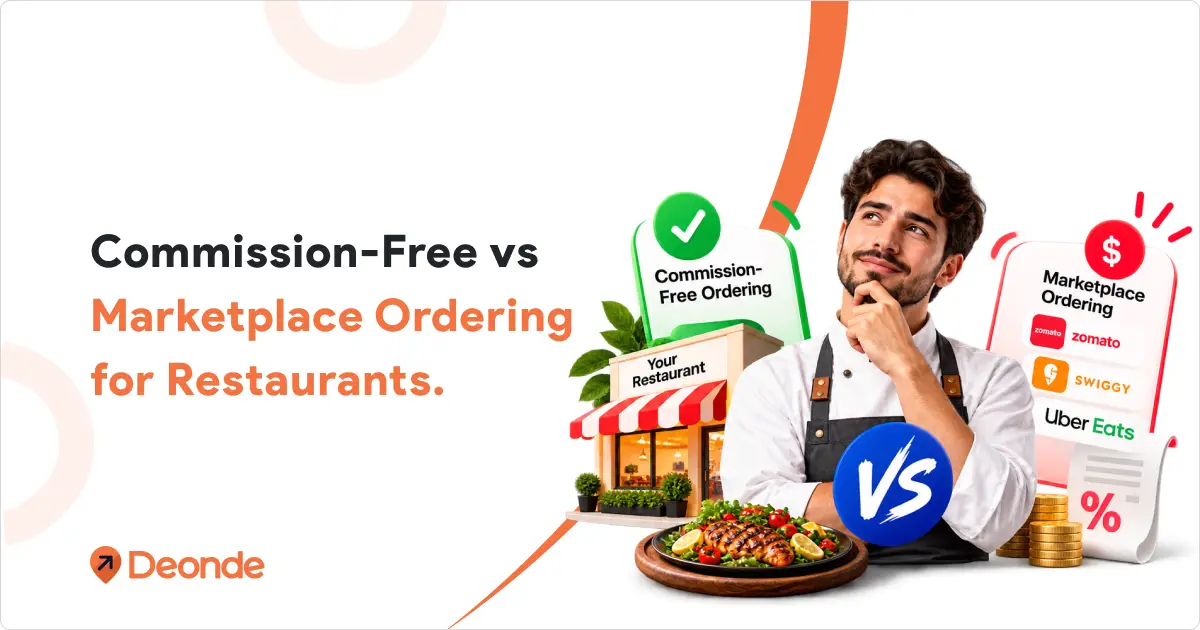
Independent restaurant owners face shrinking margins as delivery marketplaces routinely take 15% to 30% of every transaction.
For an operator generating $40,000 in monthly digital orders, switching to a white-label software platform like Deonde eliminates variable cut rates in favor of a predictable flat monthly subscription.
By migrating off legacy aggregators and tools like GloriaFood to owned customer channels, kitchens preserve their ticket contribution margins while retaining direct control of guest order records.
A full transition requires no proprietary hardware, works with standard thermal printers, and takes two to three days to deploy.
Context: The Marketplace Dependency Trap
Third-party food marketplaces pitch themselves as marketing partners that bring new diners through your door.
In practice, they often act as toll collectors standing between you and your regulars. When a customer orders through a third-party app, the platform captures that user’s contact information, order preferences, and dining habits.
The restaurant receives a ticket and a discounted payout, while the marketplace gets the data required to market competing restaurants to that exact customer next week.
Without the guest’s email address or phone number, you cannot run automated re-engagement campaigns or loyalty programs to bring them back directly.
Using a dedicated online ordering system for restaurants breaks this cycle by keeping the order flow and customer records under your direct control.
Operators who track channel performance know that revenue volume means nothing if the unit economics fail.
According to profitability research, evaluating orders by contribution margin rather than top-line revenue shows how quickly percentage-based commissions erode net earnings.
Marketplaces serve an initial discovery purpose for out-of-town diners, but funneling repeat neighbourhood demand through a 30% toll booth turns high-volume shifts into break-even operations.
The Math Of Direct Ordering: Financial And Commission Faqs
Transitioning to direct ordering fundamentally restructures how digital revenue hits your bank account. Instead of watching payout checks shrink as order counts rise, direct ordering caps your technology overhead at a fixed operating expense.
- Marketplaces take 15% to 30% off gross sales on every delivery order.
- Flat-fee software platforms charge a fixed monthly subscription regardless of your total order volume.
- Direct orders let you retain 100% of order subtotals before third-party card processing fees.
- Repeat customer volume converts from a variable commission expense into protected margin.
| Channel / Plan | Commission Rate | Payment Processing Fee | Technology Cost Model | Net on $50 Order | Customer Data Ownership |
| DoorDash Premier | 30% | Included in plan cut | Variable percentage | $35.00 | Marketplace |
| DoorDash Basic | 15% | Included in plan cut | Variable percentage | $42.50 | Marketplace |
| Uber Eats Standard | 25%–30% | Platform processing cut | Variable percentage | 35.00–37.50 | Marketplace |
| Direct via Deonde | 0% | 2.9% + $0.30 (direct gateway) | Flat monthly subscription | ~$48.25 | 100% Restaurant |
How Does The Flat-Fee Model Compare To 30% Per-Order Commissions?
The economic divergence between percentage models and flat-fee structures widens with every ticket you pack.
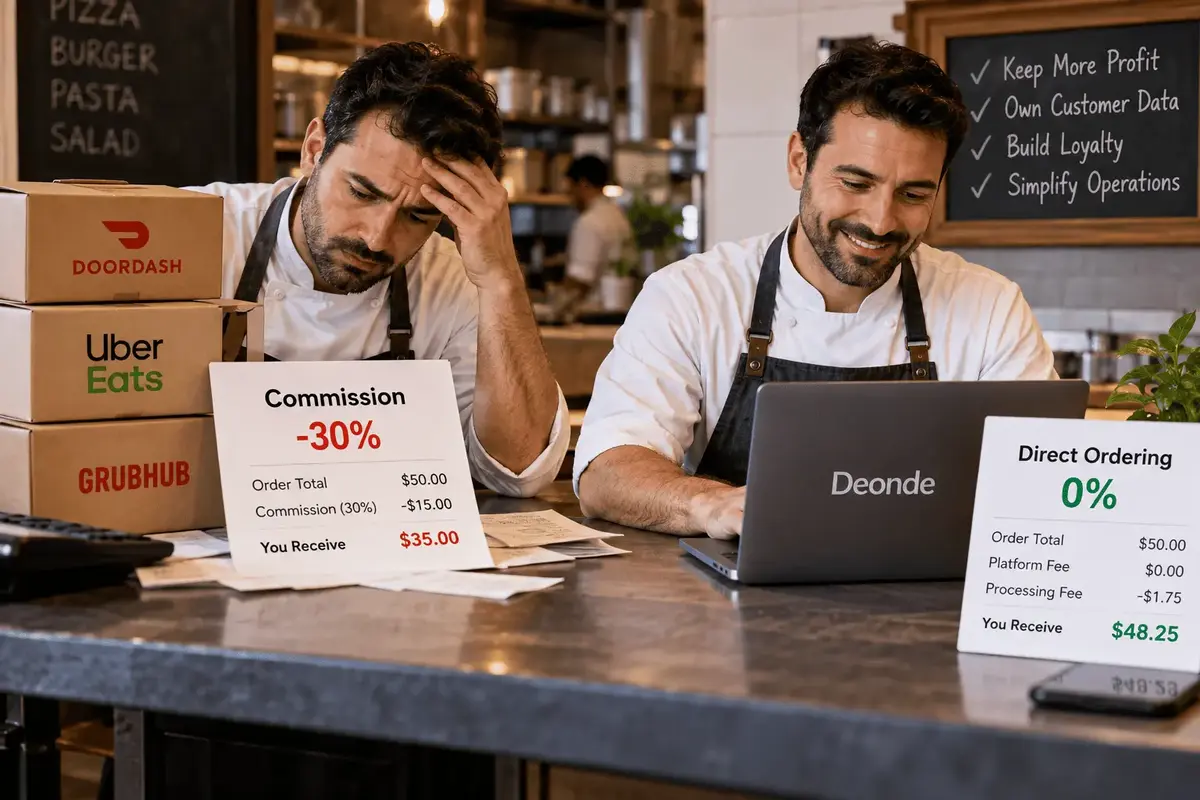
On an average $50 delivery order placed through a top-tier marketplace plan, commission deducts $15.00 immediately, leaving you with $35.00 before you pay for ingredients, packaging, and kitchen labor.
When that same order runs through your own white-label ordering app, the platform commission is zero.
As documented in channel profitability data published by FoodyOS, that single transaction represents an immediate $13.25 swing in retained revenue.
Scale that across 80 weekly digital orders, and a restaurant retains roughly $55,000 in additional cash every year.
That money stays in your operating account rather than funding an intermediary’s infrastructure. Some operators attempt to trim marketplace costs by dropping to lower 15% marketplace tiers.
Analysis from the Wehanda Blog reveals that these budget marketplace tiers regularly push restaurant listings down the algorithmic search stack, costing kitchens 40% to 60% of their platform volume.
Direct ordering through transparent pricing decouples your kitchen from these algorithmic search penalties.
Are There Hidden Gateway Fees For Credit Card Processing?
No software platform can bypass interchange fees charged by banking networks, and honest technology partners state this clearly. Deonde charges 0% commission on orders and has no hidden setup costs, but you still pay standard processing fees to your payment merchant.
When a customer pays on your branded website or app, the transaction passes through an account you own with a payment gateway like Stripe or PayPal. These processors collect their standard direct charge, usually 2.9% plus $0.30 per successful credit card charge.
The critical distinction is transparency and control. You receive settlements directly from the payment processor into your business bank account, rather than waiting for an aggregator to release your funds on their schedule after withholding undisclosed adjustments.
Kitchen Operations: Hardware And Pos Integration Faqs
One common concern for independent kitchens is counter clutter. The image of the “tablet farm” six different devices buzzing with incompatible notification sounds—is an operational headache for front-of-house staff.
- Direct ordering systems run on consumer-grade hardware you already own.
- Incoming kitchen tickets transmit directly to standard thermal receipt printers via Bluetooth or WiFi.
- Major POS setups can ingest orders automatically using direct API connections.
- Front-of-house workers manage order modifications, refunds, and preparation times from one interface.
Do We Need Proprietary Tablets And Receipt Printers?
You do not need to buy expensive, locked-down proprietary hardware to operate a direct ordering system. The merchant management applications run on off-the-shelf equipment, including consumer iPad devices, Android tablets, desktop browsers, or standard smartphones.
Kitchen ticket printing works with hardware already on your counter. The platform pairs with standard ESC/POS thermal printers that communicate over local network WiFi or Bluetooth connections.
When a customer submits a takeout order, your line cooks get a clean physical ticket printed at the expo station with item modifications, customer allergies, and pickup times clearly listed.
Front-of-house teams can accept orders, set custom kitchen preparation windows during lunch rushes, or mark sold-out items from a single tablet screen.
How Does Menu Syncing Work With Existing Pos Setups?
Handling separate menus between your in-store terminal and digital channels creates order errors if changes fail to update in parallel.
Modern delivery systems use direct application programming interfaces to talk directly with your in-store point of sale. When you alter an ingredient modifier or adjust pricing on your central menu, the changes can reflect across your customer-facing digital touchpoints.
For items that do not travel well or sell out mid-service, staff can 86 ingredients directly on the merchant application. The change reflects immediately on your web menu and mobile app, preventing customers from ordering prep items your kitchen cannot fulfill.
The Migration Process: Switching From Legacy Systems
Changing your digital ordering stack sounds disruptive during busy weekly service schedules. Most restaurant owners worry about losing existing customer records or spending hours manually copying menus, prices, and modifier variations into a new system.
- Dedicated migration specialists port existing menus, categories, and modifier hierarchies for you.
- Historical customer records and contact lists move across from legacy systems.
- Turnaround times for fully branded setups average two to three business days.
- Kitchen staff can learn the order-acceptance interface in less than an hour.
What Is The Real Timeline To Launch A Branded App?
The technical setup for a complete white-label system does not take months of custom software development. With Deonde’s food delivery software, independent operators get up and running within two to three days.
A dedicated onboarding team manages the initial configuration, uploads your menu structure, and sets up your brand assets across the administrative console. Operators do not need internal engineering staff to publish branded applications to the Apple App Store or Google Play Store.
This speed allows busy restaurant brands to reclaim their margins without missing a weekend of delivery orders. Debaditya Chaudhury, founder of multi-location restaurant chain Chowman, noted that introducing their own branded app transformed daily operations and gave guests a convenient direct purchasing channel without complex overhead.
MIGRATION TIMELINE AT A GLANCE
Day 1: Menu import, modifier mapping, and payment gateway connection
Day 2: Branding configuration, printer pairing, and staff workflow review
Day 3: Final menu validation, app store submission, and direct channel launch
Can We Port Existing Customer Databases And Menus?
If you currently take orders through services like GloriaFood, Ordering.co, or an older custom web form, you do not have to build your digital catalog from scratch.
A structured migration program imports your item descriptions, categorization structures, modifier trees, and pricing rules directly into the new platform.
Customer databases also carry over. When you own your customer contacts, you can bring phone numbers, addresses, and email lists into your new admin panel.
Once your new apps and web ordering pages go live, you can send an automated announcement SMS or email promotion to your existing diners.
By offering five dollars off their first order placed through your direct app, you convert them into direct purchasers who no longer order through third-party intermediaries.
Brand Control: Managing The Customer Experience
Direct ordering is not just about avoiding commissions; it shapes how guests perceive your hospitality.
A marketplace treats your food as one interchangeable listing among hundreds of nearby kitchens. Direct channels let you set the terms of service.
Through Deonde’s suite of white-label delivery apps and platform, your restaurant controls three distinct customer touchpoints that work together from one operational backend.
1. Branded Mobile Apps
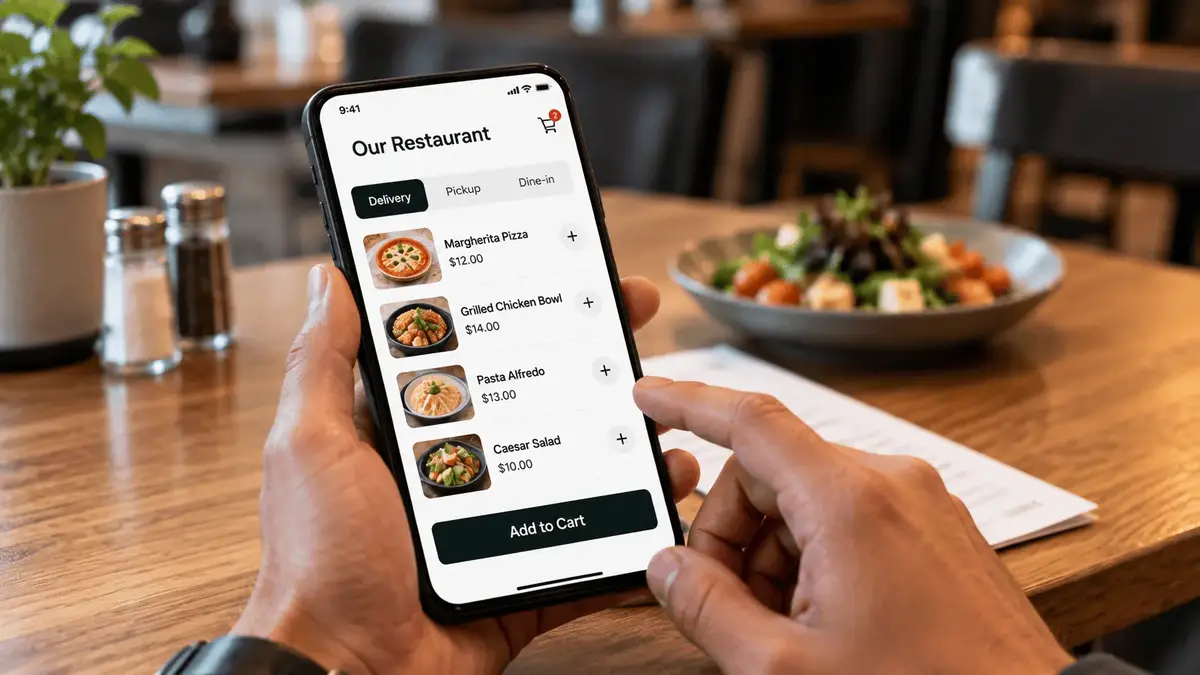
Your guests download an app carrying your restaurant’s name, logo, and brand colors directly from the App Store and Google Play. Diners save payment methods, store favorite delivery addresses, and reorder past meals with a single tap.
Push notifications let you alert loyal customers about seasonal specials or slow-night discounts without spending money on social media ads.
2. Standalone Ordering Website
Customers who do not want to download an app can use a branded, search-engine-ready ordering website that lives on your own custom web domain. The checkout flow requires minimal clicks, integrates secure card payments, and displays your food photos cleanly on desktop and mobile browsers.
3. Digital Table-Side Qr Menus
Direct ordering also streamlines physical dining rooms. Similar to the table-side ordering setups outlined by the Bank of America Merchant Help guide, placing dynamic QR codes on tables allows diners to scan, view the kitchen’s live menu, and submit orders directly from their personal phones.
Guests settle payments immediately, reducing turnaround times for service staff during peak hours.
Reclaiming Your Digital Restaurant Margins
Relying entirely on third-party aggregators leaves independent restaurants vulnerable to rising commissions, unexpected algorithm changes, and disconnected customer relationships.
Marketplaces provide discoverability for new customers, but repeat business belongs on your own platform.
Operating your own direct, commission-free ordering ecosystem gives you the margins required to run a sustainable business.
You keep every dollar earned, own your guest data for repeat marketing, and run kitchen dispatch on standard hardware you already have.
To see how a dedicated ordering platform functions for your kitchen, calculate your current monthly marketplace payouts, compare them against a flat-fee subscription, and visit Deonde to book a live platform demonstration.