Online food delivery is a roughly US$1.5 trillion market worldwide in 2026, according to Statista, a figure that includes grocery delivery. The four markets in this guide show how differently that growth plays out: DoorDash dominates the US, Canada is a three-way race, the UAE is getting more crowded, and Singapore is now a two-app contest.
Below you’ll find the latest 2026 numbers for each market, who leads and why, and the trends worth watching: AI personalization, drones and delivery robots, ghost kitchens, and subscriptions. If you run a restaurant, or you’re one of the many food delivery app startups entering this market, each section ends with what the numbers mean for you.
2026 at a glance
| Market | Who leads (2026) | Size signal |
|---|---|---|
| United States | DoorDash (about 67%), Uber Eats (about 23%), Grubhub (under 10%) | No. 2 market after China (Statista) |
| Canada | Uber Eats, DoorDash, SkipTheDishes | About US$19 billion in 2024, forecast near US$28.6 billion by 2030 (Statista) |
| UAE | Talabat; Deliveroo, Careem, noon and Keeta compete | Talabat: about US$5.6 billion GMV in H1 2026, up 15% at constant currency (all its markets) |
| Singapore | Grab (about 69%), foodpanda (about 24%) | About US$2.9 billion GMV in 2025, up 13% |
How Big Is the Online Food Delivery Market in 2026?
Since the pandemic, ordering through an app has become routine. Today, with just a few taps on a smartphone, people can browse menus from their favorite restaurants and have the same quality of food brought to their door.
Food delivery apps keep growing because they save people time and offer a restaurant-like experience at home.
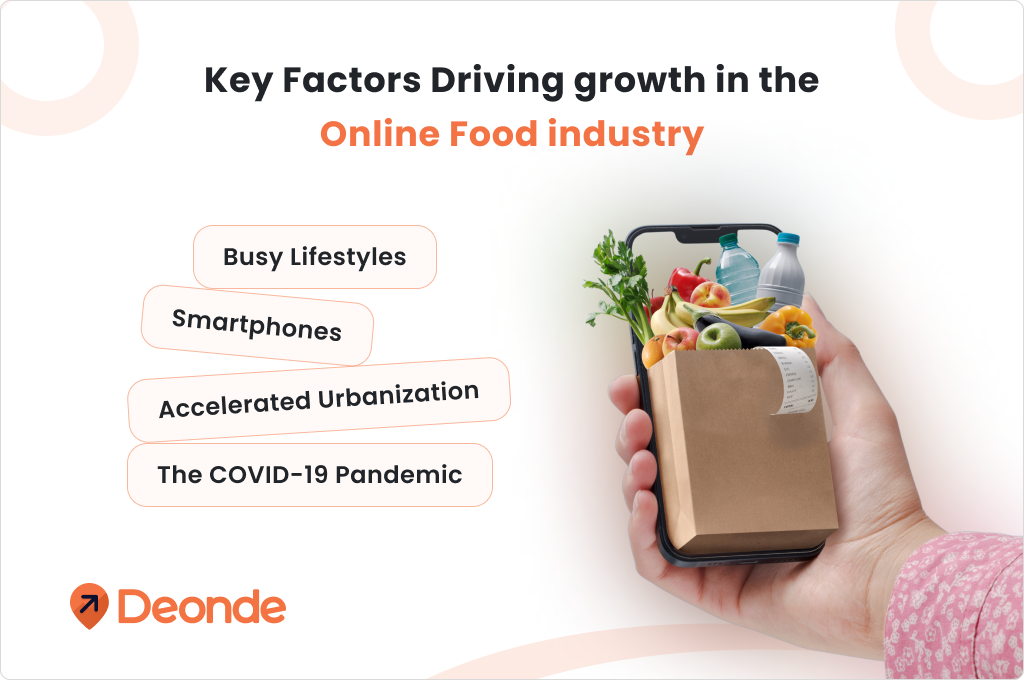
Key factors driving growth
Busy lifestyles
As consumers try to navigate through their chaotic lives, food delivery apps have proved to be a solid anchor. Apps let people order a hot meal from almost anywhere, including between meetings.
Accelerated urbanization
Urbanization has provided the means and resources to deliver food quickly to customers. Dense cities put many restaurants and many customers close together, which keeps delivery fast and affordable.
Smartphones
The widespread use of smartphones has further accelerated the growth of the online food delivery market. App stores are full of user-friendly apps that let people browse menus, place orders, pay, and track an order in real time.
Post-pandemic behavior
The pandemic pushed millions of people to try delivery for the first time, and many kept the habit.
Platform and technology maturity
Today’s delivery apps treat AI-powered recommendations, real-time tracking, subscription programs and contactless checkout as standard features that keep users coming back.
Online Food Delivery Market Size and Statistics (2026)
Statista estimates global online food delivery, meals plus grocery measured as gross merchandise value (GMV), at about US$1.4 trillion in 2025 and US$1.51 trillion in 2026, growing roughly 6% a year through 2031.
- China is the world’s largest market and the US is second (Statista, 2026).
- Grocery delivery is the bigger part of the global total, at about US$1.04 trillion in 2026. That leaves roughly US$0.47 trillion for meal delivery, the part most people mean by “food delivery” (our calculation from Statista’s figures).
- Meal-only estimates from research firms range from roughly US$160 billion to US$415 billion for 2025, depending on how each firm defines the market.
Why market-size numbers differ
Market-size figures for the same industry can differ by a factor of ten because publishers count different things. Statista includes grocery delivery and measures GMV. Other research firms count restaurant meals only, or define “online food delivery” differently. Before you compare two numbers, check three things: whether grocery is included, whether the figure is GMV or platform revenue, and the publication date.
| Publisher | What it covers | Year | Estimate |
|---|---|---|---|
| Statista | Meals plus grocery, GMV | 2026 | about US$1.51 trillion |
| Statista | Grocery delivery only | 2026 | about US$1.04 trillion |
| Statista | Meal delivery only (the remainder) | 2026 | about US$0.47 trillion |
| Spherical Insights | Online food delivery services | 2025 | about US$415 billion |
| IMARC Group | Online food delivery | 2025 | about US$162 billion |
Consumer and platform statistics
- Over 40% of adults order restaurant delivery or takeout three to five times a month (Toast).
- 51% of US consumers turn to a third-party platform such as DoorDash when choosing where to order delivery or takeout (DoorDash, cited by Toast).
- 47% of guests say they would pay $3 to $6 in delivery fees (Toast survey).
- 95% of DoorDash orders in the six months covered by its 2026 trends report came through mobile (DoorDash).
- 95% of restaurant owners say technology improves their restaurant’s overall efficiency (Toast).
For market size, user numbers and app share in more depth, see our online food delivery statistics guide.
US Online Food Delivery Market and Trends (2026)
The US is the world’s second-largest online food delivery market after China, according to Statista. Delivery through apps is concentrated in a few players: DoorDash holds about two-thirds of the market, Uber Eats close to a quarter, and Grubhub under 10%. Growth is being driven by technology investment, platform competition, and a consumer base that has made delivery a permanent habit. Convenient payment options, contactless delivery and online order tracking have all helped bring about that shift.
Key 2026 US market data:
- DoorDash: about 67% of US delivery sales in 2025 (Deliverect). Statista’s earlier estimate was about two-thirds.
- Uber Eats: about 23% to 25%, depending on the source. Postmates is part of Uber’s delivery network, not a separate competitor.
- Grubhub: under 10%, after Wonder bought it from Just Eat Takeaway.com in January 2025.
- Uber One: members make up an estimated 60% to 70% of Uber Eats bookings, depending on the market (Restaurant Business).
- Fees: DoorDash charges restaurants 15%, 25% or 30% depending on the plan. On March 11, 2026, Uber Eats raised its Lite tier from 15% to 20% and added a 30% rate on Uber One member orders in its Plus tier, its first fee increase in roughly a decade (Restaurant Dive).
What is driving US trends in 2026
AI and personalization are now table stakes
DoorDash and Uber Eats use order history, location and time of day to decide what each customer sees first. AI is also changing how people choose where to eat: 22% of consumers have used a tool such as ChatGPT or Gemini to help pick a restaurant, according to DoorDash’s 2026 trends report. Personalization is now expected rather than a differentiator.
Autonomous delivery is moving from pilot toward commercial use
In April 2026, DoorDash and Wing began drone delivery in metro Atlanta, starting near Locust Grove with select restaurants and homes within about four miles. DoorDash says its partnership with Wing has completed tens of thousands of deliveries since 2022 in Virginia, Dallas–Fort Worth and Charlotte. Autonomous delivery is real, but it is still limited to small service areas.
Ghost kitchens are permanent infrastructure
Driven by surging demand in major US cities, delivery-only kitchens have fundamentally shifted the restaurant landscape. They let restaurants and virtual brands reach customers without a storefront.
Subscription loyalty programs are replacing one-off discounts
DashPass and Uber One both use free delivery, exclusive discounts and member perks to build recurring revenue and lock in order frequency. The brands that win in the US market in 2026 are those that give consumers a reason to stay rather than constantly hunting for the next promotion.
Rising fees are pushing operators the other way. Restaurants that pay 15% to 30% per marketplace order are investing in direct ordering for repeat customers.
The rise of third-party delivery services also continues to reshape the US market. These platforms collaborate with local restaurants, bakeries, ghost kitchens, and cloud kitchens to handle end-to-end logistics, giving smaller operators access to a wider audience without building their own delivery infrastructure.
What this means for operators. With two apps controlling most US delivery and commissions of 15% to 30%, independent restaurants and regional chains protect margin by using marketplaces for discovery and direct ordering for repeat customers.
Canada Online Food Delivery Market and Trends (2026)
Food delivery is just as established in Canada. The market is led by three apps: Uber Eats, DoorDash and SkipTheDishes. Skip, which started in Winnipeg, now sits inside Just Eat Takeaway.com, which Prosus took control of in October 2025. Statista figures compiled by Deliverect put Canada’s online food delivery market at about US$19 billion in 2024, with a forecast near US$28.6 billion by 2030.
Key 2026 Canada market data
- Cloud kitchens in Canada are on track to post a 16.78% CAGR through 2031, the fastest of any foodservice type (Mordor Intelligence).
- Quick service restaurants held 53.04% of the Canadian foodservice market in 2025.
- Takeaway is the fastest-growing service channel, at an 18.75% CAGR through 2031.
- Uber Eats, DoorDash and SkipTheDishes dominate the platform landscape.
The three foodservice figures describe Canadian foodservice as a whole, not delivery alone.
What is shaping Canadian food delivery trends in 2026
Ghost kitchens are no longer pandemic-era experiments
They are now a permanent and expanding part of the Canadian food economy. Ghost kitchen aggregators and virtual brands test new concepts without storefronts, launching menus faster and at lower cost than traditional operators.
Fees and pricing are under scrutiny
In June 2025, Canada’s Competition Bureau sued DoorDash, alleging that mandatory fees added at checkout meant customers paid more than the advertised price, a practice known as drip pricing. The Bureau said the practice ran for close to a decade and brought in nearly C$1 billion. DoorDash denies the allegations (The Canadian Press). The case puts a spotlight on how platforms display fees, at a time when restaurants are also watching commissions rise.
Health and sustainability are shaping consumer choice
Canadians are gravitating toward healthier eating, including vegetarian and vegan options, and the major apps now offer dietary filters.
Long winters add to demand
Harsh Canadian winters likely add to demand for delivery, giving operators and platforms predictable seasonal peaks they can plan around.
What this means for operators. With three apps competing and fee practices under scrutiny, Canadian restaurants increasingly use marketplaces for discovery and direct ordering for regulars.
UAE Online Food Delivery Market and Trends (2026)
The UAE is smaller than the US but moves fast, and it is getting more crowded. Consumers have warmed quickly to ordering food online, and Talabat leads, with Deliveroo (now owned by DoorDash), Careem, noon and, since 2025, Meituan’s Keeta competing for orders. Amazon Now has also entered quick commerce, promising 15-minute delivery of everyday essentials. In February 2026, Talabat told investors that competition had intensified in the UAE, and it expects food delivery across the GCC to grow by less than 10% this year.
Key 2026 UAE market data
- Talabat, headquartered in Dubai and operating in eight markets, reported about US$5.6 billion in GMV for the first half of 2026, up 15% at constant currency. In August it raised its full-year GMV growth outlook to 13%–15% (Gulf News).
- More than one in four active Talabat customers subscribe to Talabat Pro, which accounted for 51% of GMV on its platform. 75% of GMV came from customers who order in more than one category.
- Keeta recruited UAE restaurants with a “Founding Vendor” program when it launched.
- Amazon announced Amazon Now in the UAE in October 2025: 15-minute delivery of everyday essentials from micro-fulfillment centers across Dubai and Abu Dhabi.
What is shaping UAE food delivery trends in 2026
Autonomous delivery is moving from announcements to pilots
In November 2025, Talabat signed an agreement with K2, an Abu Dhabi government-owned technology company, to pilot drone-to-station delivery of food and groceries (WAM). In September 2026 it signed another with Singapore-based QuikBot to test robots that handle building access and elevators in Dubai Silicon Oasis (Khaleej Times). An earlier Dubai pilot ran three AI-powered “talabots” within a 3 km radius.
Cloud kitchens thrive on high rents and strong logistics
Cloud kitchens work particularly well in the UAE because high real estate costs make traditional storefronts expensive, while delivery infrastructure is strong. Delivery platforms such as Talabat and Deliveroo have become the main distribution layer for cloud kitchen brands targeting specific cuisines or dietary preferences.
AI personalization is standard on major platforms
Major platforms personalize recommendations from order history, browsing behavior and time of day. This is no longer a competitive advantage. It is the minimum expectation.
Health-conscious and cold beverage demand reflect the climate
In a country where temperatures regularly exceed 40°C, demand for cold beverages, fresh juices, smoothies and health-focused meals is structural, and platforms have expanded their vendor lists accordingly.
Government support accelerates the market
Dubai’s Roads and Transport Authority aims to make 25% of trips smart and driverless by 2030 and has run delivery-robot pilots with Talabat. That policy backing helps explain why the UAE has become a testing ground for delivery automation.
What this means for operators. With five or more apps competing, restaurants and cloud kitchens gain by listing on several marketplaces while building a direct channel they control.
Food Delivery Trends: Singapore
Singapore is known for its vibrant food scene. As a consequence, it has witnessed a surge in online food delivery services:
The Singapore foodservice market is valued at USD 34.24 billion in 2026 and is projected to reach USD 79.73 billion by 2031 at an 18.42% CAGR.
Food delivery is the fastest-growing channel within that market, projected to grow at a 20.10% CAGR from 2026 to 2031. User penetration in Singapore’s meal delivery market has reached nearly 65% in 2024, one of the highest rates in the world.
Key 2026 Singapore market data
- The Singapore quick commerce market stands at USD 368.03 million in 2025 and is estimated to reach USD 502.86 million by 2031 at a 5.37% CAGR.
- GrabFood dominates with a 69% GMV share of food delivery apps in Singapore, while Foodpanda holds 24% of the market.
- The 11-to-30-minute delivery segment is the sweet spot, commanding 57.45% of the Singapore quick commerce market share in 2025.
- 43% of Singapore consumers are willing to use quick delivery services for restaurant meals
- 60% of Singaporeans order food delivery at least once a week.
- 50% of Singaporeans prioritize health in their food choices.
- 38% of consumers are influenced by food photography when placing orders
What is Shaping Singapore Food Delivery Trends in 2026
5G infrastructure is the hidden competitive advantage
Singtel’s upgrade of 1.5 million users to its 5G+ network quadrupled data throughput for quick commerce fleets, enabling real-time inventory synchronization and high-resolution routing that reduces dead mileage and shortens pick-pack times.
Singapore’s combination of high urban density and 5G infrastructure makes it one of the best-suited environments for quick commerce in the world.
Health-conscious demand is not a niche. It is the market
Singapore’s younger consumers and health-aware diners are driving demand for plant-based meals, gluten-free options, and functional beverages. GrabFood, Foodpanda, and Deliveroo have all expanded their health-forward vendor categories in response.
Platforms that surface nutritional information and ethical sourcing details are seeing stronger engagement from Singapore’s demanding consumer base.
Sustainability is an expectation, not a differentiator
Singapore’s government aims to reduce food waste by 35% in the coming years. Eco-conscious packaging, reduced food waste programs, and electric vehicle delivery fleets are no longer bonus features.
They are what an increasing share of Singapore’s consumers expect as standard. Operators who have not addressed sustainable packaging are losing ground to those who have.
Competition drives constant innovation
Singapore’s food delivery space is one of the most competitive in Asia-Pacific. To attract and retain consumers, platforms offer large discounts, loyalty programs, and expanding cuisine variety that spans dozens of international food cultures.
The competitive pressure has been good for consumers and has pushed every major platform to keep improving both speed and user experience.
The financial hub effect
Singapore has established itself as Asia’s financial and tech hub, attracting international talent, investors, and businesses. This has made the city an attractive entry market for food delivery platforms expanding across Southeast Asia, which in turn has accelerated local innovation and raised the quality bar for every operator in the market.
Moreover, Singapore has established itself as a financial hub and has attracted a lot of financial investors and talent in the last decade, As a result, many international food delivery services are also trying to get their foot in the Singaporean food delivery market.
Future of food delivery trends
Food delivery trends continue to evolve rapidly amidst technological advancements and changing customer preferences. Here are a few to look out for this year:
- Contactless and hyper-local deliveries that provide services within a few minutes are becoming extremely favorable in urban areas.
- Optimized operations of cloud and ghost kitchens enable them to serve customers online efficiently. Hence are becoming increasingly popular on food delivery apps.
- AI-powered recommendations that suggest personalized dishes based on past orders are becoming a go-to feature in all major third-party food delivery mobile apps.
- Customized meal kits, where customers can pick their ingredients and recipes to create food at home, are also in high demand.
- Food delivery apps are also rapidly expanding their food delivery services to include grocery delivery, fresh produce delivery, and meat delivery.
- Food delivery providers are also offering monthly subscription discounts to promote customer loyalty.
- Contactless payments and digital wallets are becoming the preferred payment methods for food delivery
Summary
Needless to say, the food delivery market is booming globally. Factors like busy lifestyles, rapid urbanization, the COVID-19 pandemic, access to technology, and government initiatives have catalyzed the growth of the food delivery market.
While the US is the largest market with robust food delivery service growth, countries like Canada and Singapore are also catching up. Some common trends across these regions include the shift to healthier eating options and the rising popularity of cloud kitchens.
On the other hand, some technical features have also played a pivotal role in the rapid adoption of online food delivery services. Features like contactless deliveries, easy payment options, live tracking, and easy-to-navigate menus have encouraged people to choose online ordering over dine-in.
In highly competitive markets like Singapore or UAE, the need for well-designed ordering apps is on the rise. Consumers like to order frequently from apps that are easy to navigate, provide a variety of culinary options, and are safe to use.
Deonde is dedicated to creating and building high-quality white-label food delivery apps so that food delivery startups can get their leg up on the competition and churn profits in competitive regions.
Deonde’s dedicated data and analytics tools like interactive dashboards and easy-to-read reports help enterprises understand customer preferences. As a result, Deonde users witness huge traffic on their food delivery apps.
With Deonde you can convert first-time users to life-long loyal customers. If you want to see how we can help you do this, please connect with us.
We’re here to help you kickstart your food delivery business even in competitive spaces.
FAQ’S
How big is the online food delivery market in 2026?
It depends on the definition. Statista estimates about $1.51 trillion globally in 2026 when groceries are included with restaurant meals. Restaurant meal delivery alone is much smaller: in the US, Statista put it a little above $100 billion in 2025, out of roughly $432 billion in total.
Who has the largest share of US food delivery?
DoorDash, with roughly two-thirds of restaurant meal delivery, followed by Uber Eats at about a quarter and Grubhub under 10%. Estimates vary by tracker.
Is Deliveroo still available in Singapore?
No. Deliveroo exited Singapore in March 2026, leaving GrabFood and foodpanda as the two main platforms.
What changed in UAE food delivery recently?
Keeta, Meituan’s international platform, launched in Dubai on September 27, 2025 and reached all seven emirates by December. It competes with Talabat, Deliveroo (now DoorDash-owned), Careem Food and Noon Food.
Are ghost kitchens still growing?
Some large operators have retreated, but delivery-only brands run inside existing restaurant kitchens remain popular. Forecasts differ widely, so check the definition before quoting a figure.
Does Grubhub operate in Canada?
Grubhub is primarily a US platform. Most Canadians order through Uber Eats, DoorDash or Skip The Dishes.