Modern life is busy. Between work, family, and personal commitments, many people struggle with meal planning, grocery shopping, and cooking healthy meals. Add the desire for sustainable and balanced eating, and the challenge becomes even bigger.
Did you know the global meal kit delivery services market is expected to hit USD 64.27 billion by 2030? That’s massive growth and it shows how hungry today’s consumers are for smarter food solutions.
This is where meal subscription apps step in. They take the stress out of planning, bring convenience to your fingertips, and allow people to eat better without wasting time or food.
This article provides a complete blueprint for entrepreneurs and businesses looking to enter this lucrative market. We will go beyond the “what” and “how” of meal subscription app development to explore the critical business aspects: the meal kit app cost, effective monetization strategies for meal apps, and how to calculate a profitable food delivery app ROI.
Why Now is the Time to Develop a Meal Subscription App?
The meal kit and food delivery market has exploded in recent years. Companies like HelloFresh, Blue Apron, Chefs Plate, and Home Chef have proven the demand, with millions of active subscribers worldwide.
As more consumers turn to digital-first food solutions, startups and businesses have a chance to carve out their own space in this growing industry.
Target Audience: Serving Every Palate
A successful app understands its users intimately. Key segments include:
The Busy Professional
This user values time above all. They need quick, delicious, and easy-to-prepare meals that fit seamlessly into their hectic schedule. Convenience, speed, and minimal cleanup are their top priorities.
The Health-Conscious Individual
This user is looking for curated, nutrient-dense meal plans that align with their specific dietary goals. They need features that allow for customization based on caloric intake, macros, and ingredients.
The Family
This segment aims to simplify the chaos of family dinners. They need a solution that pleases multiple palates, reduces grocery store trips, minimizes food waste, and makes cooking a fun, shared activity.
The Unique Selling Proposition (USP): Finding Your Niche
To stand out in a growing market, you need a distinct flavor. How will your app be different? Your USP could be built around:
- Niche Diets: Focus exclusively on specialized eating plans like keto, paleo, low-FODMAP, vegan, or gluten-free.
- Cuisine Specialization: Become the go-to app for authentic Italian, vibrant Thai, or spicy Mexican cuisine.
- Sourcing Philosophy: Emphasize a commitment to local, farm-to-table, or certified organic ingredients.
- Hyper-Convenience: Offer pre-chopped ingredients or ready-to-heat meals that require virtually no prep time.
The Essential Features: The Ingredients of a High-Performing App
A successful app is a well-balanced recipe of user-centric features and robust backend management.
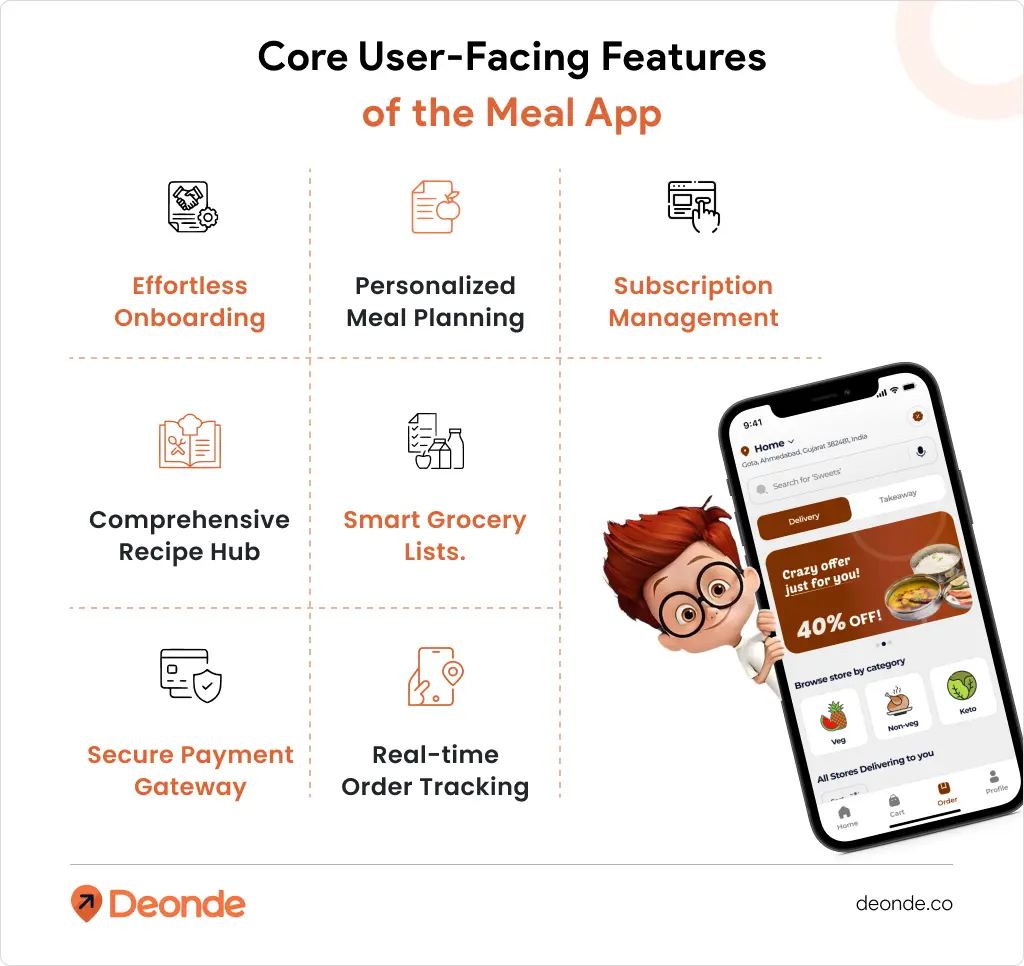
Core User-Facing Features
- Effortless Onboarding: Get users from download to discovery in seconds. With social logins and a streamlined setup, you reduce drop-offs and deliver value instantly.
- Personalized Meal Planning: The heart of the app. Users must be able to filter meals by dietary restrictions, allergies, cooking time, preferred ingredients, and nutritional goals.
- Subscription Management: A clear and simple user dashboard to easily change plans, skip weeks, update delivery dates, and manage payment information.
- Comprehensive Recipe Hub: A visually appealing library of recipes with high-quality photos, step-by-step video or text instructions, and detailed nutritional information.
- Smart Grocery Lists: For services that don’t deliver all ingredients, automated lists that sync with the user’s selected recipes are a must-have.
- Secure Payment Gateway: Integration with multiple trusted payment options like Stripe or Braintree, supporting credit cards, Apple Pay, and Google Pay.
- Real-time Order Tracking: GPS-enabled tracking that gives users peace of mind by showing them exactly where their delivery is and when it will arrive.

Admin & Logistics Panel Features
- Dashboard for Order & User Management: A central command center to oversee all orders, manage customer accounts, and handle support inquiries.
- Inventory & Menu Management: Powerful tools to track ingredient stock levels in real-time and effortlessly update or rotate weekly meal options.
- Logistics & Delivery Route Optimization: Integrated software to create the most efficient delivery routes, saving valuable time and fuel costs.
- Analytics & Reporting: A crucial feature for business intelligence. This dashboard should track key metrics like sales trends, most popular dishes, customer churn rates, and user demographics.
The Cost Breakdown: An Investment in Your Digital Business
Understanding the cost of meal subscription app development is the first step in financial planning. The price is not a single figure but a range influenced by several key factors.
Factors Influencing Development Cost
Complexity
A Minimum Viable Product (MVP) with only essential features will be significantly more affordable than a complex, full-featured app with AI-driven recommendations and third-party hardware integrations.
Platform
Developing for a single platform (iOS or Android) is the most budget-friendly option. Cross-platform development (using frameworks like React Native or Flutter) offers a good balance, while building separate native apps for both platforms is the most expensive but highest-performing choice.
Location of the Development Team:
Hourly rates for skilled developers vary drastically by region:
- North America/Western Europe: $100 – $200+/hour
- Eastern Europe: $50 – $80/hour
- Asia (India, etc.): $25 – $50/hour
UI/UX Design
A completely custom, beautifully branded, and animated user interface will cost more than a clean design based on standard templates.
Cost Estimate Table
|
App Tier |
Estimated Cost Range |
Description |
|
Basic App (MVP) |
$25,000 – $50,000 |
Essential features, one platform, standard UI/UX. |
|
Mid-Tier App |
$50,000 – $120,000 |
Advanced features, cross-platform, custom design, some integrations. |
|
Complex/Enterprise-Grade |
$120,000 – $300,000+ |
AI personalization, real-time analytics, complex logistics, full integrations. |
Ongoing Costs (The “Hidden” Expenses)
Your budget doesn’t end at launch. Plan for these recurring costs:
- Maintenance & Updates: Budget approximately 15-20% of the initial development cost annually for bug fixes, OS updates, and security patches.
- Server Hosting & Infrastructure: Monthly or annual fees for cloud services like AWS or Google Cloud.
- Third-Party APIs: Subscription costs for payment gateways, map services (Google Maps API), and SMS notification services.
- Marketing & Customer Acquisition: A significant and continuous budget is required to acquire users and build a brand presence in a competitive market.
The Path to Profitability: Monetization Strategies and ROI
A great app is only half the battle. A solid business model is what turns your vision into a profitable venture.
Monetization Models
- Subscription Model (Primary): The core of the business. Offer tiered pricing based on the number of meals per week, the number of people served, or access to premium recipes.
- Delivery Fees: Charge a flat fee for each delivery or incorporate it into the subscription price. Offering free delivery for higher-tier plans can be a powerful incentive.
- Upselling & Add-ons: Increase the average order value by offering à la carte items like desserts, snacks, wine pairings, or premium protein options.
- Sponsored Content/Promotions: Partner with complementary food brands or kitchenware companies to feature their products or offer exclusive promotions to your user base.
Calculating Return on Investment (ROI)
The ultimate measure of your business’s health is its ROI.
The Formula: The basic formula is straightforward:
ROI = ((Revenue – Investment) / Investment) × 100%
Key Metrics to Track: To use this formula effectively, you need to monitor these metrics obsessively:
- Customer Lifetime Value (LTV): The total revenue you expect to generate from a single customer throughout their time as a subscriber.
- Customer Acquisition Cost (CAC): The total cost of sales and marketing required to acquire one new paying customer.
- Churn Rate: The percentage of customers who cancel their subscription within a given period. A high churn rate can cripple profitability.
Goal: The simple equation for a sustainable business is LTV > CAC. Your customer must be worth more to you than it costs to acquire them.
Example ROI Scenario:
Let’s say your initial investment (app development + initial marketing) is $100,000.
- You acquire 500 paying subscribers in your first six months.
- Your CAC is $100,000 / 500 = $200.
- Your average subscriber pays $60/month and stays for an average of 10 months.
- Your LTV is $60 * 10 = $600.
- Since LTV ($600) is greater than CAC ($200), you have a viable business model. The revenue from these 500 users is $300,000.
- Your ROI would be (($300,000 – $100,000) / $100,000) * 100% = 200%.
Final Words: Cooking Up Success with Meal Subscription Apps
The demand for convenient, healthy, and personalized meal solutions is only going to rise. With busy lifestyles and a growing focus on sustainability, meal subscription apps are no longer just a trend, they’re becoming a way of life.
For entrepreneurs, this market presents a golden opportunity. By focusing on user needs, building a unique selling proposition, and carefully managing development costs, you can create a meal app that not only stands out but also delivers long-term profitability.
Success doesn’t come from the app alone, it comes from pairing smart technology with a strong business model. With the right features, clear monetization strategies, and a focus on customer retention, your meal subscription app can become more than just another delivery service, it can become a trusted partner in your users’ daily lives.
In short if you’ve been waiting for the right time to invest in this space, that time is now. The ingredients for growth are all here, it’s up to you to put them together and serve a winning product.
Ready to build your own meal subscription app? Let’s turn your idea into a profitable, user-focused solution that stands out in this growing market.