Running out of fuel at the wrong time is a hassle every driver knows too well. Long queues at gas stations and unexpected delays only make it worse.
For businesses with fleets, every extra stop means wasted time, higher costs, and lower productivity. Convenience has become a must, not a luxury.
That’s why on-demand fuel delivery apps are gaining massive popularity. Just like food delivery or ride-hailing, they bring fuel directly to where it’s needed.
This growing market is reshaping both personal refueling (B2C) and commercial operations (B2B), offering safety, transparency, and time savings.
Grand View Research, the global on-demand fuel delivery market is projected to expand at a compound annual growth rate (CAGR) of 21.3% through 2030.
In this guide, we’ll explore everything about fuel delivery app development — from how it works and must-have features to challenges, solutions, and future opportunities.
What is a Fuel Delivery App?
A fuel delivery app is an on-demand platform that connects users who need fuel, diesel, or gas that delivers it directly to their location. Customers can request fuel through the app, and a certified driver delivers it directly to their location. It works just like food or grocery delivery apps, but for gasoline and diesel.
Why Now Is The Perfect Time To Launch An Online Fuel Delivery App?
Before we dive into the “how,” let’s talk about the “why now.” Many on-demand markets, like food delivery or ride-sharing, are crowded with giant competitors. But on-demand fuel is different. It’s an emerging frontier.
Right now, the mobile fuel delivery market is largely unorganized. It’s a landscape of a few small, local players, with no single dominant brand. This isn’t a fiercely competitive market; it’s a wide-open field of opportunity. For an ambitious entrepreneur, this is the signal you’ve been waiting for.
Launching a professional, well-built fuel delivery app today gives you a powerful first-mover advantage.
You get to capture the market, build a loyal customer base, and set the standard for service in your area before it becomes saturated. The first companies to establish trust and efficiency will become the household names of tomorrow’s fuel industry.
The potential for growth and profit is immense. Without the massive overhead costs of a physical gas station (prime real estate, construction, staffing), a mobile delivery model is lean and can be significantly more profitable.
When you add the ability to secure lucrative B2B contracts with businesses that have large vehicle fleets, you have a recipe for a highly scalable and successful venture.
In short, the question isn’t whether on-demand fuel will become a mainstream service but who will be the leaders that make it happen. The market is ready, the technology is available, and the customers are waiting.
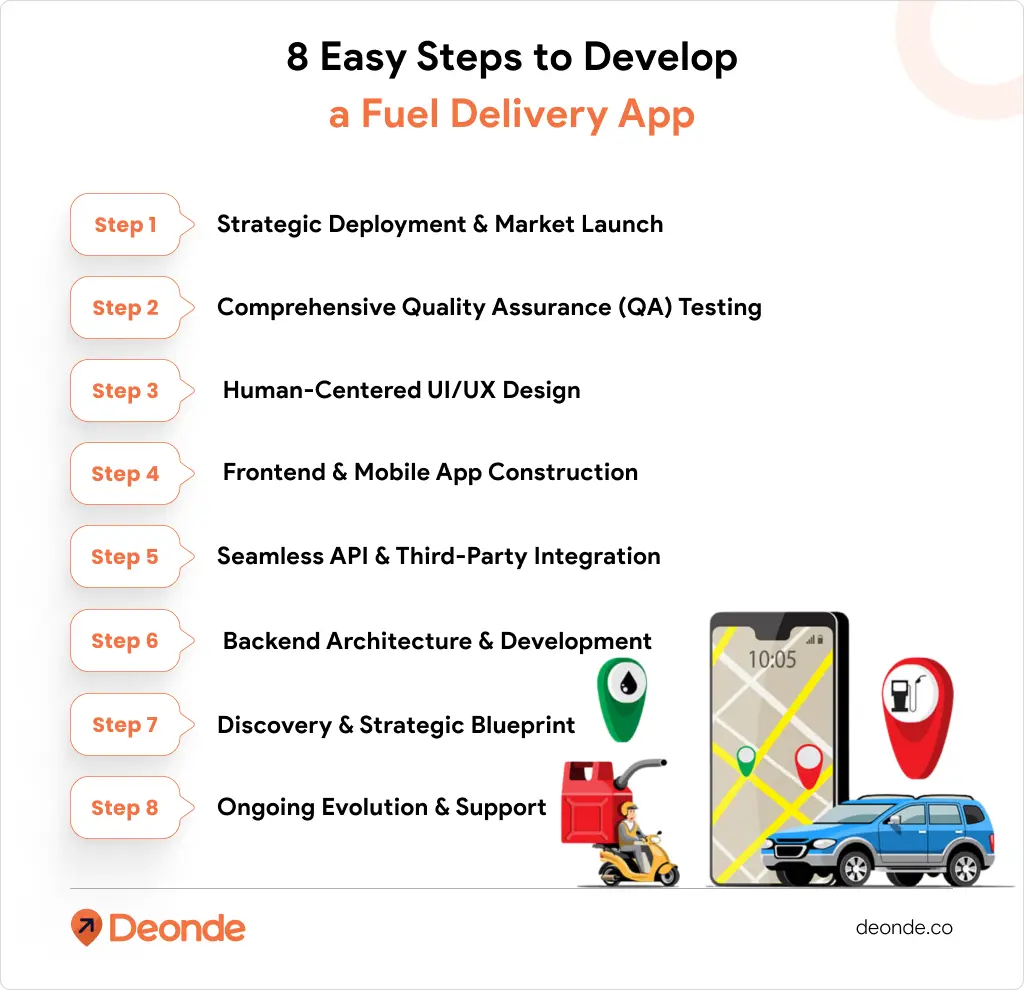
8 Easy Steps to Develop a Fuel Delivery App
Building a high-quality fuel delivery app is a collaborative journey, not just a one-time project. It requires careful planning, technical expertise, and a deep focus on the end-user.
Here’s a clearer, in-depth look at the 8 essential Steps that turn an idea into a successful, market-ready application.
Step 1: Discovery & Strategic Blueprint
This is the foundational phase where a great idea is transformed into a viable business plan, before writing any code.
- In-depth Workshops: Collaborating to understand your vision, target audience (e.g., busy urban professionals vs. commercial fleets), and business goals.
- Competitor Analysis: Studying existing solutions to identify market gaps and define your Unique Selling Proposition (USP), what makes you better?
- MVP Scoping: Prioritizing the absolute “must-have” features for a successful first launch (Minimum Viable Product), ensuring a faster time-to-market without sacrificing quality.
- Monetization Strategy: Deciding how the business will generate revenue, whether through delivery fees, subscriptions, or a per-gallon service charge.
Step 2: Human-Centered UI/UX Design
This phase is dedicated to designing how the app will look, feel, and function from a user’s perspective. The goal is an app that is not only beautiful but also intuitive and effortless to use.
- User Journey Mapping: We chart every possible path a user can take to ensure the experience is logical and frustration-free.
- Wireframing: Creating the structural skeleton of the app’s screens to focus on layout and functionality before adding color or graphics.
- Interactive Prototyping: Building a clickable, high-fidelity model of the app. This allows you to experience the app’s flow and provide crucial feedback before development begins.
- Visual Design: Applying your brand’s identity, color palette, typography, and iconography to create a polished and professional look that builds trust.
Step 3: Backend Architecture & Development
The backend is the invisible engine that powers the entire ecosystem.
- Robust Technology Stack: We select the right programming languages (like Node.js, Python), databases (like PostgreSQL), and server technologies to ensure your app is secure, fast, and scalable.
- Scalable Server Architecture: Designing a cloud-based infrastructure that can handle thousands of users from day one and grow with your business.
- API Development: Creating secure communication channels that allow the customer app, driver app, and admin panel to talk to each other seamlessly.
Step 4: Frontend & Mobile App Construction
This is where the visual designs are brought to life as a fully functional application with which users can interact.
- Platform-Specific Development: We decide the best approach for your mobile apps, building natively (Swift for iOS, Kotlin for Android) for the highest performance, or using a cross-platform framework (like React Native) to optimize for speed and budget.
- Pixel-Perfect Implementation: Our developers translate the UI/UX designs into clean, efficient code, ensuring the final product matches the approved prototype perfectly.
- Admin Panel Development: We build a powerful, web-based dashboard for your team using modern frameworks like React or Angular, giving you full control over your operations.
Step 5: Seamless API & Third-Party Integration
To provide a complete and modern experience, the app must connect with essential external services.
- Payment Gateways: Integrating trusted providers like Stripe to handle credit card and digital wallet payments securely.
- Mapping & Geolocation: Using services like Google Maps API for accurate location pinning, real-time tracking, and efficient route optimization.
- Communication Tools: Implementing services like Twilio for SMS alerts and Firebase for push notifications to keep users informed at every step of the delivery process.
Step 6: Comprehensive Quality Assurance (QA) Testing
Before launch, the application is subjected to rigorous testing to ensure it is stable, secure, and bug-free.
- Functional Testing: Verifying that every button, form, and feature works exactly as intended.
- Performance & Load Testing: Simulating heavy user traffic to ensure the app remains fast and responsive even during peak hours.
- Security Audits: Probing the system for vulnerabilities to protect user data and financial information.
- Compatibility Testing: Ensuring the app works flawlessly across a wide range of devices, screen sizes, and operating systems.
Step 7: Strategic Deployment & Market Launch
Once the app has passed all quality checks, it’s ready to go live. This is a carefully managed process:
- Server Deployment: We set up and configure the live server environment on a scalable cloud platform like Amazon Web Services (AWS).
- App Store Submission: We navigate the complex submission and review processes for both the Apple App Store and Google Play Store, ensuring your app meets all guidelines.
- Phased Rollout: We can employ strategies like a soft launch or a beta release in a limited market to gather real-world feedback before a full-scale marketing push.
Step 8: Ongoing Evolution & Support
The launch is just the beginning of the journey.
- Performance Monitoring: Proactively monitoring the app and servers 24/7 to catch and fix any issues before they affect users.
- User Feedback Analysis: Collecting and analyzing user reviews and data to plan for future enhancements.
- Iterative Updates: Regularly releasing new updates to introduce new features, improve existing ones, and keep the app aligned with the latest technology and user expectations
Building a custom fuel delivery app is a long process. The 8-step journey can take months and cost anywhere from $30,000 to $50,000, creating a major barrier for new businesses.
At deonde, we offer a smarter alternative. Our ready-made platform lets you launch your branded fuel delivery app in just 7 days. With our affordable subscription model, you can skip the high upfront costs and long development times and start growing your business immediately.
How Does Automatic Fuel Delivery Work? The Core Journey
The magic of a fuel delivery app lies in how it automates the entire process, from your request to the final delivery. While you, the user, make a simple request, the backend system works automatically to make it happen in a few simple steps.
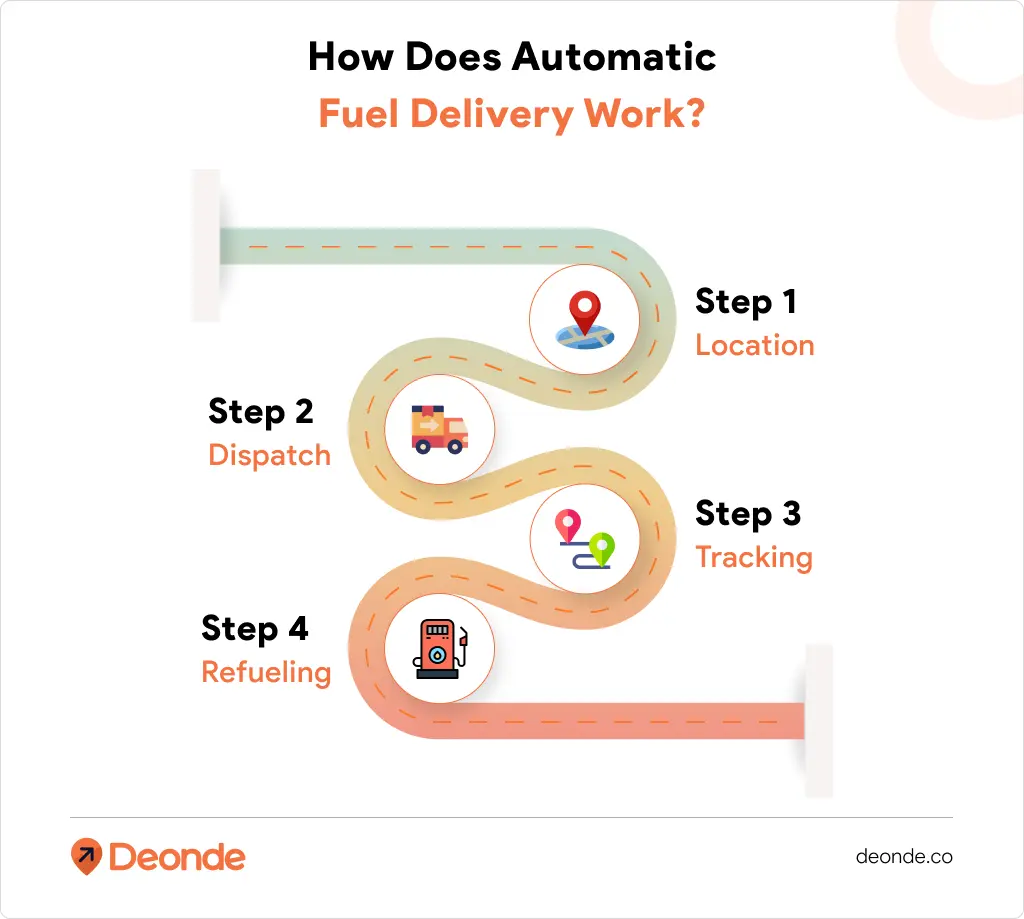
Step 1: Request & Pin Location
The user opens the app and, using their phone’s GPS, pins the exact location of their vehicle. They then select the type of fuel (e.g., Regular, Premium, Diesel) and the amount they need, either a specific number of gallons or a full tank.
Step 2: Smart Automatic Dispatch
Once the order is placed, the system’s backend logic instantly and automatically finds the nearest available delivery driver. The request, along with the location and order details, is sent directly to the driver’s dedicated app without any manual intervention.
Step 3: Real-Time Tracking
Just like with modern ride-sharing or food delivery apps, the customer can track the delivery vehicle’s approach on a real-time map. They receive an estimated time of arrival (ETA) and notifications as the driver gets closer.
Step 4: Safe Refueling & Confirmation
A certified and trained driver arrives, accesses the vehicle’s fuel tank (often with the fuel door left unlocked by the user), and performs the refueling process following strict safety protocols.
Once complete, the user receives an instant notification, a digital receipt is generated, and their payment method is automatically charged.
Beyond on-demand requests, more advanced systems can offer truly automatic fuel delivery through subscriptions. By tracking a vehicle’s typical mileage, the service can predict when a user will need a refill and schedule a delivery proactively, ensuring the customer never has to worry about an empty tank.
How Does a Fuel Delivery Module Work?
A fuel delivery module is the technological backbone of the app, orchestrating the interactions between customers, drivers, and administrators. It’s a combination of software components and algorithms that ensure smooth operations.
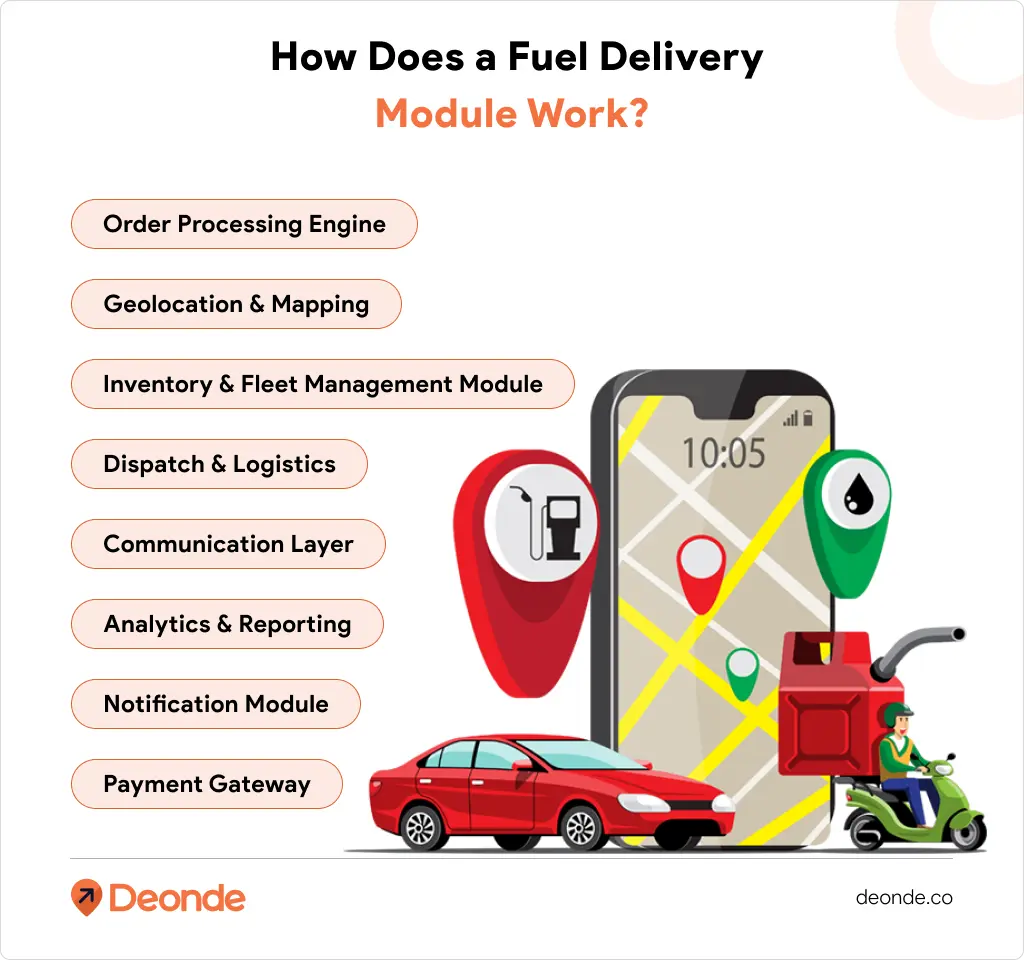
- Order Processing Engine: This module receives customer requests, validates inputs (e.g., fuel type, quantity, location), and matches them with available drivers based on proximity and availability.
- Geolocation & Mapping: Powered by APIs like Google Maps, this module enables precise vehicle pinning, route optimization for drivers, and real-time tracking for users.
- Payment Gateway: A secure module handles transactions, supporting multiple payment methods (e.g., cards, digital wallets) and generating digital receipts.
- Dispatch & Logistics: An AI-driven system assigns orders to drivers, optimizes delivery routes, and manages fleet resources to minimize delays and costs.
- Communication Layer: This module facilitates real-time notifications, in-app messaging, and updates between users, drivers, and admins.
- Analytics & Reporting: For administrators, this module tracks key metrics like order volume, delivery times, and revenue, providing insights for operational improvements.
- Inventory & Fleet Management Module: Allows admins to monitor fuel levels in their tankers, track driver locations, and manage the overall fleet logistics.
- Notification Module: Sends automated alerts and status updates via push notifications, SMS, or email to both the customer and the driver at every step of the process.
The fuel delivery module integrates these components into a cohesive system, ensuring scalability, reliability, and a seamless user experience.
Conclusion: The Future of Fuel is On-Demand
The on-demand fuel delivery app is more than just a convenience; it’s the next logical evolution in the automotive and logistics industries.
It offers a powerful value proposition of time-saving efficiency, enhanced safety, and operational transparency that resonates with both individual consumers and large-scale businesses.
As we’ve seen, the market is ripe with opportunity for entrepreneurs who are ready to act. The key to success lies not just in a great idea but in a well-executed digital platform.
From a seamless user experience to a robust backend and a feature-rich admin panel, every element must work in harmony to build trust and deliver a reliable service.
Thinking about entering this rapidly growing market? Building a secure, scalable, and intuitive platform is the most critical step. If you’re ready to build the future of fuel delivery, the expert team at deonde can help you navigate the complexities of development and launch a successful app that stands out from the competition.