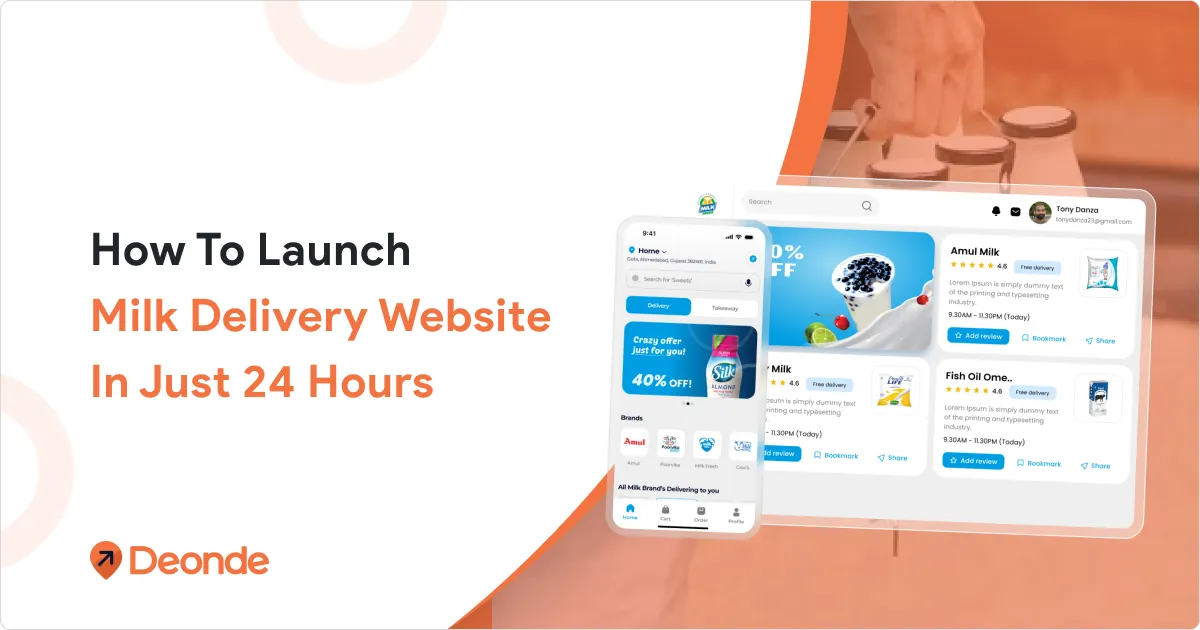
A milk delivery website lets dairy and subscription businesses take orders, manage delivery routes, and collect payments online instead of running everything by phone.
On a ready-made SaaS platform, the entire setup branding, catalog, subscription plans takes about 24 hours, and the live website itself follows within 24 hours.
Deonde’s own comparison data shows a branded milk delivery website going live within 24 hours. If you want to launch the complete tech suite including iOS and Android mobile apps the entire platform is delivered in just 7 days overall versus 9–18 months and $80,000–$150,000+ to build the same platform from scratch.
40% of consumers worldwide already order groceries and daily essentials online every week, and subscription commerce is growing roughly 12% a year in 2026.
The wider online grocery delivery market is on track to cross $1.10 trillion by 2027, with fresh dairy among the fastest-growing categories.
7 Features Your Store Must Have on Day One
Your store needs subscriptions, prepaid wallets, pause/skip, automated billing, tracking, routing, and an admin panel all working from day one, not “coming soon.” These seven features form the core of any successful online dairy business.
- Subscription engine — daily, alternate-day, weekly plans with auto-renewal
- Prepaid wallet + auto-deduction — customers load funds; system deducts per delivery
- Pause / skip / cancel — customers manage their own schedule, cutting your support calls
- Automated morning delivery lists — the system builds driver routes at 4 AM
- Payment gateway — UPI, cards, COD, and digital wallets
- Delivery tracking — customers see live driver status
- Admin dashboard — run orders, subscriptions, payments, and customers from one screen
Want the mechanics behind these? See how a milk delivery app works and how milk subscription management software ties it together.
Why Is SaaS Cheaper Than Custom Milk Delivery Website Development?
A white-label SaaS platform. There’s no upfront build cost so you only pay a monthly subscription that way is cheaper than custom milk delivery website development
SaaS (software as a service) costs less because you pay a small monthly fee and get a ready-built platform with no developer salary, no months of coding, and no separate maintenance bill. Custom building means paying a team for years of work.
The real cost of custom development isn’t just the build. Most people only count the initial quote, but custom work never ends.
You pay for the build, then you pay to fix bugs, then you pay for features you forgot, and every update is a new bill. A SaaS-based milk delivery software solution bundles all of that into one affordable subscription.
Here’s the honest comparison. You can launch a white-label platform in a few days with no coding, and the vendor handles hosting, updates, and maintenance.
Custom development needs a full team and takes many months. For a dairy owner starting out, SaaS is the clear winner; it gets you to live faster, cheaper, and with less risk.
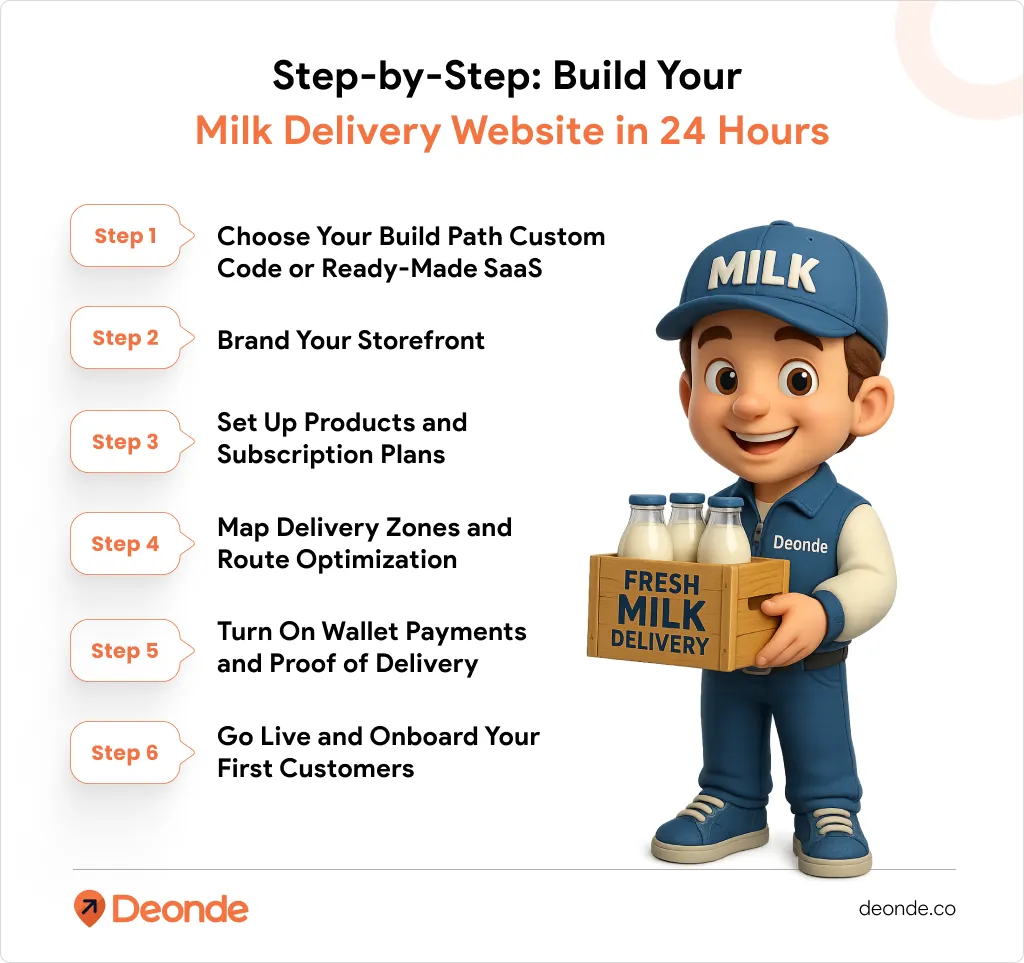
Step-by-Step: Build Your Milk Delivery Website in 24 Hours
Most of the work below is configuration, not coding logo upload, product entry, zone mapping and fits into a single day on a ready-made SaaS platform. Your branded website then goes live within about 2 hours native mobile apps take a little longer due to app store review.
Step 1: Choose Your Build Path — Custom Code or Ready-Made SaaS
Coding a milk delivery website and app from scratch means building the ordering site, subscription engine, route planner, and payment system separately.
Published cost comparisons for milk delivery platforms put that route at 9–18 months and $80,000–$150,000+ before your first real delivery.
That timeline makes sense if software is your actual product. For most milk and dairy businesses, it isn’t — the product is the milk.
This is where a white-label dairy delivery platform like Deonde fits in. The ordering website, subscription engine, route optimization, and driver app are already built — you configure them under your own brand instead of coding them from zero.
More than 300 dairy and subscription delivery businesses across 24+ countries already run on platforms like this, with independent reviewers rating Deonde 4.2/5 on G2 and 5.0/5 on Capterra.
Step 2: Brand Your Storefront
Upload your logo, set your brand colors, and connect your domain.
This step is pure configuration with no design or development skills needed. On a ready-made template, it can take under an hour.
Step 3: Set Up Products and Subscription Plans
Add your product catalog milk types, pack sizes, and pricing then build subscription plans: daily, alternate-day, or weekly.
Let customers pause, skip, or modify their own orders instead of calling you to do it.
This is the core of any real milk delivery management system: recurring revenue you don’t have to chase every morning. Deonde’s subscription management software for milk delivery handles this end-to-end.
Step 4: Map Delivery Zones and Route Optimization
Draw your service area, split it into delivery zones, and set per-zone delivery charges or minimum order values.
Route optimization software then clusters daily stops and sequences them for the shortest possible route.
Dairy businesses that switch from manual planning to automated daily dispatch scheduling see 15–25% fuel savings within the first month, according to Deonde’s analysis of milk delivery route optimization.
Step 5: Turn On Wallet Payments and Proof of Delivery
Enable a prepaid wallet so customers top up once and get billed automatically per delivery — no daily cash collection.
Add multiple gateways (cards, UPI, net banking) so no customer is turned away at checkout.
Require proof of delivery (POD) a photo, OTP, or e-signature on every drop. If you deliver in reusable bottles, turn on empty bottle return tracking from day one.
Step 6: Go Live and Onboard Your First Customers
Share your ordering link with your existing customers first; they are your easiest and fastest conversions.
Because you are using a ready-made SaaS platform, your web ordering system can be live and ready to take orders in just 24 hours. If you decide to launch the complete system including branded iOS and Android mobile apps the entire suite is delivered in just 7 days.
From there, your daily delivery lists, routes, and automated billing take over. This final step is entirely about marketing and communication, not dealing with technical setup.
Pro Tip: Based on our experience helping 300+ delivery businesses launch, the biggest time-saver is having your product photos and prices ready before the sprint starts. Prep takes about 2 hours and the build takes 24.
Common Mistakes That Delay a Milk Delivery Website Launch
Most delays come from underestimating five things: an incomplete product catalog, unset delivery zones, an unverified payment gateway, unclear subscription and refund rules, and skipping end-to-end testing before go-live. Each one is fixable in under an hour if you catch it early.
- Incomplete product catalog — missing pack sizes or prices stall checkout testing.
- Delivery zones left undefined — orders come in for areas you can’t actually service yet.
- Unverified payment gateway — some gateways need identity checks that take a day or two, so start this first.
- No clear pause/skip/refund policy — leads to a wave of support tickets in week one.
- Skipping end-to-end testing — always place one real test order before announcing launch.
- Copying a competitor screen-for-screen — study the mechanics instead. Our guide on how to build a milk delivery app like Country Delight breaks down the strategy, not just the UI.
Take Your Dairy Business Online in 24 Hours
Shifting your dairy business online shouldn’t mean becoming a software project manager.
By choosing a white-label SaaS platform over custom development, you bypass months of expensive coding and launch a fully functional, branded ordering website in just 24 hours.
This speed and automation fundamentally change how your business operates. Instead of losing hours every morning to manual route planning, confusing WhatsApp messages, and chasing wallet payments, your backend handles the logistics automatically.
You regain the time and energy needed to actually scale your subscriber base and focus on the quality of your product.
Ready to put your daily deliveries on autopilot? Book a free demo with Deonde today, and let our team get your custom platform live by tomorrow.

FAQ
Q: Can I start a milk delivery business without an app?
A: Yes. A milk delivery website handles ordering, subscriptions, payments, and delivery management. You can add mobile apps later once you’ve built a customer base.
Q: How long does it take to set up online milk delivery?
A: With a ready-made milk delivery website template, your site can be live and accepting orders in 24 hours to 3 days.
Q: What features are essential for a milk delivery website?
A: Subscription management, prepaid wallet, pause/skip, automated billing, driver routing, payment gateway, and an admin dashboard.
Q: Do I need coding skills to build a milk delivery website?
A: No. Modern no-code builders are drag-and-drop. You configure your business through an admin panel.
Q: How is subscription milk delivery different from regular online ordering?
A: Subscription delivery automates recurring daily or weekly orders with prepaid wallets and auto-billing.
Q: Do I need an app to start a milk delivery business?
A: No, this is one of the biggest myths. A mobile-friendly website gets you started in 24 hours; an app can come later.