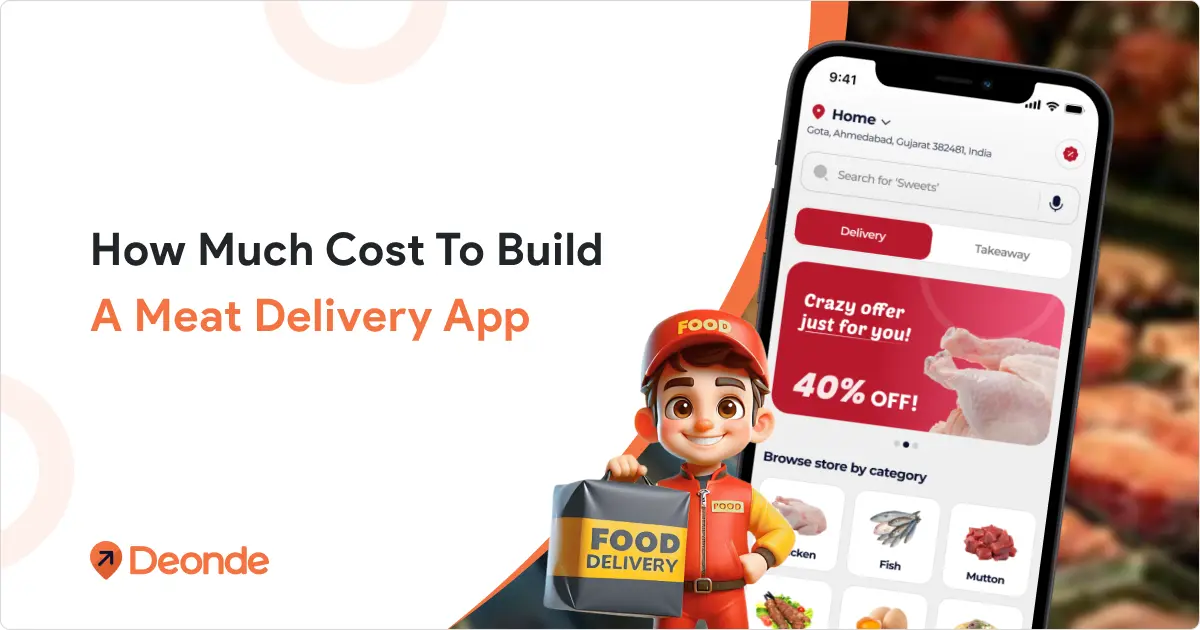
The cost to build a meat delivery app in 2026 ranges from $15,000 for a basic MVP to $120,000+ for a full-scale enterprise platform.
The final price depends on your feature set, number of panels, platform choice, cold chain requirements, the development team and whether you build from scratch or use a white label solution..
Most serious market entrants invest between $30,000 and $70,000 for a mid range product covering both iOS and Android with real time tracking and vendor management.
The online meat delivery market is growing at a CAGR of 8.5% globally. Licious, FreshToHome, ButcherBox, and ZappFresh have proven that customers will pay premium prices for fresh meat delivered to their door.
If you are a butcher shop owner, a meat wholesaler, or an entrepreneur entering this space, understanding the real cost of building a meat delivery app is the first step before committing your budget.
This guide breaks down the actual numbers, the features that move the cost dial, the hidden expenses most founders miss, and whether building custom or buying a white-label solution makes more sense for your situation.
Why Meat Delivery Apps Cost Differently Than Generic Food Apps?
A meat delivery app is not a food delivery app with a different label. It has unique cost drivers that most generic guides miss.
Cold chain integration adds cost
Unlike pizza or burger delivery, meat requires temperature controlled logistics. Your app needs freshness indicators, delivery time windows, and sometimes IoT temperature monitoring. These features are non-negotiable for a credible meat delivery business and they add $5,000 to $15,000 to your build.
Weight based pricing is more complex
Meat is sold by weight, not by unit. Your catalogue system must support variable pricing, custom cuts, and portion options. This requires more sophisticated backend logic than a standard restaurant menu.
Vendor management is harder
Butcher shops handle inventory differently than restaurants. They deal with perishable stock, daily price fluctuations, and supply chain variability. Your vendor panel needs to handle these nuances.
Regulatory compliance varies by country
In the US, the FDA requires food safety labeling. In India, FSSAI licence display is mandatory. In the UK, FSA hygiene ratings must be shown. Building for each market adds compliance work.
Meat Delivery App Development Cost by Tier
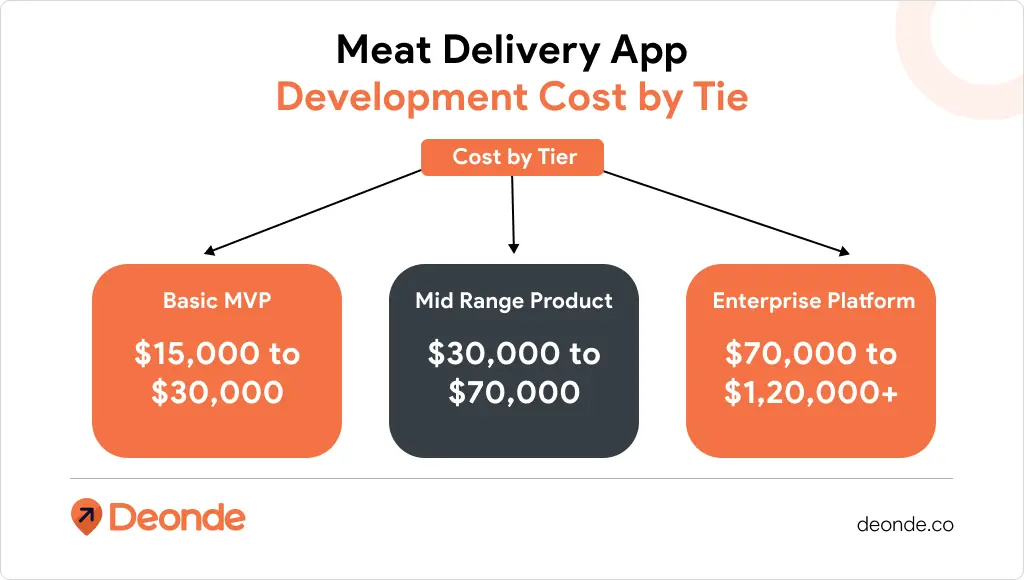
Not every business needs the same level of app. Here is what each tier delivers and what it costs.
Tier 1: Basic MVP | $15,000 to $30,000
This is your market validation build. It lets you launch, acquire first customers, and test your business model before committing to a full product.
What you get:
– Customer app on a single platform (iOS or Android)
– Browse meat categories and cuts
– Cart and checkout with basic payment gateway
– Push notifications for order updates
– Simple vendor panel for order management
– Basic admin dashboard
Who this is for: Local butcher shops going digital, solo entrepreneurs testing a new market, or Android first launches in India and Southeast Asia.
Timeline: 2 to 4 months
What is missing: Real time GPS tracking, driver app, cold chain features, subscription plans, and multi vendor support.
Tier 2: Mid Range Product | $30,000 to $70,000
This is the most common investment range for serious meat delivery app development. It covers both platforms, real delivery tracking, and features that drive retention.
What you get:
– Everything in Tier 1
– Both iOS and Android apps (cross platform using Flutter)
– Real time GPS order tracking
– Driver app with route optimization
– Cold chain alerts and freshness indicators
– Multi vendor butcher panel with inventory management
– Advanced search and filter (by cut, weight, price, origin)
– Subscription and repeat order management
– Multiple payment gateways
– Custom UI/UX design
– Full admin panel with analytics
Who this is for: Entrepreneurs launching a regional meat delivery brand, butcher chains going digital, or halal meat businesses targeting US, UK, UAE, or Australian markets.
Timeline: 4 to 7 months
Tier 3: Enterprise Platform | $70,000 to $120,000+
This tier is for businesses building a platform to compete at scale against players like Licious, ButcherBox, or Musclefood.
What you get:
– Everything in Tier 2
– AI powered product recommendations
– Predictive inventory management
– Dynamic delivery slot booking with demand based pricing
– KYC and identity verification for vendors
– Multi city and multi warehouse support
– Subscription box builder for recurring custom orders
– Cold chain IoT integration with real time temperature monitoring
– Advanced fraud detection
– Multi language and multi currency support
– Loyalty and rewards program
– Business intelligence dashboard
– Scalable cloud architecture on AWS or GCP
Who this is for: Well funded startups, established meat brands, or enterprises competing across multiple cities or countries.
Timeline: 7 to 14 months
What Actually Moves the Cost Dial
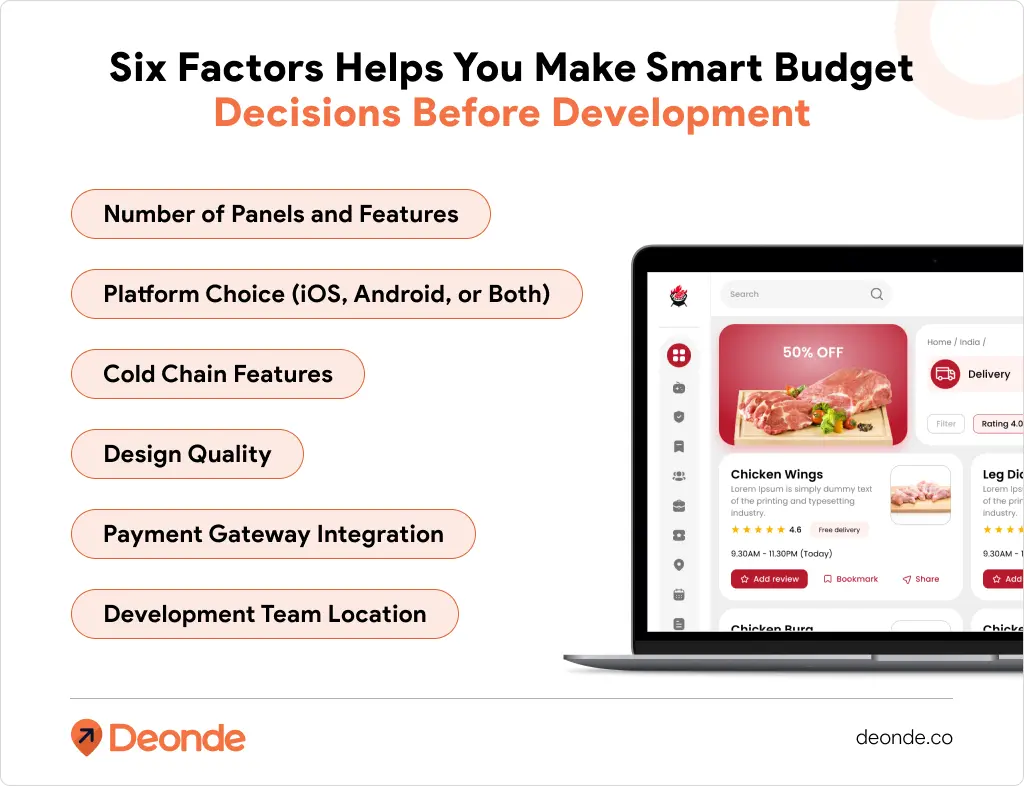
Understanding these six factors helps you make smart budget decisions before development starts.
Number of Panels and Features
A complete meat delivery platform includes four separate panels: customer app, vendor or butcher panel, driver app, and admin dashboard. Every additional panel adds design, development, testing, and integration time. If you build all four panels at once, expect the higher end of your chosen tier.
Platform Choice (iOS, Android, or Both)
Building for a single platform costs less. Cross platform development using Flutter covers both iOS and Android from one codebase at 30 to 40% lower cost than building two native apps separately. For most meat delivery startups, Flutter is the recommended approach unless you have specific performance requirements that demand native development.
Cold Chain Features
Cold chain features are the biggest cost driver unique to meat apps. Temperature monitoring alerts, freshness status indicators, insulated packaging integration, and delivery time window management add real complexity. These features typically add $5,000 to $15,000 to the total build cost depending on the level of automation required.
Design Quality
Template based UI is faster and cheaper. Custom branded UI and UX design that builds trust with premium meat buyers costs more but significantly improves conversion and retention. Premium design adds $3,000 to $8,000 to the total budget. For meat delivery where freshness and trust matter, custom design is worth the investment.
Payment Gateway Integration
Basic payment integration with Stripe or Razorpay costs $1,500 to $3,500. Multiple gateway support, subscription billing, and split payment for multi vendor setups push this higher. The US and UK markets typically require Stripe. India requires Razorpay or PayU. Australia uses Stripe or eWAY.
Development Team Location
This is the single biggest lever on your total cost. A US or Western Europe team charges $100 to $150 per hour. An Indian team charges $20 to $45 per hour for the same quality. The same mid range meat delivery app costs $150,000 with a US team and $40,000 with an Indian team.
Hidden Costs Most Founders Forget
The development invoice is not your only expense. Here is what else to budget for from day one.
App Store Fees: Apple charges $99 per year. Google Play charges a one time $25 fee. Both require compliance with their food and delivery app guidelines.
Cloud Hosting: Meat delivery apps need reliable, scalable hosting due to real time tracking and peak order volumes. Expect $100 to $800 per month for AWS or GCP hosting depending on your user base.
Annual Maintenance: Budget 15 to 20% of your initial development cost every year for bug fixes, OS compatibility updates, security patches, and feature improvements.
SMS and OTP Verification: Essential for driver and customer verification. Twilio or MSG91 costs approximately $0.01 to $0.05 per SMS. Budget $200 to $800 per month depending on order volume.
Food Safety Compliance: Different countries have different regulatory requirements. The US requires FDA compliance, the UK requires FSA standards, India requires FSSAI licence display, and Australia requires FSANZ labelling. Build compliance considerations into your app from the start rather than retrofitting later.
Marketing and User Acquisition: Acquiring your first 5,000 users typically costs as much as or more than your initial development budget. Plan for digital advertising, social media campaigns, and local butcher partnerships.
Build vs. Buy: Which Path Makes Sense
You have two options when launching a meat delivery platform.
Custom development gives you full control over every feature, design element, and business rule. You own the code, the data, and the customer relationship.
The trade off is higher upfront cost ($30,000 to $120,000+) and a longer timeline (4 to 14 months).
White label or SaaS platforms let you launch in days rather than months. Platforms like Deonde offer ready made meat delivery solutions with branded apps, driver management, and admin panels at a flat monthly subscription with zero commission on orders.
The trade off is less customization and dependence on the platform provider for updates and features.
Choose custom build if:
– You need unique features that no existing platform offers
– You are building for multiple cities or countries with complex logistics
– You have the budget and timeline to invest in development
– You want full ownership of the code and customer data
Choose white label if:
– You want to launch fast and validate your business model first
– Your budget is limited and you need to minimize upfront investment
– You want predictable monthly costs instead of a large one time build
– You prefer to focus on operations and marketing rather than technology
Many successful meat delivery businesses start with a white label solution to prove demand, then invest in custom development once they reach a scale where the platform limitations become a bottleneck.
How to Plan Your Budget: A Practical Framework
Before you approach any development team, answer these four questions.
Question 1: What is your launch market?
A local butcher shop in Mumbai has very different requirements than a halal meat delivery platform targeting the US and UK. Your target market determines compliance requirements, payment gateway choices, and delivery logistics.
Question 2: How many panels do you need on day one?
Start with the customer app and admin panel. Add the vendor panel and driver app in phase two. This staged approach reduces your initial investment while still getting you to market.
Question 3: What is your average order value?
Higher average order values justify more investment in premium design and cold chain features. Lower average order values require a leaner build focused on volume.
Businesses targeting premium segments often allocate extra budget for fresh meat delivery software pricing that includes advanced freshness guarantees.
Question 4: When do you need to launch?
A 2 month timeline requires a white label solution or a very focused MVP. A 6 month timeline gives you room for a custom mid range build with all the features that drive retention.
Based on your answers, use this budget framework:
| Your Situation | Recommended Approach | Budget Range |
| Local butcher, one city, limited budget | White label platform | $200 to $800/month |
| Regional launch, both platforms, real tracking | Custom MVP or mid range build | $25,000 to $60,000 |
| Multi city platform, subscriptions, cold chain IoT | Full custom enterprise build | $70,000 to $120,000+ |
Conclusion: Making Your Meat Delivery App Investment Count
Building a meat delivery app in 2026 requires strategic investment rather than just spending. Whether you’re a local butcher testing digital waters or an entrepreneur aiming for multi-city expansion, success starts with aligning your app’s features to your specific market needs and growth stage.
Remember that the most expensive build isn’t always the best choice—it’s the one that delivers the features your target customers actually value while fitting within your realistic budget and timeline.
The meat delivery market’s 8.5% CAGR shows strong sustained demand, but winning in this space depends on solving real customer pain points around freshness, reliability, and convenience—not just having the most features.
Start lean if you’re validating an idea, invest progressively as you gain traction, and always factor in those essential ongoing costs from day one.
Your app isn’t just a cost center—it’s the primary touchpoint for building trust with customers who are paying premium prices for quality meat delivered to their door.
Now that you understand the true cost landscape, you’re equipped to make informed decisions that set your meat delivery venture up for sustainable growth in this expanding market.
Frequently Asked Questions
How much does it cost to build a meat delivery app?
The cost to build a meat delivery app in 2026 ranges from $15,000 for a basic MVP to $120,000+ for a full enterprise platform. A mid range product with both iOS and Android apps, real time tracking, and a vendor panel typically costs between $30,000 and $70,000. The final price depends on your feature set, platform choice, and development team location.
How long does it take to develop a meat delivery app?
A basic MVP takes 2 to 4 months. A mid range product with four panels and full delivery tracking takes 4 to 7 months. An enterprise platform with AI features and multi city support takes 7 to 14 months. White label solutions can launch in as little as 2 to 3 business days.
What features are essential for a meat delivery app?
Essential features include cut and weight customization, scheduled delivery slots, real time order tracking, multiple payment options, order history with one click reorder, and push notifications. Cold chain alerts and freshness indicators are also critical for maintaining product quality and customer trust.
Is it cheaper to build or buy a meat delivery app?
Buying a white label or SaaS platform is significantly cheaper upfront, with monthly subscriptions starting around $200 to $800. Custom development costs $15,000 to $120,000+ but gives you full ownership and customization. Many businesses start with white labels to validate demand, then invest in custom builds once they scale.
What are the ongoing costs after building a meat delivery app?
Ongoing costs include App Store fees ($99/year for Apple, $25 one time for Google), cloud hosting ($100 to $800/month), annual maintenance (15 to 20% of build cost), SMS and OTP services ($200 to $800/month), and marketing and user acquisition. Budget for these expenses from day one to avoid post launch surprises.