The demand for fresh, hygienic, and traceable meat and seafood is growing rapidly across the globe. As urban lifestyles evolve and trust in traditional supply chains wanes, startups like FreshToHome are revolutionizing the way we access protein-rich foods.
As consumers become more health-conscious, they are moving away from traditional wet markets and choosing online meat and seafood delivery platforms that promise quality, transparency, and convenience.
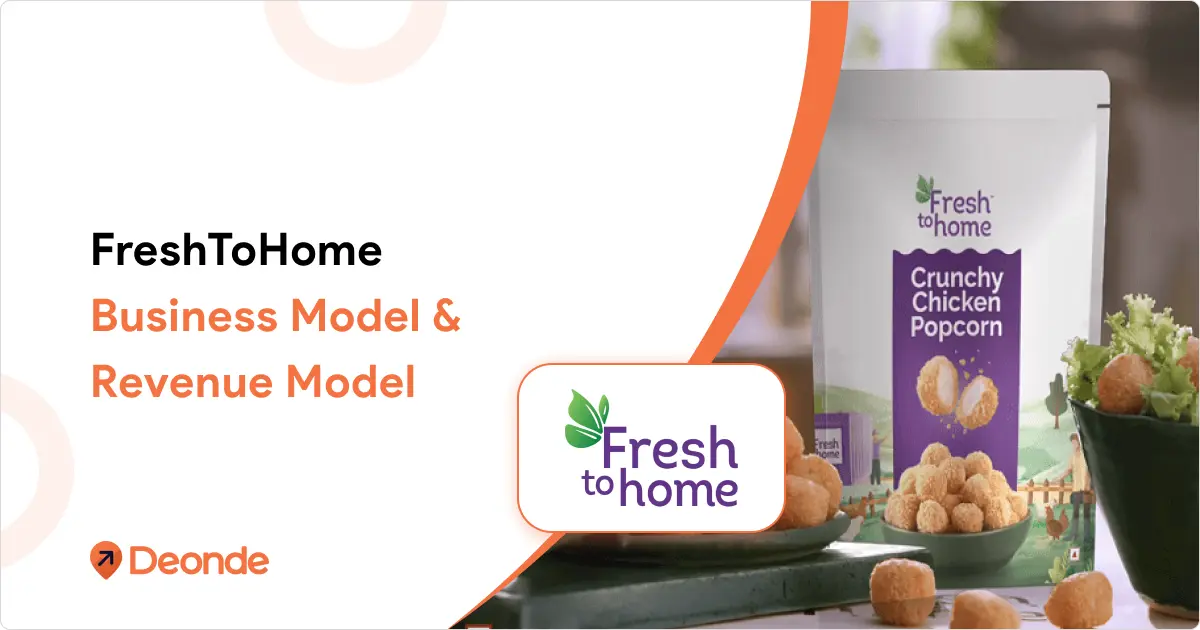
A Direct-to-Consumer (D2C) meat brand that’s changing how people buy fish and meat. By using a unique farm-to-fork model, FreshToHome connects customers directly with farmers and fishermen, ensuring 100% fresh, chemical-free produce from source to plate.
The size of India’s fish market is over $50 billion, or 1% of the GDP. And 65% of the catch was exported ten years ago. With higher incomes and rising domestic consumption, 90% of the produce is consumed domestically today.
As a startup or enterprise business, are you ready to advance your Meat Shop with our SaaS-based Meat Delivery App Solution? If yes, avoid investing thousands of dollars and get in progress immediately with FreshToHome clone app solutions.
Whether you’re a startup enthusiast looking to understand the FreshToHome business model, a marketer, or simply curious about the FreshToHome revenue model, this guide will give you a complete look inside one of India’s most innovative food-tech companies.
What is FreshToHome?
FreshToHome, a Bengaluru-based startup, is the world’s largest fully integrated e-commerce platform for fresh fish, meat, and seafood.
Co-founded in 2015 by Shan Kadavil, the former country head of Zynga India. The venture began by reviving seatohome.com, a Kochi-based startup founded by Mathew Joseph, and transforming it into a powerhouse for chemical-free food produce.
Mission and Vision
FreshToHome’s mission is to deliver fresh, chemical-free fish and meat directly to consumers, bypassing middlemen to ensure quality and transparency.
Its vision is to redefine the $100 billion Indian fish and meat market by leveraging technology to streamline sourcing and delivery.
Unique Selling Proposition (USP)
FreshToHome stands out with its promise of delivering produce within 24–48 hours of sourcing, free of preservatives and chemicals. By connecting fishermen and farmers directly to consumers, it ensures traceability, freshness, and competitive pricing
FreshToHome Growth Story
Since launch, FreshToHome has:
- Partnered with 1,000+ fishermen and farmer cooperatives
- Expanded to 160+ cities in India
- Entered international markets like the UAE and Saudi Arabia
- Planned ₹1,000 crore investment in Telangana to strengthen its presence
FreshToHome Funding and Valuation
- Total funding: Over $250 million
- Latest round: $104 million (Series D) led by Amazon Smbhav Venture Fund
- Investors include: Investcorp, Government of Dubai, and Mount Judi Ventures
- Estimated revenue: ₹1,500–₹2,000 crore (approx. $180–$240 million USD) for FY23
FreshToHome’s strong funding and valuation prove its profitable and scalable model.
How Does FreshToHome Work? A 4-Step Process
The company’s operational model is built on efficiency and total control over the supply chain. It follows a clear, four-step “farm-to-fork” process:
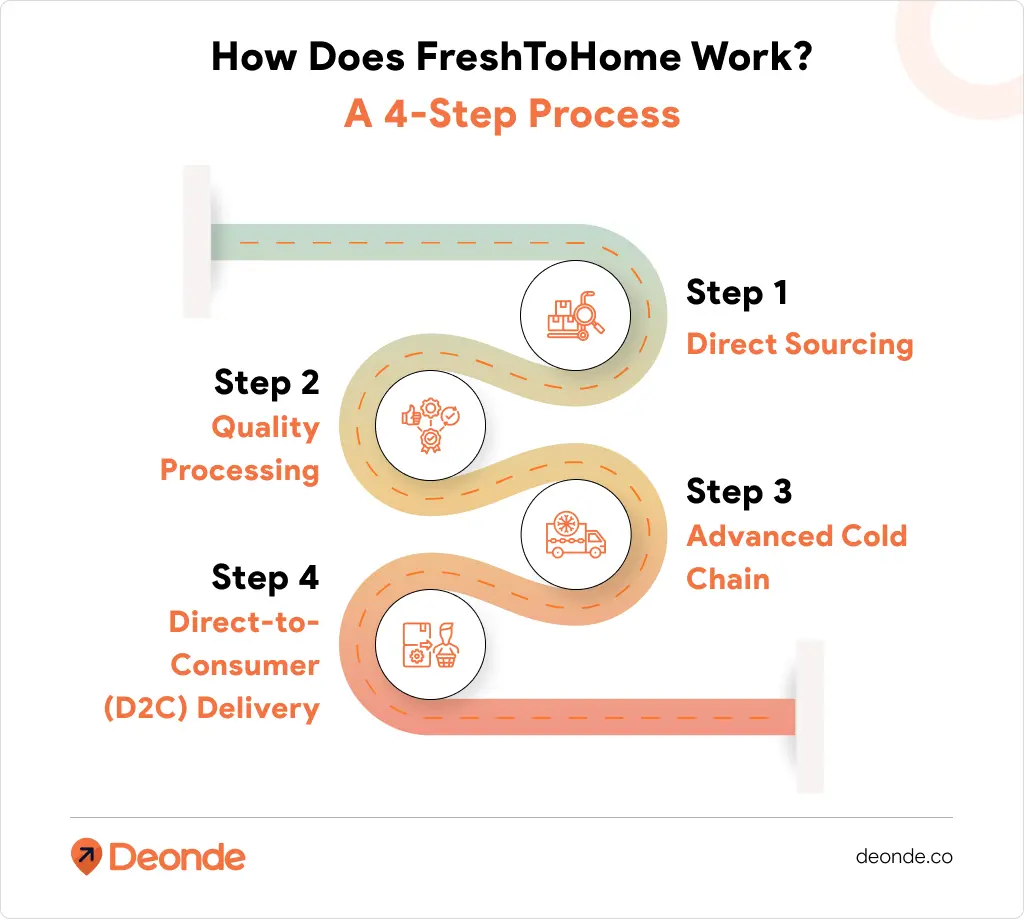
Step 1: Direct Sourcing
The process begins at the source. FreshToHome bypasses middlemen and procures meat and seafood directly from farmers and fishermen. This ensures producers get a fair price and the company gets high-quality raw materials.
Step 2: Quality Processing
The fresh produce is then taken to FreshToHome’s own state-of-the-art processing plants. Here, every item goes through strict quality checks to guarantee it meets the brand’s standards for safety and freshness.
Step 3: Advanced Cold Chain
To maintain freshness, the products are moved through a sophisticated, temperature-controlled logistics network. This cold chain is crucial for preventing spoilage and ensuring the product remains hygienic from the plant to your home.
Step 4: Direct-to-Consumer (D2C) Delivery
Finally, customers place orders via the FreshToHome app or website. These orders are fulfilled from local hubs and delivered directly to the customer’s doorstep, often within a few hours.
How Does the FreshToHome Business Model Actually Work?
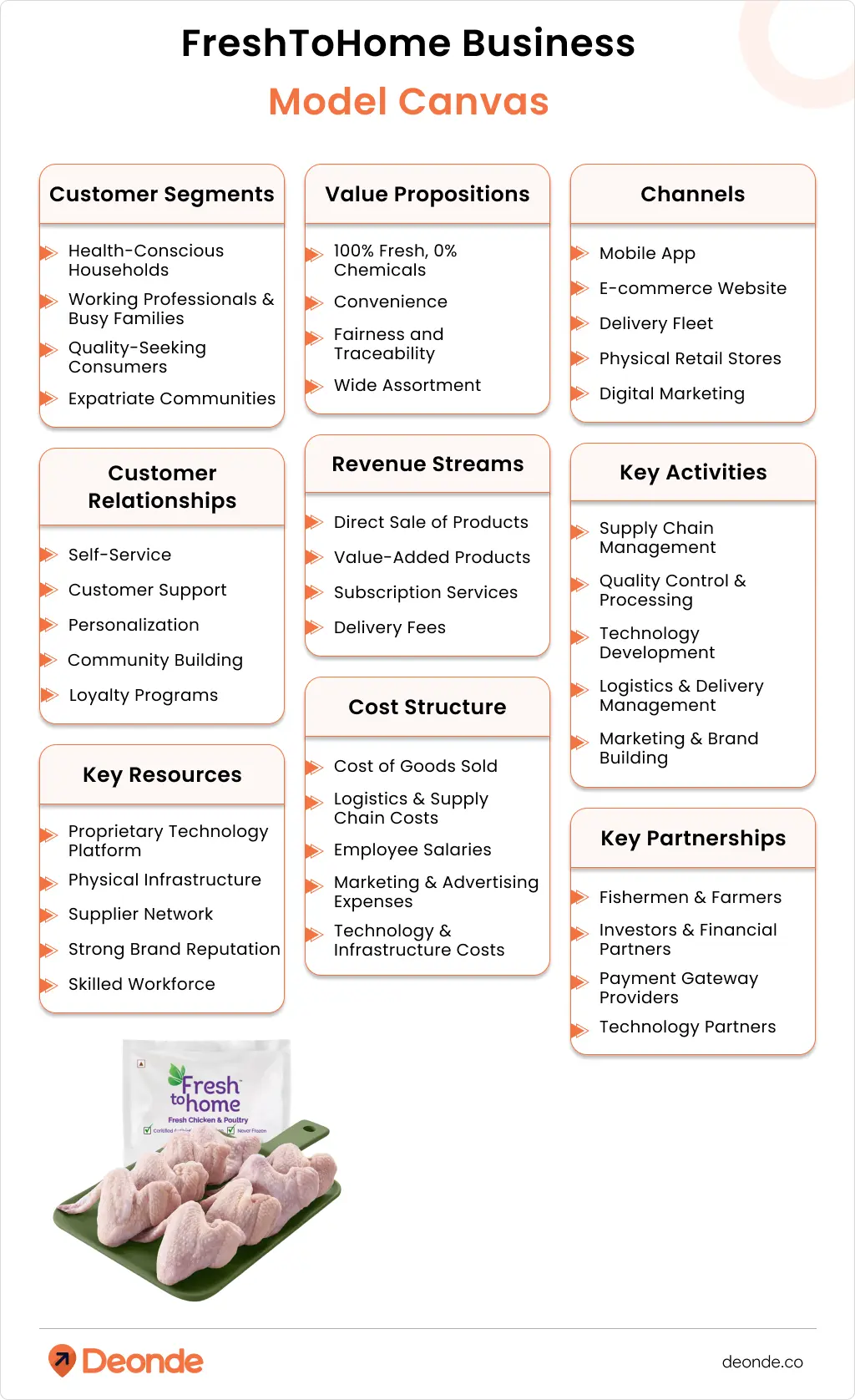
1. Customer Segments (Who do they serve?)
FreshToHome targets specific groups of people who value quality and convenience:
- Health-Conscious Households: Urban and semi-urban families who are concerned about chemicals, antibiotics, and preservatives in their food.
- Working Professionals & Busy Families: People who value the convenience of home delivery and ready-to-cook options to save time.
- Quality-Seeking Consumers: Customers who are willing to pay a reasonable price for guaranteed fresh, high-quality, and traceable meat and seafood.
- Expatriate Communities: Particularly in the UAE, catering to tastes for specific types of fish and meat from their home regions.
2. Value Propositions (What do they offer?)
This is the core promise that FreshToHome makes to its customers:
- “100% Fresh, 0% Chemicals”: Their primary promise is delivering food that is free from any harmful preservatives and antibiotics.
- Unmatched Freshness: By controlling the supply chain, they deliver products within 24-36 hours of sourcing, which is significantly faster than traditional markets.
- Convenience: Easy ordering via app/website, precise delivery slots, and a wide range of cleaned, cut, and ready-to-cook products.
- Fairness and Traceability: Customers know their food is sourced responsibly, and farmers/fishermen get a fair price, which adds an ethical value.
- Wide Assortment: A vast selection of products, from everyday chicken to exotic seafood and specialty cuts, all in one place.
3. Channels (How do they reach customers?)
These are the touchpoints FreshToHome uses to interact with and sell to its customers:
- Mobile App (iOS & Android): Their primary sales and communication channel.
- E-commerce Website: The desktop and mobile web platform for ordering.
- FTH Daily App: A separate subscription-based app for daily essentials like milk and groceries.
- Physical Retail Stores: A growing network of offline stores that act as experience centers and fulfillment hubs.
- Digital Marketing: Social media (Facebook, Instagram), search engine ads, and content marketing (recipes, blogs) to attract and engage customers.
4. Customer Relationships (How do they interact?)
This defines the type of relationship FreshToHome builds with its customers:
- Self-Service: The entire buying process is automated through the app and website.
- Customer Support: Dedicated support for order issues, queries, and feedback via email, phone, and in-app chat.
- Personalization: The app uses purchase history to offer personalized product recommendations and promotions.
- Community Building: Engaging customers through social media with cooking tips, contests, and stories about their fishermen/farmers.
- Loyalty Programs: Subscription services (like FTH Daily) and potential freemium models with benefits for regular customers to ensure high retention.
5. Revenue Streams (How do they make money?)
This is the financial engine of the business:
- Direct Sale of Products: The main revenue source is the margin on selling fresh meat, fish, and poultry.
- Value-Added Products: Higher profit margins come from ready-to-cook items, marinades, and pre-cut/cleaned products.
- Subscription Services (FTH Daily): A recurring and predictable revenue stream from customers subscribing to daily essentials.
- Delivery Fees: Charges for delivery, especially for non-subscription or express orders, to cover logistics costs.
6. Key Activities (What do they actually do?)
These are the critical operational tasks they must perform excellently:
- Supply Chain Management: Sourcing, transportation, and managing the entire cold chain from start to finish.
- Quality Control & Processing: Rigorous testing for chemicals, cleaning, cutting, and packaging at their processing hubs.
- Technology Development: Continuously updating their mobile apps, e-commerce platform, and the backend AI-powered sourcing technology.
- Logistics & Delivery Management: Managing their “hub-and-spoke” network and their own delivery fleet for timely last-mile delivery.
- Marketing & Brand Building: Running campaigns to acquire new customers and build trust in the FreshToHome brand.
7. Key Resources (What assets do they have?)
These are the strategic assets that give FreshToHome its competitive advantage:
- Proprietary Technology Platform: Their AI-based commodities exchange app is a unique, powerful asset.
- Physical Infrastructure: A network of processing centers, hubs, cold storage facilities, and delivery vehicles.
- Supplier Network: Their registered network of over 4,000 fishermen and farmers who provide a consistent supply.
- Strong Brand Reputation: The trust they have built around freshness and quality is a major asset.
- Skilled Workforce: Experts in logistics, food technology, software development, and quality assurance.
8. Key Partnerships (Who do they work with?)
While they control most of their chain, they rely on key partners:
- Fishermen & Farmers: They are the most crucial partners, forming the base of the supply chain.
- Investors & Financial Partners: Institutions and individuals who provide capital for growth and expansion (e.g., Investment Corporation of Dubai, DFC).
- Payment Gateway Providers: Companies like Razorpay that facilitate secure online transactions.
- Technology Partners: Potentially collaborating with companies for cloud infrastructure, data analytics, and logistics software.
9. Cost Structure (What do they spend money on?)
These are the major costs involved in running the business:
- Cost of Goods Sold (Procurement): The price paid to fishermen and farmers for the raw products.
- Logistics & Supply Chain Costs: Expenses for transportation, cold storage, packaging, and last-mile delivery.
- Employee Salaries: Paying their large workforce across technology, operations, and management.
- Marketing & Advertising Expenses: Costs for acquiring new customers through digital ads and brand campaigns.
- Technology & Infrastructure Costs: Investment in maintaining and upgrading their software, servers, and processing facilities.
This canvas covers the entire business, from the customer to the finances, and shows how all the pieces connect to create the complete FreshToHome business model.
How FreshToHome Makes Money: A Multi-Stream FreshToHome Revenue Model
FreshToHome has built a robust business by creating several distinct ways to earn money. It’s not just about selling fish and meat; their strategy is much smarter. Here is a breakdown of their primary revenue streams.
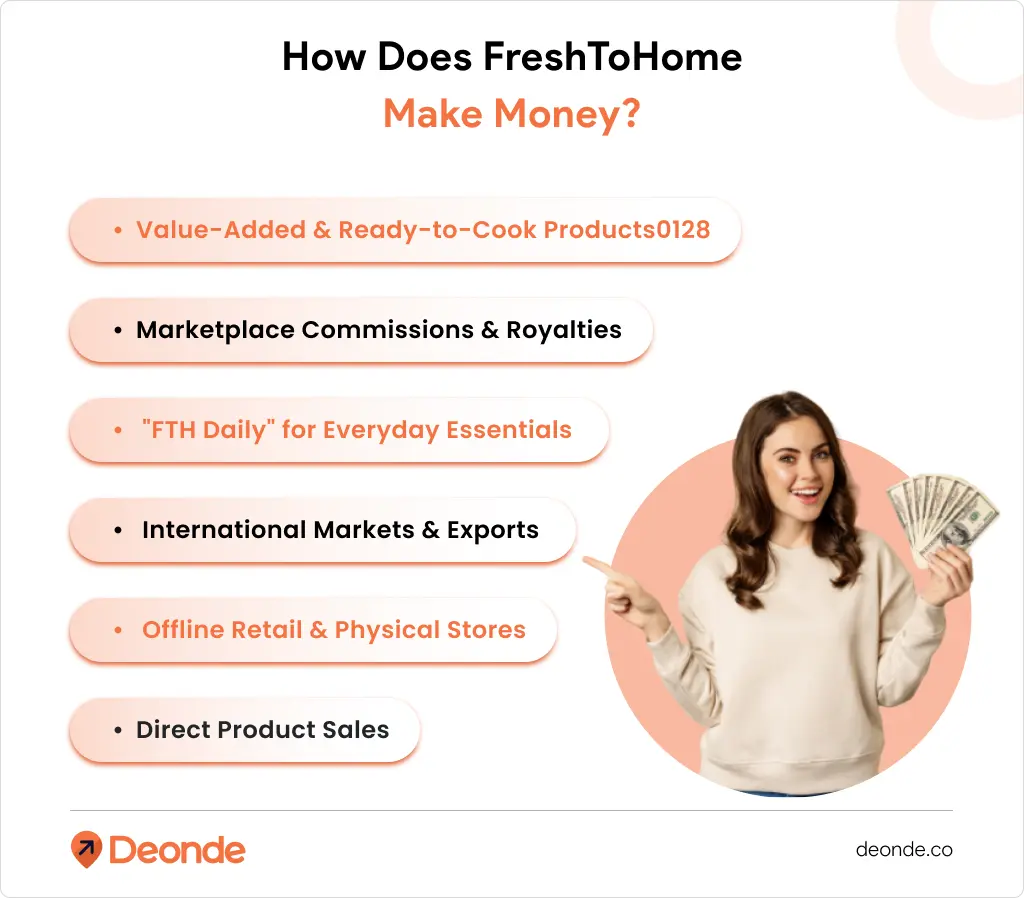
1. Direct Product Sales (The Core Business)
This is the main engine of FreshToHome’s revenue. The vast majority of their income comes from selling products directly to customers through their app and website.
- What they sell: Fresh fish, seafood, poultry, mutton, and a range of ready-to-cook items.
- How it works: They control the entire process. They source the raw product, process it in their own facilities, manage the cold chain logistics, and deliver it.
- Pricing: The final price you pay includes the cost of sourcing, processing, logistics, delivery, and, of course, a profit margin for the company.
2. Marketplace Commissions & Royalties
While most products are their own, FreshToHome also operates a marketplace model in some regions. This allows third-party vendors to sell their products on the FreshToHome platform.
- How they earn: FreshToHome takes a commission or a royalty fee from these external vendors for each sale made through their app.
- Scale: This is a smaller part of their business. For example, in the 2023 financial year, the company earned about ₹25 crore from these commissions, which is a fraction of its total sales volume.
3. “FTH Daily” for Everyday Essentials
To encourage customers to use the app more frequently, FreshToHome launched FTH Daily. This service focuses on daily grocery needs like milk, bread, eggs, and vegetables.
- The Goal: While order sizes are smaller, the goal is to create a daily habit. This increases customer loyalty and generates a steady, recurring revenue stream.
- Strategy: They often use incentives like free delivery to attract and retain customers for this service.
4. Offline Retail & Physical Stores
FreshToHome isn’t just an online brand. They operate their own physical retail stores and also have “Powered-by-FreshToHome” outlets.
- Why it works: These stores help in brand building and reaching customers who prefer to see and touch products before buying. It builds trust and serves as a physical touchpoint for the digital brand.
5. International Markets & Exports
Geographic expansion is a key part of their growth strategy. FreshToHome has a strong presence in both India and the Middle East (specifically the UAE).
- Global Revenue: Their operations in the UAE contribute significantly, accounting for roughly 10-15% of their total revenue.
- The Plan: Expanding into new international markets allows them to tap into a larger customer base and diversify their income.
6. Value-Added & Ready-to-Cook Products
Beyond just raw cuts, FreshToHome offers a wide variety of value-added products. This includes marinated meats, ready-to-cook meals, kebabs, and clean-label snacks.
- The Benefit: These products are a smart business move because they typically have higher profit margins than raw meat or fish, boosting overall profitability.
Conclusion: A Blueprint for Modern Food-Tech Success
FreshToHome has masterfully engineered a business model that directly addresses the modern consumer’s demand for quality, transparency, and convenience. Its success isn’t built on a single pillar but on the powerful integration of a technology-driven, farm-to-fork supply chain with a diverse, multi-stream revenue strategy.
By bypassing traditional middlemen, taking full control of its supply chain, and leveraging technology at every step, the company delivers on its core promise of “100% Fresh, 0% Chemicals.” This builds immense trust and customer loyalty in a market where quality is paramount.
Furthermore, by combining core direct-to-consumer sales with higher-margin value-added products, sticky subscription services like FTH Daily, and strategic international expansion, FreshToHome has created a resilient and scalable financial engine.
As the global appetite for traceable and chemical-free food continues to grow, FreshToHome’s model serves as a compelling blueprint for the future of the food-tech industry. It proves that a commitment to freshness and fairness, when backed by operational excellence, is not just a powerful mission—it’s incredibly good business.
Want to launch your own FreshToHome-like meat delivery app? Explore ready-made solutions at Deonde